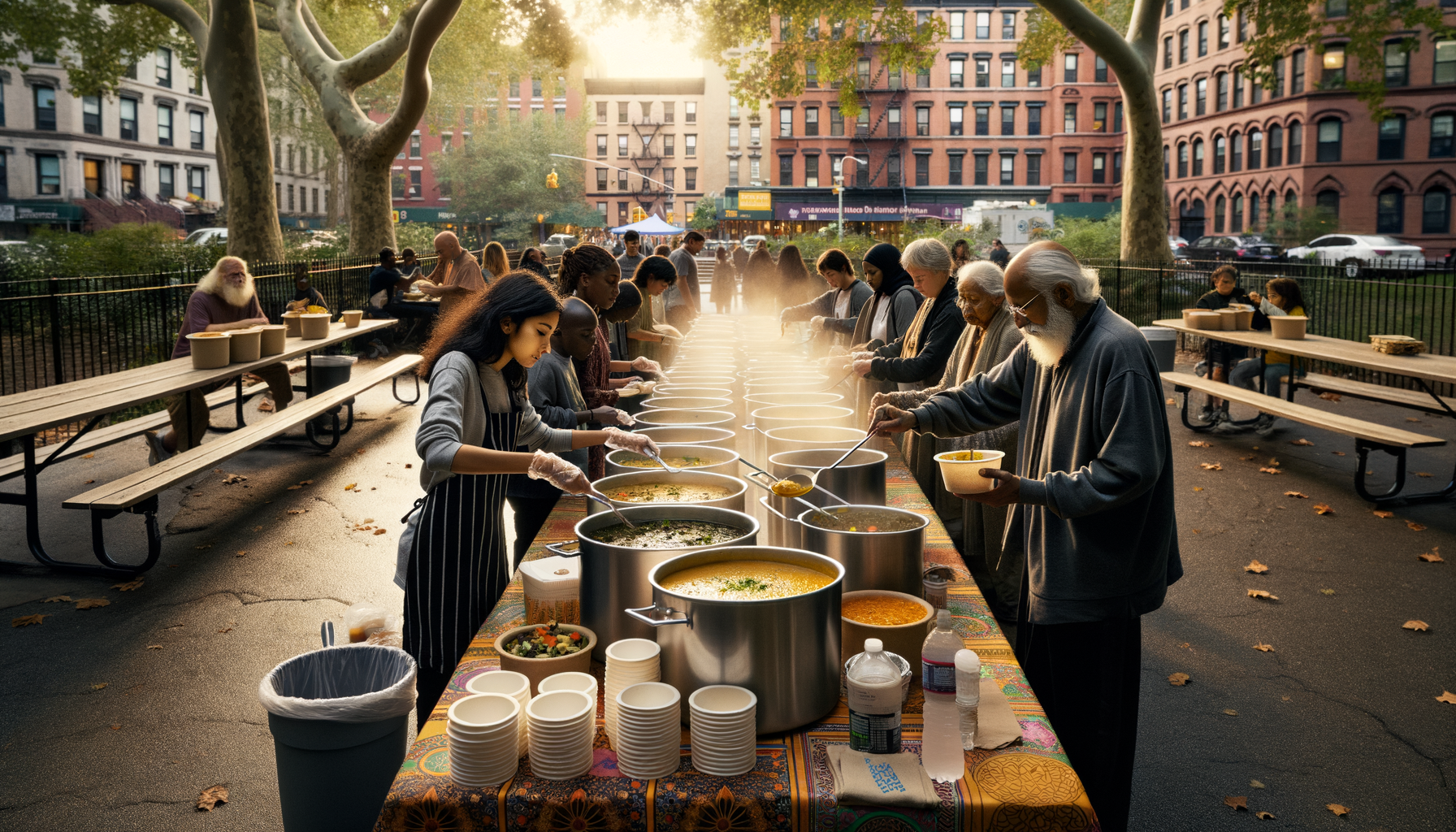
For a quarter-century, Interfaith Community Services has sustained a compassionate tradition of distributing free hot vegetarian meals in Tompkins Square Park, advancing a service legacy first inaugurated in 1965 by Bhaktivedanta Swami, a.k.a. Śrīla Prabhupāda. The continuity of this work demonstrates how spiritual conviction can be translated into reliable community care that meets immediate needs while modeling long-term public responsibility.
In a conversation recorded by Nityananda Chandra Granger, Adi Purusha articulates how the present initiative consciously extends the original vision: accessible, dignified vegetarian food distribution offered without barrier or proselytization. The emphasis remains consistenthospitality, nourishment, and steady presence for anyone who arrives, a practical articulation of service (seva) in a public commons.
Situated within the broader dharmic ethos, this effort resonates with shared values across Hinduism, Buddhism, Jainism, and Sikhism, including ahimsa, dana, and seva. Vegetarian food distribution embodies care that is compassionate, non-harmful, and welcoming, reinforcing religious harmony and interfaith cooperation in an inclusive urban space.
The program’s methodfree, hot, and wholesome mealsfunctions as a community kitchen in the open, a setting where nourishment becomes a bridge across social difference. In Tompkins Square Park, such open-handed generosity transforms a public gathering place into a site of shared dignity, affirming that spiritual practice can be measured by the quality of care extended to neighbors.
From an outcomes perspective, consistent vegetarian food distribution supports nutritional well-being, stabilizes daily routines for recipients, and reduces social isolation through respectful interaction. These practices foster trust, encourage civic participation, and soften barriers between religious communities by prioritizing human need over doctrinal difference.
Importantly, this service model exemplifies unity in spiritual diversity: it honors Śrīla Prabhupāda’s intention while remaining genuinely interfaith in delivery and reception. The ethic of seva here becomes a shared civic practice, a point of convergence where diverse traditions collaborate to uplift public life.
As a replicable framework, the initiative illustrates how faith-inspired community kitchens can operate sustainably over decades: maintain reliability, serve compassionate, vegetarian meals, uphold respect for all, and root action in values common to multiple dharmic traditions. Such alignment strengthens social cohesion and demonstrates how religious harmony flourishes when service to people is prioritized.
The historical throughline is clear: a 55-year lineage of public service began in 1965 and, for the past 25 years, has been stewarded in Tompkins Square Park by Interfaith Community Services. This continuity affirms that when spiritual ideals shape tangible, everyday care, unity across traditions is not merely aspirationalit becomes a lived reality in the heart of the community.
Inspired by this post on Dandavats.