
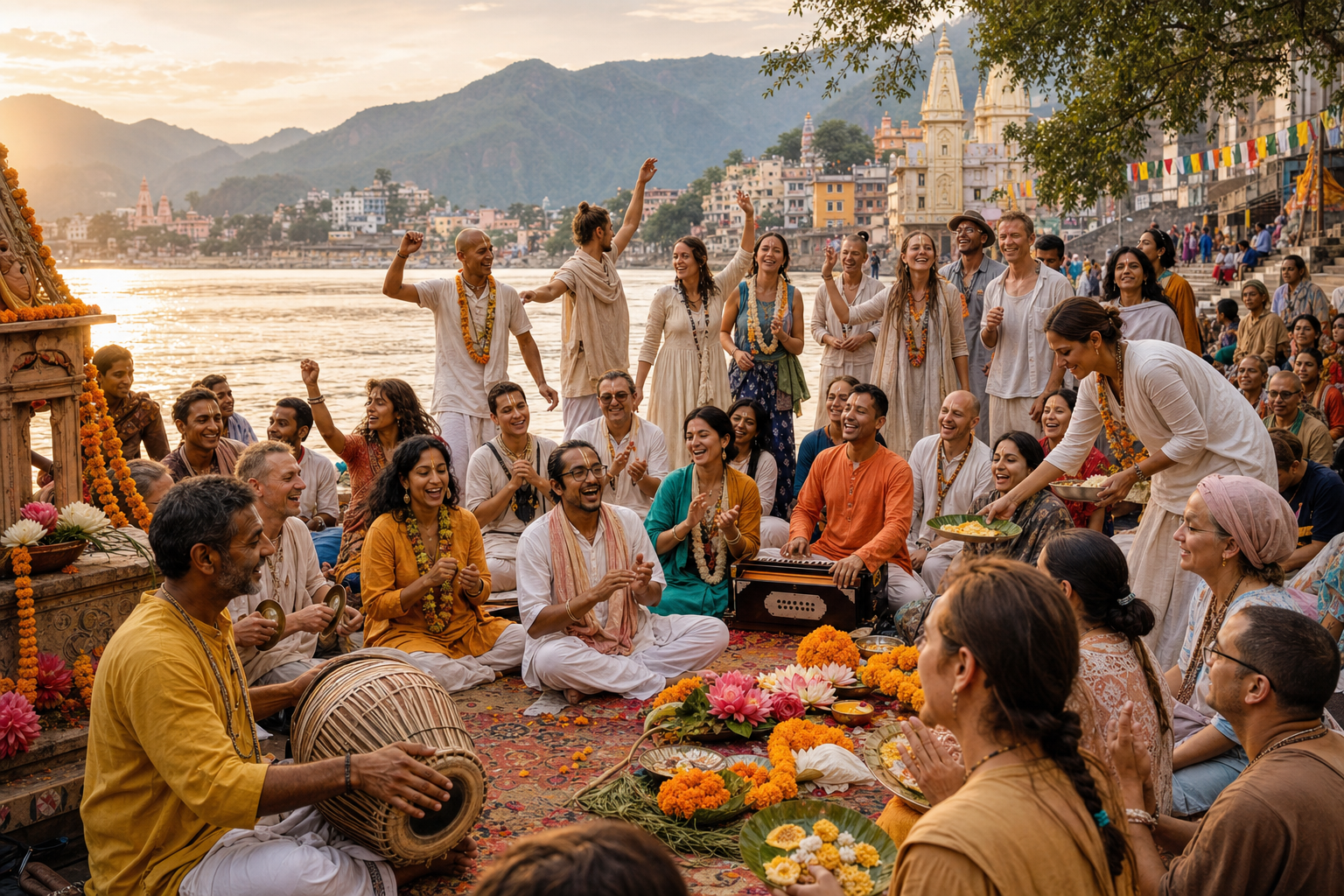
The fifth Rishikesh Kirtan Festival stands as a devotional gathering shaped by bhakti, seva, sacred sound, and community life on the banks of the sacred Ganges. Its central purpose is not entertainment in the ordinary sense, but the cultivation of collective spiritual attention through chanting, dancing, prasadam, and remembrance of the guru-shishya tradition. In the language of Gaudiya Vaishnavism, such a gathering is rooted in sankirtana: the congregational chanting of the names of the Divine as a means of purifying consciousness, deepening humility, and building community across social, linguistic, and national boundaries.
Rishikesh provides a uniquely charged setting for this work. Known globally as a center of yoga, sadhana, pilgrimage, and contemplative life, the town has long attracted seekers who come to the Himalayan foothills in search of discipline, clarity, healing, and spiritual orientation. The presence of the Ganga river intensifies that atmosphere. In Hindu sacred geography, the Ganges is not merely water flowing through a landscape; it is revered as a purifier, a witness, and a living symbol of grace. A kirtan festival held beside the river therefore becomes more than a cultural event. It becomes a meeting point between sound, place, memory, and spiritual aspiration.
The festival is offered in service to His Divine Grace Srila A.C. Bhaktivedanta Swami Prabhupada, the founder-acharya of ISKCON, whose life work carried the teachings of Krishna bhakti from India to a global audience. Srila Prabhupada founded the International Society for Krishna Consciousness in 1966 and placed public chanting, scriptural study, prasadam distribution, and devotional service at the center of its practical spiritual program. Within that framework, the Rishikesh Kirtan Festival may be understood as an extension of his instruction to share the holy names with faith, courage, discipline, and compassion.
The emotional strength of such a festival lies in its simplicity. People gather, sit together, sing together, rise to dance together, and receive sanctified food together. These actions may appear uncomplicated from the outside, yet they carry deep theological and social meaning. Kirtan shifts attention away from private anxieties and toward a shared sacred center. Dancing allows devotion to become embodied rather than merely conceptual. Feasting through prasadam turns food into fellowship, reminding participants that spiritual culture is sustained not only through ideas but through hospitality, gratitude, and care.
In technical terms, kirtan functions through repetition, rhythm, melody, call-and-response structure, and communal participation. The lead singer introduces a mantra or devotional phrase, and the assembly responds. Instruments such as mridanga, kartal, harmonium, and other acoustic supports help regulate tempo and emotional progression. The repeated chanting of the Hare Krishna maha-mantra, or other Vaishnava devotional names and prayers, gradually moves the mind from scattered thought toward focused remembrance. This process is not intended as performance alone; it is a disciplined form of bhakti yoga, where sound becomes both method and offering.
Bhakti traditions have long recognized sacred sound as a path accessible to people across differences of learning, wealth, age, and social status. While philosophical study has its place, kirtan opens a door for those who may not yet understand Sanskrit, theology, or the finer distinctions of Vedanta. A person can participate through listening, clapping, repeating the mantra, or simply sitting with sincerity. This inclusive quality explains why kirtan has traveled so widely across India and beyond. It does not demand uniform background; it invites shared intention.
The fifth year of the Rishikesh Kirtan Festival is significant because continuity itself is a form of service. A single event can inspire, but an annual festival builds memory, trust, and cultural depth. Participants begin to return not only for music, but for association, discipline, and the atmosphere of collective devotion. Volunteers learn how to serve with steadiness. Organizers learn how to preserve spiritual focus while managing practical realities such as space, sound, hospitality, schedules, and crowd movement. Over time, the festival becomes a living institution of devotional culture.
The offering of the festival at the lotus feet of Srila Prabhupada also highlights the classical meaning of discipleship. In the guru-shishya tradition, gratitude is not sentimental admiration alone. It is expressed through service that carries forward the teacher’s mission with integrity. To organize a kirtan festival in Rishikesh is therefore to transform remembrance into action. The disciple’s devotion becomes visible through the creation of a space where others may encounter chanting, prasadam, satsang, and the teachings of Krishna consciousness.
Such service also requires humility. A festival may involve stage arrangements, musicians, visitors, photography, travel, and public attention, but its deeper measure is whether it increases remembrance of the Divine and respect among participants. The most enduring devotional gatherings are those where organization serves the sacred purpose rather than overshadowing it. In that sense, the success of the Rishikesh Kirtan Festival is best understood not by spectacle, but by the quality of shared devotion it helps awaken.
The festival also reflects a broader dharmic principle: spiritual practice is strengthened when it is shared without hostility toward other sincere paths. Hinduism, Buddhism, Jainism, and Sikhism each preserve distinct doctrines, lineages, and disciplines, yet they also share a civilizational respect for inner transformation, ethical conduct, self-restraint, compassion, and liberation from ego-centered life. Kirtan belongs particularly to the Hindu bhakti stream, and within this festival especially to the Vaishnava tradition, but its atmosphere of sacred sound, humility, and service can be appreciated by seekers from many dharmic backgrounds.
This is important in the contemporary world, where religious identity is often reduced to argument, branding, or political noise. A kirtan gathering offers a different model. It shows that devotion can be intellectually serious without becoming cold, emotionally powerful without becoming disorderly, and public without becoming aggressive. The chanting of the holy names creates a shared field in which the heart is educated through participation. In that field, unity does not require the erasure of difference; it requires reverence, restraint, and a willingness to recognize sincerity in others.
Rishikesh is especially suited to this model because it already gathers a global community of yoga practitioners, pilgrims, teachers, renunciants, householders, students, and travelers. Many arrive with an interest in asana, meditation, Ayurveda, or Himalayan spirituality. Kirtan introduces them to a central insight of bhakti yoga: the heart is transformed not only by silence and self-observation, but also by loving sound and shared remembrance. For some participants, this may be their first encounter with the Hare Krishna tradition. For others, it may renew a practice that has already shaped their lives for decades.
The role of prasadam should not be treated as secondary. In Vaishnava practice, food offered to Krishna and then shared with others becomes a practical theology of grace. It teaches that nourishment is not merely consumption, and that community is not built through ideology alone. Sitting together for sanctified food softens social boundaries and gives devotional culture a domestic warmth. After intense chanting, prasadam grounds the experience, allowing joy to become hospitality and worship to become care for the body and the community.
The dancing that accompanies kirtan also deserves careful attention. In many modern settings, dance is understood primarily as performance or self-expression. In devotional kirtan, dance becomes an embodied response to sacred sound. It can be disciplined, spontaneous, simple, or ecstatic, but its purpose is not display. It allows the body to participate in remembrance. This matters because dharmic traditions often understand spiritual life as an integrated discipline involving body, speech, mind, emotion, and action. Chanting engages speech and hearing; dancing engages movement; prasadam engages gratitude; seva engages responsibility.
The festival’s location on the Ganga also invites ecological and ethical reflection. Reverence for sacred rivers must be expressed not only through ritual language but through responsible conduct. A spiritually mature festival culture encourages cleanliness, respect for public space, careful use of resources, and awareness that sacred geography must be protected for future generations. Devotion to Ganga is most credible when it includes practical stewardship. In this way, the festival can deepen both spiritual feeling and civic responsibility.
For the wider Hindu community, the Rishikesh Kirtan Festival demonstrates how traditional devotional practices can remain vibrant in a global age. It does not need to dilute bhakti to make it accessible. Instead, it presents chanting, prasadam, guru-seva, and scriptural culture in a form that welcomes newcomers while remaining rooted in lineage. This balance is essential. Spiritual traditions lose depth when they become mere cultural display, but they also lose reach when they become inaccessible to sincere seekers. A well-conducted kirtan festival offers both rootedness and openness.
Srila Prabhupada’s global mission provides the historical backdrop for this balance. His teaching emphasized that Krishna consciousness was not a sectarian identity limited by nationality or ethnicity, but a universal spiritual discipline grounded in the Bhagavad Gita, Srimad Bhagavatam, the holy name, and devotional service. The Rishikesh Kirtan Festival continues that vision by bringing people together in India, at a sacred site known across the world, to practice bhakti in a communal and embodied way.
The festival also offers a practical lesson in how spiritual communities endure. They require vision, but also logistics. They require inspiration, but also discipline. They require charismatic chanting, but also quiet service before and after the public program. Behind every visible moment of joy stand volunteers arranging seating, preparing food, coordinating sound, welcoming guests, cleaning spaces, and ensuring that the atmosphere remains respectful. This hidden seva is often the true architecture of the event.
From an academic perspective, the Rishikesh Kirtan Festival may be read as a contemporary expression of pilgrimage culture, transnational Hindu devotion, and sacred music practice. It connects local sacred geography with global bhakti networks. It brings together inherited ritual forms and modern event organization. It uses music not as passive consumption but as participatory theology. It also shows how religious communities create continuity through annual gatherings that combine memory, place, discipline, and shared affect.
Yet its deeper significance remains devotional rather than merely sociological. The festival’s heart is the offering of sound, service, and community to the Divine through the lineage of Srila Prabhupada. Participants may arrive with different levels of knowledge, but the shared experience invites them into a simple and demanding question: how can life become more centered on remembrance, humility, service, and love? That question is the enduring gift of kirtan.
The fifth Rishikesh Kirtan Festival therefore deserves attention as a serious spiritual and cultural event. It gathers people on the banks of the Ganges to chant, dance, honor prasadam, and remember the instruction of a great Vaishnava acharya. It strengthens bhakti, supports dharmic unity, and demonstrates that sacred tradition can be both ancient and urgently contemporary. In a time marked by distraction and division, the festival offers a disciplined reminder that collective devotion, when rooted in humility and service, can still create spaces of genuine transformation.
Inspired by this post on Dandavats.






Leave a Reply
You must be logged in to post a comment.