
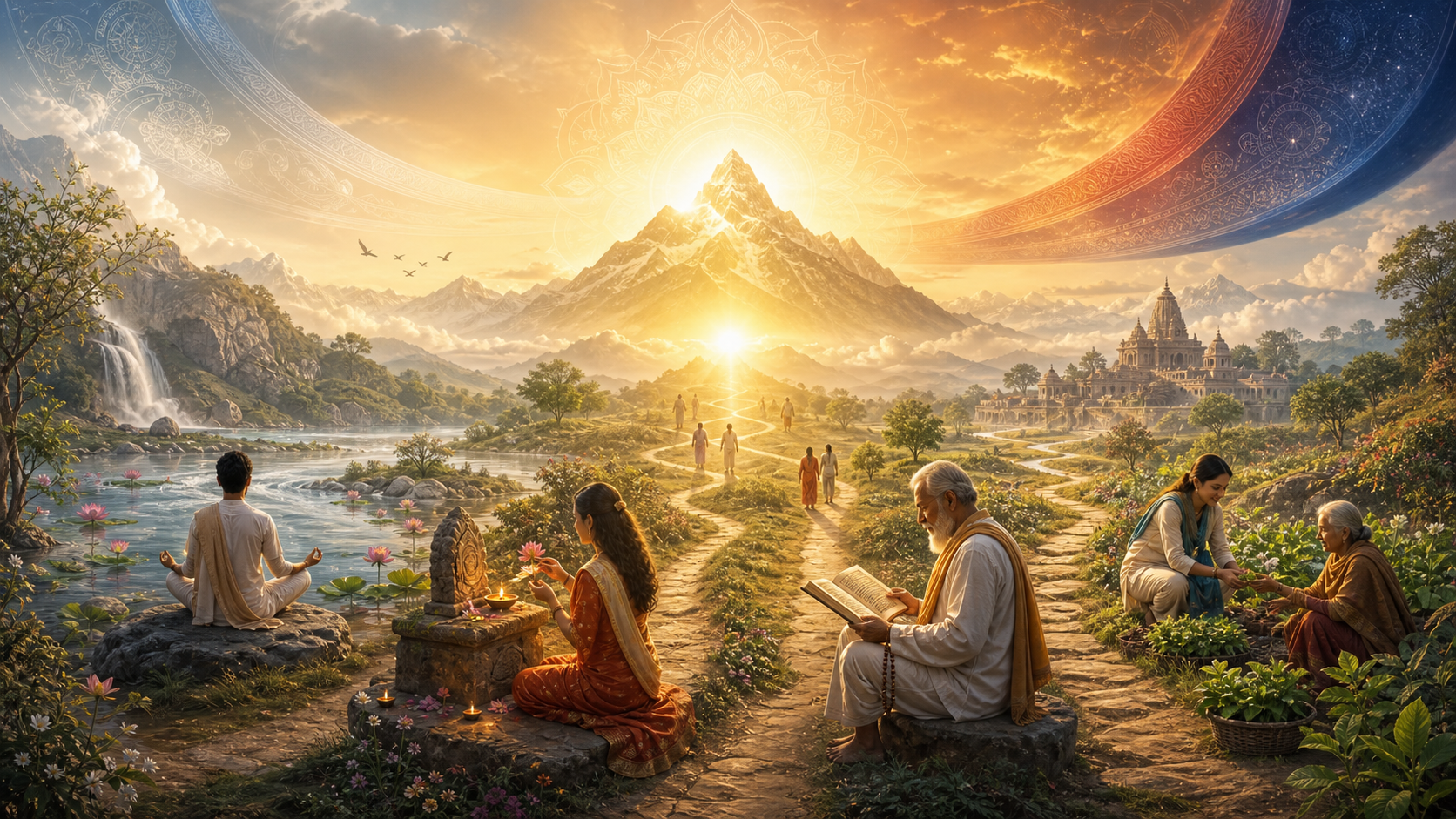
Hinduism answers the question of different spiritual paths by beginning with a realistic understanding of human nature. Human beings do not approach truth from identical temperaments, emotional histories, intellectual capacities, family duties, social conditions, or stages of life. A contemplative person may be drawn toward silence and philosophical inquiry, while another may discover inner transformation through devotion, ritual, service, mantra, ethical discipline, or meditative practice. The Hindu view of spiritual life therefore does not treat diversity as a problem to be solved. It treats diversity as a fact of existence that must be understood with compassion, discipline, and philosophical clarity.
This insight is central to Sanatana Dharma because spirituality is not merely a set of external rules. It is a process of refining the whole person: body, speech, mind, emotion, intention, memory, conduct, and awareness. Since these dimensions vary from person to person, the method of spiritual growth must also vary. What brings steadiness to one seeker may create resistance in another. What awakens devotion in one heart may feel abstract or inaccessible to another. What sharpens the intellect of one student may not heal the emotional life of a person who first needs trust, surrender, and belonging.
The technical Hindu principle behind this approach is often described through adhikara, or spiritual eligibility and readiness. Adhikara does not imply superiority or inferiority. It refers to the capacity, context, and maturity with which a person can responsibly undertake a particular discipline. A child, a householder, a renunciate, a scholar, a worker, a devotee, and a contemplative practitioner do not all need the same instruction at the same time. A path becomes spiritually meaningful only when it corresponds to the seeker’s actual condition and helps that person move toward dharma, inner clarity, and self-realization.
Hindu philosophy also explains human diversity through the framework of the three gunas: sattva, rajas, and tamas. These are not rigid labels but dynamic qualities of nature that influence perception, motivation, and behavior. Sattva inclines the mind toward clarity, harmony, and knowledge. Rajas produces activity, ambition, restlessness, and desire. Tamas expresses inertia, confusion, heaviness, or resistance. Every person contains all three in changing proportions. Spiritual practice, therefore, must meet the seeker where these tendencies are active and gradually guide the mind toward greater balance and luminosity.
This is why Hinduism recognizes multiple yogic disciplines rather than a single compulsory route. Karma Yoga disciplines action by transforming work into selfless offering. Bhakti Yoga refines emotion through devotion, surrender, remembrance, and love of the Divine. Jnana Yoga directs the intellect toward discrimination between the eternal and the transient. Raja Yoga, closely associated with meditation and mental discipline, works directly with concentration, awareness, and the fluctuations of the mind. These paths are distinct in emphasis, yet they are not mutually hostile. In lived Hindu spirituality, they often overlap and support one another.
Karma Yoga is especially meaningful for those whose lives are full of responsibility. A person engaged in family care, professional work, public service, agriculture, governance, teaching, trade, or community life may not be able to withdraw from action. Hinduism does not dismiss such a life as spiritually inferior. Instead, it teaches that action can become a discipline when performed with integrity, restraint, and detachment from egoistic craving. The field of work itself becomes a field of purification when duty is aligned with dharma and the fruits of action are offered without possessiveness.
Bhakti Yoga speaks to another deep dimension of human nature: the need for relationship, trust, beauty, gratitude, and emotional transformation. Many people do not experience spiritual life first as an abstract metaphysical inquiry. They experience it as love for Krishna, Rama, Shiva, Devi, Ganesha, Vishnu, Hanuman, or another chosen form of the Divine. Through puja, kirtan, japa, vrata, pilgrimage, and remembrance, the heart becomes softer and more disciplined. Bhakti does not reject reason; rather, it recognizes that emotion must be sanctified, not suppressed.
Jnana Yoga is suited to seekers who are moved by inquiry into the nature of self, consciousness, reality, and liberation. Such seekers ask questions about atman, Brahman, maya, impermanence, identity, and ultimate truth. The Upanishads, Vedanta, and many Hindu darshanas provide disciplined methods for this inquiry. Jnana is not mere intellectual cleverness. It demands ethical preparation, concentration, humility, and the ability to distinguish between conceptual knowledge and direct realization. Without inner purification, philosophy can become pride; with discipline, it becomes a path to freedom.
Raja Yoga and meditation traditions address the mechanics of the mind with unusual precision. The mind is observed as restless, conditioned, and easily pulled by memory, desire, fear, and sensory impressions. Practices such as yama, niyama, asana, pranayama, pratyahara, dharana, dhyana, and samadhi provide a structured method for stabilizing awareness. For seekers inclined toward introspection and discipline, this path offers a technical psychology of spiritual transformation. It shows that liberation is not only a belief but also a refinement of attention.
The Hindu principle of Ishta Devata further clarifies why different people need different spiritual paths. Ishta means the chosen or cherished form through which the seeker relates to the Divine. This does not imply that truth is fragmented into competing realities. It means that the human mind needs a meaningful point of relationship. A devotee of Shiva, a worshipper of Vishnu, a seeker devoted to Devi, a practitioner centered on Surya, or a family attached to a Kula Devata may all participate in the larger spiritual vision of Hindu Dharma while retaining a deeply personal mode of worship.
This plurality is not spiritual confusion. It is a sophisticated response to the complexity of human consciousness. Hinduism distinguishes between the ultimate reality and the many valid approaches through which finite minds orient themselves toward it. The same mountain may be approached from different sides, but each path still requires effort, guidance, discipline, and sincerity. Diversity of spiritual practice does not mean that every impulse is equally mature. It means that valid disciplines can differ while remaining rooted in dharma, self-control, reverence, and the pursuit of liberation.
The Bhagavad Gita expresses this inclusiveness with remarkable balance. It does not force Arjuna into a single model of spirituality divorced from his nature and duty. Instead, it teaches action, devotion, knowledge, meditation, surrender, and disciplined discernment in an integrated manner. Arjuna’s crisis is not solved by rejecting life but by understanding his svadharma with clarity. The Gita therefore becomes a classic example of Hindu spiritual psychology: the right teaching must address the actual seeker, the actual crisis, and the actual duty before that person.
The concept of svadharma is important here. Svadharma refers to one’s own duty, nature, and rightful mode of participation in the moral order. It does not justify selfishness or social arrogance. Properly understood, it asks each person to examine capacity, responsibility, temperament, and context. A student’s dharma differs from a parent’s dharma. A contemplative’s discipline differs from that of a community leader. A person recovering from grief may need devotional steadiness, while another facing intellectual doubt may need philosophical study. Spiritual maturity begins when practice becomes truthful to one’s condition rather than borrowed for appearance.
Hinduism’s acceptance of different paths also protects seekers from unnecessary despair. Many people assume that if one discipline does not suit them, they have failed spiritually. Hindu thought offers a more compassionate and accurate diagnosis. The problem may not be lack of sincerity; it may be a mismatch between method and temperament. A restless person may first need disciplined action before deep meditation becomes possible. A wounded heart may need devotion before metaphysical abstraction can become meaningful. A proud intellect may need service before knowledge becomes wisdom.
This approach has practical consequences for family and community life. In many Hindu homes, one person may be drawn to temple worship, another to scriptural study, another to fasting, another to mantra, another to seva, and another to quiet meditation. A mature Dharmic culture does not need to reduce all of them to one pattern. It can hold them together through shared values: respect for elders, reverence for sacred texts, ethical living, compassion, restraint, gratitude, truthfulness, and the pursuit of inner refinement. Unity is preserved not by uniformity but by a common orientation toward dharma.
The same principle supports harmony among Dharmic traditions such as Hinduism, Buddhism, Jainism, and Sikhism. These traditions differ in doctrine, language, metaphysics, ritual, and institutional history, yet they share deep civilizational concerns: liberation from ignorance, ethical discipline, self-mastery, compassion, truth, non-possessiveness, service, and reverence for spiritual practice. A unity-oriented understanding does not erase differences. It allows differences to be studied honestly while recognizing the shared Dharmic commitment to transforming the human being from within.
Buddhist traditions, for example, developed rigorous methods of mindfulness, ethical discipline, insight, and compassion. Jain traditions refined the ideals of ahimsa, aparigraha, austerity, and karmic purification with extraordinary seriousness. Sikh tradition emphasized devotion to the One, remembrance of the Divine Name, honest labor, equality, courage, and seva. Hindu traditions developed vast forms of worship, yoga, Vedanta, Tantra, temple culture, sacred geography, and philosophical debate. When approached with respect, these traditions do not weaken one another. They enrich the wider Dharmic understanding of human transformation.
A single compulsory spiritual model can unintentionally neglect the real diversity of human beings. It may privilege one temperament as universal and then judge all others by that standard. Hinduism avoids this reduction by recognizing that spiritual disciplines must be adapted without being diluted. Adaptation is not the same as carelessness. A practice must still be guided by guru, shastra, sadachara, and reasoned reflection. The seeker is not invited to invent spirituality out of convenience but to find an authentic doorway into discipline, humility, and realization.
This is why the role of the guru and spiritual teacher is traditionally so important. A competent guide does not merely distribute the same instruction to everyone. The teacher observes temperament, weakness, strength, ego-pattern, devotional capacity, intellectual maturity, and life circumstance. One student may be asked to serve. Another may be instructed in mantra. Another may be directed toward study. Another may be warned against premature austerity. Another may be encouraged to simplify life. In this model, guidance becomes diagnostic, not mechanical.
Scriptural diversity also reflects this principle. The Vedas, Upanishads, Itihasas, Puranas, Agamas, Yoga texts, Bhakti literature, Dharma Shastra traditions, and philosophical commentaries do not all speak in the same style. Some teach through ritual. Some through dialogue. Some through metaphysics. Some through narrative. Some through hymns. Some through discipline of the body and mind. Some through moral dilemmas. This literary diversity is not accidental. It shows that wisdom must be communicated through many forms because seekers awaken through many forms of understanding.
The Puranic imagination, in particular, makes spiritual truth emotionally and culturally accessible. Stories of Shiva, Vishnu, Devi, Ganesha, Skanda, Hanuman, and countless saints allow ordinary people to encounter subtle principles through narrative, ritual, festival, and sacred memory. A philosophical truth that might seem distant in abstract form becomes intimate through story and worship. This is not a lower form of religion. It is a different pedagogical mode, one that recognizes the power of image, rhythm, place, sound, and shared community experience.
At the same time, Hinduism does not reduce spirituality to emotion or ritual alone. It preserves rigorous traditions of logic, debate, grammar, metaphysics, meditation, and ethical analysis. Nyaya, Mimamsa, Vedanta, Samkhya, Yoga, Vaisheshika, and other darshanas show that reason has a sacred role when disciplined by humility. This range matters because some seekers are persuaded by devotion, some by reason, some by experience, and some by disciplined conduct. A broad spiritual civilization must provide meaningful methods for all these forms of seeking.
Modern life makes this teaching especially relevant. Contemporary seekers often face fragmented attention, professional stress, family pressure, loneliness, ideological confusion, and loss of inherited cultural memory. A rigid spiritual demand may discourage them before they even begin. A wiser approach asks what can restore balance. For some, daily japa may create steadiness. For others, studying the Bhagavad Gita may clarify duty. For some, seva may dissolve self-centeredness. For others, pranayama and meditation may regulate the mind. For many, temple worship reconnects the individual with community, beauty, and sacred continuity.
The emotional value of this teaching is significant. It allows a seeker to feel seen rather than judged. A person who struggles with abstract philosophy can still be spiritually sincere through devotion and service. A person who does not express emotion easily can still progress through inquiry and meditation. A person immersed in worldly duties can still spiritualize action through Karma Yoga. A person shaped by grief can still approach the Divine through prayer. Hinduism’s plurality gives the seeker room to begin honestly, which is often the first condition of genuine transformation.
However, diversity of paths should not be confused with spiritual relativism. Hinduism does not teach that every desire is a path or that every opinion is wisdom. The different margas are disciplined methods. They require ethical grounding, sincerity, self-restraint, reverence, and gradual purification. Bhakti without humility can become sentimentality. Jnana without compassion can become arrogance. Karma without detachment can become egoistic activism. Meditation without ethics can become self-absorption. The plurality of Hindu spirituality is therefore held together by dharma.
This dharmic framework also explains why spiritual growth is gradual. Samskaras, or deep impressions, shape tendencies over time. Vasanas, or latent desires, influence what the mind seeks and avoids. The journey is not completed by adopting a label or performing an isolated ritual. It requires repeated practice, correction, reflection, and grace. Different paths address different layers of the person. Ritual sanctifies habit. Devotion transforms emotion. Knowledge clarifies understanding. Meditation steadies attention. Service purifies action. Ethical discipline restrains harmful impulses.
The inclusive Hindu view is therefore both compassionate and demanding. It is compassionate because it recognizes that people begin from different places. It is demanding because every valid path still asks the seeker to grow beyond ego, confusion, selfishness, and narrow identity. A person may choose a path according to temperament, but the path must eventually transform that temperament. The angry must become calmer. The proud must become humbler. The restless must become steadier. The fearful must discover trust. The intellectually sharp must become wise, not merely argumentative.
In this sense, Hinduism’s many spiritual paths are not competing products in a marketplace of belief. They are carefully preserved disciplines for different configurations of human nature. Their purpose is not entertainment, social branding, or sectarian superiority. Their purpose is moksha, inner freedom, and the restoration of life to dharma. When the diversity of paths is understood properly, it deepens respect among Hindu sampradayas and strengthens harmony across Dharmic traditions.
The answer to why different people need different spiritual paths is therefore clear. Human beings differ, and a wise spiritual tradition must understand those differences without abandoning truth. Hinduism offers this balance through adhikara, svadharma, the gunas, Ishta Devata, yoga, bhakti, jnana, karma, meditation, ritual, scripture, and living guidance. It affirms that unity does not require sameness. The deepest unity is found when many sincere paths guide different seekers toward self-mastery, compassion, wisdom, and realization of the sacred.
Inspired by this post on Hindu Blog.
