
A social media controversy involving a Texas woman identified in media reports as Kelly Smith has drawn attention to the recurring problem of Hinduphobia, anti-Indian prejudice, and the misuse of digital platforms to mock minority religious traditions in the United States. The incident reportedly centered on AI-generated imagery and online remarks that many Hindu and Indian American users interpreted as insulting to Hindu temples, Indian cultural identity, and immigrant communities in Texas.
The case matters because it is not merely about one offensive post or one online personality. It reflects a broader social pattern in which religious symbols, temple customs, ethnic identity, and immigrant presence can be turned into viral material for political performance. For Hindu Americans, Sikh Americans, Jain Americans, Buddhist Americans, and the wider Dharmic diaspora, such incidents are often experienced as more than casual ridicule; they touch the dignity of communities that have worked for decades to build institutions, preserve cultural practices, and participate responsibly in American civic life.
According to reports cited in the original material, Smith presented herself as a write-in candidate for governor in Texas, though there was no independently confirmed media verification of her candidacy in the formal election process. This distinction is important. In Texas, write-in candidates generally do not appear automatically on printed ballots in the same manner as major-party nominees. Voters must manually write in eligible names, and official recognition depends on election rules, filing requirements, and administrative confirmation. The political status of any self-described candidate therefore requires careful verification before being treated as equivalent to a recognized campaign.
The controversy reportedly intensified after Smith posted an AI-generated image of herself in Indian clothing before a setting resembling a Hindu temple. The caption, as quoted in media coverage, stated: “I have decided to become Indian since they say they are just as American as me. I will now call myself Pria – Priya’s misspelled.” The wording was widely criticized because it appeared to reduce Indian identity to costume, mock the name Priya, and question whether Indian Americans can be considered fully American.
That last implication is central to why many people found the post so disturbing. Indian Americans are citizens, taxpayers, professionals, entrepreneurs, public servants, students, parents, and neighbors. Their Americanness is not weakened by Hindu, Sikh, Jain, Buddhist, Muslim, Christian, Jewish, or any other heritage. A plural society does not require immigrants or their descendants to erase their names, festivals, foodways, languages, or places of worship in order to belong.
The posts attributed to Smith also reportedly included remarks about eating hamburgers at a temple and wearing shoes inside a temple. These statements generated anger because they referenced practices that are deeply meaningful in many Hindu spaces. In numerous Hindu temples, removing shoes is a sign of respect, cleanliness, humility, and sacred orientation. The treatment of the cow is also tied to long-standing Hindu cultural and religious values, including reverence for life, restraint, gratitude, and the symbolic place of gau mata in Hindu tradition. Not every Hindu community practices these values in identical ways, but deliberately invoking beef inside a temple context is widely understood as provocation rather than ordinary political speech.
A technically informed reading of the incident also requires attention to the role of generative artificial intelligence. AI-generated images can simulate religious environments, ethnic clothing, and cultural symbols with little friction and little accountability. When such tools are used for satire, parody, or political attack, they can rapidly create content that appears visually persuasive even when it is artificial. In this case, the reported use of an AI-generated temple backdrop made the insult feel more targeted because the image did not merely state an opinion; it staged a symbolic performance inside a simulated sacred space.
This is one reason digital Hinduphobia has become a serious subject for analysis. Prejudice no longer circulates only through speeches, pamphlets, or organized campaigns. It spreads through screenshots, memes, short videos, AI images, quote posts, livestream clips, and algorithmically amplified outrage. A single post from a fringe figure can reach a large audience if it triggers enough anger, ridicule, or political tribalism. The result is a media environment in which marginal actors may receive attention far beyond their institutional significance.
Local political analysts, according to the provided source material, viewed the controversy as an example of how self-proclaimed or fringe candidates can become highly visible through social media even when they are not major participants in the formal electoral process. This observation is persuasive. Digital platforms often reward emotional intensity over civic relevance. A person with little official power can still shape discourse if their content activates fear about immigration, resentment toward cultural change, or hostility toward religious minorities.
The Texas setting also gives the controversy wider meaning. Texas has a growing Indian American population, and Indian-owned businesses, Hindu temples, Sikh gurdwaras, Jain centers, Buddhist organizations, yoga communities, classical dance schools, and cultural associations have become visible parts of public life. For many families, this visibility represents hard-earned belonging. Temples are not only places of worship; they are community institutions where children learn languages, elders gather, festivals are observed, food is served, charity is organized, and intergenerational identity is sustained.
When public figures or social media personalities frame Indian cultural presence as a threat to “Texas” or “America,” they draw on a familiar exclusionary logic. The underlying claim is that some communities are permanent insiders while others remain conditional guests. Such logic has historically been used against many groups, including Catholics, Jews, Hindus, Sikhs, Muslims, Buddhists, Jains, African Americans, Native Americans, Asian Americans, and newer immigrant communities. The specific target changes, but the structure of suspicion remains recognizable.
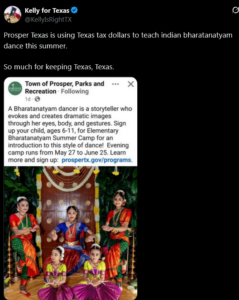
One reported post criticized Bharatanatyam programming in Prosper, Texas, stating: Prosper Texas is using Texas tax dollars to teach indian bharatanatyam dance this summer. So much for keeping Texas, Texas. Bharatanatyam is one of India’s classical dance traditions, with deep connections to temple aesthetics, devotional literature, music, rhythm, gesture, and philosophical storytelling. In contemporary America, Bharatanatyam is also taught as a performing art, a cultural discipline, and an educational practice. Treating it as incompatible with Texas civic life reveals a narrow view of public culture.
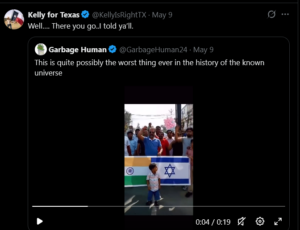
Public arts education often includes traditions from around the world: ballet, flamenco, jazz, hip-hop, African drumming, Chinese dance, Native American cultural programming, Japanese taiko, Irish step dance, and many others. A plural educational environment does not become less American because it introduces students to Bharatanatyam. It becomes more honest about the diversity of the people who live in the country. The presence of Indian classical dance in a public program should be evaluated by ordinary standards of educational value, access, funding rules, and community interest, not by ethnic suspicion.
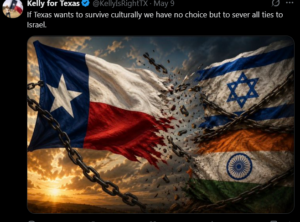
The original material also referred to posts and videos said to target Muslims and Hindus, along with a quoted statement attributed to Smith: “If Texas wants to survive culturally, we have no choice but to sever all ties to Israel. -Kelly For Texas” The statement, as presented, should be handled carefully. Criticism of a foreign state is not automatically hatred of a religious community, but political language can overlap with prejudice when it invokes collective suspicion, cultural survival narratives, or hostility toward groups identified with that state. The responsible approach is to evaluate the full pattern of statements rather than rely on one quotation in isolation.
For Dharmic communities, the immediate issue remains the mocking of Hindu sacred spaces and Indian cultural identity. Hindu temples are built around consecration, ritual discipline, and community norms. Wearing shoes in certain areas, bringing prohibited food into temple grounds, or staging meat-centered mockery around temple imagery can be interpreted as religious disrespect because these actions violate the symbolic order of the space. Even people who do not share Hindu beliefs can understand that sacred spaces deserve basic courtesy.
This principle is not uniquely Hindu. Many religious traditions have rules for entering sacred places. Shoes may be removed in gurdwaras, mosques, temples, and homes across Asia. Food restrictions exist in Jewish, Muslim, Hindu, Jain, Buddhist, Sikh, Christian monastic, and other religious communities. Silence, head coverings, modest dress, ritual cleanliness, and spatial boundaries are common in many traditions. Respect does not require agreement with every religious practice; it requires the maturity to avoid deliberate desecration or humiliation.
The incident also invites reflection on how Hindu advocacy should respond. Outrage is understandable when a sacred tradition is mocked, but the most effective response is disciplined, factual, and civic-minded. Documentation matters. Screenshots, archived links, dates, platform names, and exact wording help distinguish verifiable conduct from rumor. Community organizations can then engage schools, local officials, media outlets, interfaith partners, and civil rights groups with credible evidence rather than emotional generalization.
Hindu Americans and the broader Indian American community should not have to choose between silence and anger. There is a third path: principled public engagement. That includes explaining why temple customs matter, challenging racist stereotypes, asking journalists to avoid minimizing Hinduphobia, and building alliances with other communities that have also experienced religious or ethnic hostility. Such engagement reflects dharma more fully than reactive insult because it protects dignity while preserving moral clarity.
At the same time, the incident should not be used to stereotype all Christians, all conservatives, all Texans, or all people who hold strict views on immigration. Academic and factual analysis must distinguish between a reported set of statements by one individual and the beliefs of millions of people. Many Christians, conservatives, Texans, and immigration skeptics reject religious bigotry and support respectful treatment of Hindu temples and Indian American neighbors. Criticism becomes stronger when it avoids the same essentialism it seeks to oppose.
The same standard applies across political lines. Hinduphobia and anti-Indian prejudice can appear on the right, the left, and within supposedly progressive spaces. It may appear as crude religious mockery, as racialized suspicion of immigrants, as academic caricature of Hindu traditions, as selective outrage about caste, as dismissal of temple vandalism, or as pressure on Hindu students to distance themselves from their own heritage. No single ideology has a monopoly on prejudice, and no community benefits when hatred is excused because it comes from a preferred political side.
The controversy also exposes a recurring problem in media framing. When Hindus object to insults against their temples or traditions, their response is sometimes portrayed as oversensitivity or nationalism rather than a legitimate civil rights concern. Yet other communities are rightly permitted to object when their sacred symbols are mocked. Equal respect requires that Hindu concerns be heard in the same moral vocabulary used for antisemitism, Islamophobia, anti-Sikh hate, anti-Buddhist violence, anti-Jain stereotyping, anti-Christian persecution, and other forms of religious discrimination.
For younger members of the diaspora, these incidents can be especially painful. A student who learns Bharatanatyam, visits a temple with grandparents, observes vegetarian discipline, wears a bindi, ties a rakhi, keeps a kara, studies Jain ahimsa, chants a Buddhist mantra, or participates in seva may see online mockery and wonder whether their culture will always be treated as foreign. That emotional cost should not be dismissed. Public ridicule can shape whether children feel pride, embarrassment, confusion, or resilience about their heritage.
There is also a civic cost. When immigrant communities feel that their sacred practices are fair targets for humiliation, trust in institutions declines. Communities become less willing to participate openly in public life. They may hesitate to host cultural events, invite neighbors to temples, or engage in interfaith dialogue. A healthy democracy cannot thrive if minority communities feel they must hide their identity to avoid becoming viral targets.
The best response is not withdrawal. Dharmic traditions have long histories of philosophical debate, social resilience, and cultural adaptation. Hinduism, Buddhism, Jainism, and Sikhism each carry distinctive teachings, but they also share civilizational commitments to discipline, compassion, self-cultivation, reverence for life, and the search for truth. In the American context, these traditions can stand together against religious hatred while maintaining their own identities and practices.
Interfaith partners also have a role. Churches, synagogues, mosques, gurdwaras, temples, viharas, Jain centers, universities, civic associations, and local governments can affirm a basic rule: sacred spaces should not be used as props for ethnic or religious contempt. Such a statement does not require agreement on theology or politics. It simply recognizes that pluralism depends on mutual restraint and shared dignity.
Social media platforms face a related responsibility. Content that mocks religious communities may not always meet legal definitions of incitement or platform-defined hate speech, but amplification systems can intensify harm. Algorithms often reward provocation because it produces engagement. The technical architecture of virality therefore becomes part of the social problem. Transparency, consistent moderation, user reporting tools, and contextual labeling can help, though none of these measures can replace community education and ethical digital behavior.
Journalists covering such controversies should avoid sensationalism. The focus should be on verified statements, public reaction, political relevance, and the broader issue of religious discrimination. Describing every viral personality as a major political figure risks inflating their importance. At the same time, dismissing the incident as mere trolling fails to recognize how online mockery contributes to real-world prejudice. Responsible reporting must hold both truths together.
The use of AI-generated temple imagery also raises questions for future civic discourse. As generative tools become easier to use, communities may see more fabricated images placing public figures, religious symbols, or ethnic markers in offensive settings. This will require stronger media literacy. Viewers should ask whether an image is real, altered, staged, AI-generated, or taken out of context. Communities should develop rapid-response habits that verify content before sharing it widely, even when the content appears to confirm legitimate concerns.
The reported remarks about Indian-owned businesses and Indian cultural events in public places also deserve scrutiny. Business ownership by immigrant communities is not cultural conquest; it is part of economic participation. Indian Americans have contributed to medicine, technology, small business, education, hospitality, public service, engineering, academia, and entrepreneurship across the United States. Their visibility in Texas should be understood as part of American pluralism and economic life, not as evidence of displacement.
Debates over immigration, demographic change, and local identity are legitimate in a democracy. Citizens can discuss housing, infrastructure, wages, schools, taxation, legal immigration, border policy, and cultural integration. However, those debates become harmful when they turn minority religious practices into objects of contempt or suggest that some Americans are less American because of ancestry, skin color, names, temples, food habits, or dance traditions.
This is why Hinduphobia should be understood not only as a religious issue but also as a civil society issue. It affects how children are treated in schools, how temples are viewed by neighbors, how public officials respond to community concerns, and how media organizations frame Hindu identity. It also intersects with racism, xenophobia, anti-Asian bias, and broader hostility toward immigrants. A technical analysis of the phenomenon must therefore include religion, race, ethnicity, politics, media systems, and digital culture.
The path forward requires firmness without dehumanization. Condemning reported anti-Hindu or anti-Indian remarks does not require personal abuse. It requires accuracy, public accountability, and a refusal to normalize contempt. Where statements are offensive, they should be named as offensive. Where facts are uncertain, uncertainty should be acknowledged. Where a community is harmed, that harm should be explained in terms that neighbors, educators, journalists, and civic leaders can understand.
In practical terms, Hindu and Indian American organizations can respond by issuing fact-based statements, contacting local media, requesting clarification from public institutions involved in cultural programming, educating community members about reporting hate incidents, and strengthening interfaith relationships before crises occur. Temples can also host open houses that explain customs such as shoe removal, prasada, vegetarian offerings, aarti, darshan, and the sacred treatment of cows in many Hindu traditions. Knowledge reduces the space in which ridicule can masquerade as commentary.
The deeper lesson is that cultural confidence and civic responsibility must go together. A community secure in its dharma can defend itself without mirroring the hostility directed at it. It can protect temples, honor Bharatanatyam, preserve Sanskrit and regional languages, teach children about Hindu philosophy, and stand in solidarity with Buddhists, Jains, Sikhs, and others who face similar forms of erasure or mockery. Unity among Dharmic traditions does not mean uniformity; it means shared dignity in the public square.
The Texas controversy should therefore be treated as a warning and an opportunity. It warns that online Hinduphobia can be amplified quickly through AI images, political grievance, and social media outrage. It also offers an opportunity for a more mature public conversation about religious respect, immigrant belonging, cultural education, and the responsibilities of digital citizenship. In a plural democracy, Hindu temples, Bharatanatyam classes, Indian American businesses, and Dharmic community institutions are not threats to civic life. They are part of the lived reality of modern America.
Inspired by this post on Hindu Human Rights Blog.
