
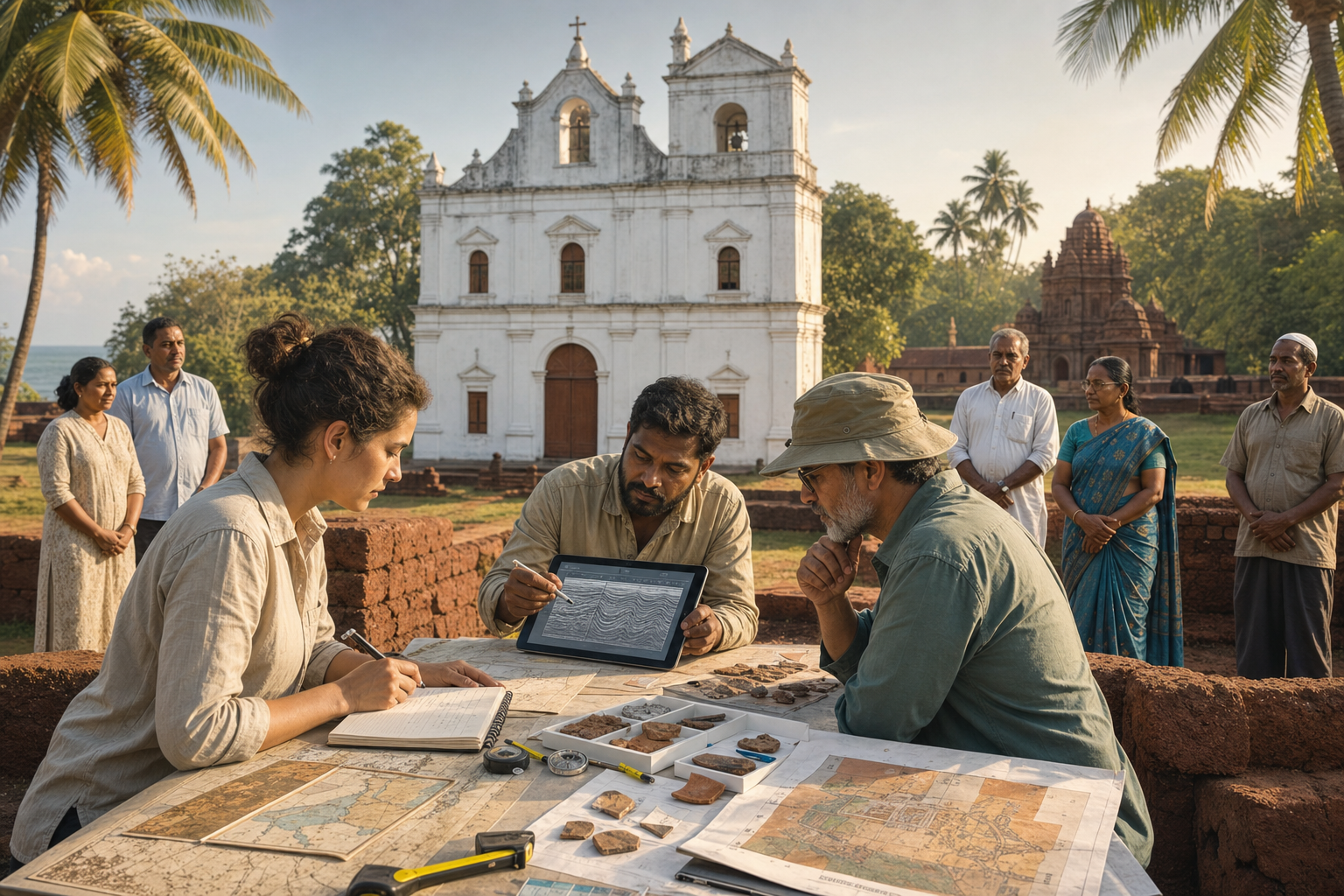
Hindu Raksha Maha Aghadi has called for scientific excavation at selected church sites in Goa, arguing that claims about buried historical evidence should be established through a proper investigation rather than through speculation, slogan, or political assertion. The demand is significant because Goa is not only a coastal state with a layered religious and cultural past, but also a living landscape where temples, churches, shrines, villages, archives, and family memories continue to shape public identity.
The central issue is not merely whether an excavation should take place. The more important question is how any such historical investigation should be conducted in a lawful, scientific, transparent, and socially responsible manner. Archaeological excavation is not an act of public emotion; it is a technical process governed by method, evidence, permissions, conservation ethics, and expert interpretation. If any claim is to be tested, it must be tested under these standards.
Goa’s history makes the subject sensitive. The region has seen ancient settlements, maritime exchange, temple traditions, colonial rule, missionary activity, social change, and modern democratic institutions. Its heritage cannot be reduced to one community’s memory alone. A serious academic approach must recognize that multiple communities have inherited the same geography, often with different stories attached to the same land. That is precisely why evidence, not accusation, must guide public debate.
Scientific excavation, when justified, usually begins long before a spade touches the ground. Researchers first examine archival records, old land grants, inscriptions, cadastral maps, oral traditions, architectural layers, previous survey reports, and the known settlement history of the area. Only after preliminary evidence indicates a credible archaeological question can non-invasive methods such as ground-penetrating radar, magnetometry, resistivity surveys, photogrammetry, LiDAR mapping, and structural assessment be considered.
This distinction matters because excavation is destructive by nature. Once a layer is removed, it cannot be restored to its original archaeological context. Professional archaeology therefore proceeds through stratigraphy, controlled trenches, measured drawings, material cataloguing, soil analysis, carbon dating where suitable organic material exists, ceramic typology, metallurgical study, iconographic assessment, and peer review. A conclusion becomes credible only when the chain of evidence is documented and open to expert scrutiny.
In India, such work also requires legal authority. The Archaeological Survey of India, state archaeology departments, conservation bodies, courts, and local administrations may all become relevant depending on the status of the site. If a church, temple, mosque, monastery, or any other religious structure is active, additional concerns arise: worship rights, public order, structural safety, heritage conservation, and the dignity of devotees must be protected. Due process is not an obstacle to truth; it is the framework that prevents truth-seeking from becoming social conflict.
The demand by Hindu Raksha Maha Aghadi should therefore be assessed through the lens of evidence-based heritage inquiry. If the organization possesses documents, architectural observations, inscriptions, historical references, or survey data, those materials should be submitted to competent authorities for examination. If the request is based only on broad historical suspicion, then the responsible path would be preliminary research rather than immediate excavation. A democratic society must allow historical questions, but it must also insist on disciplined methods.
There is also a moral dimension. Religious sites are not inert monuments. They are places where people pray, grieve, celebrate, marry, mourn, and transmit memory across generations. For Hindu, Buddhist, Jain, Sikh, Christian, Muslim, and other communities, sacred spaces often carry emotional meaning beyond what legal records can capture. Any investigation into religious sites must therefore be conducted with restraint, because historical inquiry and social harmony should not be treated as opposing values.
For dharmic traditions in particular, the search for truth is not meant to deepen hostility. Hinduism, Buddhism, Jainism, and Sikhism have all preserved strong traditions of inquiry, discipline, memory, and ethical conduct. These traditions support the recovery of heritage, but they also remind society that anger is a poor instrument for historical clarity. Evidence should be pursued firmly, yet without contempt for ordinary worshippers of any faith.
The public conversation around Goa’s church sites should therefore avoid two extremes. One extreme is to dismiss all heritage-related concerns as communal provocation before examining the evidence. The other is to treat unverified claims as proven history before any investigation has occurred. Both approaches weaken public trust. A mature response would ask for documentation, appoint qualified experts, preserve peace at the site, and publish findings in a transparent manner.
Technically, any proposed study should begin with a clear research question. Authorities would need to identify the exact site, the historical claim being tested, the type of evidence expected, the age range under consideration, and the least invasive method available. A survey team should include archaeologists, conservation architects, historians of Goa, epigraphists where inscriptions are relevant, structural engineers, and representatives responsible for site protection. Without such a framework, excavation risks becoming symbolic rather than scientific.
Transparency would be equally important. If an investigation is approved, its scope should be publicly defined. The chain of custody for artifacts should be recorded. Photographs, trench logs, maps, laboratory results, and conservation notes should be archived. Interim claims should be avoided until experts complete their analysis. Heritage disputes often become volatile when partial information circulates faster than verified conclusions. Responsible communication is therefore part of the scientific process.
Goa’s cultural heritage deserves that level of seriousness. The state’s history includes temple traditions, old village institutions, sacred groves, maritime trade, Portuguese-era architecture, Christian liturgical art, Konkani cultural expression, and memories of social transformation. A careful historical investigation should illuminate this layered inheritance rather than flatten it into a single political narrative. The purpose of archaeology should be knowledge, preservation, and public understanding.
The broader lesson is clear: where historical claims concern sacred geography, scientific standards and civic sensitivity must move together. Calls for excavation can be legitimate only when they are connected to credible evidence, lawful procedure, expert review, and a commitment to peace. In that sense, the demand made by Hindu Raksha Maha Aghadi has value only if it leads to disciplined inquiry rather than public polarization.
Ultimately, Goa’s past should not be approached as a weapon. It should be approached as a shared archive that requires patience, courage, and intellectual honesty. If evidence exists beneath any site, it should be studied with professional care. If evidence does not support a claim, that too must be accepted. A society committed to dharma, justice, and historical truth must be prepared for both possibilities.
Inspired by this post on Hindu Jagruti Samiti.
