
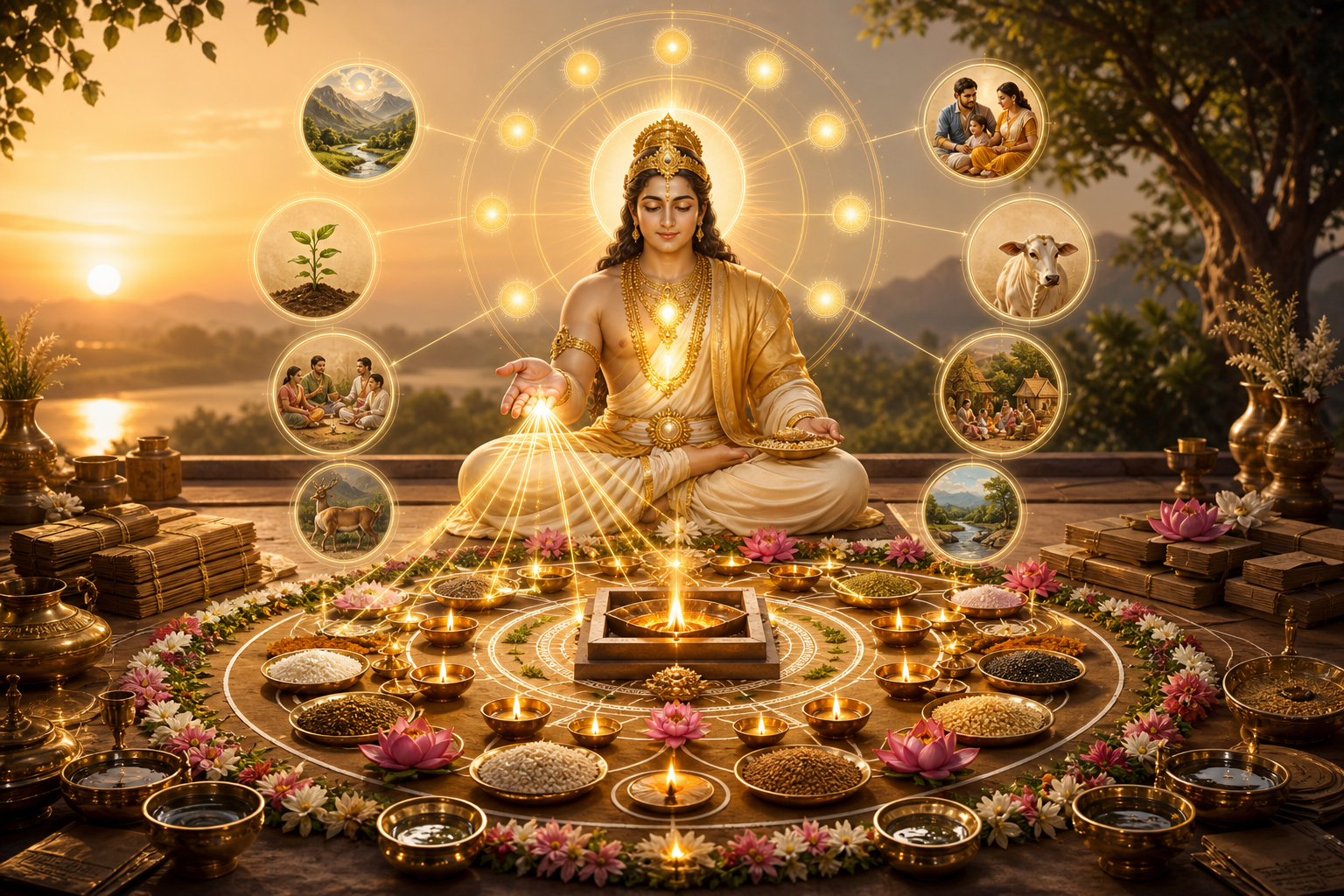
Amsha Deva occupies a quiet but meaningful place in Vedic literature. Unlike Indra, Agni, Soma, Varuna, or Mitra, he does not dominate the hymns with dramatic battles, blazing fires, or grand cosmic declarations. His importance lies in a subtler field: the idea of the rightful share, the ordered portion, and the sacred distribution that keeps life, ritual, society, and the cosmos from falling into disorder.
The name Amsha is commonly understood from the Sanskrit sense of a portion, share, part, or allotted division. This meaning is not incidental. In Vedic thought, names often carry theological weight, and Amsha represents more than a minor divine personality. He expresses a principle: every being, force, duty, offering, and relationship has its proper place within the larger order of existence.
To understand Amsha Deva in the Vedas, it is necessary to approach him through the world of the Adityas. The Adityas are associated with Aditi, the vast and unbounded motherly principle, and with the maintenance of cosmic and moral order. They are not merely solar beings in a narrow physical sense. They are guardians of truth, obligation, right relation, and dharma before dharma becomes the later fully developed ethical and philosophical category found across Hindu scriptures.
In the Rig Veda, the Adityas appear as divine upholders of rta, the ordered pattern by which the universe remains intelligible and morally responsive. Mitra preserves bonds and agreements. Varuna is linked with vast sovereignty, law, and moral oversight. Aryaman is associated with hospitality, nobility, and social order. Bhaga is connected with fortune and apportionment. Within this constellation, Amsha naturally belongs to the theme of rightful allocation, the share that is neither hoarded nor denied.
This makes Amsha especially relevant for a modern reader. Human life is full of questions of distribution: how wealth is shared, how duties are assigned, how credit is given, how resources are used, how ritual offerings are made, how family responsibilities are balanced, and how society prevents the powerful from taking more than what is rightfully theirs. Amsha gives a Vedic form to this deeply practical concern.
The Vedic ritual world was built around precision. Offerings were not random gestures of devotion. They were carefully measured acts that recognized the place of each deity, the role of each priest, the responsibility of the patron, the rhythm of time, and the sanctity of speech. In such a world, a divine figure whose name suggests share or portion becomes a theological reminder that sacred order includes fair distribution.
Amsha should therefore not be dismissed simply because he is less frequently mentioned than the more famous Vedic deities. In the Vedas, silence and scarcity do not always imply insignificance. Some concepts appear briefly because they function as foundational assumptions. The ordered share is one such assumption. Without proper portioning, yajna loses precision, society loses fairness, and the moral imagination loses balance.
The relationship between Amsha and Bhaga is particularly illuminating. Bhaga is often understood as the deity of fortune, enjoyment, and the blessed share. Amsha, by contrast, can be read as the portion itself or the principle by which portions become meaningful. Together, they suggest that prosperity is not merely acquisition. Prosperity becomes dharmic when it is rightly distributed, gratefully received, and ethically enjoyed.
This distinction matters because Vedic wisdom does not treat wealth, food, cattle, land, ritual merit, or social honor as isolated possessions. They exist within networks of obligation. A share is never only material. It may be a share of responsibility, a share of sacrifice, a share of knowledge, a share of protection, or a share of gratitude. Amsha points toward this larger moral economy.
The Adityas as a group also help clarify why Amsha belongs to the language of balance rather than greed. Aditi, their mother, signifies expansiveness, freedom from narrow limitation, and a cosmic wholeness that cannot be reduced to selfish possession. The sons of Aditi preserve order precisely because they prevent fragmentation from becoming chaos. Amsha, as a divine share, belongs to wholeness rather than separation.
In this sense, a share is not a break from unity. It is a way unity becomes livable. A family can remain united only when responsibilities are shared. A community can remain healthy only when benefits and burdens are distributed with fairness. A ritual can remain sacred only when each part is performed in relation to the whole. Amsha represents the part that serves the complete order.
This insight also speaks to the unity of dharmic traditions. Hinduism, Buddhism, Jainism, and Sikhism developed distinct vocabularies, practices, and philosophical commitments, yet each places serious emphasis on ethical conduct, restraint, responsibility, compassion, and the rightful use of life. The Vedic idea embodied by Amsha can be appreciated as one early expression of a broader dharmic concern: no being exists for isolated self-claim alone.
Within Hindu thought, Amsha later gains additional resonance through the theological use of the term as a portion or partial manifestation of divinity. In Vaishnava contexts, for example, amsha can refer to a partial descent, expression, or manifestation of Vishnu. This later meaning should not be carelessly projected backward into every Vedic reference, but it shows how powerful the underlying concept remained in Sanskrit religious imagination.
The movement from share to manifestation is philosophically rich. If every portion participates in a larger fullness, then the part is never spiritually empty. The individual self, the community, the ritual act, the ethical duty, and the divine manifestation may all be understood through a relationship between part and whole. Amsha becomes a doorway into one of Indian philosophy’s recurring concerns: how multiplicity emerges without destroying unity.
The Vedas often present reality through layered relationships rather than rigid abstractions. Fire is physical flame, sacrificial messenger, divine presence, domestic center, and cosmic principle. Sunlight is visible radiance, time, life, insight, and moral witness. In the same way, Amsha is not merely a name in a list. He is a religious idea condensed into a deity: the portion that belongs within order.
For readers accustomed to dramatic mythology, Amsha may appear almost too quiet. Yet the quiet deities often guard the structures that make dramatic life possible. A society remembers warriors and kings, but it survives through fairness, measured responsibility, mutual obligation, and the ability to give each person and principle its due. Amsha belongs to this less spectacular but essential field of civilization.
The ethical dimension of Amsha is especially visible when placed beside the Vedic concern for rta. Rta is not simply natural law. It includes the rightness of speech, the reliability of vows, the rhythm of seasons, the order of sacrifice, and the moral consequences of human action. A rightful share is one expression of rta in social and ritual life.
When a person takes more than the rightful share, the issue is not only economic. It becomes spiritual disorder. Excessive taking disturbs trust. Denying another’s share weakens community. Misallocating sacred offerings disturbs ritual harmony. Ignoring one’s own share of duty leads to moral decline. Through this lens, Amsha is a quiet guardian against imbalance.
This is why Amsha can be read as an important deity for discussions of dharma in everyday life. Dharma is not only heroic sacrifice or philosophical contemplation. It is also the careful fulfillment of what is appropriate: the right word at the right time, the right duty in the right relationship, the right use of wealth, the right measure of desire, and the right recognition of others.
In family life, the principle of Amsha appears when affection, labor, inheritance, care, and authority are distributed with justice. In social life, it appears when institutions protect the vulnerable and restrain exploitation. In spiritual life, it appears when devotion does not become fanaticism and knowledge does not become arrogance. In ecological life, it appears when human beings recognize that nature too has a claim upon restraint and reverence.
This ecological reading is not artificial. Vedic literature repeatedly links divine order with natural order: dawn, rain, fire, rivers, seasons, cattle, food, and sunlight all belong to a connected world. If Amsha means share, then the human share of the earth is not a license for unlimited consumption. It is a disciplined participation in a larger cosmic household.
Such an interpretation also helps correct a common misunderstanding about Vedic religion. The Vedas are sometimes approached only as ritual manuals or collections of archaic hymns. Yet their ritual language carries philosophical and ethical meaning. The distribution of offerings, the invocation of deities, and the precision of sacred speech all train the mind to see life as ordered, relational, and morally accountable.
Amsha’s relative obscurity may therefore be an advantage. He invites careful reading rather than immediate assumption. He encourages attention to the margins of the Vedic world, where brief names preserve deep structures of thought. In studying him, one learns that Vedic wisdom is not found only in grand hymns to famous gods, but also in the smaller divine figures who reveal how finely tuned that worldview was.
The later enumeration of twelve Adityas, often connected with the twelve months, adds another layer of meaning. As the Adityas become linked with the solar year, they also become symbols of time’s ordered movement. In that framework, Amsha can be understood as the rightful portion within time itself. Each season has its duty. Each phase of life has its discipline. Each moment asks for a fitting response.
This view is deeply compatible with the broader Hindu understanding of ashrama, karma, yajna, and dharma. Life is not lived well by claiming every role at once. The student, householder, forest-dweller, renunciate, parent, teacher, ruler, servant, seeker, and devotee each has a distinct share of responsibility. Balance comes when the share is accepted without resentment and performed without selfishness.
Amsha also speaks to the intellectual humility required in scriptural study. Not every deity can be reduced to one simple definition. Vedic figures are polyvalent, shaped by language, ritual, poetic context, and later interpretation. Academic care requires acknowledging what is clear, what is probable, and what remains suggestive. It is clear that Amsha belongs among the Adityas and carries the semantic field of share or portion. It is reasonable to interpret him through righteous distribution and cosmic balance. It would be excessive to invent a large independent mythology where the textual record remains restrained.
This restraint is itself part of good dharmic reading. Reverence does not require exaggeration. A lesser-known deity need not be made artificially grand to become meaningful. Amsha’s importance lies precisely in the way a modest textual presence can preserve a major principle. The sacred share is not a minor idea. It is one of the foundations of justice.
In contemporary life, the principle of Amsha can be applied without reducing the deity to a slogan. Economic inequality, family conflict, institutional corruption, environmental depletion, and spiritual ego all involve distorted shares. Someone takes too much, gives too little, claims what is not earned, or refuses the responsibility that belongs to them. The Vedic imagination would not see these as merely administrative failures. They are failures of order.
At the same time, Amsha should not be read only as a deity of external distribution. There is also an inner distribution of attention. A balanced life gives proper share to study, work, devotion, rest, service, family, self-discipline, and silence. When one part consumes the whole, the person becomes inwardly disordered. The wisdom of Amsha gently asks whether each part of life has been given its rightful place.
This makes Amsha Deva a valuable subject for spiritual insight. His teaching is not loud, but it is exacting. He does not demand theatrical devotion. He asks for proportion. He asks for fairness. He asks that the offering reach its rightful destination, that the worker receive due respect, that the vulnerable not be deprived, and that the self not mistake possession for harmony.
In the larger landscape of Hindu deities, Amsha reminds readers that divinity is not confined to overwhelming power. Divinity also appears as measure, relation, boundary, and rightful participation. The same tradition that celebrates cosmic forms and heroic avatars also preserves the sanctity of a portion correctly given. This breadth is one of the great strengths of Vedic literature and Hindu philosophy.
Amsha’s relevance extends beyond sectarian boundaries because the principle he represents is universal in ethical life. A Buddhist may recognize in it the need for moderation and right conduct. A Jain may see resonance with restraint and non-possessiveness. A Sikh may connect it with honest living, sharing, and service. A Hindu may relate it to yajna, dharma, and the cosmic order of rta. The language differs, but the moral concern converges.
Such convergence does not erase difference. Dharmic unity is strongest when it respects distinct traditions while recognizing shared ethical seriousness. Amsha offers a useful model: the part does not need to disappear into the whole, and the whole does not need to crush the part. Each receives its rightful place. That is the deeper harmony of the sacred share.
Studying Amsha Deva in the Vedas therefore leads to a refined understanding of Vedic wisdom. He is a quiet Aditya, but quietness should not be mistaken for absence. Through him, the Vedic world affirms that order depends on distribution, that prosperity requires fairness, that ritual requires precision, and that dharma begins when each being receives what is rightly due.
In the end, Amsha is best understood as the divine reminder that life is not sustained by possession alone. It is sustained by right relation. Every share must return to harmony. Every portion must serve the whole. Every blessing carries responsibility. This is the enduring lesson of Amsha Deva: balance is sacred, fairness is spiritual, and righteous distribution is one of the quiet foundations of cosmic order.
Inspired by this post on Hindu Blog.
