
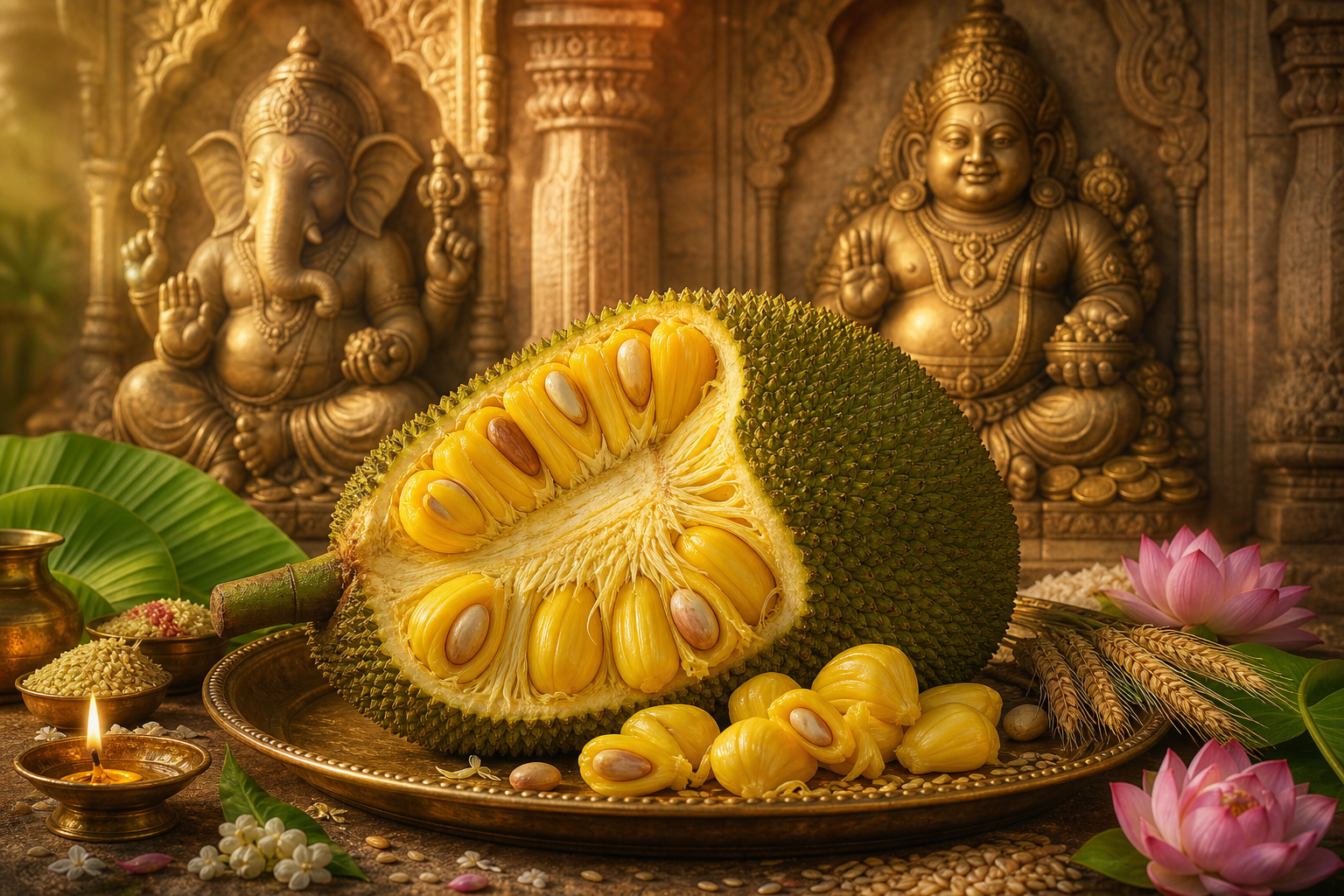
In Hindu iconography, the objects held by deities are rarely decorative afterthoughts. They function as a visual language through which philosophical ideas, ritual priorities, social memory, and devotional emotion become visible. The jackfruit, known in Sanskrit as panasa, belongs to this symbolic vocabulary as an image of abundance, fertility, nourishment, and material fulfilment. Its presence in the hands of deities such as Kubera and Ganesha invites a careful reading of Hindu religious symbols, because the fruit’s physical form itself communicates plenty: a large body, many seeds, dense sweetness, protective exterior, and generous yield from a single tree.
The symbolism of panasa is especially compelling because it joins the ordinary and the sacred. Jackfruit is not a remote or abstract emblem. It is a familiar fruit of village life, temple offerings, seasonal cooking, household hospitality, and agrarian prosperity across many regions of India. When such a fruit appears in divine iconography, the everyday experience of food, shade, harvest, family, and shared meals is elevated into a religious sign. The devotee is reminded that prosperity is not merely gold or currency; it is the capacity of life to nourish, multiply, sustain, and be shared.
Within Hindu symbolism, abundance is often expressed through natural forms: the lotus, banana plant, coconut, mango, pomegranate, grain, sugarcane, and full water pot. Panasa belongs to the same symbolic family, but it carries a distinct visual force. The jackfruit is large, textured, heavy, and filled with many edible bulbs surrounding seeds that can themselves become future growth. It therefore suggests prosperity in a layered way: visible fullness, hidden sweetness, reproductive potential, and long-term continuity. This makes it a particularly suitable emblem for deities connected with wealth, auspicious beginnings, and the removal of scarcity.
Kubera, the lord of wealth and guardian of the northern direction, is among the most important figures for understanding the symbolism of panasa. In Hindu, Buddhist, and Jain artistic worlds, Kubera or related yaksha figures are often associated with treasure, guardianship, fertility, and the earth’s stored riches. His iconography varies across regions and periods, but the underlying idea remains stable: wealth is not only an economic category; it is a cosmic resource that must be guarded, distributed, and ethically situated within dharma. When a fruit of abundance appears with Kubera, it reinforces his role as a divine custodian of prosperity rather than a mere patron of accumulation.
The jackfruit’s rough outer surface and sweet interior offer an especially rich metaphor for Kubera worship. Wealth, in a dharmic framework, is not judged only by its surface appearance. It requires discernment, discipline, protection, and proper use. A jackfruit must be opened with effort; its edible portions are embedded within fibrous layers; its sticky latex requires patience and skill. In symbolic terms, prosperity also demands skill, restraint, and responsibility. Panasa therefore becomes more than a sign of possession. It becomes a reminder that abundance must be approached with maturity.
Ganesha provides another important interpretive setting for the jackfruit symbol. As Vighneshvara, the remover of obstacles, and as the deity invoked at the beginning of undertakings, Ganesha is closely associated with auspiciousness, intelligence, success, and fulfilment. His familiar offerings include modaka, laddus, fruits, flowers, and durva grass. In regional iconographic and devotional contexts, fruit-bearing forms of Ganesha may include panasa or other fruits that signify sweetness, nourishment, and successful completion. When read in this broader symbolic field, the jackfruit reflects the fullness that follows disciplined effort and divine grace.
Ganesha’s connection with food is not accidental. His rounded belly, delight in sweets, and association with offerings express a theology of contentment. The body is not rejected as impure; rather, embodied life becomes a field for discipline, devotion, generosity, and joy. Panasa, with its many sweet segments, echoes this vision. It suggests that the fruit of effort may be abundant, but it also must be opened, divided, and enjoyed in community. In this sense, the jackfruit becomes a symbol of both material success and the ethical sharing of that success.
The Sanskrit name panasa also matters because Hindu iconography often preserves older cultural memories through names, materials, and ritual associations. Sanskritic vocabulary does not erase regional names and practices; rather, it frequently coexists with Tamil, Kannada, Telugu, Malayalam, Bengali, Marathi, Odia, and other linguistic traditions. This layered cultural life is important for understanding Hindu symbols. A fruit may be identified in Sanskritic terms in a shilpa or puranic context while also living in regional kitchens, festivals, songs, and temple offerings under local names. The symbol grows stronger because it belongs to both sacred learning and lived culture.
The physical structure of the jackfruit helps explain its symbolic appeal. A single fruit can contain numerous bulbs, each surrounding a seed. This multiplicity within unity is one of its most striking features. Hindu philosophy often returns to the relationship between the one and the many: one reality expressed through many forms, one dharma lived through many duties, one sacred order reflected in countless traditions. Panasa visually participates in this idea. Its many edible portions are held within one body, making it a natural metaphor for abundance without fragmentation.
This symbolic logic also supports the larger dharmic emphasis on unity among diverse paths. Hinduism, Buddhism, Jainism, and Sikhism all preserve, in different ways, a respect for discipline, ethical conduct, self-transformation, and compassion. While their doctrines and practices are distinct, their cultural worlds have often shared artistic motifs, ritual vocabulary, pilgrimage spaces, and moral ideals. A symbol such as the fruit of abundance can therefore be read without sectarian narrowness. It points toward nourishment, generosity, and the responsible use of resources, values that resonate across dharmic traditions.
In temple art, the meaning of an object depends on context. A fruit in a deity’s hand may indicate fertility, fulfilment, offering, royal generosity, seasonal bounty, or the granting of boons. With Kubera, panasa naturally leans toward prosperity and stored wealth. With Ganesha, it leans toward auspicious success, sweetness after effort, and the removal of obstacles to material and spiritual well-being. With yaksha figures, it may evoke fertility, guardianship of nature, and the earth’s overflowing vitality. The same fruit can therefore carry several related meanings without becoming vague.
The jackfruit also belongs to the symbolic world of agrarian India. Before wealth was commonly imagined through banks, markets, and digital numbers, abundance was experienced through harvests, cattle, orchards, water, stored grain, healthy children, skilled hands, and stable households. A fruit tree that produces generously over many seasons becomes a living form of security. Its shade shelters, its fruit feeds, its seeds renew, and its wood may be useful. Panasa thus represents wealth in a holistic sense, closer to the older Hindu idea of artha as a necessary support for life rather than a detached pursuit of luxury.
Artha, one of the four purusharthas, refers to material well-being, livelihood, power, and practical security. In Hindu thought, artha is legitimate when guided by dharma and integrated with kama and moksha. The jackfruit symbol fits this framework well. It does not glorify poverty, nor does it worship greed. Instead, it honours the material foundations of a dignified life: food, household stability, productive land, generosity, and the ability to fulfil responsibilities. In the hands of a deity, panasa teaches that prosperity becomes sacred when it serves dharma.
The abundance suggested by jackfruit is also ecological. The tree’s productivity depends on soil, rain, season, biodiversity, and patient cultivation. This dimension is significant in a time when prosperity is often separated from environmental responsibility. Hindu cultural traditions frequently treat trees, rivers, mountains, animals, and food plants as participants in sacred life. Panasa iconography can be read within that larger ecological imagination. It reminds communities that wealth is not produced by human effort alone; it arises from a network of life that must be respected and preserved.
The fruit’s texture adds another layer of meaning. The jackfruit’s exterior is formidable, sometimes even intimidating, while the interior is fragrant and sweet. Such a contrast appears frequently in spiritual literature and moral teaching. Wisdom, prosperity, and inner sweetness may be hidden beneath effort, austerity, or difficulty. The hard exterior does not deny the sweetness inside; it protects it. For devotees, this creates a relatable spiritual insight: life’s blessings often arrive through labour, patience, and the willingness to look beyond appearances.
In Ganesha worship, this insight is especially powerful. Obstacles are not always meaningless interruptions; they may be the outer covering through which maturity develops. Just as panasa must be opened before its sweetness can be enjoyed, a difficult undertaking may require perseverance before its reward becomes visible. Ganesha’s iconography often teaches through such concrete images. The elephant head, broken tusk, large ears, small eyes, and rounded belly each carry interpretive depth. A fruit of abundance placed within this symbolic environment becomes part of a larger grammar of wisdom, patience, and fulfilment.
Kubera’s association with panasa also helps clarify a common misunderstanding about wealth in Hindu tradition. Wealth is not inherently condemned. Lakshmi, Kubera, Ganesha, Annapurna, and many regional deities are associated with prosperity, food, fortune, and household well-being. The question is never whether prosperity matters, but how it is obtained, protected, used, and shared. A fruit, unlike a coin, carries the memory of growth and nourishment. It therefore softens the idea of wealth by grounding it in life-sustaining abundance.
This is why panasa symbolism can speak to modern readers with unusual clarity. In contemporary life, abundance is often measured through salary, consumption, property, or status. The jackfruit proposes a broader measure. Abundance includes the ability to feed others, preserve family bonds, honour guests, maintain ritual obligations, support learning, care for elders, and contribute to community life. Such wealth may be material, but it is also relational and ethical. The fruit’s many segments become a visual reminder that prosperity is most meaningful when it circulates.
There is also a strong ritual dimension to fruit offerings in Hindu worship. Fruits are considered sattvic, nourishing, and suitable for presentation before the deity. They represent the best of the earth’s yield, offered back in gratitude to the divine source of life. When devotees place fruit before Ganesha or Kubera, the act expresses humility: the fruits of labour do not belong to the individual alone. They are received, sanctified, and redistributed as prasada. Panasa, as a fruit of exceptional fullness, intensifies that devotional grammar of receiving and giving.
The iconographic use of jackfruit should also be understood with regional sensitivity. Hindu art is not a single rigid code repeated identically everywhere. It is a family of visual traditions shaped by shilpa texts, temple lineages, local materials, patronage, sectarian emphasis, and regional ecology. In areas where jackfruit is culturally prominent, its symbolic presence would naturally feel more immediate. The fruit’s inclusion in divine imagery therefore reflects not only theological abstraction but also the sacred geography of local life.
In South Indian cultural settings, for example, the jackfruit has long been associated with food, seasonal abundance, and domestic hospitality. In parts of coastal and tropical India, the fruit is not exotic; it is part of the sensory memory of home. Its smell, size, stickiness, and sweetness make it unforgettable. When such a fruit is linked with Ganesha or Kubera, the image does not remain distant. It carries emotional immediacy: the prosperity of a household kitchen, the generosity of a harvest, and the joy of food shared among relatives, neighbours, and pilgrims.
Panasa also illustrates how Hindu symbols work through scale. A small seed indicates potential; a flower indicates beauty and impermanence; a full fruit indicates completion. The jackfruit, because of its size and density, makes completion visible in an emphatic form. It is not a delicate hint of fulfilment but a bold declaration of plenty. In the hand of a deity, this fullness becomes a blessing: may effort mature, may resources multiply, may homes be nourished, and may prosperity remain rooted in dharma.
The fruit’s seeds deserve particular attention. Seeds are future-oriented. They contain the possibility of another tree, another season, another harvest, and another generation. In this way, panasa does not merely symbolize present abundance; it symbolizes continuity. Prosperity in dharmic thought is not complete if it ends with one person. It must support descendants, students, dependents, guests, institutions, temples, learning, charity, and social stability. The many seeds inside the jackfruit make visible this idea of abundance that extends beyond the immediate moment.
This continuity aligns with the household-centered dimensions of Hindu religious life. The grihastha stage is not treated as spiritually inferior when lived responsibly. It sustains society through work, family, hospitality, ritual, education, and charity. Panasa, as a fruit of household abundance, belongs naturally to this world. It affirms that spiritual life is not confined to withdrawal or renunciation. Dharma also lives in kitchens, fields, markets, orchards, ceremonies, and the careful management of resources.
At the same time, the symbol should not be reduced to materialism. The sweetness of the fruit can point toward rasa, the savour of life and devotion. The hidden edible portions can suggest inner realization. The difficulty of opening the fruit can represent tapas, disciplined effort. The many seeds can evoke karmic continuity and the responsibility of action. The protective outer layer can symbolize boundaries, restraint, and the need to preserve what is valuable. A single iconographic object can therefore hold theological, ethical, ecological, and emotional meanings together.
In Kubera and Ganesha worship, panasa ultimately becomes a symbol of auspicious prosperity that is both practical and sacred. Kubera guards and grants wealth; Ganesha removes obstacles and blesses beginnings. The jackfruit stands between these divine functions as a sign of fruitful effort. It suggests that wealth should be generated through right action, protected through wisdom, enjoyed with gratitude, and shared with generosity. This interpretation preserves the dignity of material life without allowing material desire to become the highest aim.
The symbol also encourages a more nuanced appreciation of Hindu iconography as a knowledge system. Images of deities are not merely artistic products; they are visual texts. Their attributes carry encoded meanings, and their interpretation requires attention to scripture, ritual, local tradition, aesthetics, and lived practice. A fruit in a divine hand may appear simple, but it can open a wide conversation about ecology, economics, family life, devotion, and metaphysics. Panasa is a strong example of this layered symbolic intelligence.
For contemporary spiritual reflection, the jackfruit’s message is direct and practical. Abundance should not be confused with excess. True prosperity includes nourishment, resilience, sweetness, fertility, generosity, and continuity. It has an outer structure and an inner essence. It requires work to access and wisdom to use. It is most beautiful when shared. These insights make panasa a meaningful symbol not only for temple art and Hindu religious studies but also for modern discussions of sustainable living, ethical wealth, and cultural heritage.
The presence of panasa in the symbolic world of Kubera and Ganesha reveals a sophisticated understanding of prosperity. Wealth is not isolated from food, family, ecology, devotion, or responsibility. The jackfruit’s many segments and seeds show that abundance is plural, generative, and meant to sustain life beyond the individual. Its rough exterior and sweet interior teach patience and discernment. Its association with divine hands transforms a familiar fruit into a sacred emblem of dharmic prosperity.
Seen in this way, jackfruit symbolism is not a minor detail in Hindu iconography. It is a compact theology of abundance. Panasa teaches that material fulfilment can be sacred when it is rooted in gratitude, governed by dharma, and offered for the welfare of the wider community. In the hands of Kubera and Ganesha, it becomes a blessing of nourishment, auspicious success, and responsible prosperity for all who seek wealth with wisdom.
Inspired by this post on Hindu Blog.
