
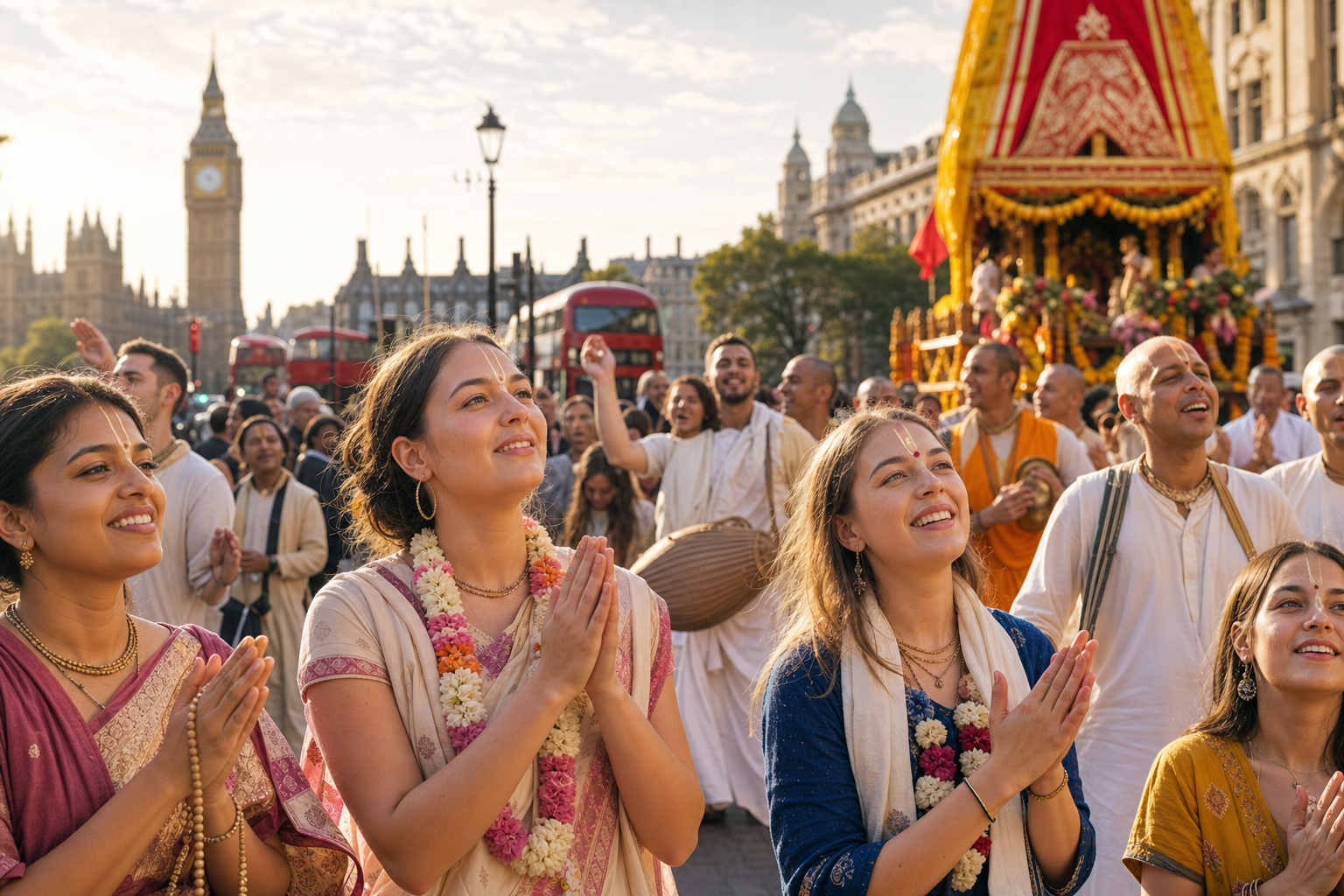
London’s public embrace of the Hare Krishna mantra on 20 June 2026 offers more than a fleeting image of street devotion. It presents a living example of how bhakti, music, ritual movement, and community participation can transform an urban space into a site of spiritual reflection. The scene suggested by the original post is simple: people gathered in London, hands joined, voices raised, and attention drawn toward the devotional sound of the Hare Krishna mantra. Yet behind that simplicity stands a much longer history of Hindu spirituality, Gaudiya Vaishnava practice, diaspora community life, and the remarkable journey of sacred sound from Indian devotional culture into the public squares of the modern world.
The Hare Krishna mantra is widely known as the Mahamantra, a sixteen-word Vaishnava mantra rooted in the devotional worship of Sri Krishna and associated especially with the Gaudiya Vaishnava tradition. Its familiar form is: Hare Krishna Hare Krishna, Krishna Krishna Hare Hare, Hare Rama Hare Rama, Rama Rama Hare Hare. In this mantra, the names Krishna and Rama invoke the divine as the source of attraction, joy, protection, and spiritual fulfillment, while Hare is commonly understood in Vaishnava theology as an address to the divine energy of the Lord, often associated with Sri Radha. The practice is therefore not merely musical repetition; it is a theology of relationship, longing, remembrance, and surrender expressed through sound.
In academic terms, the London gathering may be understood as a public form of kirtan, the collective chanting of divine names. Kirtan has deep roots in the bhakti movements of India, where devotion was often expressed through song rather than abstract philosophical argument alone. It allowed spiritual participation across social boundaries because the central requirement was not elite learning, institutional rank, or ritual specialization, but sincere engagement of the voice, body, and heart. This is one reason public chanting has retained such power in modern cities: it creates a participatory spiritual field in which spectators can become participants, and strangers can briefly recognize one another through rhythm, melody, and shared attention.
London has a distinctive place in the global history of the Hare Krishna movement. The city became one of the important Western centers for ISKCON, the International Society for Krishna Consciousness, founded by A. C. Bhaktivedanta Swami Prabhupada. In the late 1960s and early 1970s, London’s Radha-Krishna Temple and its association with George Harrison helped introduce the Hare Krishna mantra to audiences far beyond traditional Hindu circles. The 1969 recording of the Hare Krishna Mantra on Apple Records became a cultural landmark, showing how a Sanskrit devotional chant could enter popular music while retaining its sacred identity. This history makes any contemporary London chanting event part of a longer continuity rather than an isolated spectacle.
The phrase “London joins hands” is especially meaningful. It evokes more than physical coordination; it suggests civic participation, devotional solidarity, and a temporary softening of the ordinary separations that define metropolitan life. London is a city of sharp contrasts: ancient churches and modern financial towers, immigrant neighborhoods and royal ceremonial routes, secular institutions and living religious communities. When the Hare Krishna mantra is sung publicly in such a city, it does not withdraw spirituality into a private corner. It places dharmic sound in the open, where it can be heard by devotees, tourists, commuters, skeptics, and seekers alike.
For many observers, the emotional force of such an event comes from the way sound changes the atmosphere. A mantra does not function like a slogan. A slogan demands agreement; a mantra invites attention. The Hare Krishna mantra, when chanted collectively, produces a rhythm that can be joined gradually, even by those who do not know the full theological background. The repeated names create a sense of stability amid movement. Hands clap, feet move, drums mark the pulse, cymbals brighten the sound, and the city’s noise becomes part of a larger field of listening. In this way, bhakti becomes visible and audible without becoming aggressive.
This matters for the unity of dharmic traditions. Hinduism, Buddhism, Jainism, and Sikhism differ in theology, metaphysics, ritual, and historical development, yet they share a deep respect for disciplined practice, ethical refinement, self-transformation, and the power of remembrance. Public chanting in the Hindu bhakti tradition can therefore be appreciated not as a claim of superiority, but as one dharmic expression among many. Sikh kirtan, Buddhist chanting, Jain stavan, and Hindu nama-sankirtana each demonstrate that sacred sound can shape consciousness, strengthen community, and turn ordinary time toward higher reflection.
The Hare Krishna movement’s public chanting also raises an important point about diaspora identity. For Hindu communities outside India, public festivals and devotional gatherings serve as cultural preservation, religious education, and community affirmation. Children who grow up in Britain may encounter Sanskrit names, Indian instruments, Vaishnava symbols, prasada, temple culture, and the language of seva through these events in a way that feels immediate rather than abstract. Elders see continuity. Newcomers discover accessibility. Non-Hindu participants encounter Hindu spirituality through hospitality and music rather than through stereotype or political controversy.
At the same time, such events should not be reduced to ethnic celebration alone. The Hare Krishna mantra belongs to a devotional theology in which the divine name is understood as spiritually potent. In Gaudiya Vaishnava practice, chanting is a form of remembrance, purification, and relationship with Krishna. The public dimension is not merely performative; it reflects the traditional idea that sacred sound benefits both the chanter and the listener. This belief helps explain why devotees carry kirtan into streets, parks, festivals, and processions. The goal is not entertainment alone, but spiritual sharing through sound.
London’s Hare Krishna celebrations are often associated with Rathayatra, the Festival of Chariots, in which Lord Jagannath, Balabhadra, and Subhadra are brought in procession for public darshan. Although the brief source post offers only an image and title, the broader cultural context strongly connects London’s public Hare Krishna presence with this tradition of procession, music, and communal worship. Rathayatra’s symbolism is profound: the divine moves outward from the temple toward the people. In a modern urban setting, this movement becomes an image of accessibility. Spirituality is not locked away; it travels through the city and invites people into relationship.
The academic significance of such a gathering lies in its blending of continuity and adaptation. The mantra is ancient in orientation, the kirtan method is rooted in bhakti practice, the theology is Vaishnava, and the performance space is modern London. This combination challenges simplistic assumptions that tradition survives only by resisting change. In reality, living traditions endure by carrying their core principles into new environments. The Hare Krishna mantra in London is not a dilution of dharma; it is an example of dharma adapting its public form while preserving its devotional center.
There is also a social dimension. Modern urban life often produces isolation even in crowded spaces. Public kirtan interrupts this isolation by creating a shared soundscape. People may arrive with different levels of belief, but the act of standing together, listening together, clapping together, or walking together can create a modest but real experience of community. Such moments do not erase social problems, nor should they be romanticized. Yet they demonstrate how religious culture can offer non-coercive forms of public belonging in societies marked by fragmentation, speed, and distraction.
The visual element of joined hands is equally important. In many dharmic contexts, the joining of hands expresses respect, humility, greeting, and inner composure. Whether understood through namaste, prayer, or collective participation, the gesture represents a turning away from ego-centered posture toward shared reverence. When paired with the Hare Krishna mantra, it becomes a symbol of embodied devotion. The body is not excluded from spiritual life; it participates through voice, hands, movement, posture, and disciplined attention.
From the perspective of cultural heritage, London’s engagement with the Hare Krishna mantra shows how Hindu traditions have become part of Britain’s public religious landscape. Hindu festivals in the United Kingdom are no longer confined to private homes or temple interiors. They contribute to the civic calendar, neighborhood culture, interfaith awareness, and the broader understanding of Britain as a multi-religious society. This visibility is important because it allows Hindu, Sikh, Jain, and Buddhist communities to be understood not as marginal additions, but as active contributors to shared public life.
Still, the most meaningful interpretation remains spiritual. The Hare Krishna mantra endures because it is simple enough to be sung by anyone and deep enough to sustain lifelong practice. It carries theology, music, memory, discipline, and joy in a compact form. In London, its public chanting becomes a reminder that devotion can travel across continents without losing its essence. It also shows that dharmic traditions do not need to abandon their particularity in order to contribute to unity. Real unity is not sameness; it is respectful coexistence grounded in clarity, humility, and shared aspiration.
The event represented by “London joins hands to the Hare Krishna mantra” should therefore be read as more than a cultural clip. It is a small public window into a large civilizational current: the movement of bhakti from temple to street, from India to the world, from inherited practice to living experience. Its power lies in the way it holds together devotion and openness, tradition and accessibility, local community and global spirituality. In a city shaped by many histories and many faiths, the sound of Hare Krishna offers a peaceful reminder that sacred traditions can meet the modern world with confidence, compassion, and song.
Inspired by this post on Dandavats.




Leave a Reply
You must be logged in to post a comment.