
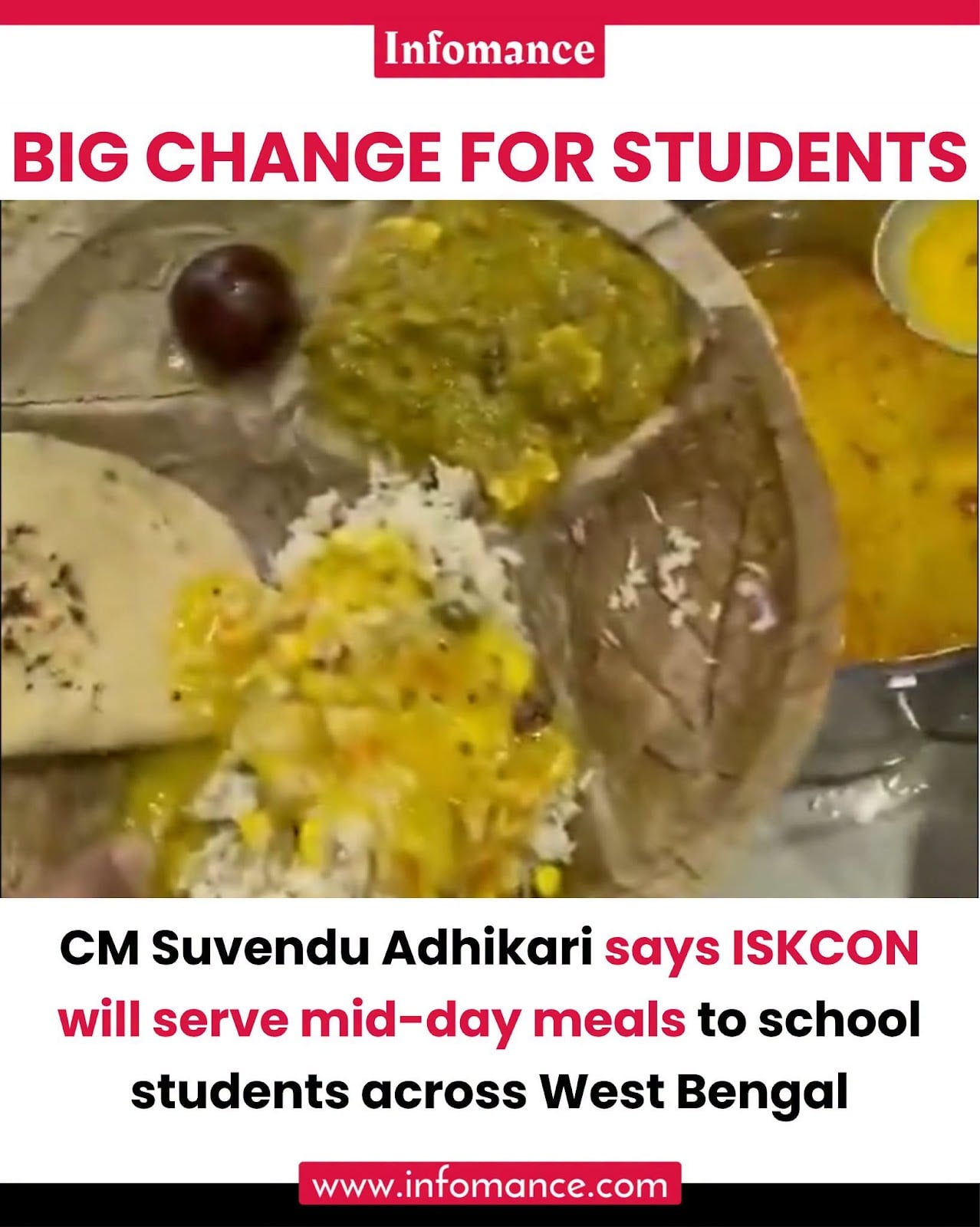
ISKCON’s proposed role in providing mid-day meals to school students across West Bengal marks a significant development in the state’s public nutrition and education landscape. The initiative, announced by state leaders and discussed publicly by ISKCON Vice President Radharamn Das, is expected to draw upon the organisation’s long experience in preparing large quantities of vegetarian meals through centralised kitchen systems. At its core, the proposal is not only about food distribution; it is about the relationship between classroom hunger, educational continuity, public health, and the dharmic ethic of seva.
The immediate plan, as reported in recent public accounts, places ISKCON in a major implementing role under the PM POSHAN framework, beginning with a large number of schools in Kolkata and potentially influencing wider school meal delivery across West Bengal. Reports indicate that the programme may cover around one lakh students up to Class VIII across more than 1,800 primary and upper primary schools in Kolkata. The emphasis is expected to be on pure sattvik vegetarian meals prepared under hygienic conditions and delivered in time for the school lunch period.
This development should be understood within the broader history of India’s school meal system. PM POSHAN, earlier known as the Mid-Day Meal Scheme, is one of the world’s largest school feeding programmes. Its official purpose is to provide one hot cooked meal in government and government-aided schools, improve nutritional levels among children, and support enrolment, retention, and attendance. The scheme covers children in Classes I to VIII and, in recent policy framing, has also been extended toward Balvatikas in government and government-aided primary schools.
Nutrition is the central public policy question. For primary students, the mid-day meal framework has historically aimed at a minimum nutritional value of 450 calories and 12 grams of protein. For upper primary students, the expected level is 700 calories and 20 grams of protein. These figures matter because school meals cannot be reduced to charity or symbolism. They are a formal nutritional entitlement, and any implementing agency must meet the standards required for child growth, school participation, and everyday learning capacity.
ISKCON’s stated approach is rooted in sattvik food, meaning meals prepared without meat, fish, or eggs and aligned with Vaishnava devotional principles. In the public debate, this has generated discussion because some Kolkata schools currently serve eggs once a week. Radharamn Das has argued that vegetarian sources such as soya chunks, rajma, paneer, beans, dal, and pulses can provide sufficient protein when menus are designed carefully. From a technical standpoint, this places menu planning, dietitian review, ingredient quality, and portion control at the centre of the programme’s credibility.
The nutritional debate should be handled with precision rather than sentiment. Eggs are widely valued for protein quality and micronutrients, while well-planned vegetarian meals can also deliver protein, calories, iron, folate, fibre, and other nutrients through pulses, legumes, dairy, grains, vegetables, and fortified ingredients. The decisive issue is not whether a meal is vegetarian in principle, but whether it is nutritionally adequate in practice. A sattvik school meal programme can succeed only if it is measured against transparent standards, monitored regularly, and adjusted according to children’s health needs.
ISKCON’s institutional advantage lies in its experience with large-scale food service. Through affiliated food relief initiatives such as Annamrita and through the broader ecosystem of Krishna-conscious community kitchens, the movement has participated in mid-day meal and food relief work in several parts of India. Similar temple-linked food service models have also shown how centralised kitchens can combine scale, standardised processes, and devotional motivation. The proposed West Bengal initiative is therefore not a sudden experiment in cooking for schools, but an extension of a known service model into a politically and administratively important state.
Centralised kitchens can offer several operational benefits when properly managed. They allow bulk procurement, uniform recipes, mechanised cooking, hygiene control, quality checks, and predictable dispatch schedules. In dense urban settings such as Kolkata, where many schools face space constraints, a central kitchen can reduce pressure on school premises and allow teachers to focus more on academic work. However, centralisation also creates risks: if supply chains fail, transport is delayed, or quality control weakens, the disruption can affect many schools at once.
For West Bengal, the logistical challenge is substantial. Hot meals must reach children during the school lunch window, which requires careful route planning, insulated transport, kitchen capacity, food safety protocols, and coordination with school authorities. Urban traffic, monsoon conditions, school timing variations, and storage limitations must be built into the design. A successful system will need more than a noble intention; it will require a disciplined operational architecture that treats every lunch period as a time-sensitive public service.
The social dimension is equally important. Existing self-help groups and community kitchens have been part of Kolkata’s meal delivery structure, and some workers have expressed concern that a large transition could affect livelihoods. A thoughtful implementation would need to consider how current workers, women’s groups, local suppliers, and community-level food networks can be integrated rather than abruptly displaced. Public nutrition programmes work best when efficiency is balanced with social continuity.
From a dharmic perspective, the initiative reflects a long-standing civilisational principle: feeding the hungry is a sacred duty. In Hindu, Buddhist, Jain, and Sikh traditions, food service is not merely welfare; it is an expression of compassion, discipline, humility, and shared humanity. The Sikh langar, Jain ahimsa-based food ethics, Buddhist compassion, and Hindu annadanam all point toward the same ethical horizon. When a child receives a clean, dignified meal at school, the act carries social meaning beyond nutrition.
ISKCON’s model is particularly associated with prasada and the idea that food prepared with purity and devotion can become an instrument of service. In a public school context, this spiritual motivation must be translated into inclusive civic practice. The meals are meant for children from varied families, castes, languages, and communities. Therefore, the programme should be framed not as sectarian expansion, but as disciplined seva offered within a constitutional and educational framework.
The language of sattvik meals can also be interpreted in a practical public health sense: fresh, clean, vegetarian food prepared with restraint, hygiene, and nutritional balance. Such meals can include rice, chapati, dal, vegetables, paneer, soya, legumes, seasonal produce, and fortified staples where required. The challenge is to avoid monotony. Children are more likely to eat meals that are warm, tasty, familiar, and varied. Nutrition exists on paper only until the child actually consumes the food.
Menu diversity is therefore not a minor detail. A technically sound meal plan should rotate pulses, grains, vegetables, and protein sources across the week. It should account for local Bengali food habits while remaining within ISKCON’s vegetarian framework. Khichdi, dal-rice combinations, vegetable pulao, soya preparations, rajma, chana, paneer-based dishes, seasonal sabzi, and fortified grain options can all be considered if they meet cost, taste, and nutrition requirements. Local acceptability will determine whether the programme becomes a daily comfort or a bureaucratic formality.
Food safety deserves special attention because children are a vulnerable population. Large-scale kitchens must maintain strict standards for water quality, hand hygiene, cooking temperatures, storage, transport containers, pest control, and waste disposal. Regular inspection, public reporting, and grievance channels can improve trust. The public should not have to choose between faith-based service and scientific accountability. In a well-designed system, the two can reinforce each other.
The initiative also has educational implications. Classroom hunger directly affects attention, memory, emotional regulation, and attendance. A child who waits for lunch because the meal is dependable experiences school differently from a child who arrives uncertain about food. In many families, especially those facing economic stress, the school meal reduces household pressure and encourages regular attendance. The mid-day meal is therefore an education policy instrument as much as a nutrition policy instrument.
There is also a gender dimension. In many low-income households, girls’ schooling can be more vulnerable to economic constraints, household responsibilities, and nutritional neglect. Reliable school meals can make education more attractive to families and help normalise the presence of girls in classrooms. While one meal cannot solve structural inequality, it can become one stabilising factor in a child’s daily routine.
West Bengal’s context makes this initiative especially consequential. The state has a dense school network, a strong culture of public education, and a long history of community-level social programmes. Kolkata’s urban school system also faces infrastructure constraints that make meal preparation difficult in many individual schools. If ISKCON’s central kitchen model can deliver safe, timely, nutritious, and culturally acceptable food, it could become an important case study in public-private collaboration for school nutrition.
At the same time, public-private partnerships require strong governance. The government remains responsible for policy standards, monitoring, funding rules, and student welfare. ISKCON or any implementing organisation would be responsible for execution, quality, and delivery. Parents, school heads, teachers, local committees, and health officials should all have channels to provide feedback. A programme serving children must remain answerable to the public, regardless of the reputation of the organisation involved.
The debate over eggs should not distract from the deeper test: whether the meal improves child nutrition and school experience. If vegetarian menus are used, they must be nutritionally robust. If children are accustomed to certain foods, transition should be managed with sensitivity. If self-help groups are affected, livelihood concerns should be addressed. If a new central kitchen is planned, its readiness should be assessed before large-scale dependence begins. These are not objections to the initiative; they are conditions for its success.
Radharamn Das has indicated that ISKCON is prepared to take responsibility because of its experience in preparing meals for lakhs of children daily. That claim carries both promise and accountability. The promise is that a disciplined, spiritually motivated institution may bring scale and consistency to a vital public service. The accountability is that schoolchildren cannot become subjects of symbolic claims. Every plate must meet the standards of nutrition, dignity, hygiene, and timeliness.
The proposal also shows how dharmic institutions can contribute meaningfully to modern welfare systems. Seva, when organised professionally, can support state capacity rather than replace it. Temples and spiritual organisations have historically fed pilgrims, monks, travellers, the poor, and the public during festivals and crises. In the contemporary setting, that tradition can be adapted through audited kitchens, nutrition science, public procurement norms, and school-level monitoring.
A balanced assessment therefore recognises both the spiritual ideal and the administrative complexity. ISKCON’s West Bengal mid-day meal initiative could become a powerful example of Hindu charitable service aligned with public education. It could also strengthen confidence in vegetarian school nutrition if the menus are evidence-based and consistently executed. The outcome will depend on implementation details that are still expected to be clarified by the government and the organisation.
The most humane way to view the initiative is through the child’s experience. A student does not evaluate procurement systems, ideological debates, or institutional histories. The student experiences whether the food is hot, clean, filling, tasty, and served with respect. If the programme can meet that standard every school day, it will honour both the constitutional purpose of PM POSHAN and the dharmic principle that feeding a child is among the highest forms of service.
In this sense, the proposed ISKCON mid-day meal programme in West Bengal is more than a news item. It is a test of how spiritual service, public nutrition, educational welfare, and social trust can work together. Its success will require science, compassion, logistics, transparency, and humility. If those elements are held together, the initiative can become a constructive model of community service rooted in Sanatana values while serving children from every background with equal dignity.
Reference context consulted for this analysis includes public reporting on ISKCON’s proposed PM POSHAN role in Kolkata, the official PM POSHAN overview from the Government of India, and publicly available background on large-scale school feeding initiatives associated with ISKCON-linked food relief institutions.
Inspired by this post on Dandavats.
