
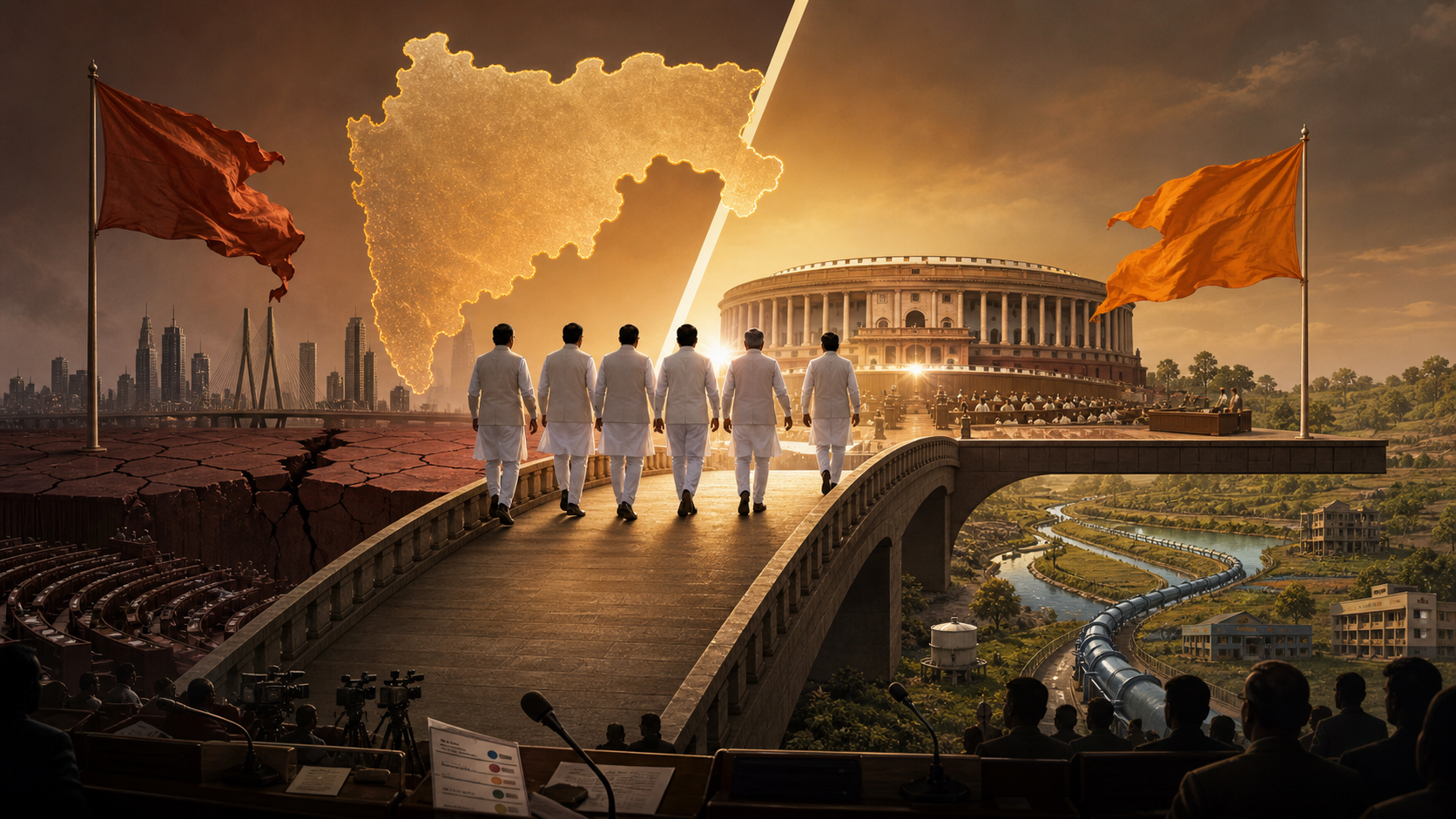
The reported movement of six Shiv Sena (UBT) Members of Parliament to the Eknath Shinde-led Shiv Sena marks one of the most consequential developments in Maharashtra politics since the 2022 split in the original Shiv Sena. The episode is not merely a story of legislators changing camps; it is a study in political legitimacy, ideological inheritance, development bargaining, parliamentary arithmetic, and the continuing contest over Balasaheb Thackeray’s legacy.
According to reports published on June 24, 2026, Maharashtra minister Nitesh Rane welcomed the decision and framed it as a return to what he described as the authentic Hindutva line associated with the older Shiv Sena tradition. The six MPs named in the report were Sanjay Uttamrao Deshmukh, Sanjay Haribhau Jadhav, Bhausaheb Rajaram Wakchaure, Omprakash Bhupalsingh Nimbalkar, Sanjay Dina Patil, and Nagesh Bapurao Patil Ashtikar. Their movement to the Shinde-led party was presented by supporters of the ruling side as a major political setback for Uddhav Thackeray’s Shiv Sena (UBT).
The importance of this event lies in the symbolic weight of the Shiv Sena name. Since the split led by Eknath Shinde in 2022, Maharashtra has witnessed two competing claims: one based on organisational continuity around the Thackeray family, and the other based on legislative strength, official recognition, and an asserted commitment to Balasaheb Thackeray’s Hindutva and Marathi regionalist politics. Each such defection deepens that unresolved public debate.
Rane’s central argument was ideological. He alleged that Shiv Sena (UBT)’s participation in broader opposition politics with the Congress, the Nationalist Congress Party, and other anti-BJP forces had created disillusionment among leaders who still identified with the older Hindutva-oriented vocabulary of Shiv Sena politics. In a calmer reading, this reflects a persistent question before many regional parties in India: how far can a party travel through coalition politics before its core supporters begin to perceive a dilution of ideological identity?
At the same time, the defection cannot be understood only through ideology. Sanjay Deshmukh reportedly argued that the National Democratic Alliance already had sufficient parliamentary strength and therefore did not need these MPs for numerical survival. He said the decision was linked to development work and to maintaining the Hindutva line associated with Balasaheb Thackeray. He also claimed that projects in his constituency had been delayed because of funding constraints.
This development-versus-ideology explanation is familiar in Indian politics. Elected representatives often defend party shifts by invoking constituency interest, access to state resources, and the need to deliver roads, institutions, water projects, welfare support, or local infrastructure. Critics, however, interpret the same movement as a breach of voter trust. Both readings matter because democratic politics rests on two obligations at once: loyalty to the mandate and the ability to secure tangible benefits for citizens.
Shiv Sena (UBT) leader Sanjay Raut reportedly alleged that the MPs were paid ₹85 crore by the ruling Mahayuti alliance to defect. That allegation remains politically serious and should be treated as a claim unless supported by verifiable evidence through institutions, documents, or lawful inquiry. In a constitutional democracy, accusations of inducement deserve scrutiny, but public debate also requires restraint so that allegations do not replace proof.
The names involved make the episode more than an abstract party dispute. The reported defectors represent important regions and constituencies across Maharashtra, including parts of Vidarbha, Marathwada, Mumbai, and western Maharashtra. Their movement therefore signals not simply a parliamentary adjustment but a wider test of organisational loyalty across the state’s political geography.
For voters, such moments often produce mixed emotions. There is frustration when representatives appear to move after an election, because the ordinary citizen votes for a person, a party symbol, a local network, and a political promise all at once. Yet there is also a practical expectation that MPs should bring funds and attention to their constituencies. The tension between principle and delivery is one of the hardest moral questions in representative politics.
The Shiv Sena split has always carried a deeper cultural dimension. Balasaheb Thackeray built the party around a combination of Marathi asmita, Hindu identity, street-level mobilisation, and a direct style of political communication. After his passing, the inheritance of that style became contested. Uddhav Thackeray’s supporters argue that family continuity and organisational memory remain central. Eknath Shinde’s supporters argue that the party’s legislative majority and Hindutva alignment give their camp the stronger claim.
The Election Commission’s earlier recognition of the Shinde-led faction as Shiv Sena gave that camp institutional advantage, but it did not end the political and emotional argument among voters. Party identity in India is not only a legal designation. It is also a memory carried by shakhas, local workers, families, slogans, festivals, crisis responses, and decades of neighbourhood-level political service. That is why every defection is read as evidence by one side and betrayal by the other.
The phrase "real Hindutva" requires careful handling. In electoral debate, it is often used to claim ideological authenticity. In a broader dharmic and civilisational sense, however, any serious discussion of Hindutva should be anchored in social responsibility, cultural confidence, respect for Dharma, and harmony among Hindu, Buddhist, Jain, and Sikh traditions. Political competition should not become a license for contempt, dehumanisation, or unnecessary social division.
Viewed academically, Hindutva in Maharashtra politics has functioned both as an ideological marker and as a coalition instrument. It invokes cultural pride, temple politics, historical memory, national security, Marathi identity, and the idea of civilisational continuity. Yet its electoral use varies across parties and leaders. Some emphasise assertive cultural politics; others present it through welfare, governance, national integration, or development.
The present shift therefore raises a technical political question: are voters witnessing ideological consolidation or strategic realignment before future electoral contests? The answer may be both. Leaders may sincerely prefer one ideological camp while also recognising the material advantages of joining a ruling formation. Political behaviour often emerges from overlapping motives rather than one pure explanation.
The anti-defection dimension also deserves attention. In India, party switching by elected representatives is regulated through constitutional and parliamentary mechanisms, but the practical consequences depend on procedure, petitions, recognition, and decisions by competent authorities. A public announcement of alignment does not by itself settle every legal question. The institutional process is often slower than the political spectacle.
For Shiv Sena (UBT), the immediate challenge is organisational recovery. A party facing defections must reassure workers, protect remaining legislators, strengthen local committees, and explain its ideological line with clarity. It must also address the perception that elected representatives may find it difficult to secure constituency-level work while remaining outside the ruling structure. That perception can be politically damaging even when a party retains emotional support among loyal voters.
For the Shinde-led Shiv Sena, the development strengthens the claim that the party continues to attract leaders from the Thackeray camp. It allows the ruling side to argue that its combination of Hindutva politics, access to governance, and alliance with the BJP remains attractive. But it also creates responsibility. Newly inducted leaders bring expectations from their constituencies, and political credibility will depend on whether promised development actually materialises.
The Mahayuti alliance will likely read this movement as a strategic gain before future electoral tests in Maharashtra. The psychological effect of defections can be as important as the numbers themselves. They influence media narratives, worker morale, donor confidence, local negotiations, and the calculations of undecided leaders. In a state where coalition politics has repeatedly reshaped power, perception often becomes a political resource.
Yet the democratic question remains larger than party advantage. Voters deserve transparency when representatives change sides. They deserve a clear explanation of whether the shift is based on ideology, development, constituency pressure, leadership disagreement, or political opportunity. Public trust improves when leaders speak plainly and submit their claims to democratic accountability rather than relying only on rhetoric.
This episode also illustrates the changing nature of Indian regional parties. Traditional family-led formations increasingly face pressure from ambitious second-line leaders, alliance compulsions, legal battles, and centralised electoral machinery. The old model of party loyalty is being tested by a more fluid politics in which power, identity, governance, and media perception interact continuously.
In Maharashtra, such fluidity is especially intense because the state combines strong regional identity with national political importance. Mumbai’s economic weight, Vidarbha’s development demands, Marathwada’s agrarian stress, western Maharashtra’s cooperative networks, and the Konkan’s cultural politics all shape party strategy. A shift by six MPs therefore carries regional implications beyond a single headline.
The most constructive interpretation is that Maharashtra’s politics must now move from accusation to accountability. If the MPs joined the Shinde-led Shiv Sena for development, measurable progress should follow in their constituencies. If the move was ideological, they must articulate that ideology in a way that strengthens social cohesion and dharmic confidence rather than deepening bitterness. If allegations of inducement are pursued, they should be tested through lawful channels.
The reported defection is unquestionably a blow to Uddhav Thackeray’s camp, but its long-term significance will depend on what happens next. Defections can alter headlines quickly; durable political legitimacy is built more slowly through governance, ideological coherence, disciplined organisation, and public trust. Maharashtra’s voters will ultimately judge whether this was a principled realignment, a development-driven decision, or another chapter in the continuing churn of post-2022 Shiv Sena politics.
Sources reviewed include the original June 24, 2026 report at Hindu Existence and corroborating agency-based coverage from The Economic Times.
Inspired by this post on Struggle for Hindu Existence.
