
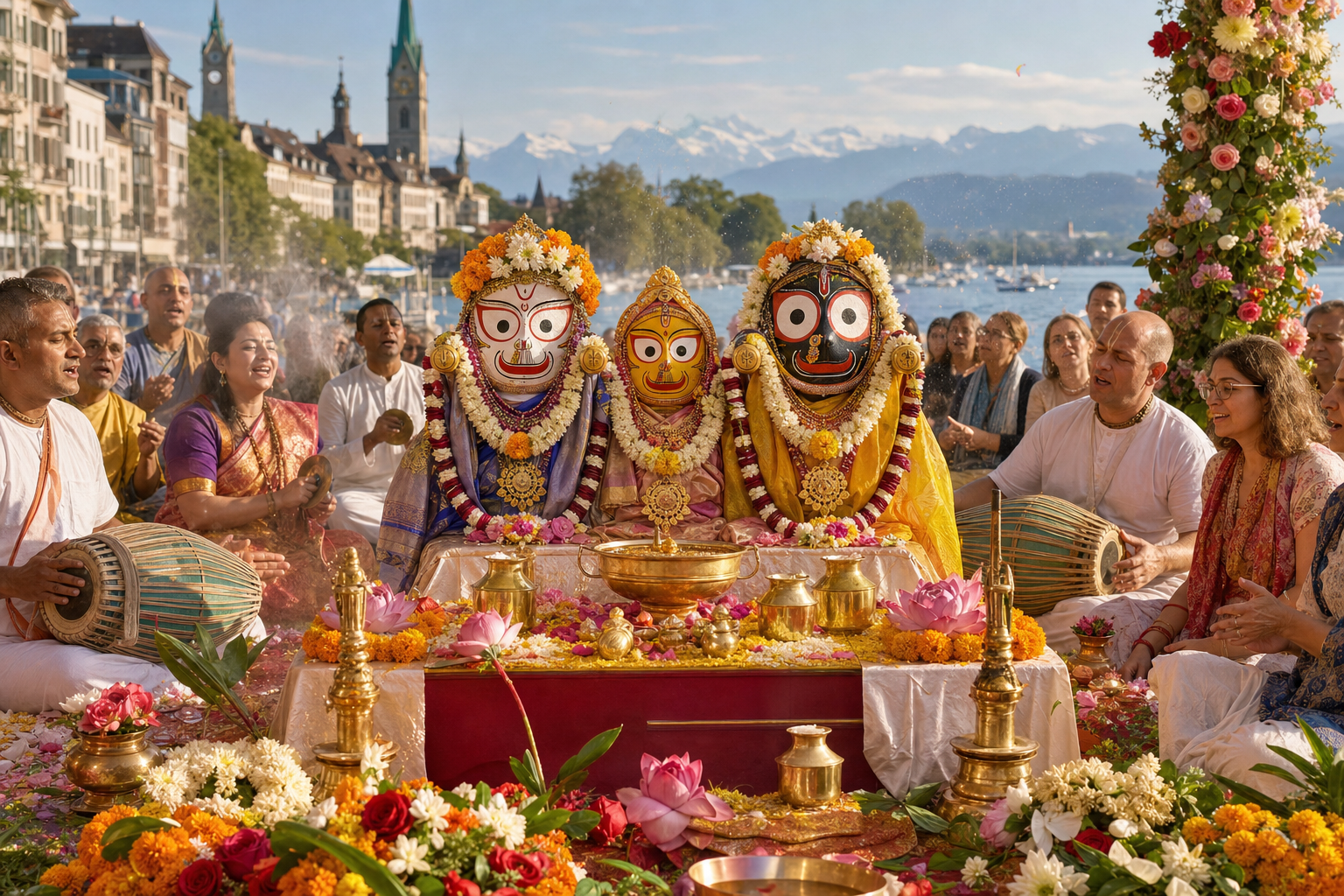
Snan Yatra 2026 in Zurich represents more than a local ISKCON celebration; it reflects the global movement of Jagannath devotion, Gaudiya Vaishnava practice, and the enduring spiritual power of Mahamantra chanting. In the setting of Switzerland, where many cultures and languages meet, the festival becomes a living example of how Hindu traditions travel across borders while retaining their devotional depth. The public sound of kirtan, the visual presence of sacred images, and the collective mood of worship create an atmosphere in which theology, ritual, memory, and community come together.
Snan Yatra, also called Snana Yatra or Debasnan Purnima, is traditionally associated with Lord Jagannath, Balabhadra, Subhadra, and Sudarshana. It is observed on the full moon day of the Hindu month of Jyeshtha and is widely understood as the ceremonial bathing festival of Lord Jagannath. In 2026, the traditional Debasnan Purnima observance connected with Puri falls on June 29, with Rath Yatra following in July. For devotees in the ISKCON tradition, such festivals are not merely cultural performances; they are structured acts of bhakti, centered on remembrance, seva, sacred sound, and the experience of divine presence.
The Zurich observance is significant because it demonstrates how the Jagannath tradition has become part of a global devotional vocabulary. The festival may be far from Puri geographically, yet it remains connected to the same core themes: purification, darshan, joyful service, and public participation. In a European city, Snan Yatra becomes a bridge between inherited ritual memory and contemporary diaspora life. It allows families, students, seekers, and long-time practitioners to experience a festival that carries centuries of meaning while adapting to the practical realities of modern urban life.
At the ritual level, Snan Yatra is centered on abhisheka, the ceremonial bathing of the deities. In the Jagannath tradition, the bathing is not treated as a symbolic spectacle alone; it is a formal act of honor, care, and intimacy. The deity is approached not as an abstract concept but as a living sacred presence. Water, mantras, flowers, cloth, fragrance, music, and food offerings all function within a devotional grammar. Each element has a purpose: water purifies, mantra sanctifies, flowers express beauty, prasadam extends grace, and kirtan gathers the community into shared remembrance.
Mahamantra chanting forms the emotional and theological center of such gatherings. The Hare Krishna Mahamantra, “Hare Krishna Hare Krishna Krishna Krishna Hare Hare Hare Rama Hare Rama Rama Rama Hare Hare,” is understood in Gaudiya Vaishnava practice as both prayer and direct engagement with divine names. Its repetition is not intended to be ornamental. It trains attention, softens the heart, and creates a shared rhythm in which individual voices become a collective offering. In Zurich, the chanting also turns public space into a temporary field of devotional sound, allowing people who may know little about Hindu festivals to encounter bhakti through listening.
ISKCON, the International Society for Krishna Consciousness, has played a major role in making kirtan, prasadam distribution, Bhagavad Gita study, and public festivals recognizable across the world. Founded by A. C. Bhaktivedanta Swami Prabhupada in 1966, the movement placed special emphasis on chanting the holy names, temple worship, scriptural teaching, and accessible devotional community. In cities such as Zurich, this global history becomes locally embodied through temple programs, festival gatherings, music, food, and shared acts of service.
The importance of Lord Jagannath within this context is especially profound. Jagannath is not only a deity of Odisha or Puri; the form has become a universal symbol of divine accessibility. The large eyes, broad face, and distinctive form of Jagannath, Balabhadra, and Subhadra communicate a theology of openness. Devotees often describe Jagannath as the Lord who comes out to see everyone, especially during public festivals. This inclusive dimension makes Snan Yatra and Rath Yatra deeply suitable for diaspora settings, where temples often become centers of cultural continuity and spiritual hospitality.
For many participants, the most memorable aspect of Snan Yatra is not only the formal ritual but the feeling of shared belonging. The sound of kartals and mridanga, the repetition of the Mahamantra, the fragrance of flowers and incense, and the sight of devotees preparing offerings can evoke memories of childhood festivals, temple courtyards, family traditions, or first encounters with bhakti. Even for those without inherited familiarity, the experience can be deeply relatable: people gather, sing together, honor the sacred, and share food. The festival shows that devotion is not confined to private belief; it can become a public ethic of joy, discipline, and community care.
Academically, Snan Yatra can be understood through several intersecting lenses: ritual studies, diaspora studies, performance, theology, and cultural transmission. As ritual, it follows a recognizable structure of preparation, invocation, offering, bathing, darshan, singing, and prasadam. As diaspora practice, it helps preserve identity while inviting wider participation. As performance, it uses music, procession, visual form, and embodied movement. As theology, it expresses the Vaishnava conviction that the divine can be served through loving attention. As cultural transmission, it teaches younger generations through participation rather than lecture alone.
The festival also carries a subtle message of unity among dharmic traditions. While Snan Yatra is specifically rooted in Vaishnava and Jagannath devotion, its broader themes are recognizable across Hindu, Buddhist, Jain, and Sikh sensibilities: purification, humility, sacred sound, disciplined remembrance, compassion, seva, and community. The public practice of kirtan resonates with the wider Indic understanding that sound can refine consciousness. The sharing of prasadam reflects the ethics of generosity. The collective atmosphere invites respect across sectarian boundaries and presents dharma as a lived culture of reverence rather than a narrow identity marker.
In the Swiss context, such a celebration also raises important questions about how religious communities preserve authenticity while adapting responsibly. Timing, venue rules, public permissions, language, music volume, food distribution, and intergenerational participation all shape the final form of the event. A festival in Zurich cannot look exactly like one in Puri, yet it can honor the theological center of the tradition. The most meaningful observances maintain humility toward the original sacred calendar and ritual logic while making the celebration accessible to local devotees and visitors.
The technical structure of a well-conducted Snan Yatra reflects careful planning. Deity worship requires cleanliness, trained service, appropriate materials, and respect for temple standards. Kirtan requires coordination between lead singers, instrumentalists, and the congregation. Public participation requires clear movement, safety, and hospitality. Prasadam service requires food discipline, allergen awareness, and orderly distribution. These details may appear administrative, but in devotional culture they are part of seva. The quality of organization becomes an expression of respect for the deity and care for the community.
Mahamantra chanting during Snan Yatra also deserves attention as a disciplined contemplative practice. Unlike entertainment music, kirtan is participatory and cyclical. Its repetition gradually shifts attention away from distraction and toward sacred remembrance. The leader-and-response form allows even newcomers to join quickly. The melody may vary, but the names remain central. In this sense, kirtan is both accessible and demanding: accessible because anyone can hear or chant, demanding because sincere practice asks for attention, humility, and steadiness.
The image associated with the Zurich Snan Yathra 2026 video suggests a visual record of a devotional gathering, but the deeper value of such content lies in what it preserves. It captures a moment when a community gathered around Lord Krishna and Lord Jagannath through sacred sound. Online recordings cannot replace temple experience, yet they can extend memory, introduce others to the practice, and help dispersed devotees remain connected. In the digital age, such media becomes a form of cultural documentation when presented with care, context, and reverence.
For readers approaching the subject for the first time, Snan Yatra 2026 in Zurich should be understood as a devotional festival shaped by history but alive in the present. It is about bathing the deity, but also about cleansing the heart. It is about ISKCON, but also about the broader journey of Hindu festivals into global public life. It is about Mahamantra chanting, but also about the human need for rhythm, community, and meaning. Its most powerful contribution is the way it brings sacred tradition into a modern city without losing the tenderness at the heart of bhakti.
Ultimately, the celebration affirms that dharma is sustained not only through texts and temples but through repeated acts of remembrance. When devotees gather in Zurich to chant, serve, and honor Lord Jagannath, they participate in a tradition that is both ancient and contemporary. Snan Yatra becomes a reminder that sacred culture survives through disciplined practice, shared joy, and respect for all sincere seekers. In that sense, the festival is not only an event on a calendar; it is a living expression of spiritual continuity, cultural dignity, and devotional unity.
Inspired by this post on Dandavats.









Leave a Reply
You must be logged in to post a comment.