
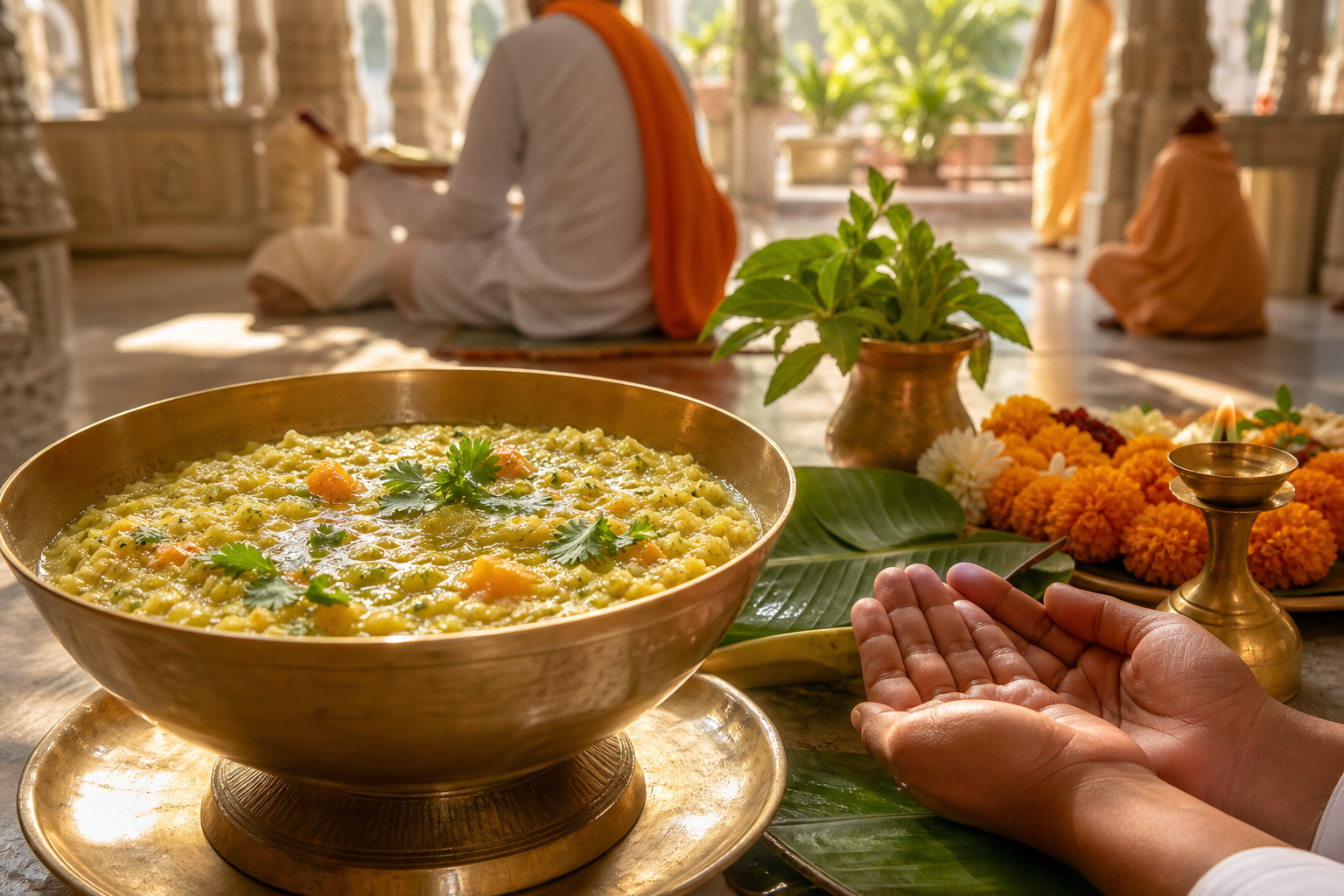
On 20 June 2026, the theme of Divine Khichdi Prasadam at ISKCON Vrindavan points to a deeply familiar yet spiritually profound experience within the Hare Krishna tradition: the offering and sharing of simple food as Krishna’s mercy. The available source material presents only a title and image reference rather than a detailed transcript, so a careful treatment must avoid inventing event-specific claims. Even so, the subject itself opens a meaningful window into ISKCON, Vrindavan, bhakti, seva, and the theology of prasadam as practiced in Hindu spiritual life.
Khichdi is often described as one of the most approachable dishes in the Indian culinary and devotional world. Made traditionally from rice and dal, and sometimes enriched with mild spices, vegetables, ghee, and salt, it is nourishing without being ostentatious. In many homes, temples, and pilgrimage spaces, khichdi carries the feeling of care, simplicity, and digestible warmth. When prepared in a devotional setting and offered to Lord Krishna, that humble food becomes prasadam, meaning food received as divine grace rather than consumed merely as a meal.
In the Vaishnava understanding followed by ISKCON, food becomes spiritually significant through intention, purity, and offering. The ingredients are selected according to devotional discipline, the cooking is performed with cleanliness and remembrance, and the prepared dish is first offered to Krishna before being distributed. This process transforms the social meaning of food. Khichdi ceases to be only rice and dal; it becomes a medium through which devotion, gratitude, and community participation are made tangible.
ISKCON Vrindavan holds special importance because Vrindavan is inseparable from the sacred memory of Sri Krishna’s childhood pastimes. For devotees, the geography of Vrindavan is not merely historical or cultural; it is devotional. The land, temples, kirtan, deity worship, and shared prasadam all participate in a larger spiritual ecosystem. In that setting, even a modest serving of khichdi can be experienced as a reminder that Krishna’s presence is approached not only through philosophy and ritual, but also through taste, hospitality, and shared nourishment.
The phrase “Taste of Krishna’s Blessings” captures this devotional logic with emotional precision. A blessing is usually imagined as words, gestures, protection, or insight. In prasadam culture, blessing can also be tasted. This is not a casual metaphor. The act of receiving prasadam trains the senses to become part of spiritual discipline. Eating is no longer treated as an isolated act of appetite; it becomes connected with humility, remembrance, and gratitude.
From an academic perspective, prasadam functions at several levels at once. Theologically, it expresses the relationship between the devotee and the divine. Ritually, it marks the completion of an offering. Socially, it builds community by allowing people of different backgrounds to sit, receive, and participate in a shared sacred economy. Culturally, it preserves food practices that are tied to temple life, festival observance, pilgrimage, and household devotion. Emotionally, it often evokes comfort, belonging, and the feeling of being cared for in a sacred space.
Khichdi is especially suited to this role because it resists excess. Unlike elaborate festival sweets or royal temple preparations, khichdi communicates nourishment through balance. Rice and dal together offer a practical combination of carbohydrates and plant protein. Its soft texture and mild seasoning make it accessible to children, elders, pilgrims, and those seeking a simple sattvic meal. This accessibility helps explain why khichdi has long been associated with healing, fasting transitions, community kitchens, and devotional distribution.
In the context of ISKCON, the distribution of prasadam is also inseparable from seva. Service is not limited to visible ritual roles. The person washing grains, cutting vegetables, stirring the pot, cleaning vessels, serving plates, organizing queues, or ensuring that guests are fed participates in the same devotional chain. This makes prasadam distribution one of the most democratic forms of temple service. It allows devotion to move from the altar to the kitchen, from the kitchen to the serving area, and from the serving area into the lives of devotees and visitors.
The academic study of religion often emphasizes texts, doctrines, institutions, and historical movements. Prasadam reminds observers that lived religion is also sensory and embodied. The aroma of cooked dal, the sound of kirtan in the background, the discipline of waiting respectfully, and the moment of receiving food with folded hands can shape religious memory as powerfully as a lecture or scripture class. For many visitors, such experiences become the first deeply personal encounter with bhakti.
Vrindavan’s devotional culture gives this experience a distinctive texture. The town is marked by temples, ashrams, parikrama routes, sacred groves, Yamuna memories, and a continuous rhythm of Radha-Krishna worship. In such an environment, prasadam is not an isolated practice but part of a broader devotional atmosphere. The act of receiving khichdi after darshan or kirtan can feel like a continuation of worship, not a break from it.
The principle behind prasadam also carries ethical implications. In a consumer culture where food is often evaluated by novelty, luxury, or personal preference, prasadam shifts attention toward gratitude and restraint. The devotee does not approach the plate with entitlement, but with the understanding that food is a gift. This perspective can cultivate humility, reduce waste, and encourage mindful consumption. It also restores dignity to simple food, showing that spiritual value is not dependent on material extravagance.
Khichdi prasadam also illustrates the unity of dharmic traditions through shared reverence for food, compassion, discipline, and non-harm. Hindu, Buddhist, Jain, and Sikh traditions all preserve, in different forms, the idea that food is ethically and spiritually charged. Sikh langar, Jain emphasis on ahimsa in food discipline, Buddhist monastic alms culture, and Hindu prasadam traditions all reveal a common civilizational intuition: nourishment becomes sacred when it is connected with humility, service, and concern for others.
Within Hindu practice, offering food to the divine has deep scriptural and household roots. The Bhagavad Gita presents devotion not as a matter of wealth, but sincerity. A leaf, a flower, fruit, or water offered with bhakti becomes meaningful because the inner disposition matters. Khichdi prasadam at a temple such as ISKCON Vrindavan belongs to this same devotional logic. It demonstrates that the sacred can be encountered through simplicity when the act is framed by love and surrender.
There is also a strong social dimension to temple prasadam. In many pilgrimage centers, prasadam distribution softens social boundaries by creating a shared moment of reception. People may arrive with different languages, regions, economic backgrounds, and levels of religious knowledge, yet the plate of prasadam establishes a common participation. The meal becomes a quiet teacher of equality. It suggests that before Krishna, the most meaningful identity is not status, but receptivity.
For modern readers, the significance of khichdi prasadam can be understood in practical terms as well. It is nutritious, economical, scalable, and suited to community distribution. A large temple kitchen can prepare khichdi efficiently while maintaining devotional standards. This makes it an ideal food for gatherings, festivals, pilgrim feeding, and relief-oriented service. Its simplicity is not a limitation; it is precisely what gives the dish its public and spiritual strength.
The Hare Krishna movement has made prasadam distribution one of its most recognizable forms of outreach. Around the world, ISKCON temples and affiliated initiatives have used sanctified vegetarian food to introduce people to Krishna consciousness in a non-coercive and welcoming manner. A person may not immediately understand Sanskrit terminology, temple theology, or the philosophical depth of bhakti yoga, but the experience of receiving prasadam can communicate warmth before doctrine is explained.
This is why khichdi prasadam at ISKCON Vrindavan should not be dismissed as a minor devotional detail. It is a compact expression of theology, culture, hospitality, and spiritual pedagogy. It teaches that sacred life is not confined to grand rituals. The divine may also be approached through a ladle of warm khichdi served with care, received with gratitude, and remembered as Krishna’s mercy.
The emotional power of such prasadam lies in its ability to make devotion ordinary and extraordinary at the same time. Ordinary, because it uses familiar ingredients and a familiar act: eating. Extraordinary, because the same act is lifted into remembrance of Krishna. This fusion is central to bhakti. It does not reject daily life; it reorients daily life toward the divine.
In a time when spiritual practice is often fragmented by speed, distraction, and individualism, prasadam restores a slower and more relational rhythm. Someone cooks with devotion. Someone offers with reverence. Someone serves with humility. Someone receives with gratitude. The chain is simple, but it carries a complete vision of community. It makes visible the idea that spiritual culture is sustained not only by belief, but by repeated acts of care.
The date 20 June 2026 therefore becomes meaningful not merely as a timestamp attached to a devotional image or video title, but as a reminder of an ongoing tradition. At ISKCON Vrindavan, khichdi prasadam represents the living continuity of Krishna bhakti: simple food, sacred offering, shared service, and a community gathered around divine grace. Its lesson is enduring. When food is prepared with purity, offered with devotion, and received with humility, it becomes more than sustenance; it becomes a taste of Krishna’s blessings.
Inspired by this post on Dandavats.
