
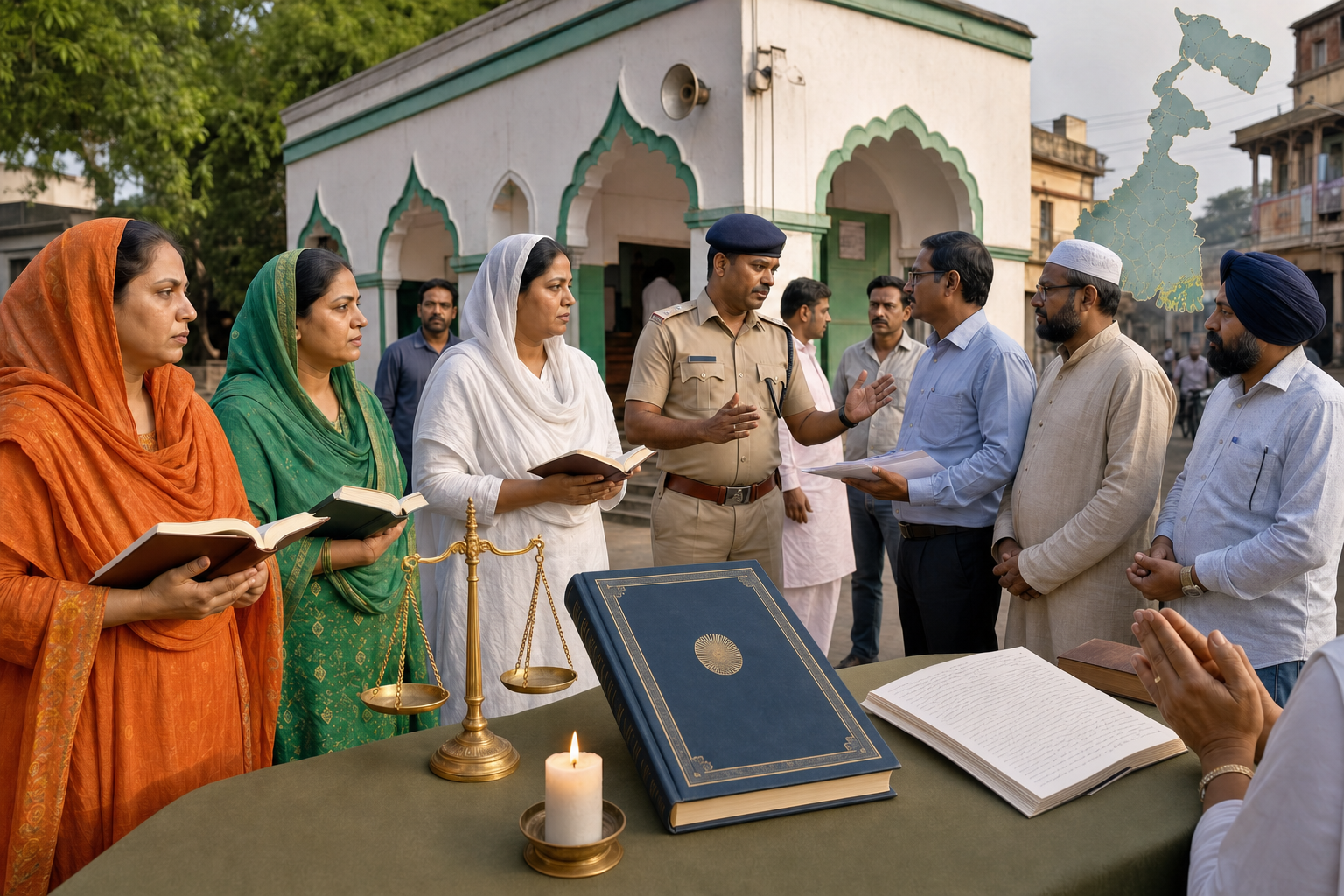
The reported disruption of a Christian prayer gathering in Raniganj, West Bengal, on June 21, 2026, deserves careful examination because it sits at the difficult intersection of religious freedom, community anxiety, political change, and public order. According to the source report, members associated by participants with Hindu organizations including the Vishva Hindu Parishad, Bajrang Dal, and Bhairav Sena entered a prayer meeting and confronted those present over allegations of religious conversion among local Hindu women. The episode reportedly involved the seizure of religious books, shouting of slogans, and physical intimidation, while attendees denied that any conversion had taken place through force, threat, or inducement.
The most important principle in such a case is factual discipline. Allegations of coercive conversion are serious and must be investigated under law. At the same time, the mere presence of prayer, religious literature, or voluntary change of belief cannot be treated as proof of illegality. A society committed to dharma, justice, and civil order cannot allow suspicion to replace evidence, nor can it permit vigilante action to substitute for lawful procedure.
India’s constitutional framework protects freedom of conscience and the right to profess, practice, and propagate religion, subject to public order, morality, and health. This means two ideas must be held together. First, every person has a protected inner freedom to believe, worship, and change religious conviction voluntarily. Second, the state may regulate conduct when conversion is alleged to involve force, fraud, coercion, misrepresentation, or material inducement. The legal and ethical challenge is to distinguish voluntary religious choice from unlawful pressure without demonizing entire communities.
West Bengal, unlike several other Indian states, has not traditionally had a specific anti-conversion statute. Other states have enacted laws commonly described by supporters as freedom of religion laws, aimed at preventing conversion through improper means. Supporters argue that such legislation protects vulnerable communities from organized pressure. Critics argue that these laws can be misused to harass minorities and chill legitimate religious practice. The Raniganj incident therefore becomes not only a local law-and-order matter but also part of a wider debate over whether legal safeguards can be designed without empowering social intimidation.
The status of women in this controversy requires particular care. The source report states that Christian women at the gathering told both the crowd and police that they had adopted Christianity voluntarily and had not been coerced. Their agency should not be erased by either side of the debate. If adult women state that their religious choices are voluntary, that statement deserves serious legal and moral weight unless credible evidence proves otherwise. Protecting community identity cannot mean treating women as passive objects over whom competing groups claim authority.
At the same time, concerns about coercion should not be dismissed without inquiry. In plural societies, unethical religious outreach can damage trust, especially where poverty, social dependency, or local power imbalances exist. If inducement, deception, or organized pressure is alleged, the appropriate response is documentation, complaint, investigation, and judicial scrutiny. Public confrontation inside a prayer gathering risks escalating fear, communal polarization, and retaliatory narratives, all of which weaken the social fabric that dharmic traditions seek to preserve.
Dharmic traditions have historically valued debate, self-discipline, compassion, and respect for conscience. Hinduism, Buddhism, Jainism, and Sikhism differ in doctrine and practice, yet each contains strong ethical resources for restraint. Ahimsa, seva, satya, karuna, and responsible community leadership are not abstract ideals; they are practical tools for preventing local disputes from becoming communal wounds. In that spirit, any response to alleged conversion activity should remain lawful, proportionate, and rooted in truth rather than anger.
The role of police and district administration is therefore central. Authorities must protect the immediate safety of worshippers, prevent intimidation, preserve evidence, and examine complaints about unlawful conversion through proper channels. If those who disrupted the gathering committed assault, trespass, unlawful restraint, or intimidation, those allegations also require investigation. Law and order cannot be selective. A credible state response must protect religious liberty while also addressing genuine complaints about coercion where evidence exists.
Social media footage, which reportedly circulated after the incident, should be treated cautiously. Videos can establish atmosphere and visible conduct, but they rarely provide the full legal context. Edited clips can intensify outrage before investigators have verified chronology, identities, and statements. Responsible public discussion should therefore avoid declaring guilt in advance, whether against the prayer participants or the organizations accused of disrupting the meeting.
The political context in West Bengal adds another layer. The incident occurred during a period of heightened ideological contestation after a major shift in state politics. Questions of religious conversion, minority rights, Hindu community mobilization, and border-state demography have become politically sensitive. That sensitivity makes restraint more necessary, not less. When political actors turn local religious disputes into symbolic battles, ordinary residents are often left to carry the consequences in their neighborhoods, workplaces, and families.
A more constructive model would begin with community-level transparency. Religious groups conducting outreach should be clear about the nature of their activities and avoid any practice that could be interpreted as exploiting distress, illness, poverty, or dependency. Hindu, Buddhist, Jain, Sikh, Christian, Muslim, and other community leaders should publicly affirm that no one should be converted through pressure and no one should be threatened for voluntary worship. Such a shared standard would reduce suspicion while strengthening religious freedom for all.
The Raniganj episode also reveals a deeper emotional reality. Communities often react strongly when they feel culturally insecure, unheard, or demographically anxious. Those feelings cannot be solved by slogans or police cases alone. They require patient civic engagement, credible institutions, and leadership that can speak to fear without inflaming it. A dharmic approach to public life should transform anxiety into vigilance guided by law, not hostility guided by rumor.
Religious freedom is strongest when it protects everyone equally. Christians must be able to pray without intimidation. Hindus and other communities must be able to raise legitimate concerns about coercive conversion without being dismissed. The state must investigate both sets of claims without prejudice. This balance is not weakness; it is the practical meaning of constitutional order in a diverse civilization.
The lasting lesson from Raniganj is that public order and religious liberty cannot be separated. If conversion allegations are real, they require evidence and lawful remedy. If the allegations are unproven, they must not become a license for harassment. The path forward lies in due process, community dialogue, and a renewed commitment to dharmic ethics of truth, restraint, and coexistence.
Inspired by this post on Struggle for Hindu Existence.
