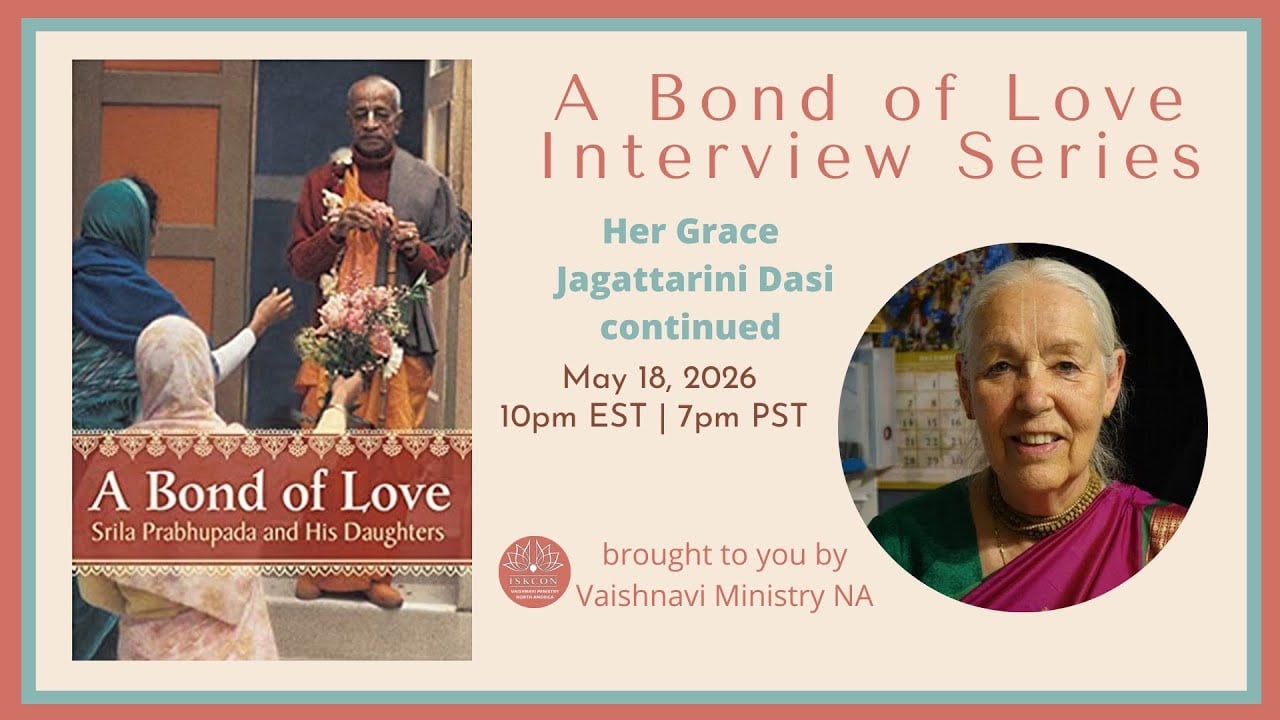
Bond of Love Interview Series ~ Part II – HG Jagattarini dasi, hosted by Vaishnavi Ministry NA, was streamed live on Facebook and YouTube on Monday, May 18 at 10:00 PM EDT. Presented as a continuation of an evolving dialogue, the installment brought forward key themes in contemporary bhakti such as devotional service, sacred storytelling, and the cultivation of inclusive community grounded in compassion and wisdom.
Designed as a sustained public conversation, A Bond of Love Interview Series highlights the voices and lived experiences of Vaishnavis across the global community. By centering women in spirituality, the series strengthens the Guru-Shishya Tradition while aligning with a broader dharmic vision that honors unity in diversity. It provides a forum where devotion, ethics, and practice are articulated with clarity for seekers, educators, and community organizers.
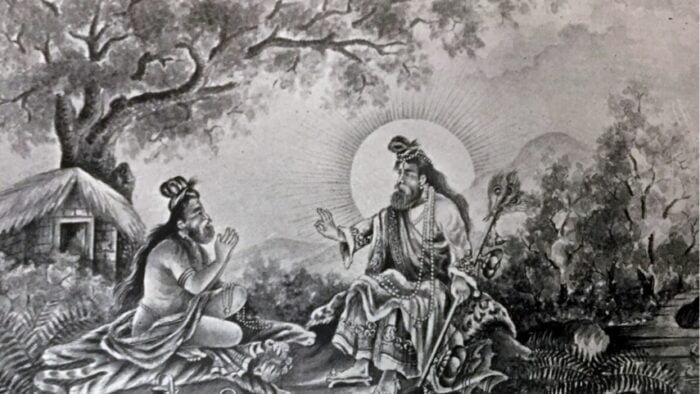
HG Jagattarini dasi is widely regarded in ISKCON (International Society For Krishna Consciousness) circles for contributions to devotional arts and narrative pedagogy. Her approach illustrates how sacred art, kirtan, and storytelling function as rigorous methods of spiritual education, transmitting core principles of bhaktilove, humility, and servicethrough accessible and emotionally resonant forms. This integration of aesthetics and ethics exemplifies how Vaishnava traditions sustain cultural heritage while adapting to contemporary audiences.
At a conceptual level, the “bond of love” emphasized in bhakti is not merely affective; it is an epistemic and ethical framework that orients practice toward seva (selfless service), satsanga (association with the wise), and sadhana (disciplined practice). Within Hindu spiritual traditions, love becomes the organizing principle that harmonizes devotion with discernment, enabling practitioners to translate scriptural insights into daily conduct. Such a framework naturally fosters inter-personal cohesion and community resilience.
The series’ focus on women in spirituality demonstrates how leadership arises organically from practicethrough mentorship, teaching, and stewardship of sacred narratives. This is consonant with dharmic traditions more broadly, where compassion, self-discipline, and truthfulness constitute shared ethical ground. While vocabulary differs across Hinduism, Buddhism, Jainism, and Sikhism, the underlying commitments to karuna (compassion), ahimsa (non-harm), and seva/simran (service and remembrance) reflect a common aspiration: the cultivation of inner transformation expressed as social harmony.
Seen through a comparative lens, the bhakti ethos resonates with other dharmic pathways: the cultivation of loving-kindness parallels the practice of metta; non-possessiveness aligns with aparigraha; and remembrance of the Divine finds echo in the discipline of simran. A Bond of Love Interview Series, therefore, operates as a bridgehonoring Vaishnava specificity while inviting respectful dialogue with allied traditions. This integrative vision advances interfaith understanding within the dharmic family and strengthens unity without erasing distinct identities.
In methodological terms, the program illustrates how narrative pedagogy and sacred art function as high-impact educational tools. Storytelling encodes complex theological insights into memorable structures; music and visual arts engage affective cognition; and dialogic interviews scaffold reflective inquiry. These modalitiessupported by digital distributionextend the reach of lived wisdom, enabling transnational audiences to participate in a shared learning ecology grounded in empathy and intellectual rigor.
The digital format underscores an important shift: devotional pedagogy increasingly unfolds across platforms that privilege open access, archiving, and asynchronous engagement. For communities and researchers, this yields tangible benefitsimproved documentation, broader participation across time zones, and the preservation of oral histories. For practitioners, it provides practical models for cultivating sangha online while maintaining fidelity to tradition.
Key takeaways for community leaders and educators include the value of women-led narrative stewardship, the strategic use of sacred arts to deepen comprehension, and the role of inter-tradition dialogue in preventing fragmentation. For youth and new seekers, the episode demonstrates how bhakti integrates heart and intellect, offering a path that is emotionally nourishing and philosophically grounded. For scholars of religion and culture, it offers a living case study in how diasporic communities transmit intangible heritage with integrity.
Archival note: Channel – Vaishnavi Ministry NA; Program – Bond of Love Interview Series ~ Part II – HG Jagattarini dasi; Format – live-streamed conversation. As a record of a community event, this summary situates the program within wider currents in devotional education, cultural heritage, and unity-centered dharmic discourse.
By exemplifying devotion as a disciplined, art-infused practice oriented toward compassion and service, Bond of Love Interview Series contributes meaningfully to dharmic unity. It affirms that respectful dialogue and shared ethical commitments can foster cohesion across Hinduism, Buddhism, Jainism, and Sikhismpreserving distinctive insights while strengthening collective well-being.
Inspired by this post on Dandavats.