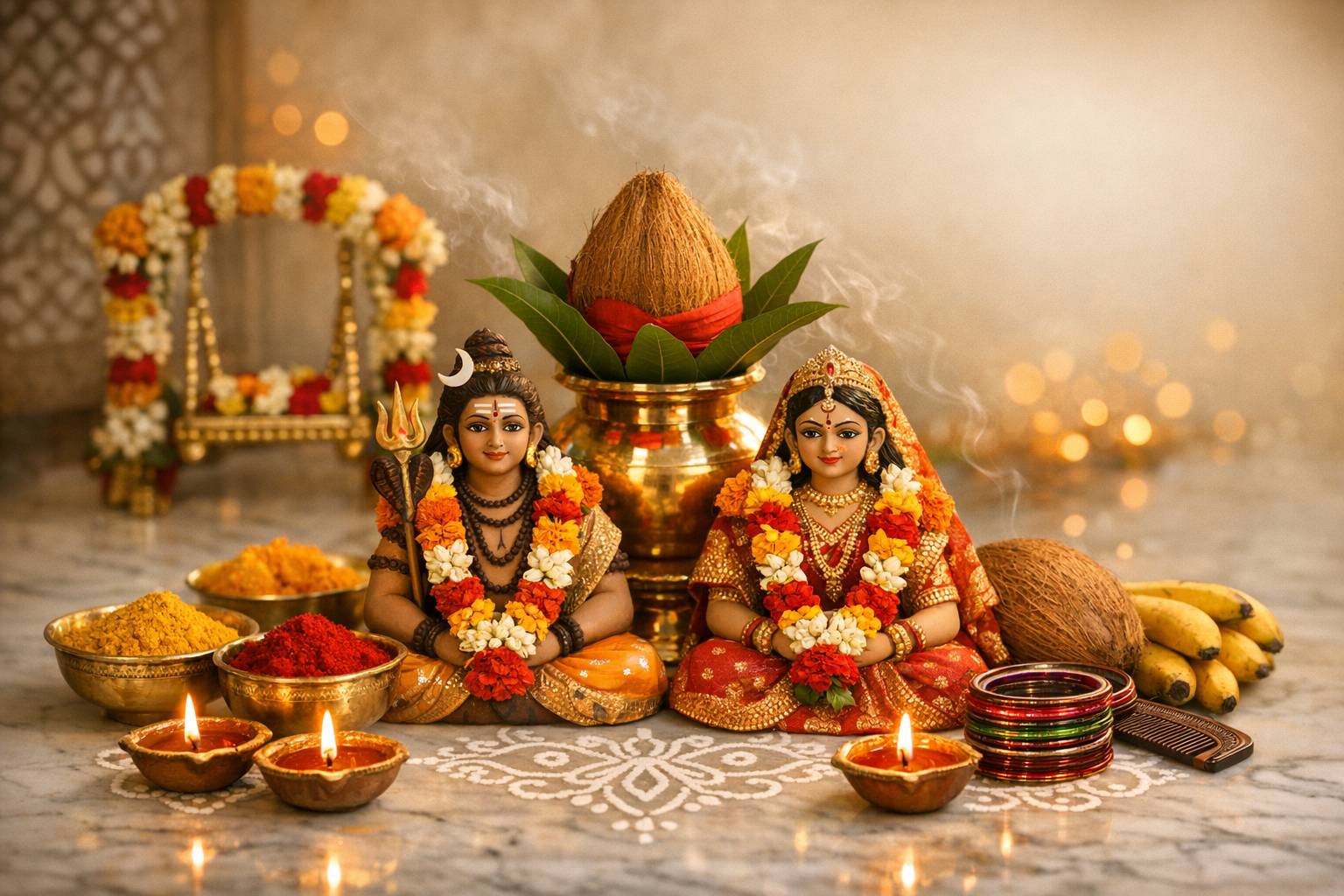
Soubhagya Gauri Vratam, also known as Soubhagya Thadiya, Sowbhagya shayana vratham, Gauri Tritiya vrata, Dola Gauri vrata, Ganagouri puja, or the Gangaur festival, is observed on Chaitra Shukla Tritiya, the third tithi of the bright fortnight of the Chaitra month in the Hindu calendar. In 2026, the vrata falls on 21 March. Across regions and languages, the central intent remains constant: a focused invocation of Devi as Gauri the auspicious, benevolent form of Pārvatī for harmony in family life, prosperity, and the well-being and longevity associated with marital bliss, referred to in Sanskrit as saubhāgya.
Traditionally, married women undertake this vrata seeking the health, protection, and longevity of their spouses, while unmarried women pray for a virtuous and compatible life partner. Many households extend participation to all family members, honoring the ideal of grihastha dharma, where devotion, discipline, and mutual care sustain the fabric of domestic and social life. The vrata is therefore both personal and communal, shaping cultural memory through shared preparation, songs, and ritual practices.
The name variants reflect rich regional traditions. Gangaur is especially prominent in Rajasthan and adjoining areas, where the celebration culminates on Chaitra Shukla Tritiya with processions carrying paired images of Isar (Shiva) and Gauri. In other regions, the day is called Soubhagya Thadiya or Gauri Tritiya vrata, and in some households the murtis of Gauri are placed upon a swing, leading to the devotional epithet Dola Gauri vrata. Despite the different artistic and musical expressions, the spiritual core and the tithi remain the same.
From the Panchang perspective, the observance aligns with the third lunar day when the longitudinal difference between the Moon and the Sun lies between 24 and 36 degrees. Chaitra Shukla Tritiya is determined by the prevailing tithi at one’s location, and the recommended practice (Smarta convention) is to observe the vrata on the civil date when Tritiya is operative at sunrise; certain regional traditions may privilege a midday or evening window if Tritiya substantially spans that period. Given time-zone and Panchang variations, local tithi timings should be checked to schedule home puja appropriately on 21 March 2026.
Calendar terminology may vary across India’s two primary month-reckoning systems. In the Purnimanta tradition followed largely in North India, Chaitra is counted from the day after Phalguna Purnima, whereas the Amanta tradition in many parts of South India begins Chaitra after the Phalguna Amavasya. The tithi, however, is a pan-Indian astronomical marker, so Soubhagya Gauri Vratam remains anchored to Chaitra Shukla Tritiya in both systems, ensuring unity in practice across linguistic and regional lines.
Ritual preparation typically includes cleaning the altar space, adorning it with rangoli or kolam, and arranging a sanctified seat for Devi Gauri. Devotees may install beautifully crafted clay or wooden images of Gauri or establish a kalasha as the icon of worship, decorated with mango or betel leaves, a coconut, turmeric, kumkum, and flowers. The sankalpa a concise, intentional resolve is then taken, affirming observance on Chaitra Shukla Tritiya for saubhāgya, śānti, and kṣema (good fortune, peace, and well-being).
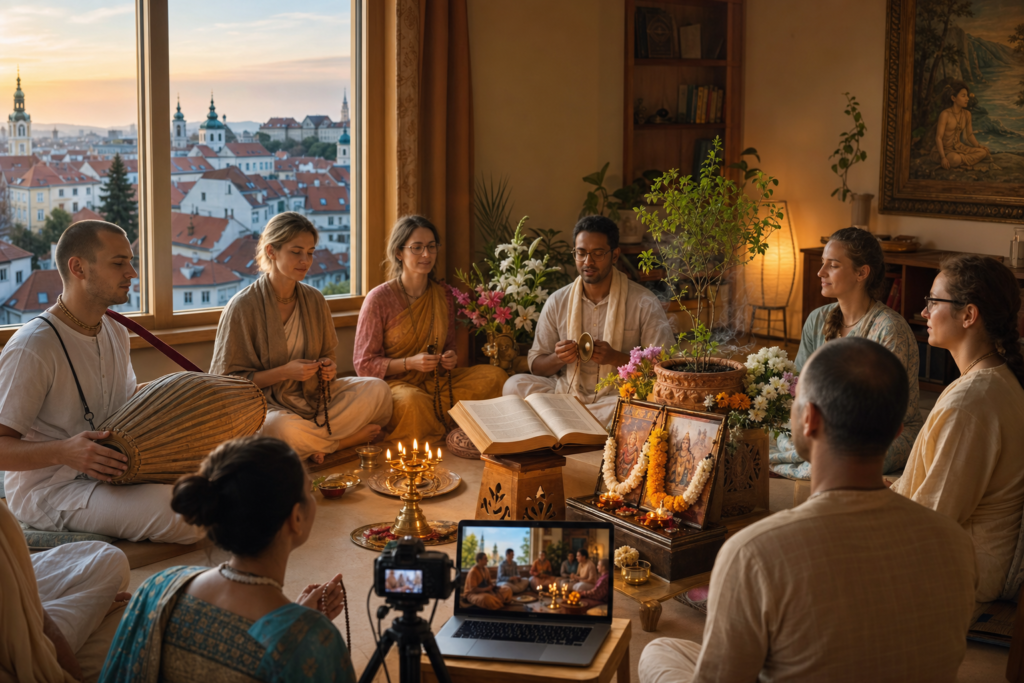
For home puja, a systematic sequence offers clarity and depth. After invoking Ganesha for obstacle removal, devotees invite Devi Gauri and perform the sixteen upacharas (honors), which include offering a seat, water for washing hands and feet, fragrant bath, clothing, sandalwood paste, flowers, incense, lamp, naivedya, and arati. A brief Uma-Maheshwara puja is often included to honor the inseparable auspicious union of Shiva and Pārvatī. At the vrata’s core lies attentive mantra japa and contemplative remembrance of Devi’s qualities compassion, resilience, and protective strength.
Fasting practices adapt to health, climate, and family custom. Many follow a partial fast with phalahara (fruits and light foods) until the completion of the puja, while some choose a stricter nirjala or near-nirjala vrata where feasible. Upon completing the worship, devotees break the fast with sanctified offerings and distribute prasada to family members and neighbors, reinforcing bonds of care and community.
Commonly recited stotras for this vrata include Gauri Ashtottara Shata Namavali, Shiva-Parvati kalyana verses, and widely loved invocations such as Sarva-mangala-mangalye and classical Devi mantras like Om Gauryai Namah and Om Parvatyai Namah. Some households also recite portions of Lalita Sahasranama, Durga Suktam, or passages from the Puranas that extol Pārvatī’s grace and steadfastness. The selection of mantra and stotra is flexible, emphasizing sincerity and attentive recitation over rigid uniformity.
Offerings reflect both season and region. Turmeric, kumkum, bangles, combs, mirror, and small items of shringara are offered as sowbhagya-dravya, symbolizing the prayer for harmony and well-being in married life. Naivedya may include sweet preparations suitable for fasting days, along with coconuts, bananas, or seasonal fruits. It is customary in many communities to honor sumangalis with haldi-kumkum and small tokens, sharing the merits of the vrata and celebrating sisterhood through gentle hospitality.
In the broader cultural tapestry, Gangaur is distinguished by folk songs, community gatherings, and processions, especially in Rajasthan and parts of Madhya Pradesh, where paired images of Isar-Gauri are carried in devotion. Elsewhere, the same day is observed with quieter home worship reflecting the idiom of Soubhagya Gauri Vratam or Gauri Tritiya vrata. In a few traditions, the Gauri murti is reverentially placed on a swing, evoking Dola Gauri vrata and the playful, life-giving energy associated with the Divine Feminine.
The theological significance of the vrata reaches beyond immediate domestic concerns. Gauri embodies Shakti the sustaining force in all beings and endeavors and the vrata nurtures sattva through mindful fasting, disciplined worship, and acts of sharing. The symbolism of Uma-Maheshwara also illuminates dharmic ideals of companionship, mutual respect, and balance in household and community, reinforcing that spiritual practice and ethical living are inseparable in the Hindu way of life.
The honoring of the Sacred Feminine on this day resonates across dharmic traditions. The reverence for compassionate wisdom and protective grace appears in varied forms Devi as Shakti in Hinduism, Tara in Buddhist traditions, Ambika and Padmavati in Jain lore, and the Sikh emphasis on dignity, equality, and respect for women as an ethical cornerstone. These shared values underscore a civilizational unity grounded in compassion, responsibility, and spiritual aspiration.
Because tithis are astronomical and not strictly coterminous with civil dates, Chaitra Shukla Tritiya in 2026 aligns to 21 March at most locations, though the exact start and end of Tritiya may differ by region. Those planning temple visits or community observances often confirm local Panchang data a few days in advance. If Tritiya spans two civil dates, many traditions prioritize the one on which Tritiya is present at sunrise, while others perform the principal puja when Tritiya predominates during the main worship window. Local guidance ensures both accuracy and adherence to custom.
Eco-conscious observance enhances the vrata’s spirit. Clay or biodegradable idols, reusable lamps, and natural decorations align with ahimsa and stewardship values. Distributing prasada responsibly, reducing single-use plastics, and extending the day’s merit through quiet service such as supporting community kitchens or sharing festival meals with neighbors reflect the vrata’s inner message of care and interconnectedness.
Common questions arise each year. Unmarried participants may observe the vrata with the aspiration of a dharmic life partnership and general well-being; men may assist in preparations and join the puja as an expression of family devotion. Those with health constraints can perform a simplified vrata through brief archana, mantra japa, and lamp offering. If unavoidable commitments impede daytime worship, a concise evening puja with the Tritiya tithi still in effect is both meaningful and traditional.
For many families, Soubhagya Gauri Vratam is remembered through sensory and emotional textures the fragrance of haldi and jasmine, the glow of the evening lamp, the cadence of folk melodies, and the gentle joy of distributing prasada. These recollections carry forward intergenerational wisdom, affirming that devotion is not merely ritual repetition but a living, renewing relationship with the Divine that shapes values, relationships, and community life.
In summary, Soubhagya Gauri Vratam on 21 March 2026 offers a sacred occasion to align intention, practice, and community. Grounded in the precise tithi of Chaitra Shukla Tritiya, enriched by regional customs from Gangaur processions to serene home worship, and suffused with the aspiration for saubhāgya and śānti, the vrata illuminates the path of disciplined devotion. When observed with clarity, care, and inclusivity, it becomes a profound celebration of the Divine Feminine and of unity across the wider dharmic family.
Inspired by this post on Hindu Pad.