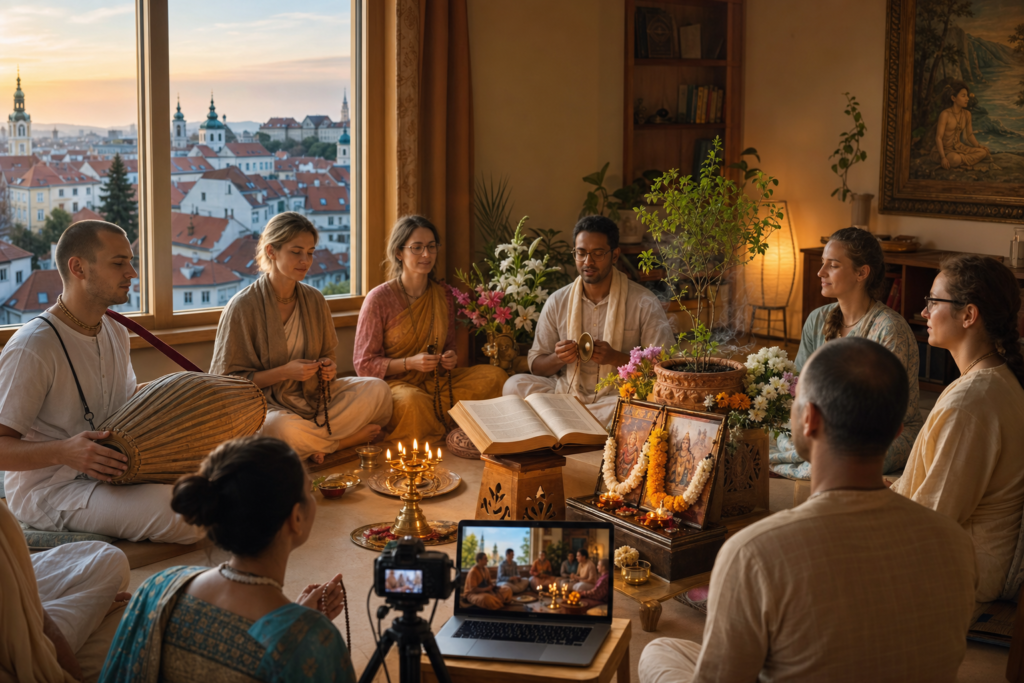
“Dear Maharaja, Prabhu, Mataji, please accept my respectful obeisances. AgtSP!” With this succinct greeting, a Vaishnava voice encapsulates the culture of humility and reverence that animates the Bhakti Tradition. Circulating in service of HH Smita-Krishna Swami and the ISKCON (International Society For Krishna Consciousness) community at Almviks gård in Sweden, such messages invite a broader reflection on the meaning, methods, and responsibilities of personal seva within the Guru–Shishya Tradition.
Beyond any immediate logistical concerns, the context at Almviks gård provides a living laboratory for examining how devotional service translates into daily practice. In Gaudiya Vaishnavism, a “personal servant” (often called sevaka/sevika) is not a subordinate in the worldly sense but a practitioner engaged in intentional, disciplined, and ethical care. The offering is to Bhagavan, expressed through service to the Guru and the community, and grounded in humility, attentiveness, and accountability.
Seva in the Guru–Shishya Tradition is anchored in three pillars: devotion (bhakti), competence (kauśalya), and ethics (dharma). Devotion ensures the mood of service remains selfless; competence ensures service is effective and sustainable; ethics ensures safety, dignity, and trust. When these pillars align, personal seva becomes a powerful catalyst for inner cultivation and community well-being, reflecting the best of Hindu spirituality.
Role clarity is essential. Personal seva typically spans five domains: daily schedule coordination; sadhana facilitation (ensuring timely participation in kirtan, japa, and study); health and well-being support; travel and logistics; and communication and documentation. Each domain requires not only practical skill but also emotional intelligence, discretion, and a steady devotional disposition.
Daily schedule coordination involves nuanced time management, respectful reminders, and alignment with temple routines. A sevaka helps optimize energy across the day’s arc, considering factors like Sweden’s seasonal daylight variations and community responsibilities at Almviks gård. The aim is rhythm, not rigiditysupporting both spiritual depth and realistic pacing.
Sadhana facilitation includes preparing spaces for worship, ensuring access to sacred texts and devotional items, and maintaining a calm, sattvic atmosphere. The tone remains non-intrusive: facilitating, not directing. In Gaudiya Vaishnavism, the mood of service is affectionate but measuredpresent, yet never possessive.
Health and well-being support requires sensitivity and clear boundaries. Practical assistance may encompass routine scheduling of check-ups, coordination with healthcare providers, and attention to rest and recovery. While no clinical interventions are implied, awareness of medication schedules (as appropriate), ergonomic considerations, and stress mitigation practices (e.g., balanced routines, mindful breathing) contributes to safe, dignified care.
Food and nutrition support benefits from knowledge of sattvic cooking, dietary restrictions, and seasonal adaptation. In a Nordic climate, warm, easily digestible preparations, hydration, and timing of meals can materially improve comfort and focus. Cleanliness, kitchen hygiene, and prasad etiquette uphold both health and devotion.
Travel and logistics planning spans itinerary design, visa and residency considerations where relevant, packing essentials for worship, and contingency planning. Documentation, ticketing, and liaising with hosts are handled with foresight and discretion. In all steps, the principle is seamlessnessminimizing friction so spiritual responsibilities receive full attention.
Communication and documentation include careful management of correspondence, meeting notes, and archiving talks or teachings. Respect for privacy is paramount. In a European setting, adherence to data protection norms (e.g., GDPR) underscores the ethical core of seva: to protect dignity and confidentiality while sustaining the flow of service.
Professional ethics in devotional contexts emphasize consent, boundaries, and accountability. Clear role expectations, regular check-ins, and a transparent line to community leadership help maintain balance. Policies that address harassment prevention, non-discrimination, and grievance redressal safeguard the sanctity of the Guru–Shishya Tradition and nurture a culture of trust.
Core competencies for personal seva include time management, cultural sensitivity, situational awareness, and calm decision-making under pressure. Communication skillslistening deeply, speaking respectfully, and reporting accuratelyare non-negotiable. In Sweden’s intercultural environment, comfort with English and basic Swedish is advantageous for interfacing with services, neighbors, and institutions.
Emotional steadiness matters as much as technical skill. Presence without intrusion, empathy without enmeshment, and initiative without overreach are hallmarks of mature service. A sevaka preserves equanimity during schedule shifts, unexpected requests, or health concerns, modeling the balanced mind praised across dharmic traditions.
Burnout prevention is an ethical imperative. Sustainable seva integrates personal sadhana, adequate sleep, wholesome diet, and reasonable time off. Communities thrive when roles are shared, duties are rotated where feasible, and training pathways allow more practitioners to serve skillfully over time without exhaustion.
Almviks gård adds a distinctive layer: the cadences of farm life, Sweden’s seasonal rhythms, and the intimacy of a devotional rural community. Seva here naturally includes ecological mindfulness, efficient use of resources, and alignment with local norms. In such settings, the material and the spiritual are palpably intertwined, and stewardship of land and time becomes a form of worship.
Spiritual formation through seva is a well-noted pattern in ISKCON (International Society For Krishna Consciousness). Graduates of such roles often demonstrate strengthened humility, refined judgment, and lived insight into the dynamics of leadership and community care. Practical exposure to scheduling, health awareness, and pastoral sensitivities frequently translates into more grounded future service.
A vital caution prevents misunderstanding: seva to the Guru does not cultivate a personality cult; it honors the parampara by recognizing the Guru as carrier of śāstra and guide to Bhagavan. When framed by scripture, accountability, and community norms, personal seva elevates all involved and centers devotion where it belongson the Divine.
Parallels across dharmic traditions reveal a shared ethic. In Sikhism, nishkam seva and the institution of langar embody humility, equality, and service to the Guru and sangat. In Buddhism, attendant roles (e.g., upaṭṭhāka) and lay stewards (kappiya) have historically supported monastic practice by managing worldly needs with discretion. In Jainism, vaiyavrityaservice to asceticsand the lay responsibilities of śrāvakas and śrāvikās express compassion and discipline through practical care. These resonances underscore Unity in spiritual diversity.
Such convergences affirm that genuine service cuts across doctrinal boundaries, shaping character through compassion, restraint, and reliability. The language may differseva, upaṭṭhāna, vaiyavrityabut the orientation is one: to reduce ego, relieve burdens, and enable contemplative life. This shared foundation fosters mutual respect among Hinduism, Buddhism, Jainism, and Sikhism.
Field observations from devotional communities indicate that well-structured seva correlates with healthier institutions: fewer avoidable crises, clearer communication, and more consistent spiritual practice. When communities invest in training, SOPs, and mentorship, the result is not bureaucracy but grace with guardrailsfreedom expressed as reliability.
Ultimately, personal seva exemplifies a synthesis of heart and method. Heart without method risks disorder; method without heart risks sterility. In the Guru–Shishya Tradition, the two meet in a disciplined tenderness that dignifies both the one who serves and the one who is served. Almviks gård, with its serene landscape and living bhakti, offers a tangible setting where this synthesis becomes daily life.
Viewed through this lens, a simple greeting“Dear Maharaja, Prabhu, Mataji, please accept my respectful obeisances. AgtSP!”is more than etiquette. It is the doorway to a comprehensive ethic of care: devotional, competent, and accountable, radiating a spirit of unity that harmonizes the diverse streams of the dharmic family.
Inspired by this post on Dandavats.