Falgun Melaalso known as Shyambaba Falgun Mela, Nishan Yatra, and Lakkhi Melais the signature Falgun Festival observed at Shyam Baba temples worldwide, with its most renowned celebration at the Khatu Shyamji Temple in Khatu, Sikar district, Rajasthan. For 2026, the Falgun Mela is scheduled to begin on 18 February and conclude on 28 February, drawing lakhs of devotees for darshan, parikrama, bhajans, and the iconic flag-bearing processions that define the Nishan Yatra.
The spiritual core of Khatu Shyam devotion rests on the Mahabharata-era figure Barbarika, who is venerated as Shyam Baba. According to revered tradition, Sri Krishna bestowed the name Shyam upon Barbarika and granted a boon that he would receive worship in the Kali Yuga as a compassionate form of Krishna, blessing those who remember him with faith and humility. The Khatu Shyamji Temple enshrines this living legacy and has evolved into a vibrant pilgrimage center where devotion, service, and song converge across communities.
The Falgun Mela is anchored in the lunar month of Phalguna and typically intensifies around the bright fortnight (Shukla Paksha), culminating near Dwadashi close to Holi. Regional calendars (Purnimanta in North India and Amanta elsewhere) can cause local naming differences, but the spiritual cadence remains uniform: a season of renewal, gratitude, and collective celebration. In 2026, the 18–28 February window captures the principal fair, processions, and special darshan phases announced by the temple administration in the run-up to the event.
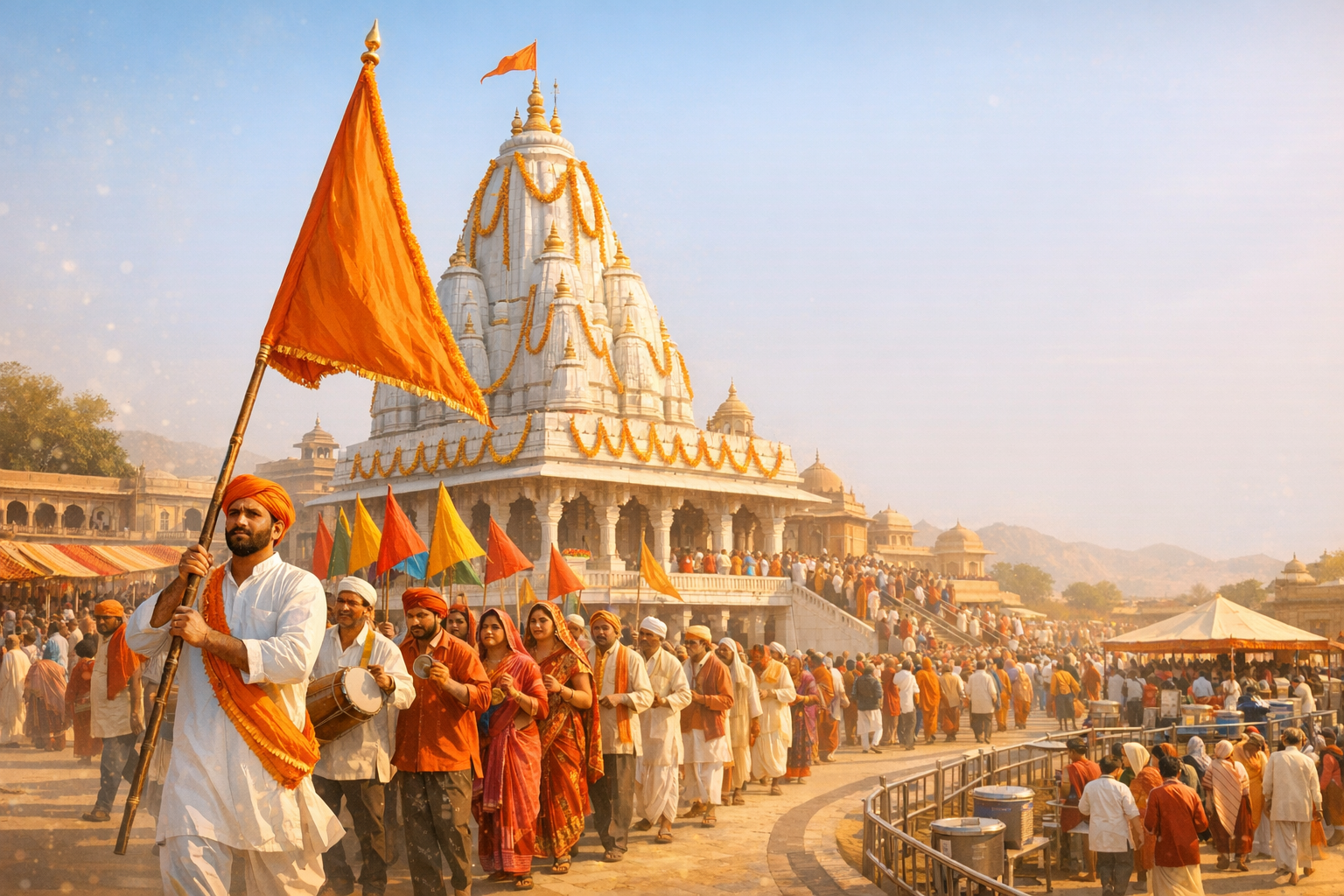
Nishan Yatra is the most visible symbol of the festival’s fervor. Devotees carry saffron or multicolored triangular flagsnishansoften after taking a vrata (vow) for healing, gratitude, or wish-fulfillment. Many yatris travel on foot from neighboring towns and even distant cities such as Jaipur, Delhi, Agra, and Ahmedabad, forming kirtan groups that move with discipline and joy. The flags are offered at Khatu Shyamji with prayers for sarva-mangalam (universal well-being), signaling a deep ethic of seva (service), humility, and unity that resonates across the broader dharmic family.
The term Lakkhi Mela reflects the sheer scale of footfalllakhs of pilgrims arrive over these days. The district administration and the Shree Shyam Mandir Committee typically coordinate extended darshan hours, crowd-flow corridors, public address systems, first-aid posts, water points, sanitation units, and volunteer-managed langar and prasadalaya arrangements to uphold both safety and sacred order. The fair’s soundscapebhajans, kirtans, and akhand naam-japatransforms the Shekhawati landscape into a living mandala of devotion.
Khatu lies in the Sikar district of Rajasthan. The nearest railhead is Ringas Junction (approximately 17–20 km from Khatu), offering broad connectivity to Jaipur, Delhi, and other hubs. Jaipur International Airport is roughly 80–90 km from Khatu Shyamji, with state and private buses, taxis, and shared jeeps available onward. By road, Khatu can be approached from Sikar, Jaipur, and Ringas via well-marked routes; pilgrims typically plan arrivals during early morning or late evening to avoid midday rush and heat.
Daily worship at Khatu Shyamji generally follows aarti sequences such as Mangala Aarti (pre-dawn), Shringar Aarti (morning adornment), Bhog Aarti (midday offering), Sandhya Aarti (evening), and Shayan Aarti (night), with intervals reserved for naivedya and temple rituals. During the Falgun Mela, darshan windows are substantially extended, and on peak days queues can run continuously with only short closures for ceremonial duties. Exact timings vary yearly and are customarily published closer to the festival; devotees should plan flexible itineraries and anticipate brief operational pauses for temple rites.
Across the 18–28 February 2026 timeline, crowds typically surge around weekend clusters and around the principal Nishan Yatra culmination days. Many groups choose auspicious tithis within this span for their flag offerings. While detailed day-by-day schedules are finalized by the temple committee nearer to the event, the larger rhythm remains consistent: early arrivals by yatris, intensifying processions, heightened bhajan mandalis through the evenings, and special aarti-focused darshans that maintain the sanctity of the sanctum throughout.
Practical planning greatly improves the pilgrimage experience. Trains and buses to Ringas and Jaipur become heavily booked weeks in advance; early reservations are advisable. On arrival, designated pedestrian corridors lead to queue complexes equipped with drinking water, basic medical assistance, and emergency exits. Cloakrooms and shoe-counters are typically available near approach points; carrying only essential personal items helps maintain both speed and safety in queues.
Accommodation spans dharamshalas, budget lodges, and seasonal tented camps in and around Khatu and Ringas. Given the Lakkhi Mela volumes, most pilgrims pre-book rooms well before mid-February. Family travelers often prefer staying in Ringas for better multi-day logistics, commuting early to Khatu for morning darshan and returning before nightfall. During the fair, many local groups and sanghas organize langar and water stalls, reflecting the long-standing dharmic ethos of annadana and communal care.
Safety and crowd-discipline are paramount. It is prudent to carry a refillable bottle, electrolyte sachets, and head coverings to manage dry heat and dust. Footwear protocols should be followed strictly; where permitted, wear comfortable sandals that can be left at shoe-counters. Queue patience, adherence to one-way flow, assisting elders, and keeping children close ensure collective well-being. Devotees with respiratory sensitivities may consider light masks to mitigate dust during peak afternoon winds common to Rajasthan.
The festival’s sustainability footprint receives growing attention each year. Pilgrims can contribute through zero-litter practices, bio-degradable offerings, mindful water use, and respect for local habitats. Local authorities and volunteer networks often install segregated waste bins; avoiding single-use plastics and opting for cloth bags meaningfully reduces environmental load. Such small, practical steps align devotion with stewardship and reflect the dharmic principle of ahimsa toward the environment.
Falgun Mela embodies an inclusive devotional culture that harmonizes the diverse streams of Sanatana Dharma. While Khatu Shyamji is a Vaishnava shrine linked to Sri Krishna, devotees from Hindu, Jain, Sikh, and Buddhist communities are frequently seen participating in seva, kirtan, and langarunderscoring a civilizational value of unity in spiritual diversity. The Nishan Yatra’s shared symbolismoffering a flag of gratitude and surrenderspeaks a universal language of faith that is welcoming rather than exclusionary, echoing the broader dharmic vision of mutual respect.
Offerings traditionally include nishan (flags), saffron or pitambara vastras, malas, coconuts, and simple sweets as chadava. Many pilgrims undertake sankalpas for personal and social welfareseeking health, harmony in families, and prosperity used in the spirit of dharma. Kirtan groups often sing Shyam bhajans through the night, and devotees practice nama-smarana while moving in queues. Observing local etiquettemaintaining silence close to the sanctum, following volunteer guidance, and avoiding photography where restrictedpreserves the sanctity of the space for all.
The Falgun Mela also enhances awareness of Shekhawati’s cultural heritage. Many visitors combine the pilgrimage with brief visits to regional sites such as the painted havelis of the Shekhawati belt and nearby historic temples. These experiences, when balanced with the primary purpose of darshan, offer a deeper understanding of Rajasthan’s sacred geography and its living continuum of art, architecture, and ritual.
Accessibility considerations help more devotees participate meaningfully. Senior citizens and differently-abled pilgrims benefit from early-morning arrivals, hydration planning, and assistance from registered volunteers. Families with young children often pace their darshan across multiple days, choosing lower-density windows for smoother movement. The administration periodically sets aside special passages for medical emergencies and ensures ambulance readiness; keeping emergency numbers handy is advisable.
In essence, Falgun Mela 2026 at Khatu Shyamji18 to 28 Februaryoffers a rare confluence of bhakti, seva, and shared celebration. The Nishan Yatra’s visual power, the ceaseless chorus of Shyam bhajans, and the Lakkhi Mela’s collective discipline convey a timeless message: devotion matures into service, and service blossoms into community. With thoughtful preparation, ecological mindfulness, and a spirit aligned to the dharmic ideal of unity in diversity, pilgrims can experience a safe, elevating, and memorable Falgun Festival at the lotus feet of Shyam Baba.
Key notes for 2026: dates are based on the temple fair window announced for public planning. Specific aarti schedules, traffic diversions, queue arrangements, and any special advisories are typically released by the Shree Shyam Mandir Committee and local authorities closer to the event; checking these locally just before travel ensures the most accurate on-ground information.
Inspired by this post on Hindu Pad.