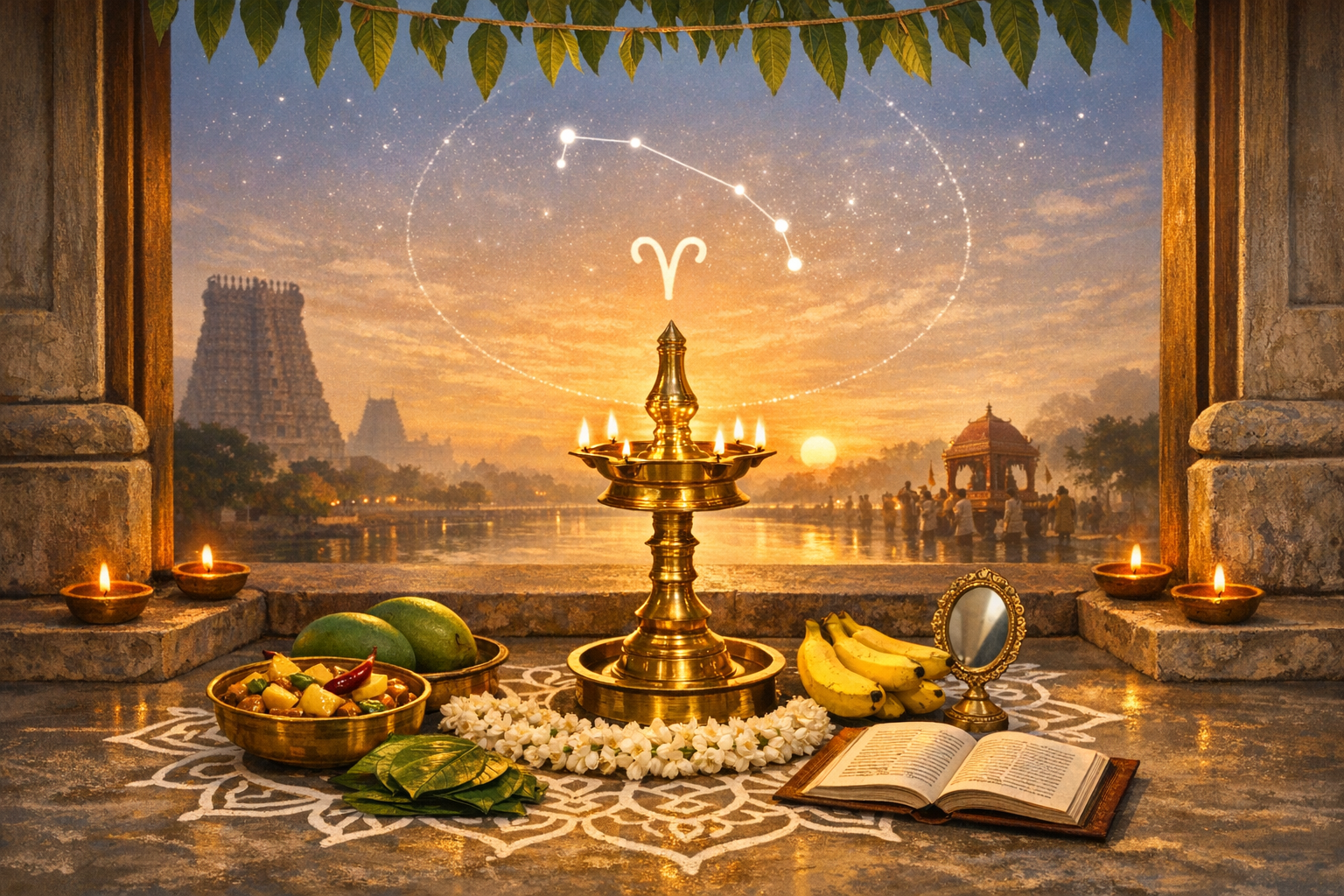
Chithirai Masam 2026 is the first month of the traditional Tamil Panchangam and inaugurates the Tamil solar year with Tamil New Year, widely known as Puthandu or Varusha Pirappu. As a solar month, Chithirai aligns with the Sun’s entry into Mesha (Aries), making it both a calendrical reset and a cultural renewal that families, temples, and communities observe with devotion, gratitude, and resolve.
In 2026, Chithirai 1 (Puthandu/Varusha Pirappu) is expected to occur on 14 April 2026 (Tuesday, IST) for most of Tamil Nadu and Sri Lanka, coinciding with Mesha Sankranti. For locations outside India, day and date may shift based on local sunrise; diaspora communities are advised to consult a regional Tamil Panchangam for precise observance. Accordingly, Chithirai Masam 2026 is anticipated to span approximately from 14 April 2026 to 14 May 2026 (IST).
The Tamil Calendar follows a sidereal solar framework: months begin when the nirayana (sidereal) Sun enters successive zodiac signs. Chithirai commences at Mesha Sankranti, when the Sun’s sidereal longitude reaches 0° of Mesha. This differs from tropical calendars that anchor to the equinoxes; the sidereal system incorporates ayanamsa (the precessional offset between tropical and sidereal zodiacs), which is why Tamil New Year consistently falls around mid-April. Most contemporary Tamil almanacs employ Lahiri ayanamsa, ensuring a shared computational basis across regions.
Day reckoning for festivals is sunrise-based in the Tamil tradition; thus, if the Sun’s sidereal ingress (sankramana) occurs before the local sunrise, Chithirai 1 falls that same civil day; if after sunrise, the new month is reckoned from the next sunrise. Differences between drik (observational/analytic) and vakya (traditional canonical) Panchangam systems may yield small timing variations without altering the month’s cultural arc.
Chithirai 1 (Puthandu/Varusha Pirappu) foregrounds auspicious beginnings. Households customarily draw kolam at the threshold, exchange new-year greetings, and read the Panchangam forecast (Panchanga Sravanam) to understand the year’s samvatsara qualities, planetary transits, and agricultural indicators. Many prepare festive foods, including maanga pachadi that symbolically blends sweet, sour, bitter, and pungent notesan embodied reminder that a wholesome life integrates all rasas. Some families also curate a kani arrangement at dawn, echoing related South Indian traditions of welcoming abundance and clarity.
The cultural high point of the month is the famed Chithirai Thiruvizha of Maduraian expansive festival sequence venerating Meenakshi Amman and Sundareswarar and culminating with the sacred procession of Kallazhagar (a form of Vishnu) towards the Vaigai River. The festival’s enduring beauty lies in its harmonization of Shaiva and Vaishnava devotion, reaffirming the integrative fabric of Sanatana Dharma. In 2026, the procession schedule will fall between late April and early May; exact dates are announced by the concerned temples closer to the time.
Chitra Pournami, the full-moon day of Chithirai, is dedicated to Chitragupta and is widely observed through fasting, charity, acts of accountability, and evening lamps. The day invites personal reflection on karma and ethical stewardshipan inner audit that complements the outer calendar reset. Pilgrimage, river bathing where feasible, and annadaanam are common, with many temples conducting special homas and pujas to bless the new cycle.
Regional observances in Chithirai also include folk and temple traditions that embody plural strands of dharmic culture. The Koovagam Aravan festival in Tamil Nadu, for instance, connects to narratives from the Mahabharata and is marked by inclusive community participation and devotional theater, illustrating how living heritage adapts to social realities while retaining core moral motifs of compassion and dignity.
Seasonally, the latter part of Chithirai in Tamil Nadu coincides with the onset of Agni Nakshatram (Kathiri Veyyil), the peak heat phase that typically stretches into Vaikasi. Communities emphasize hydration, water stewardship, and cooling foods such as neer mor, panakam, tender coconut water, and nannari sherbet. Many temples and volunteer groups arrange water kiosks (thanneer pandal), aligning practical care with spiritual duty.
From a muhurta perspective, Chithirai is considered auspicious for initiating studies, inaugurating businesses, and beginning construction or renovations, subject to the standard avoidance of Rahu Kalam, Yamagandam, and Gulikai periods. Wedding and griha pravesh dates are further refined by Guru/Shukra astha (combustion) conditions, star compatibilities, and local Panchangam guidance. In 2026, practitioners are encouraged to verify family-specific muhurta with a qualified astrologer or a regionally authoritative Tamil Panchangam.
Regular monthly fasts and observances also occur within Chithirai: Ekadashi fasts, Pradosham devoted to Shiva, Amavasya tarpanam, Sankashti Chaturthi for Ganesha, and weekly vrata practices aligned to planetary deities. Their exact civil dates vary by longitude and sunrise and should be read from a location-adjusted Tamil Panchangam 2026.
Computationally, Mesha Sankranti is identified when the Sun’s geocentric sidereal longitude equals 0°00′00″ of Mesha. Almanac compilers calculate this using precise solar ephemerides and an adopted ayanamsa (Lahiri being the national standard). The sankramana punyakala (merit-bearing interval) surrounding ingress is considered especially sacred for dana, snana, japa, and homa. Tamil almanacs may differ slightly in punyakala windows due to computational conventions, yet the festival praxisanchored to sunrise and temple protocolretains coherence.
Chithirai Masam also resonates with a wider dharmic ecumene. The mid-April solar ingress is celebrated in multiple Indic culturesVishu in Kerala, Vaisakhi in Punjab and among Sikhs, Pohela Boishakh in Bengal, and the Sinhala–Tamil New Year in Sri Lankareflecting a shared civilizational rhythm rooted in agrarian cycles and ethical renewal. The month often contains Akshaya Tritiya (depending on lunar alignment), a significant day in Hindu and Jain traditions associated with imperishability of merit and charitable works. These convergences underscore the unity-in-diversity of Hinduism, Buddhism, Jainism, and Sikhism in their emphasis on compassion, right conduct, and community welfare.
Key 2026 markers at a glance: Chithirai 1 (Puthandu/Varusha Pirappu) is expected on 14 April 2026 (Tuesday, IST). Chithirai Masam 2026 is anticipated to run from about 14 April to 14 May 2026 in Tamil Nadu and Sri Lanka. Chitra Pournami will fall in the last third of April or early May 2026; temples will publish precise schedules. As always, those outside the Indian subcontinent should confirm their local sunrise-based Panchangam for observance dates.
In sum, Chithirai Masam 2026 unites astronomical precision with living tradition. It opens a new ledger of intentions, invites reflection on karma and service, and brings communities together in shared celebration. Whether observed through grand temple festivals like the Chithirai Thiruvizha of Madurai or intimate home rites of Puthandu, the month’s essence is the same: step into the new year with clarity, compassion, and a renewed commitment to dharma that resonates across Hindu, Buddhist, Jain, and Sikh paths.
Inspired by this post on Hindu Pad.