Chaitra Navratri 2026 (also known as Vasant Navratri) begins on 19 March 2026 and concludes on 27 March 2026. Observed across India and in the global diaspora, this nine-night festival aligns with the waxing phase of the Moon (Shukla Paksha) in the lunar month of Chaitra. The opening day, Shukla Paksha Pratipada, anchors both the ritual calendar and the spiritual momentum of the days that follow.
In many regional calendars, Chaitra Navratri coincides with the opening of the lunisolar year; it is the same tithi that heralds regional new-year observances such as Ugadi and Gudi Padwa. This calendrical convergence underscores the shared civilizational matrix of the Indian subcontinent, where seasonal renewal, ethical intention, and ritual practice harmonize at the turn to spring.
Technically, the festival’s dating relies on tithithe lunar day defined by the angular distance between Sun and Moonas determined by the local Panchang. Because tithi boundaries can straddle civil dates and vary by location, communities are advised to refer to a credible, region-specific Panchang for precision, especially for time-sensitive rites such as Ghatasthapana (Kalasha Sthapana) and Sandhi Puja.
Chaitra Navratri centers on the adoration of the Navadurgathe nine manifestations of Devibeginning with Shailaputri and culminating in Siddhidatri. The festival integrates vrata (fasting), dhyana (contemplation), japa (mantra recitation), and daily puja, creating a structured sadhana that many households adopt both individually and collectively. For families, the sanctum-like atmosphere at homefragrance of dhoop and the quiet cadence of stotra recitationoften becomes a yearly anchor of serenity and purpose.
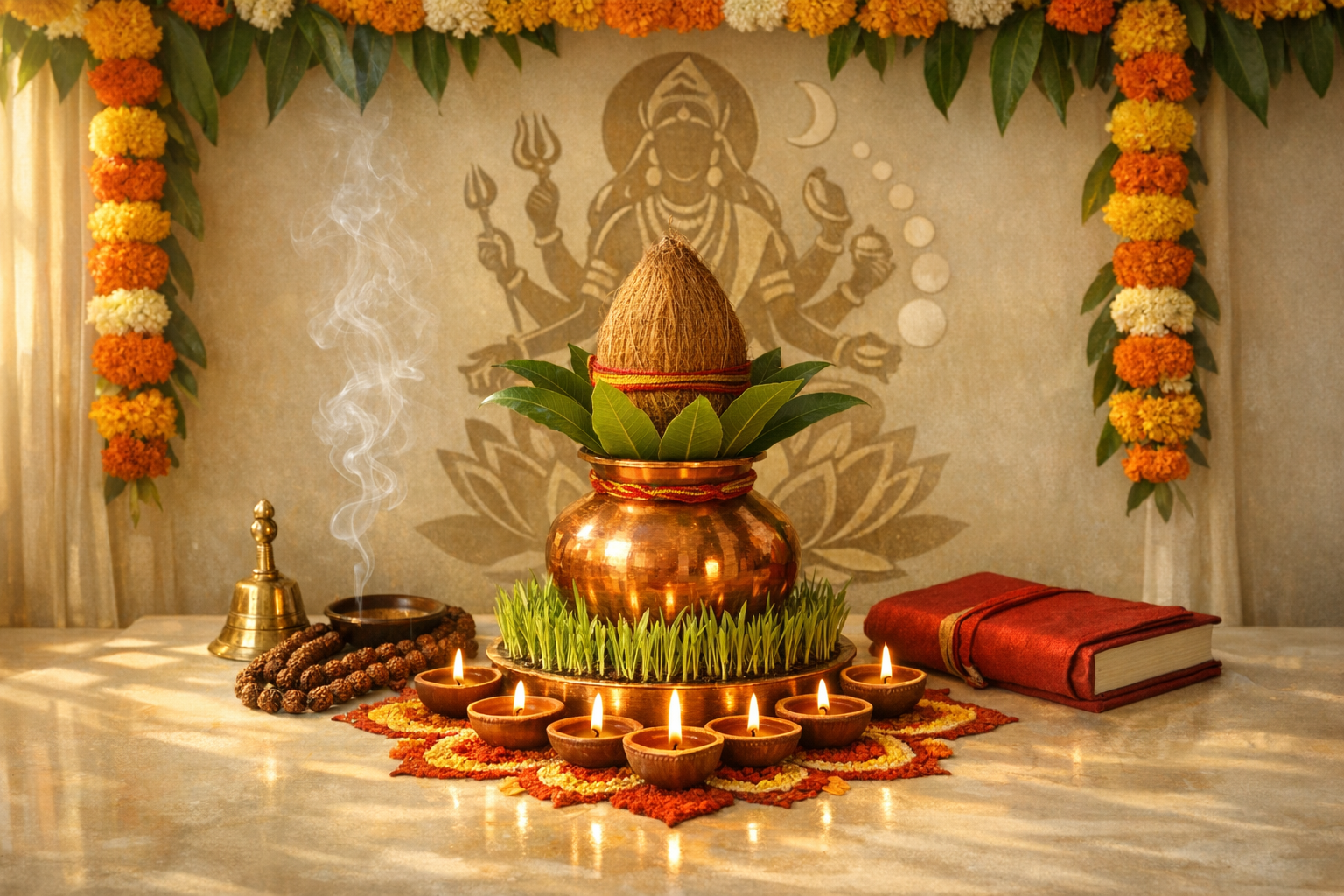
Ghatasthapana, also called Kalasha Sthapana, is the canonical inauguration of Navratri worship on Pratipada. Tradition recommends performing it during the first third of the day after sunrise when Pratipada prevails, avoiding inauspicious periods and nighttime. Where exact intervals are constrained, established authorities allow Abhijit Muhurta when Pratipada overlaps that span. The Kalashatypically a copper or clay vessel filled with sanctified water, grains, and adorned with mango leaves and a coconutsymbolizes the presence of Shakti and the fertility of the season.
A standard Ghatasthapana procedure involves preparing a clean altar, spreading a bed of barley or wheat for germination, placing the Kalasha with a swastika mark, filling with water and auspicious items (akshata, durva, pancharatan), tying a mauli (red-yellow thread), and invoking Devi with sankalpa that states time, place, lineage, and intention. Simple but considered offeringsfresh flowers, incense, lamp, and fruitmaintain ritual purity while keeping the focus on inner clarity and devotion.
Fasting (vrata) during Chaitra Navratri is practiced in ways that balance discipline and health. Common approaches include phalahar (fruits and milk), satvik one-meal fasts, or abstention from grains and legumes in favor of vrat-friendly foods. Hydration, rest, and moderation are important to sustain the nine-day rhythm; those with medical conditions are advised to adapt the vrata in consultation with professional guidance.
Day-wise observances in 2026 span nine tithis from Pratipada to Navami. While the following outline reflects the conventional order of worship, local Panchang calculations can shift a deity’s upasana to align with the precise tithi in a given region:
Day 1 19 March (Pratipada): Shailaputri. Worship emphasizes steadiness and grounding; many begin the germination of barley signifying growth, resilience, and seasonal renewal.
Day 2 20 March (Dwitiya): Brahmācharini. Focus on tapas, study, and simplicity; devotees often read passages from the Devi Mahatmyam or Durga Saptashati to anchor daily contemplation.
Day 3 21 March (Tritiya): Chandraghanta. Associated with courage and composure; families commonly add a bell (ghanta) during arati to invoke serenity and protective grace.
Day 4 22 March (Chaturthi): Kushmanda. Revered as the creative matrix of the cosmos; offerings of gourd and seasonal produce celebrate abundance and the life-sustaining gifts of spring.
Day 5 23 March (Panchami): Skandamata. The maternal aspect of Shakti is honored; many households emphasize nurturing bonds, education for children, and seva in the community.
Day 6 24 March (Shashti): Katyayani. A day of determination and ethical resolve; devotees often intensify mantra japa and focus prayers on removing obstacles.
Day 7 25 March (Saptami): Kalaratri. Symbolizes dispelling fear and ignorance; lamps are offered to affirm light over darkness in both the home and the heart.
Day 8 26 March (Ashtami): Mahagauri. Associated with purity and renewal; Kanya Puja (worship of young girls as embodiments of Shakti) is widely observed. The Sandhi Pujaperformed in the 48-minute juncture between Ashtami and Navamiholds special significance where timed precisely by local tithi.
Day 9 27 March (Navami): Siddhidatri. Completion of the vrata is marked with gratitude and dakshina. In many regions, Ram Navami coincides with Navami, aligning the adoration of Devi with remembrance of Sri Rama’s maryada (righteousness) and ethical statecraft.
Chaitra Navratri’s spiritual architecture is inclusive in both practice and ethos. While distinctly a Hindu festival venerating Devi, its valuesahimsa, self-discipline, mindfulness, and sevaresonate across the dharmic spectrum. The contemplative focus (dhyana) celebrated in Buddhism, the disciplined non-violence (ahimsa/tapas) cherished in Jainism, and the primacy of remembrance and service (simran/seva) in Sikh tradition all converge in spirit with the festival’s core intent of inner refinement and compassionate living.
In the home setting, many families create a modest shrine that evolves over the nine daysadding a new flower, a line from scripture, or a personal vow daily. Children often learn the stories of the Navadurga in the evenings, forming intergenerational memory that carries forward ritual literacy and cultural belonging. The quiet repetition of mantras, when paired with a calm household rhythm, becomes a shared practice in attentiveness and gratitude.
Temple communities mark the festival through daily abhishekam, alankaram of Devi, and collective recitation of stotras. While large-scale garba and dandiya are more closely associated with Sharad Navratri, many regions host devotional singing (bhajans), readings of Durga Saptashati, and special homas during the spring observance, rising and ebbing with the cadence of each tithi.
Durga Ashtami and the Sandhi intervalbridging Ashtami and Navamiare often highlighted for special worship. In the precise muhurat designated by the local Panchang, lamps, flowers, and offerings are placed with deliberate care, symbolizing the seeker’s turn from inner turbulence to luminous resolve. Kanya Puja, observed respectfully and without ostentation, reaffirms dignity, protection, and education for the girl child as living embodiments of Shakti.
Ram Navami, frequently coinciding with the ninth day in Chaitra Navratri, complements the festival’s culmination by emphasizing maryada, courage, and public ethics. Many communities read passages from the Ramayana or Sundara Kanda on or near this day, linking devotion to Devi with the cultivation of personal integrity and social responsibility.
From a calendrical perspective, Chaitra Navratri highlights the sophistication of the Hindu lunisolar system, which calibrates months by lunar tithi while modulating seasons to the solar year. This frameworkpreserved in classical texts and refined in regional Panchangsexplains why local daylight and longitude can influence the exact windows for Ghatasthapana and key pujas.
Practical planning remains grounded in a few reliable guidelines: perform Kalasha Sthapana on Pratipada after sunrise; avoid nighttime and inauspicious intervals; consult the local Panchang for Sandhi Puja; and align Ashtami and Navami observances with the tithi prevailing at the time of worship. This method ensures both ritual accuracy and continuity with long-standing traditions.
Environmental mindfulness can be integrated seamlessly into the festival. Natural flowers, biodegradable offerings, clay lamps, and minimal-plastic decor align the reverence for Devi with stewardship of the living world. Quiet, considerate soundscapes, inclusive community seating, and accessibility provisions honor the festival’s spirit of dignity and care for all participants.
For those new to the observance, a balanced approachsimple daily puja, short passages from the Devi Mahatmyam, and an attainable vrataoften proves sustainable and deeply meaningful. Over nine days, the cumulative effect of modest daily steps can reshape attention, reduce anxiety, and enrich shared life at home and in community.
The 2026 dates19 March to 27 Marchare particularly convenient for educational calendars in many regions, facilitating participation by students and families. Diaspora communities often synchronize evening gatherings after work hours, with temples publishing day-wise schedules that track local tithi to ensure shared accuracy.
At its heart, Chaitra Navratri is a disciplined celebration of inner renewal. It welcomes practitioners of varied temperamentsthose drawn to mantra, to study, to service, or to quiet contemplationand demonstrates a civilizational principle central to the dharmic family: unity in spiritual diversity. Across Hinduism, Buddhism, Jainism, and Sikhism, there is a shared confidence that ethical cultivation and mindful living can elevate both the individual and the collective.
As spring unfolds, the festival’s nine-night arc becomes a practice in patience, presence, and purposeful action. With Shukla Paksha Pratipada as the threshold, the daily liturgy, vrata, and reflection align personal life with cosmic rhythm. The closing Navami offers a moment of inventory and gratitude, sealing intentions that carry well beyond the festival itself.
Inspired by this post on Hindu Pad.