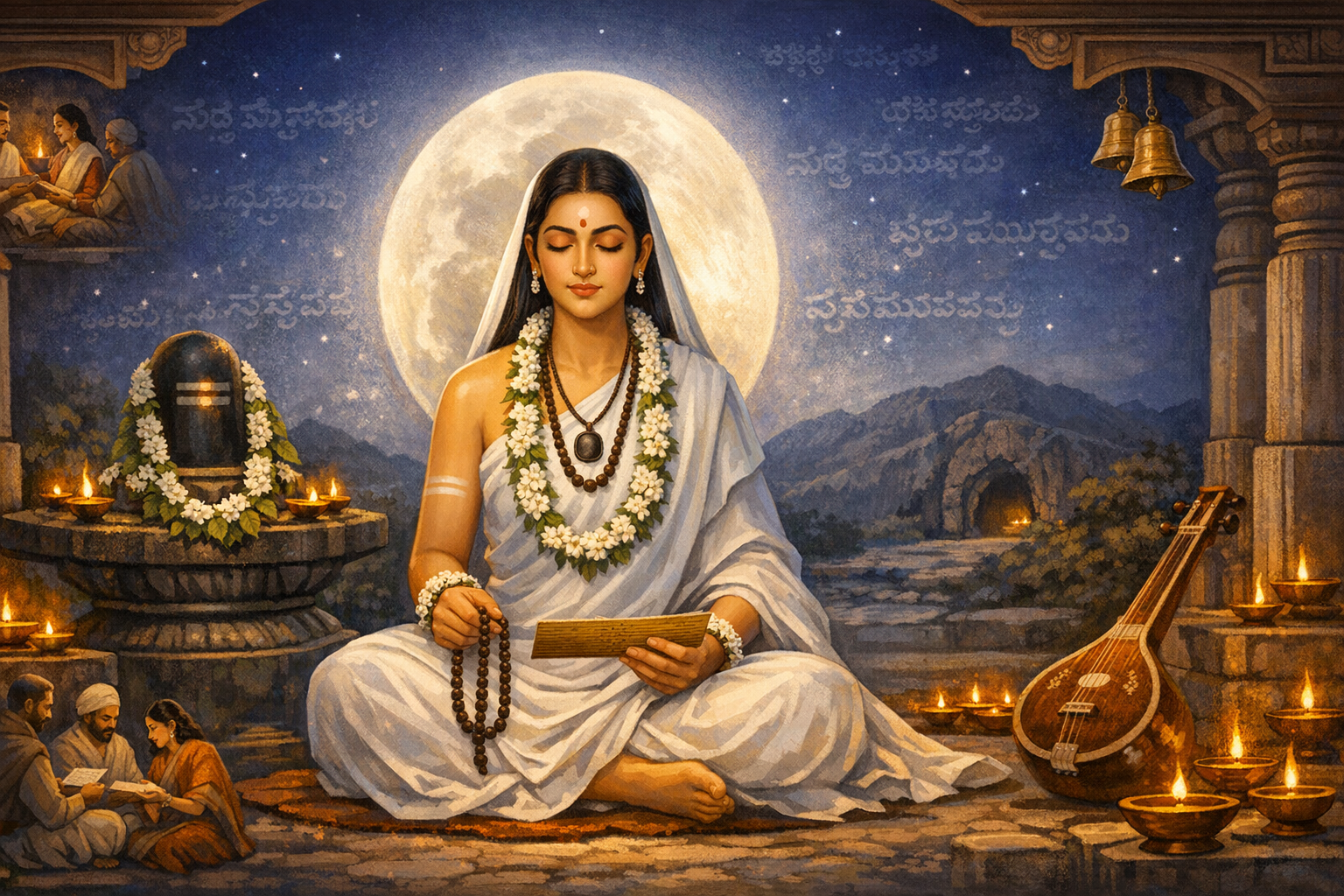
Akka Mahadevi Jayanthi on Chaitra Pournami commemorates the birth anniversary of Akka Mahadevi, the renowned 12th-century Kannada poet-saint of the Veerashaiva Bhakti movement. In 2026, Akka Mahadevi Jayanti (Jayanthi) falls on 1 April, coinciding with Chaitra Purnima/Chaitra Pournami. The observance is especially significant in Karnataka, where she is affectionately known simply as “Akka,” a mark of reverence that also underscores her enduring presence in the region’s spiritual and literary heritage.
Historically situated within the dynamic milieu of the 12th century, Akka Mahadevi’s life and work intersect with the transformative currents of the Veerashaiva (Lingayat) reformist movement. This movement emphasized direct devotion (bhakti) to Shiva, ethical living, and the egalitarian sanctity of the devotee community (sharana-samaja). It privileged vernacular expression, bringing profound philosophical and social ideas into everyday Kannada. Associated contemporaries include Basavanna and Allama Prabhu, whose gatherings at the Anubhava Mantapa cultivated a culture of dialogue, introspection, and social critique that reshaped the religious and cultural landscape of Karnataka.
Traditional accounts place Akka Mahadevi’s early life in present-day Karnataka, where intense devotion to Shivainvoked by her distinctive ankita (signature deity-name) Cennamallikarjunaformed the core of her sadhana. Hagiographies describe her radical renunciation of worldly ties, a commitment framed not as rejection of society but as a fierce affirmation that the inner relationship with the Divine supersedes all other bonds. Her presence in the sharana network and her later association with sacred geographyespecially Śrīśaila (Srisailam), where local memory preserves the “Akka Mahadevi Caves”illustrate how lived devotion, pilgrimage, and literary expression intertwined in the making of her legacy.
Akka Mahadevi’s literary contributions are preserved primarily in her Vachanas, a form of didactic, aphoristic, and rhythmically charged free-verse prose. Vachana literature in Kannada is notable for its conceptual clarity and spiritual urgency; it often resists formal metrical constraints in order to speak with directness and moral intensity. Her Vachanas feature hallmarks of the genre: striking metaphors, incisive antithesis (outer vs. inner, transient vs. eternal), layers of alliteration (anuprāsa), and a concluding invocation of the ankita, here Cennamallikarjuna. Approximately 430–470 Vachanas are commonly attributed to her across anthologies, though textual historians note that numbers and attributions vary across manuscripts and later compilations.
Thematically, Akka Mahadevi’s poetry embodies a deep bhakti of longing (viraha-bhakti), presenting a sustained contemplation of the soul’s yearning for union with Shiva. Her work interrogates material attachment, social expectations, and ritual formalism, consistently elevating experiential wisdom (anubhava) over outward performance. Traditional hagiographies also recount her vow of complete renunciation, with some sources describing unclothed asceticism as a metaphor of total transparency before the Divine. Read in its medieval devotional context, this stance functions as a radical statement: the true ornament of a seeker is inner purity and unwavering devotion, not social markers or possessions.
Chaitra Purnima (often styled Chaitra Pournami in South Indian usage) bears pan-Indic auspiciousness and aligns well with Akka Mahadevi’s emphasis on illumination and inner clarity. In Karnataka and elsewhere, the Jayanti typically inspires collective recitations of Vachanas, reflective talks on the Sharana tradition, reading circles that explore her Kannada oeuvre and translations, and visits to Shiva temples with a focus on contemplative worship (dhyana, japa, and svadhyaya). Many communities mark the day with inclusive gatherings that underscore ethical living, seva (service), and the dignity of all devotees regardless of birth or social statusvalues that sit at the heart of the broader Bhakti Tradition.
Calendar practitioners note that festival dates may vary slightly with local panchang computations, lunar-day observance (tithi), and time-zone differences. Nonetheless, for 2026 the widely observed date for Akka Mahadevi Jayanti is 1 April, aligning with the full-moon phase of Chaitra. As with many lunar observances, regional customsPurnimanta versus Amanta month reckoning, or local sunrise-to-sunrise calculationscan lead to shifts by a day in some locations.
Beyond its historical and literary importance, Akka Mahadevi Jayanthi offers a contemplative bridge across dharmic traditions. The ethical thrust of aparigraha (non-possessiveness) that animates her Vachanas resonates with Jain ideals; the call to inner awakening converges with Buddhist emphasis on direct insight; and the primacy of the Divine Name and inward remembrance finds consonance with Sikh praxis of simran. Highlighting these affinities deepens a shared commitment to compassion, truth-seeking, and the primacy of lived spiritual experience, while honoring the distinctiveness of each tradition. In this way, the Jayanti affirms unity in diversity across the dharmic tapestry.
From the standpoint of Kannada literature, Akka Mahadevi’s voice is both formally innovative and socially expansive. Vachanasby designdemocratize access to spiritual and philosophical discourse, favoring lucid vernacular over scholastic exclusivity. Her consistent invocation of Cennamallikarjuna localizes the universal impulse of bhakti, situating it in a devotional geography that is both intimate and transcendent. Modern scholarship often focuses on her poetics of embodiment and interiority, the gendered dynamics of authority in medieval devotional spaces, and the philological transmission of Vachanas through later canonical anthologies such as the Śūnyasaṁpādane.
Communities and individuals seeking meaningful observance in 2026 may consider combining traditional worship with reflective study. Reading cycles that pair Vachanas in Kannada with reliable English translations can be complemented by satsangs dedicated to the ethical dimensions of the Sharana movementhonesty, humility, and service. Musical renditions of selected Vachanas, quiet periods of japa (Om Namah Shivaya), and short sessions of pranayama or dhyana align practice with the inner orientation Akka Mahadevi extols. Educators and cultural institutions in Karnataka and the diaspora often host talks that situate her within the wider 12th-century reformist currents alongside Basavanna and Allama Prabhu, encouraging a holistic view that integrates literature, history, and lived spirituality.
Ultimately, Akka Mahadevi Jayanthi on Chaitra Pournami is not only a date on the festival calendar; it is a call to renew the moral and contemplative energies she championed. By engaging with her Vachanas, reflecting on their ethical gravity, and nurturing inclusive community practices, devotees and readers honor a legacy that continues to shape Kannada literature and the Bhakti Tradition. Observed on 1 April 2026, this Jayanti offers a timely opportunity to foreground unity across dharmic traditions through the shared pursuit of inner freedom, devotion, and compassionate action.
Inspired by this post on Hindu Pad.