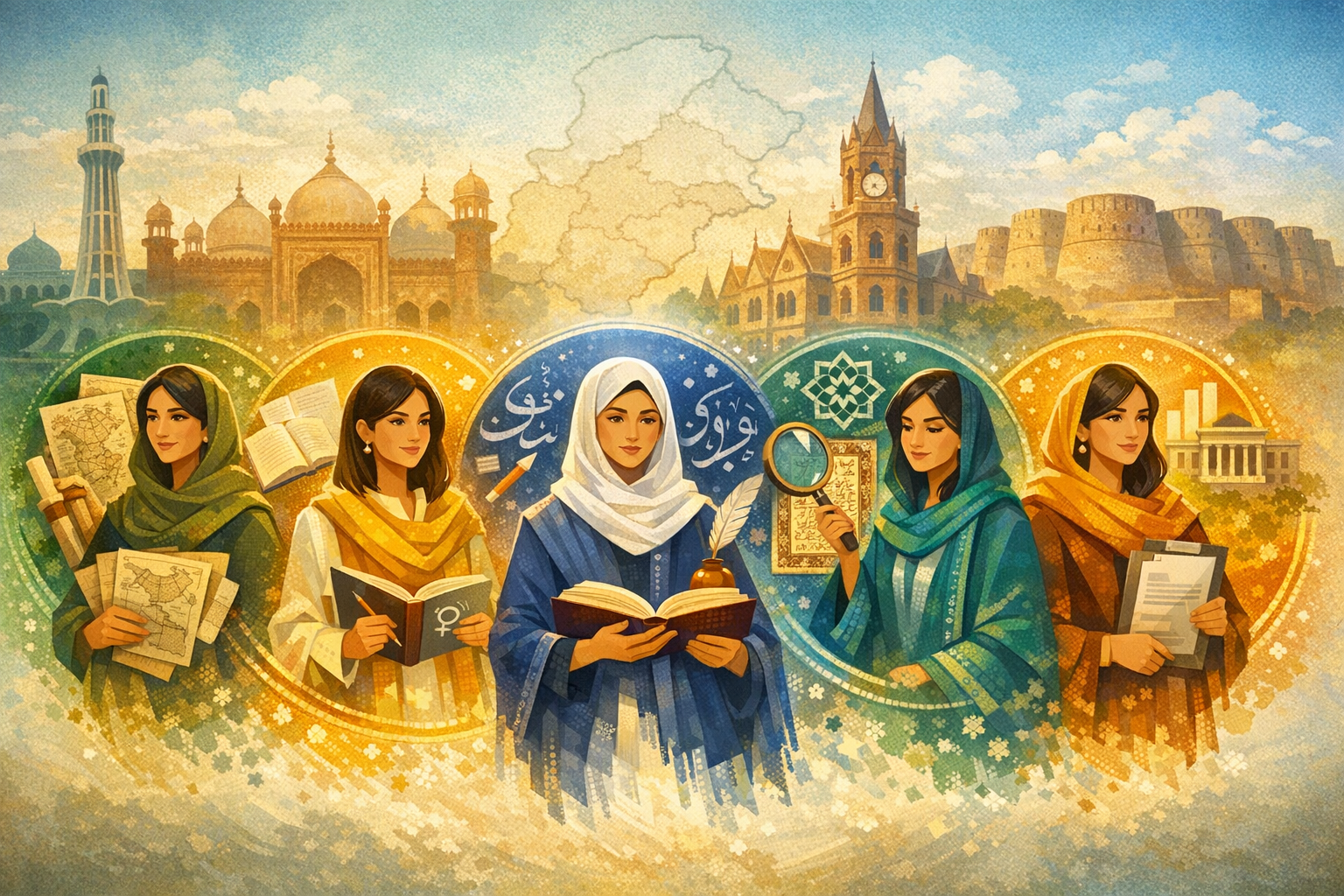
Pakistani Punjab has long served as a crucible of South Asian scholarship, with Lahore and Bahawalpur anchoring a dense network of universities, research institutes, and publishing houses. Within this intellectual ecosystem, women scholars have advanced rigorous research, mentored generations of students, and informed national and international debates across history, education, languages, religion, and security studies. Examining their work illuminates how academic leadership in the region increasingly shapes discourse on pluralism, curriculum, and governanceissues that matter not only to Pakistan but to a wider South Asian public committed to cultural understanding and social progress.
This analysis highlights five eminent women academics of Pakistani Punjab whose contributions demonstrate breadth, originality, and public relevance: Ayesha Jalal (history), Rubina Saigol (gender and education), Arfa Sayeda Zehra (Urdu and Punjabi literature and education), Riffat Hassan (religious studies), and Ayesha Siddiqa (civil–military relations). Their trajectories span classrooms and archives in Lahore and Bahawalpur, extend into global universities and think-tanks, and return to curricula, classrooms, and public debate at home. Together, their work models evidence-based inquiry, dialogic engagement, and the scholastic virtues of clarity, balance, methodological care, and ethical responsibility.
Ayesha Jalal, born in Lahore and trained in the United States, is a leading historian of modern South Asia whose research reframed understandings of Partition, state formation, and political leadership. Her archival method intersects political history with intellectual history, producing nuanced accounts of contingency, competing interests, and the mechanics of negotiation that accompanied the end of empire. By meticulously reconstructing decision-making contexts, she has challenged teleological narratives and foregrounded the interplay between individual agency and structural constraints in twentieth-century South Asian history.
The international influence of Ayesha Jalal’s scholarship stems not only from landmark monographs but also from collaborative and comparative works that position South Asia within a global conversation. Her writing on state sovereignty, identity, and citizenship encourages scholars and students in Lahore, Delhi, Dhaka, and beyond to consider how local histories are embedded in world-historical processes. In teaching and public talks, Jalal has consistently emphasized reading across bordersan approach that dovetails with the subcontinent’s civilizational tapestry and advances a discourse of mutual understanding among diverse religious and cultural communities.
Rubina Saigol (1959–2021), a Lahore-based scholar of education and gender, produced a body of work that is central to contemporary debates on curriculum, nationalism, and critical pedagogy in Pakistan. Her analyses dissected how textbooks, language policies, and classroom practices can transmit unexamined assumptions about gender, nationhood, and the “other,” often inadvertently narrowing students’ interpretive horizons. Saigol’s scholarship offered constructive correctives by advocating for content that develops critical thinking, nurtures civic responsibility, and portrays communitiesincluding religious and ethnic minoritieswith empathy and respect.
In policy dialogues and teacher education forums, Rubina Saigol argued that robust education systems cultivate citizens able to reason with complexity, appreciate plural intellectual traditions, and collaborate across difference. Her Lahore-based collaborations with civil society groups and academic centers exemplified “translational scholarship,” i.e., research that moves from the page to the policy table and the classroom. The outcome was a blueprint for more inclusive learning materials consonant with Pakistan’s multicultural reality and with the broader South Asian ethos of coexistence across Hinduism, Buddhism, Jainism, Sikhism, and Islam.
Arfa Sayeda Zehra, a distinguished educationist and scholar of Urdu and Punjabi, has been an influential public intellectual whose lectures and administrative leadership have elevated discourse on language, literature, and national identity. Her work underscores how linguistic heritageespecially Urdu and Punjabistructures cultural memory, aesthetic sensibilities, and ethical imagination. By presenting classical and modern literary texts as living repositories of values and social commentary, she has helped generations of students and listeners discover how language can strengthen civic belonging and intercultural respect.
Through senior academic roles and national advisory service on education and culture, Arfa Sayeda Zehra has championed pedagogies that marry literary grace with analytical rigor. She has consistently advocated for curricula that make room for multiple voices and historical layers, enabling learners to engage with South Asia’s composite inheritance. In doing so, she situates Punjab’s linguistic gifts as bridges rather than barrierspaths to mutual understanding in a region shaped by movement, exchange, and a shared civilizational grammar.
Riffat Hassan, born in Lahore and widely recognized for pioneering work in religious studies, focuses on hermeneutics and gender-just readings in Islamic thought. By attending closely to primary texts and interpretive traditions, her scholarship critiques androcentric exegesis and highlights ethical commitments inherent in scriptural sources. While grounded in Islamic studies, her methodhistorically informed, philologically attentive, and ethically orientedhas proven relevant to comparative religion classrooms across South Asia and the diaspora.
In university seminars and public dialogues, Riffat Hassan has encouraged intertextual learningplacing Islamic sources in conversation with South Asia’s wider tapestry of philosophical and religious thought. This scholarly practice fosters the intellectual habits necessary for civic coexistence: careful listening, contextual understanding, and willingness to learn from parallel traditions. Such an approach aligns with the region’s long-standing interplay among Hindu, Buddhist, Jain, and Sikh ideas and illuminates how comparative study can deepen mutual respect without collapsing differences.
Ayesha Siddiqa, a scholar of civil–military relations from Bahawalpur, has made significant contributions to understanding the political economy of security institutions. Her research analyzes organizational incentives, budgetary opacity, and the implications of extended military roles in non-military sectors. By assembling cross-verified evidence from public accounts, interviews, and secondary literature, she has crafted a methodologically robust portrait of how institutional structures shape national policy and economic outcomes.
The public value of Ayesha Siddiqa’s work lies in its clarity and civic orientation: it illuminates how transparency, rule-based governance, and civilian oversight can strengthen state capacity and public trust. This is a scholarly intervention, not a polemical onerooted in comparative frameworks and attentive to Pakistan’s historical trajectory. The research invites constructive dialogue among policymakers, academics, and citizens about pathways to institutional reform that support social welfare, educational investment, and long-term stability.
These five academics demonstrate how Pakistani Punjab’s knowledge ecosystemcentered on institutions such as the University of the Punjab, Government College University Lahore, Lahore College for Women University, and LUMSnurtures scholarship that is locally grounded and globally relevant. Their classrooms have been formative spaces where first-generation university students, aspiring researchers, and mid-career professionals learn to interrogate sources, debate interpretations, and synthesize perspectives drawn from history, policy, and literature.
Progress in women’s participation in higher education and research in Punjab is visible in expanding faculty cohorts, rising publication outputs, and widening disciplinary footprints. Yet the road ahead still calls for deeper mentorship pipelines, inclusive hiring and promotion practices, and research funding models that support fieldwork, archival travel, and collaborative projects. The careers profiled here offer a practical template: cultivate methodological excellence, engage the public courteously and candidly, and build durable bridges between research and policy.
Cross-cutting themes run through their work. First, rigorous method: careful reading of archives and texts, triangulation of evidence, clarity about assumptions, and openness to reconsider conclusions. Second, dialogic engagement: scholarship is not a monologue but a sustained conversationacross departments, institutions, borders, and faith traditions. Third, curricular impact: research must inform what students read, how they read it, and how that reading equips them to contribute ethically to society.
In a region where cultural and religious traditionsHinduism, Buddhism, Jainism, Sikhism, and Islamhave interacted for centuries, these scholars exemplify an intellectual ethos that seeks understanding over antagonism. Whether analyzing Partition, reimagining textbooks, explicating Urdu classics, interpreting religious sources with care, or clarifying institutional economics, their work advances the principle that knowledge should reduce fear, widen empathy, and enable reasoned cooperation in public life.
For students and general readers wishing to delve further, the corpus associated with these scholars offers a structured path: seminal histories of modern South Asia; critical studies of education, nationalism, and gender; lectures and essays on Urdu and Punjabi literary thought; methodologically transparent analyses of civil–military relations; and comparative reflections on religious ethics. Read together, these works cultivate historical sense, interpretive skill, and civic imagination.
The cumulative lesson is clear: Pakistani Punjab’s women academics have helped transform how South Asians study themselves and one another. Their scholarship models patience with complexity, humility before sources, and steadiness in public engagementqualities that sustain intellectual communities and nurture a broader culture of respectful dialogue. As universities and research centers on both sides of borders deepen collaboration, this legacy will continue to inspire students, inform policy, and strengthen the shared fabric of South Asian scholarship.
Inspired by this post on SikhNet – News.