On 17 September 1948, the Indian Union concluded Operation Polo, integrating the erstwhile Hyderabad State into a constitutional democracy. Far from extinguishing a fully sovereign power, the action capped a long historical arc in which Hyderabad had persistently lacked external sovereignty. Acharya Jadunath Sarkar articulated this case with incisive clarity in 1948. Revisiting his core claimssupplemented by contemporaneous recordssheds light on the legal, administrative, and ethical contours of Hyderabad’s status and the broader imperative of stable, inclusive governance in the Deccan.
The inquiry that follows proceeds in four parts. First, it reconstructs Hyderabad’s legal position across Mughal, Maratha, and British epochs, emphasizing the concepts of suzerainty and paramountcy. Second, it examines administrative performance through eyewitness and official reports. Third, it analyzes British policy in Hyderabad. Finally, it reflects on remedies debated in the late nineteenth and early twentieth centuries and on how the 1948 integration aligned with constitutional nation-building and social harmony across Hindu, Buddhist, Jain, Sikh, and Muslim communities.
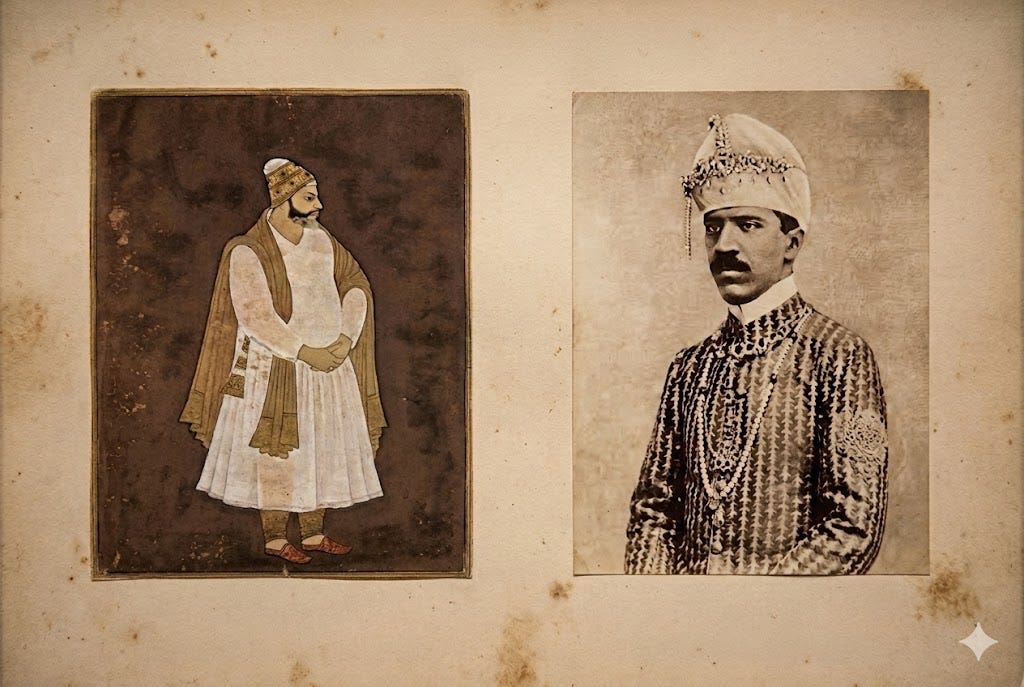
Legal status is the fulcrum of the debate. Asaf Jah I, the first Nizam (i.e., governor) of Haidarabad, left a will that is preserved in the Nizam’s Government Record Office. Two clauses capture the institutional posture he bequeathed to his descendants: deference to the de facto landholders in the Deccan (the Marathas) and procedural restraint in capital punishment under authorized judicial authority.
“Awal an ke rais-i-Dakhin ra lazim ke ba Marhatta ke zamindar-i-in mulk ast, ashti warzad.
Duyam an ke dar hadm-i-baniad-i-bani-Adam . . tamul kunad wa mujrim wajib-ul-qatl ra ba Qazi, ke hakim-i-shara ast, tafwiz numaid.”
Significantly, the founder styled himself a Rais (chieftain), not a Shah or Sultan. Even the pivotal victory at Shakarkheda in 1724later celebrated by some as a day of “independence”did not induce Asaf Jah I to abandon the titulature of a provincial head. Semantics here reflect substance: throughout the Mughal period, Hyderabad’s rulers sought formal recognition of succession from the Delhi Padshah (or his regent), consistent with their role as hereditary office-holders within a larger imperial framework.
The practice of recognition endured well beyond Shakarkheda. When Emperor Shah Alam II appointed Mahadji Sindhia as perpetual Regent, the Nizam sent an agent to Sindhia’s camp near Delhi to obtain recognition through him. British Residency Records published by the Bombay Government corroborate this practice, locating the Nizam’s claim firmly within the idiom of imperial endorsement as late as 1785fully six decades after the supposed “independence.”
With British ascendancy in north India, the axis of suzerainty shifted. By 1804, the British controlled Delhi and, in effect, the regency of the Padshah; the Nizam’s external position was thereafter circumscribed by British paramountcy. The auxiliary treaties (notably under Lord Wellesley’s Subsidiary Alliance) entrenched this dependence through defense, foreign affairs, and communicationscore attributes of external sovereigntymanaged by the paramount power. In 1858, Crown rule formally replaced Company authority, consolidating a single sovereign over the former Mughal provinces, including Haidarabad.
Debates intensified again in 1947 with the Indian Independence Act. While British paramountcy lapsed, practice and prudence converged to affirm that princely states lacked the requisites of external sovereigntytreaty-making, independent defense, and international personalityin the absence of a suzerain. The Indian Union, controlling the former imperial center at Delhi and inheriting the responsibilities of a modern state, asserted and operationalized the successor role for external matters. In practical constitutional terms, the Nizam could not exist politically in vacuo.
Persian chronicles further situate Hyderabad’s self-understanding within an imperial milieu. When Nadir Shah entered Delhi in 1739, he reportedly offered Asaf Jah I the throne of Delhi; Asaf Jah declined, expressing contentment with his station as a provincial governor. Etymology itself is telling: “Nizam,” from the same root as “Nazim,” denotes a governor or the king’s deputy, not an independent sovereign.
Subsidiary arrangements over the nineteenth century deepened the pattern. The British disbanded or subordinated foreign-trained corps, stationed their troops, andcruciallyredirected territorial revenues (e.g., Berar from 1853, later regularized in 1903–1905) to sustain these obligations. In constitutional vocabulary, Hyderabad had internal autonomy but not the external indicia of statehood; its rulers consented to, and benefited from, the protective umbrella that the arrangement provided.
Beyond legalities, legitimacy rests on the condition of the governed. Observers across eras assessed Hyderabad’s administration against standards of order, justice, and welfareconcerns shared by all communities in the Deccan, including Hindus, Buddhists, Jains, Sikhs, and Muslims.
In 1776, the Comte de Modave wrote of the capital: “Les Musalmans triomphent dans cette ville qu’ils ont batie et ou ils sont les maitres.” The remark captured the predominance of the courtly elite rather than the everyday lives of the region’s diverse peoples, whose fortunes hinged on roads, policing, markets, and justice.
Administrative dispatches in the early nineteenth century were often stark. On 6 May 1812, Edmonstone, Secretary to the Governor-General, observed: “Never, to be sure, was there such a Government as that of Haidarabad since the world began, and what can be done to remedy its present state would baffle any politician.”
By 1820, reports warned: “The country soon became depopulated and necessities rose to famine prices. Government ceased. There was not a shadow of law or police anywhere; bands of armed plunderers traversed the roads and jungles.” While the phraseology reflects the idiom of its time, the core concernpublic order and livelihoodswas concrete and non-sectarian.
Mid-century opinion in Britain linked the Resident’s custodial role to the welfare of the populace. On 6 November 1847, the Times of London wrote of “the moral and political right of myriads of the population to turn to the Governor-General for succour, protection and redress … The Governor-General’s easy task is to level those masses of misgovernment which obstruct the free circulation of prosperity and happiness throughout the peninsula (i.e., the Deccan), and to advance those improvements by which such blessings are so materially promoted … The Nizam is morally accountable to us.” (Lee-Warner, Dalhousie, I, 97).

From London, Sir Charles Wood (President, Board of Control) asked the Governor-General on 8 May 1853: “What are you going to do with the Nizam? Everybody seems to suppose that he cannot administer his own affairs much longer.” (Lee-Warner, II, 131). On 14 May 1852, Resident General Fraser similarly concluded that if the Nizam was to be placed “in a position of honourable independence among the Native Princes of India,” it could be achieved only “under temporary European management.” (Memoir, p. 373).
Resident Sir Richard Templewriting of his 1867 tenuresummarized the challenge: “My main business was to secure the stability of His Highness’s realm by decent administration. That realm had several times been brought to the brink of destruction by misgovernment. In the present temper of the Nizam, these evils might but too easily recur.” (Story of My Life, I, 174). Of the imported Arab soldiery: “But for Lord Dalhousie’s interposition in 1855, they would have imprisoned the Nizam in his own apartments … In 1857 … they would have seized the sovereign power in the Deccan.” (Ibid., 179).
Even sympathetic visitors registered unease. W. S. Blunt, conversant in Arabic and broadly favorable to Muslim elites, recorded in December 1883: “A teacher at the Moslem School told me, the Muhammadans here were far from happy. They were isolated and without knowledge of what happened in the outer world. We discussed the drinking of wine which is common among the Muhammadans of Haidarabad.” (India Under Ripon, pp. 68–69).
On the Berar question, L. Fraser summarized the prevailing sentiment in 1904: “The inhabitants of Berar would have been dismayed at the prospect of reverting to Haidarabad rule.” (India Under Curzon, p. 225). In 1910, Mr. Casson Walker’s final report pointed to infrastructural deficits: “There are not more than four or five roads in the interior of the Dominions, which are passable all the year. Owing to the lack of roads, and still more of bridges and culverts, the peasantry cannot market their spare produce in time of plenty, while when scarcity prevails, the absence of transport facilities leaves them at the mercy of the local money-lender.” (Ibid., p. 227).
These assessments, read together, spotlight structural governance failuresfiscal, administrative, and infrastructuralrather than the character of any faith community. All communities bore the costs of poor roads, weak police, debt peonage, and stalled markets. In the spirit of dharmic unity, the historical task is not to assign communal blame but to understand how institutional design can better protect dignity, justice, and prosperity for Hindus, Buddhists, Jains, Sikhs, and Muslims alike.
Why did misrule persist under the Union Jack at the Hyderabad Residency? Contemporary British voices were candid about the paradoxes of paramountcy.
Resident Russell wrote in 1819: “If we owe the foundation of our empire in this country to the weakness in which we found the Native Powers, we ought not to complain of the evils which that weakness necessarily produces. If we have reaped the benefits, we must submit to witness the inconveniences which are its inseparable attendants.”
Sixty-five years later, W. S. Blunt echoed the critique: “The policy [of the British] seems to be to keep the Haidarabad nobles in ignorance of modern thought, and it also looks as if the British Indian Government encourages the bad administration purposely.” (India Under Ripon, p. 68). In 1918, E. S. Montagu, Secretary of State, linked political calculus to communal management: “The Nizam is, of course, enormously important to us, because he has kept the Muhammadans of India straight, and we have used him; by means of his wily old ministers and our Resident, for this purpose.” He added a prescient caution: “Really, this is ridiculous, and they are going to have trouble with this man [Sir Osman Ali, G.C.B.] by exalting him into a position of kingship.” (An Indian Diary, 213, 218).
Remedies proposed by late nineteenth-century statesmen reveal both administrative urgency and the paternalist frames of that era. In December 1883, Minister Laik Ali (later styled Salar Jang II) reportedly told Blunt that he did not think the Nizam would be fit to govern the country by himself, adding, “But neither is the country fit for self-government.” (Ibid., p. 77). Such language reflects the conventions of imperial oversight rather than the civic capacities of Deccan society, whichlike the rest of Indiahad robust associational life, self-help institutions, and a living fabric of dharmic ethics.
By the 1940s, the question had become practical: should the subcontinent delay constitutional integration until some ill-defined test of “fitness” was met, or proceed to representative government with institutional safeguards? Sarkar’s insistence on legal clarity and accountable administration anticipated the consensus that prevailed after 1947: accession on defense, external affairs, and communications, followed by political integration and democratic rights.
Education policy in late Asaf Jahi Hyderabad shows the frictions of modernization. Sir Osman Ali founded a university with Urdu as the medium of higher instruction, and a substantial translation bureau rendered English texts into Urdu. Critics questioned alignment with local literacy patterns and quality control. An often-cited anecdote recounts the translation of “Luther burnt the Papal Bull” as ‘as Luther ne Papa-Rome ka byle ko jalai dia’an error that confuses “Bull” (a papal decree) with “byle” (ox). The episode, noted by a Muslim professor from Aligarh in a 1946 conversation with Dr. Rajendra Prasad, illustrates the need for scholarly rigor rather than indicting any language or community.
Across these strandstitles and treaties, reports and reformsthe verdict of history is consistent. Hyderabad emerged as a powerful provincial government under the Mughals and, after the late eighteenth century, as a protected state under British paramountcy. It did not exercise the instruments of external sovereignty. Claims to absolute independence, especially when invoked in 1947–48, lacked constitutional and practical foundation in light of geography, treaty history, and the settled doctrine that internal autonomy under a paramount power is not the same as international statehood.
Operation Polo, therefore, should be read not as a repudiation of pluralism but as a culmination of constitutional consolidationaimed at securing order, rights, and equitable development for all communities. The moral of this history is constructive: legitimacy follows from just administration, impartial law, and shared prosperity. That aspiration resonates across the dharmic traditions of Hinduism, Buddhism, Jainism, and Sikhism, and with Muslim ethical thought as well. Plural societies endure when governance honors the dignity of each person, and when historical memory is harnessed to strengthen, not fracture, social unity.
In sum, Hyderabad was never an independent state in the international-law sense. It was a hereditary governorship that evolved into a protected polity under British paramountcy and, after 1947, faced an inescapable choice between isolation and constitutional integration. The Indian Union’s settlement of 1948led by Sardar Vallabhbhai Patel with key inputs from K. M. Munshiconcluded a two-century trajectory and opened the path to representative institutions. Remembering that trajectory with sobriety and empathy helps today’s readers see beyond polarizing myths, affirming a common civic future anchored in the shared values of the subcontinent’s diverse traditions.
Inspired by this post on Dharma Dispatch.