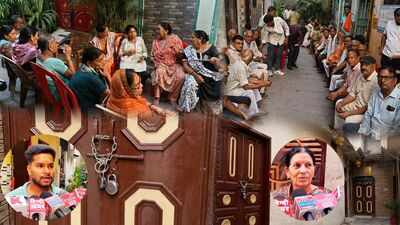
Surajya Abhiyan has publicly condemned the Brihanmumbai Municipal Corporation’s ‘Vruksha Sanjeevani’ campaign as superficial and a mere photo event, arguing that performative tree drives cannot substitute for compliance with binding environmental law. The organisation has called for First Information Reports (FIRs) and penal action against contractors and agencies responsible for tree damage across Maharashtra, while urging strict enforcement of National Green Tribunal (NGT) orders and the state’s tree protection statutes.
The controversy arrives at a time when urban forestry in Mumbai and other Maharashtra cities is under unprecedented pressure from civil works, utilities, and large infrastructure projects. Tree root zones are frequently compacted by heavy machinery, protective bark is stripped during excavation, and canopies are lopped without arboricultural rationale, collectively eroding urban canopy and weakening public safety during monsoon storms. Against this backdrop, the question is no longer whether tree care programs photograph well, but whether environmental governance translates into measurable protection on the ground.
According to Surajya Abhiyan, the ‘Vruksha Sanjeevani’ initiative risks being staged optics unless accompanied by accountability tools that deter unlawful pruning, trenching, and felling. The group’s core contention is unambiguous: contractors that harm trees must face FIRs, monetary penalties, and blacklisting where warranted, and municipal agencies must demonstrate compliance with NGT directions rather than relying on ceremonial plantation events that fail to offset concurrent damage.
The legal baseline for such enforcement is robust. The Maharashtra (Urban Areas) Protection and Preservation of Trees Act, 1975 establishes a Tree Authority, prohibits felling or transplantation without permission, mandates compensatory plantation, and prescribes penalties for contraventions. These provisions operate alongside municipal regulations and can be complemented, where applicable, by provisions of the Indian Penal Code concerning mischief and damage to public property, the Prevention of Damage to Public Property Act, 1984, and the Environment (Protection) Act, 1986. Together, these instruments provide the statutory traction to move from guidance to consequences.
NGT benches, including the Western Zone at Pune, have repeatedly underscored the precautionary principle, the polluter pays principle, post-transplant survival audits, and the need for scientifically defined root-zone protection during urban works. Typical directions require permission-led tree handling, arborist-certified method statements, compensatory plantation at ratios often set at three to five saplings per tree, and multi-year monitoring to ensure survival rather than mere planting counts. Non-compliance can invite directions for damages, restoration, and personal accountability of officials responsible for oversight.
Within this framework, municipal obligations are technical as well as administrative. The Tree Authority should ensure that every project proponent submits a pre-construction tree survey, species-wise inventory, health and risk assessments, and a Tree Protection Plan that specifies how each tree will be retained, pruned, transplanted, or compensated with evidence-based justification. Enforcement should include not only permissions but field supervision, spot checks, and post-works audits.
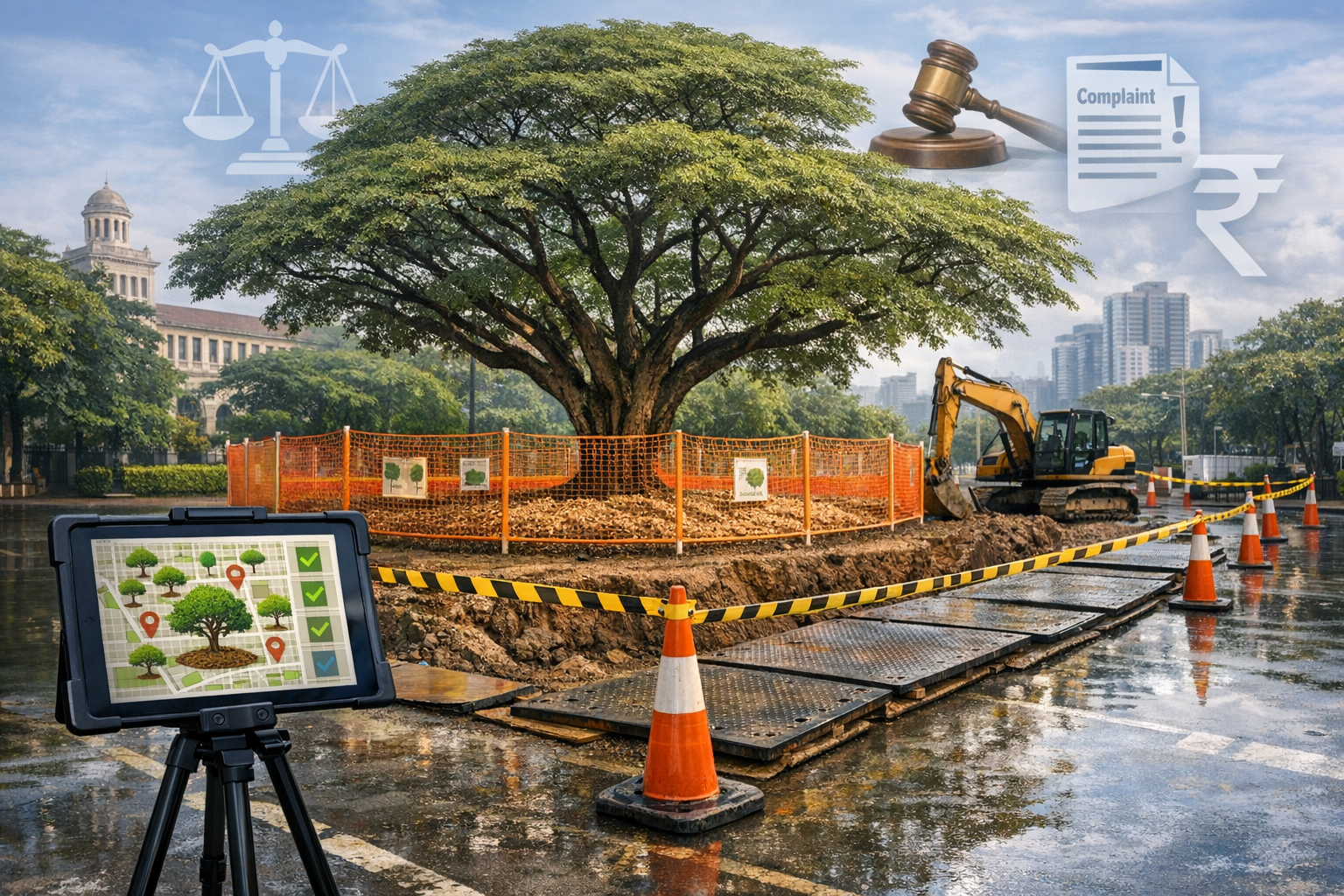
Sound arboriculture practices must anchor implementation. Works should delineate a Root Protection Area (RPA) around each retained tree, with tree fencing and visible signage prior to mobilization. No excavation, material storage, or vehicle movement should occur within the RPA; where unavoidable, root-sensitive methods such as hand digging, air spading, bridging mats, and root pruning under an arborist’s supervision are necessary to prevent irreversible damage. Mulching, decompaction, and vertical trenching may be applied to restore soil porosity after works conclude.
Internationally referenced good practice (for example, specifications inspired by BS 5837) recommends setting the RPA as a radius approximately 10–12 times the trunk diameter at breast height, adjusted to site constraints and species tolerance. In dense Indian urban contexts, that principle can be adapted by allocating the maximum achievable root protection, supplemented by load-distribution mats, geotextiles, and low-impact equipment to minimize compaction. Structured pruning must follow arboricultural standards, avoiding harmful topping and indiscriminate lopping that weaken structure and invite decay.
Quality assurance depends on competent staffing and verifiable processes. Projects should appoint qualified arborists for pre-works surveys, method statements, and site supervision; crews should be trained in tree physiology, safe pruning cuts, and damage avoidance; and method statements must be integrated into the Contractor’s Environmental Management Plan. Photographic and geotagged records should document baseline conditions, protection measures, and outcomes at defined milestones.
Procurement design can hardwire accountability. Tender documents should include explicit tree protection clauses, liquidated damages for non-compliance, and performance bonds that are partially tied to post-works tree survival. Repeated violations should trigger blacklisting consistent with public works manuals, with contractual rights reserved for recovery of restoration costs under the polluter pays principle. Public dashboards can disclose compliance metrics to enable civic oversight.
Where tree damage rises to the threshold of an offence, FIRs provide the criminal-law pathway Surajya Abhiyan seeks. Field officers or affected citizens may lodge complaints with supporting evidence such as site photographs, videos, geotagged coordinates, and copies of permissions or their absence. Police investigation can then proceed under applicable provisions, typically drawing on state tree law violations, mischief-related IPC sections, and environmental statutes, with the municipal Tree Authority’s records and expert inputs establishing the evidentiary chain.
Evidence management strengthens outcomes. Establishing time-stamped condition reports before, during, and after works; recording machine entry into RPAs; and noting cut roots, bark wounds, or canopy loss can demonstrate causation. Joint inspections with the Tree Authority, measurements of trunk diameter and canopy spread, and expert assessments of structural compromise and mortality risk help quantify damage and inform both penal and restorative orders.
Administrative sanctions should run in parallel with criminal remedies. These include stop-work notices, revocation or suspension of permissions, mandatory transplantation or replacement with survival obligations, and recovery of ecosystem restoration costs. When public property or public safety is implicated, department heads may initiate departmental action against supervisory lapses to reinforce a culture of due diligence.
Citizen oversight is a proven force multiplier for environmental conservation and good governance. Accessible complaint channels, a dedicated tree helpline, ward-level grievance cells, and mobile apps that allow residents to flag violations in real time can deter non-compliance. The Right to Information (RTI) Act, 2005 enables requests for pruning or felling permissions, method statements, and survival audits, ensuring transparency. Where complaints are not acted upon, petitioners may seek magisterial directions under appropriate criminal procedure provisions.
Quantifying ecosystem services clarifies why prevention matters more than compensatory planting. Urban trees moderate the heat island effect, reduce stormwater runoff, filter particulate pollution, sequester carbon, dampen noise, and improve mental well-being. Decision-support tools such as i-Tree and allied valuation frameworks translate these functions into monetary terms, enabling penalty schedules and investment plans that reflect the real, recurring value of established canopy that saplings cannot immediately replicate.
Maintenance should be science-led and seasonally timed. Structural pruning is most effective when guided by arborists, avoiding severe cuts that create decay columns. Monsoon preparedness entails selective weight reduction in end-heavy limbs, cabling and bracing where appropriate, and root-collar excavation to correct buried flares, all while preserving the tree’s photosynthetic capacity. Chemical quick-fixes or indiscriminate injections cannot substitute for biologically sound care.
To ensure that ‘Vruksha Sanjeevani’ is more than ceremony, its design should include measurable key performance indicators. These may include the number of trees protected in situ, RPA compliance rates, transplantation survival percentages after one, two, and three years, grievance redress timelines, and the quantum of penalties recovered from errant contractors. Independent third-party audits and the publication of survival data enable course correction and build public trust.
Comparative experience from Indian and international cities supports this trajectory. Jurisdictions with mature urban forestry programs institutionalize tree inventories, GIS tagging, arborist licensing, and root-zone protection standards embedded in public works. Learning from both successes and setbacks elsewhere underscores a constant: without enforcement, even the best-written guidelines underperform in the field.
Beyond law and administration, the protection of trees resonates deeply with dharmic traditions across Hinduism, Buddhism, Jainism, and Sikhism. Vruksha denotes life-giving presence; Sanjeevani evokes renewal and healing. Ahimsa, karuna, and seva converge in the shared ethic of reverence for living systems. Preserving urban trees thus aligns environmental stewardship with a unifying civilizational value that encourages communities to act together for the common good.
A practical roadmap for the Brihanmumbai Municipal Corporation and other Maharashtra urban local bodies would prioritize five pillars: permission-led decision-making by the Tree Authority; arborist-certified protection plans and method statements; on-site supervision and photographic documentation; penalties, FIRs, and blacklisting for violations; and transparent dashboards that publish survival outcomes and enforcement actions. Each pillar advances accountability and sustainability in tangible, verifiable ways.
Contractors can operationalize compliance by integrating RPAs into site layout plans; scheduling works to avoid critical growth periods; training crews in damage avoidance; deploying low-impact equipment near trees; and budgeting for post-works rehabilitation, including decompaction, mulching, and supplemental irrigation. Performance bonds linked to verified survival rates ensure that incentives are aligned with long-term outcomes rather than short-term targets.
Residents and civil society can help close the loop by reporting violations, participating in ward consultations, and monitoring transplanted or newly planted trees through community stewardship. Equitable canopy distribution should be a policy goal, with particular attention to heat-vulnerable and flood-prone neighborhoods that benefit most from shade and infiltration services.
In sum, Surajya Abhiyan’s demand for FIRs and strict NGT-aligned enforcement highlights a broader shift from optics to outcomes in urban environmental governance. When contractors that damage trees face predictable consequences and municipal agencies disclose performance transparently, programs like ‘Vruksha Sanjeevani’ can evolve from symbolism into systems that measurably protect life, property, and the ecological fabric of Mumbai and Maharashtra.
Inspired by this post on Hindu Jagruti Samiti.