Historical nationhood, religious sovereignty, and the homeland of the Khalsa converge in Punjab to form a distinctive yet deeply interconnected civilizational community. The Sikhs of Punjab emerged from a matrix of Bhakti and Sant traditions and developed a disciplined, egalitarian order whose institutions remain among the most effective engines of social trust in South Asia. Read as a single arcfrom Guru Nanak’s message to the codified discipline of the Khalsa and modern constitutional arrangementsthe Sikh experience offers a rigorous case study in how spiritual authority, community self-organization, and ethical statecraft can reinforce one another without collapsing into sectarianism. Within the broader family of dharmic traditions, this history exemplifies unity-in-diversity and the possibility of shared flourishing grounded in seva, compassion, and righteous courage.
Three interlocking ideas define the subject. Historical nationhood (qaum) expresses the Sikh sense of a collective, ethically anchored people. Religious sovereignty is captured by miri-piri, the disciplined integration of temporal responsibility and spiritual authority. The homeland of the Khalsa is both a concrete geographyPunjab’s Majha, Doaba, and Malwaand a living moral landscape, extending to pan-Indian and transborder sacred sites that orient collective memory. Approached together, these ideas clarify that Sikh identity is not an ethnic silo but a civically outward, universalist path that thrives in dialogue with Hinduism, Buddhism, and Jainism.
Origins lie with Guru Nanak (1469–1539), whose teachings emphasized Ik Onkar, truthful living, remembrance of the Divine, and solidarity across caste and creed. Early Sikh organization matured through sangat (congregation) and pangat (shared langar), which hardwired social equality into everyday life. Guru Angad standardized the Gurmukhi script, enabling scriptural literacy and an accessible devotional culture in Punjabi. This choice of script and language embedded faith into the rhythms of common lifevillages, markets, and courtsand seeded a community resilient to political pressure and cultural deracination.
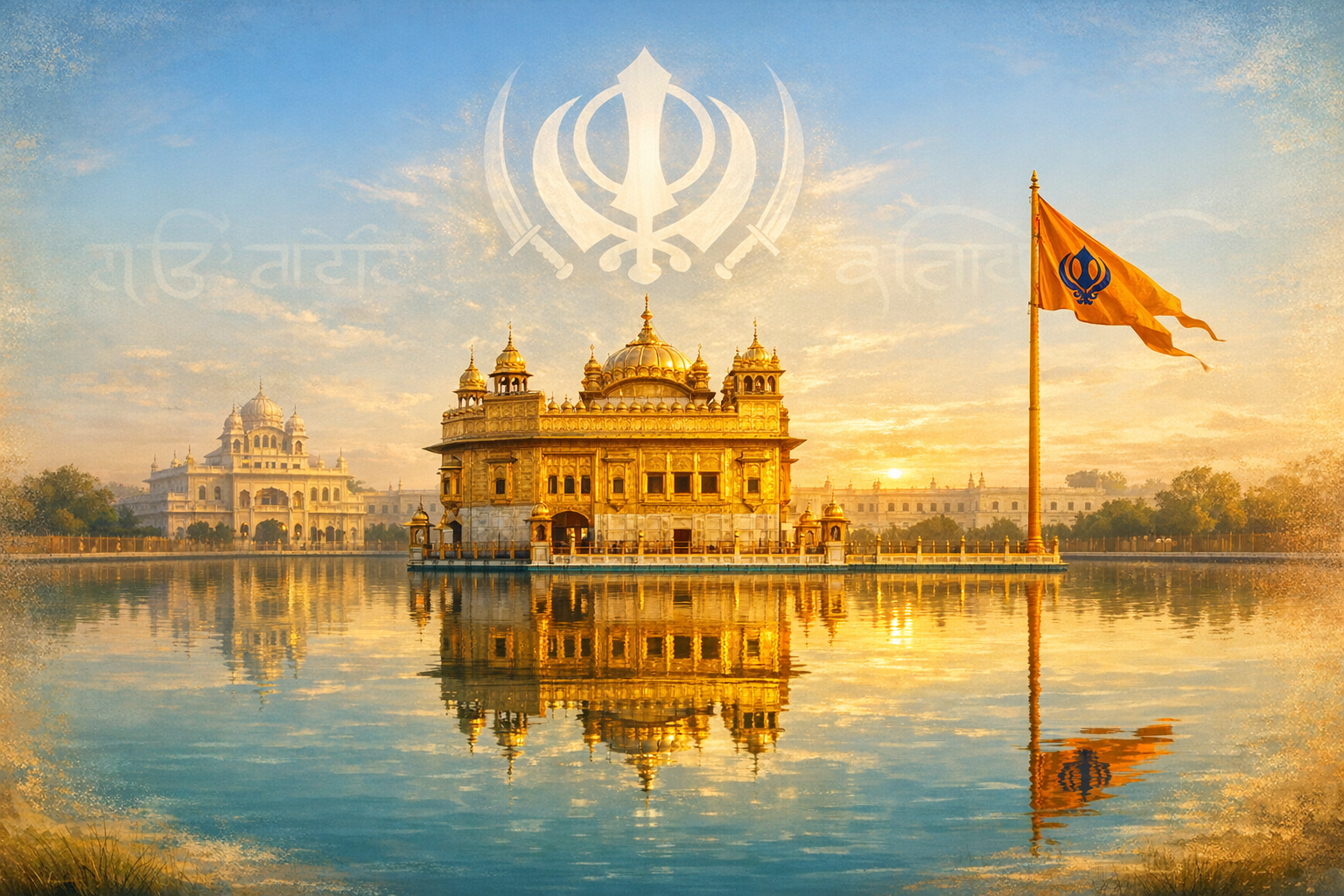
Institutional consolidation accelerated under Guru Arjan (1563–1606), who compiled the Adi Granth and oversaw the development of Harmandir Sahib in Amritsar with four open doors to symbolize welcome to all directions and all peoples. The installation of scripture at the center of communal life gave the Sikhs a stable axis of authority authenticated by shared kirtan, collective memory, and ethical practice. In this period, the community articulated norms of inclusivity that aligned with the wider dharmic ethos of hospitality and plural paths to the Divine.
Miri-piri took institutional form with Guru Hargobind (1595–1644), who bore two swords to symbolize temporal and spiritual responsibility and founded the Akal Takht (1606) opposite Harmandir Sahib. This pairing asserted that true sovereignty is anchored in dharma, not dominion; it disciplined political action under transcendent accountability. In practical terms, the Akal Takht enabled adjudication of community matters, affirmed defensive duty (dharma-yuddha) against persecution, and kept spiritual priorities central in times of conflict.
The Khalsa was established by Guru Gobind Singh at Vaisakhi in 1699 at Anandpur Sahib through Khande-ki-Pahul (Amrit Sanchar). The discipline codified five visible articleskesh, kangha, kara, kirpan, and kacheraalongside a rigorous ethical regimen. The Khalsa neutralized inherited status by bestowing Singh and Kaur as surnames and abolished the masand system, reaffirming direct accountability to the Guru and the collective Panth. Equality of women and men, casteless belonging, and the courage to defend the weak were not rhetorical ideals but operational requirements of the order.
With Guru Gobind Singh’s designation of the Guru Granth Sahib as the eternal Guru in 1708, scriptural sovereignty became the enduring reference-point for personal and collective conduct. Banda Singh Bahadur’s campaign (1708–1716) combined military resistance with radical agrarian measures that challenged entrenched hierarchies. Through the eighteenth century, the Sikh misls and the Dal Khalsa protected autonomy under chaotic conditions, while Sarbat Khalsa assemblies at Amritsar deliberated common strategy, signaling a model of confederal decision-making under sacred authority.
Maharaja Ranjit Singh’s era (1799–1839) translated Sikh political grammar into an inclusive state. The Lahore Darbar welcomed Hindus and Muslims in senior roles, restored temples and gurdwaras, and maintained the Khalsa Army as a disciplined force. The motto Deg Tegh Fateh captured the logic of a just commonwealthprovision (deg) and protection (tegh). Coin legends invoked the Gurus, underscoring that sovereignty derived moral legitimacy from spiritual guidance. The polity’s plural composition affirmed that Sikh statecraft, at its best, safeguarded diversity rather than homogenizing it.
British annexation after the Anglo-Sikh Wars (1845–1849) catalyzed institutional renewal. The Singh Sabha movement professionalized education and clarified doctrine, while the Gurdwara Reform (Akali) movement in the early twentieth century wrested shrines from hereditary custodians. The Sikh Gurdwaras Act (1925) recognized community management through the Shiromani Gurdwara Parbandhak Committee (SGPC). The Sikh Rehat Maryada (finalized mid-twentieth century) standardized liturgical and ethical norms, creating a widely accepted code of conduct that aligns congregational practice across regional and diasporic contexts.
In the crucible of Indian nationalism, Sikhs contributed decisivelyfrom Ghadar Party networks to leadership in non-cooperation and armed strugglewhile retaining the community’s institutional integrity. Partition in 1947 inflicted profound trauma on Punjab, sundering historic gurdwaras in West Punjab from communities in East Punjab. Families across generations continue to remember the loss and re-foundation of livelihood, even as post-1947 East Punjab became a pillar of India’s agrarian modernization and national defense.
Punjab’s homeland is at once geographical and sacred. The three cultural regionsMajha (Amritsar–Gurdaspur), Doaba (Jalandhar–Hoshiarpur–Kapurthala), and Malwa (Ludhiana–Patiala–Bathinda)shape dialects, livelihoods, and local traditions. The Panj Takht articulate a sacred map that is wider than political Punjab: Akal Takht (Amritsar), Takht Sri Keshgarh Sahib (Anandpur Sahib), Takht Sri Damdama Sahib (Talwandi Sabo), Takht Sri Patna Sahib (Bihar), and Takht Sri Hazur Sahib (Nanded, Maharashtra). Nankana Sahib and Kartarpur (now in Pakistan) remain vital to memory; the Kartarpur Corridor, opened in 2019, illustrates how pilgrimage can transcend borders without threatening them.
Religious sovereignty in contemporary India operates within constitutional guarantees of freedom of conscience and worship. Article 25 protects religious practice while Explanation provisions ensure that laws for Hindu religious institutions can, where appropriate, include Buddhists, Jains, and Sikhs for specific administrative purposes; this is a legal drafting device for institutions and does not erase distinct religious identities. Indian jurisprudence also specifically recognizes the kirpan as an essential religious article of faith for Sikhs. These arrangements, while occasionally debated in public forums, have largely enabled the Sikh Panth to govern internal religious affairs through bodies such as the SGPC while participating fully in India’s democratic and plural order.
Sikh institutions translate spiritual ideals into measurable social outcomes. Langar democratizes nutrition and dignity at scale; seva mobilizes volunteer labor for disaster relief, education, and healthcare; kirtan embeds scripture in collective memory; and the Nishan Sahib anchors the gurdwara as a civic beacon. Hukamnama practice guides moral decision-making. These institutions keep community sovereignty tangible, local, and oriented toward sarbat da bhalathe welfare of all.
Ethically, Sikh teachings harmonize with dharmic values celebrated across Hinduism, Buddhism, and Jainism: generosity (dana), fearlessness in defense of the innocent, humility, and disciplined self-transformation. Chardi kala cultivates resilient optimism, and the Khalsa’s duty-bound courage parallels the dharma-yuddha ethos found in Indian epics, even as non-violence and compassion remain cardinal virtues. This family resemblance among dharmic paths is not a call to sameness; it is a charter for mutual respect and shared action in the public good.
Cultural contributions radiate beyond Punjab. Gurmukhi enabled a rich literature; shabad kirtan developed a profound musicology; gatka refined a martial art of restraint and precision; and Punjabi provided a linguistic commons for farmers, artisans, and scholars alike. The four-door architecture of Harmandir Sahib remains a living metaphor for open access, echoed in interfaith langars and civic kitchens worldwide.
Demographically, global Sikh population estimates commonly range in the tens of millions, with the largest concentration in India and significant diasporas in the United Kingdom, North America, Southeast Asia, and Oceania. Punjab in India remains the demographic core, while urban concentrations in Delhi, Maharashtra, and other states sustain vibrant gurdwara networks and professional guilds. Diasporic Sikhs frequently serve as cultural and philanthropic bridges, supporting education, heritage conservation, and humanitarian relief across borders.
Public discourse sometimes reduces Sikh history to episodes of conflict or the rhetoric of separatism. A fuller view shows a constitutional, dialogic, and service-oriented tradition whose sovereignty is primarily moral and institutional rather than territorial. Within this framework, differences are addressed through deliberation, hukamnama guidance, lawful protest, and service. Solutions that preserve civil peace and protect religious freedom align most closely with Sikh principles and with the dharmic commitment to pluralism.
Forward-looking challenges in Punjabwater stress, agricultural diversification, youth employment, and heritage protectioninvite collaborative responses that draw on Sikh, Hindu, Buddhist, and Jain ethical resources. Environmental stewardship resonates with the reverence for rivers and forests in the region’s sacred geography, while educational partnerships can amplify Gurmukhi literacy, manuscript preservation, and digital archiving. Strengthening these public goods carries the spirit of miri-piri into twenty-first century governance.
Taken together, the Sikhs of Punjab exemplify how a community can embed sovereignty in service, courage in compassion, and identity in openness. The Khalsa’s homeland is therefore not only a place on a map but also a discipline of mind and a habit of public virtue. In honoring this legacy alongside the shared values of Hinduism, Buddhism, and Jainism, South Asia retains a living proof that unity in diversity is not merely aspirationalit is historically validated, ethically coherent, and practically achievable.
Inspired by this post on SikhNet – News.