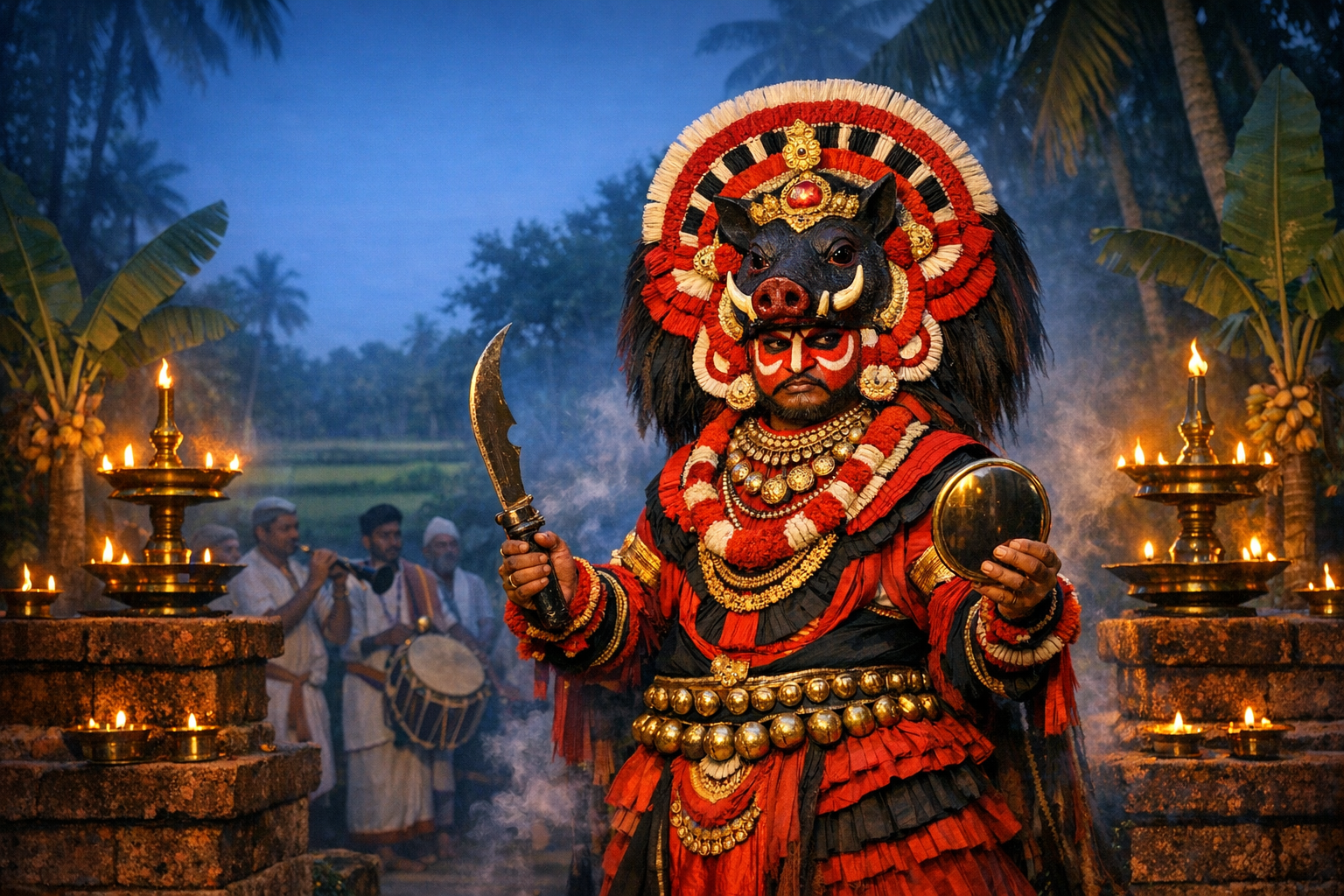
Across the Tulu-speaking belt of coastal KarnatakaDakshina Kannada, Udupi, and parts of KasaragodPanjurli Daiva is revered as a protective boar spirit whose presence safeguards fields, forests, and village boundaries. Rooted in the living tradition of Bhuta Kola (also called Daiva Kola), the Panjurli narrative is framed as a sacred descent from Kailasa, the abode of Shiva and Parvati, to guard the earth with compassion and justice. As a guardian, Panjurli mediates between human community, landscape, and dharma, and continues to anchor cultural identity in Tulunadu.
Sacred origin narratives transmit meaning rather than a single fixed plot. In an oft-told variant, a spirited boar in Kailasa disturbs the goddess’s garden; rather than destroy it, the divine couple ordains its descent to the mortal realm, charging it to uphold order and protect beings. In another strand, a royal hunt wrongs a boar whose awakened spirit is later installed as a village protector. Despite their differences, these oral histories converge on two themes central to dharma: compassion for the vulnerable and the restoration of balance between the wild and the cultivated.
Etymology and classification illuminate Panjurli’s place in regional ritual systems. Folk linguistics in Tulu commonly parse the name as panji (boar) + urli/urliya (young, sprightly), underscoring agility and vitality. Within the coastal taxonomy of spirit worship, Panjurli is addressed as a daivaan honored guardianwhose benevolent temperament contrasts with fiercer entities while remaining capable of enforcing justice.
Bhuta Kola, the ceremonial medium through which Panjurli is encountered, is a night-long, community-wide performance that unites music, dance, costume, and oracular speech. Lineage performers from Parava, Nalike, and Pambada communities undertake rigorous preparation before donning the Panjurli alankara (regalia). As drums and wind instruments build a charged ambience, the performer enters trance, and the daiva speaks, blesses, questions, and adjudicates. For many in Tulunadu, the flicker of oil torches, the cadence of ritual songs, and the moment of possession evoke childhood memories and a shared sense of belonging.
Oral epics known as paddanas are integral to Panjurli worship. Recited or sung in Tulu, paddanas recount the origin, migrations, covenants, and previous interventions of the daiva. They function as a mythic charter, articulating why Panjurli protects a hamlet, a family, or a stretch of land, and which norms constitute rightful conduct. Their narrative density preserves history, ecology, and ethics in a single performative archive.
The visual grammar of Panjurli Kola is technically sophisticated. The headgear often features stylized tusks and a boar-like visage, complemented by layered fabrics, metal ornaments, waist-bells that punctuate footwork, and hand-held blades emblematic of protection. Each componentmask, anklets, mirror, swordcontributes to the transformation of the human body into a mobile shrine, enabling the guardian to be both seen and heard.
Agrarian timeframes shape when Panjurli is propitiated. Kola calendars cluster around agricultural phasespost-sowing, pre-harvest, and after the monsoonwhen communities seek protection for paddy, arecanut, and coconut. Offerings, vows, and thanksgiving rites recognize Panjurli as a mediator at the forest–field edge, one who ensures coexistence between wildlife and cultivation and who safeguards water sources, soil fertility, and household well-being.
Social jurisprudence is a hallmark of Panjurli’s presence. During kola, the daiva hears disputes, elicits oaths, and pronounces daiva-neeti (rulings) that emphasize restitution, restraint, and truthfulness. While non-statutory, these decisions carry moral authority that regularly diffuses tensions over land, inheritance, and cooperation, reinforcing communal harmony without recourse to coercion.
Comparative dharmic perspectives situate Panjurli within a wider Indic imagination of guardian beings. The protective boar recalls Vaishnava theological memory of Varaha rescuing Bhudevi, while Shakta traditions venerate Varahi as a fierce yet protective mother, and Vajrayana Buddhism exalts Vajra Varahi in analogous terms of liberative power. Shaiva lineages honor ganas and bhairavas as kshetrapalas (field guardians), and Jain practice recognizes yakshas and yakshinis as protectors of sacred spaces. Read together, these traditions reveal a civilizational ethos of plurality and mutual respect, in which localized daivas like Panjurli complement, rather than compete with, pan-Indic deities.
Spatially, Panjurli resides in moola-sthanas (sacred groves) and daivasthanas (community shrines), and is also revered as a Kula Devata (lineage deity) by numerous families in coastal Karnataka. Clan-specific ties anchor ritual obligations that may include annual kola sponsorship, maintenance of the shrine precinct, and transmission of paddanas. This reciprocal covenantdevotees uphold the daiva’s seat, the daiva upholds devoteesbinds memory, territory, and identity.
Contemporary life has neither diminished Panjurli nor frozen the tradition. Urban migration has carried Bhuta Kola schedules to new venues; documentation by scholars and cultural practitioners has deepened public understanding; and popular cinema has brought unprecedented visibility to Daiva Kola. While films offer valuable exposure, responsible engagement distinguishes dramatization from liturgy and honors the authority of custodial communities.
The experiential texture of a Panjurli Kola is both aesthetic and ethical. Observers often report a palpable quiet when the daiva listens, a surge of relief when reconciliations occur, and a renewed commitment to shared duties when blessings conclude. That affective arcattention, adjudication, and assurancetranslates the abstract vocabulary of dharma into lived compassion.
Ultimately, the Panjurli Daiva storywhether narrated as a descent from Kailasa or as the sanctification of a wronged boarexpresses a singular intuition: the earth is guarded when justice is practiced with compassion. In Tulunadu, that intuition is renewed each season through Bhuta Kola, sustaining cultural heritage, ecological care, and interfaith respect within the broader family of dharmic traditions.
Inspired by this post on Hindu Blog.