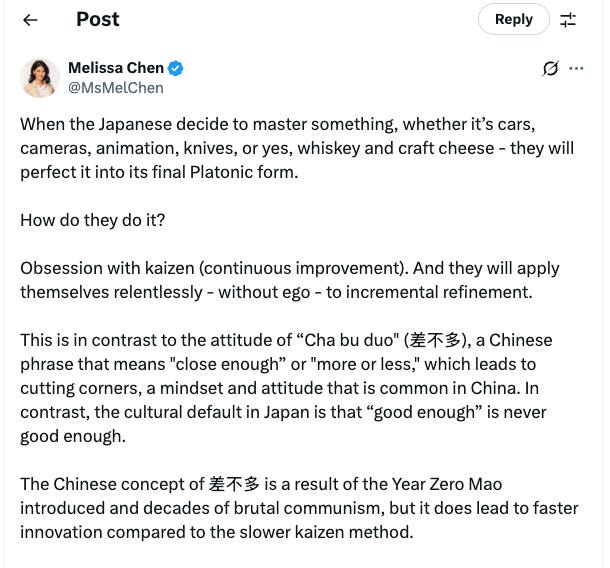
Recent commentary has spotlighted Japan’s remarkable reputation for quality, spanning pizzas and pastries to jeans, cars, and watches. Against this backdrop, a common contrast is drawn with the Chinese impulse of “Cha bu duo” (差不多)meaning “close enough”and with India’s “jugaad” culture. The assumption that Chinese or Indian excellence must remain unlike Japan’s has become a convenient narrative. Evidence from industrial history suggests otherwise.
Industrial cultures evolved along distinct pathways. Britain and the United States embraced mass manufacturing, emphasizing scale and standardization. France and Italy privileged artisanal manufacturing, elevating craftsmanship and aesthetics. Germany sought a synthesis: artisanal ambition in engineering and design combined with operational rigor at scale. This hybrid often created a conceptual separation between warm, inventive design and cool, calculating operations.
Japan initially attempted to imitate Western templates and discovered their limits. The turning point arrived as ideas from W. Edwards Deming and Joseph Juran intersected with Japanese thinkers such as Kaoru Ishikawa, Taiichi Ohno, and Genichi Taguchi. Rather than copying Western methods, Japan adapted them to domestic cultural strengths. The outcome was a profound industrial renaissance built on disciplined systems of quality, problem-solving, and scientific experimentation.
Central to this shift was transforming operators into craftspeople. Japanese art culture blends rules and discipline with flair and Iki, enabling creativity within clear boundaries. This ethos turned the shop floor into a studio for mastery, where craftspeople naturally interfaced with engineering and design. The feedback loopKaizenproduced relentless, incremental improvement punctuated by strategic leaps. The trajectory moved from quality to efficiency and later to design and innovation, a progression visible even in the refinement of Japanese packaging that many practitioners recognize immediately.

China demonstrates similar potential. State-led risk mitigation under the Chinese Communist Party enabled rapid scale and execution, expanding operations-driven industries. Over time, the maturation of markets, tolerance for experimentation, and acceptance of failure typically invite artistry and aesthetic ambition. As freedom to iterate grows, quality and design depth tend to followan evolution historically observed across industrial ecosystems.
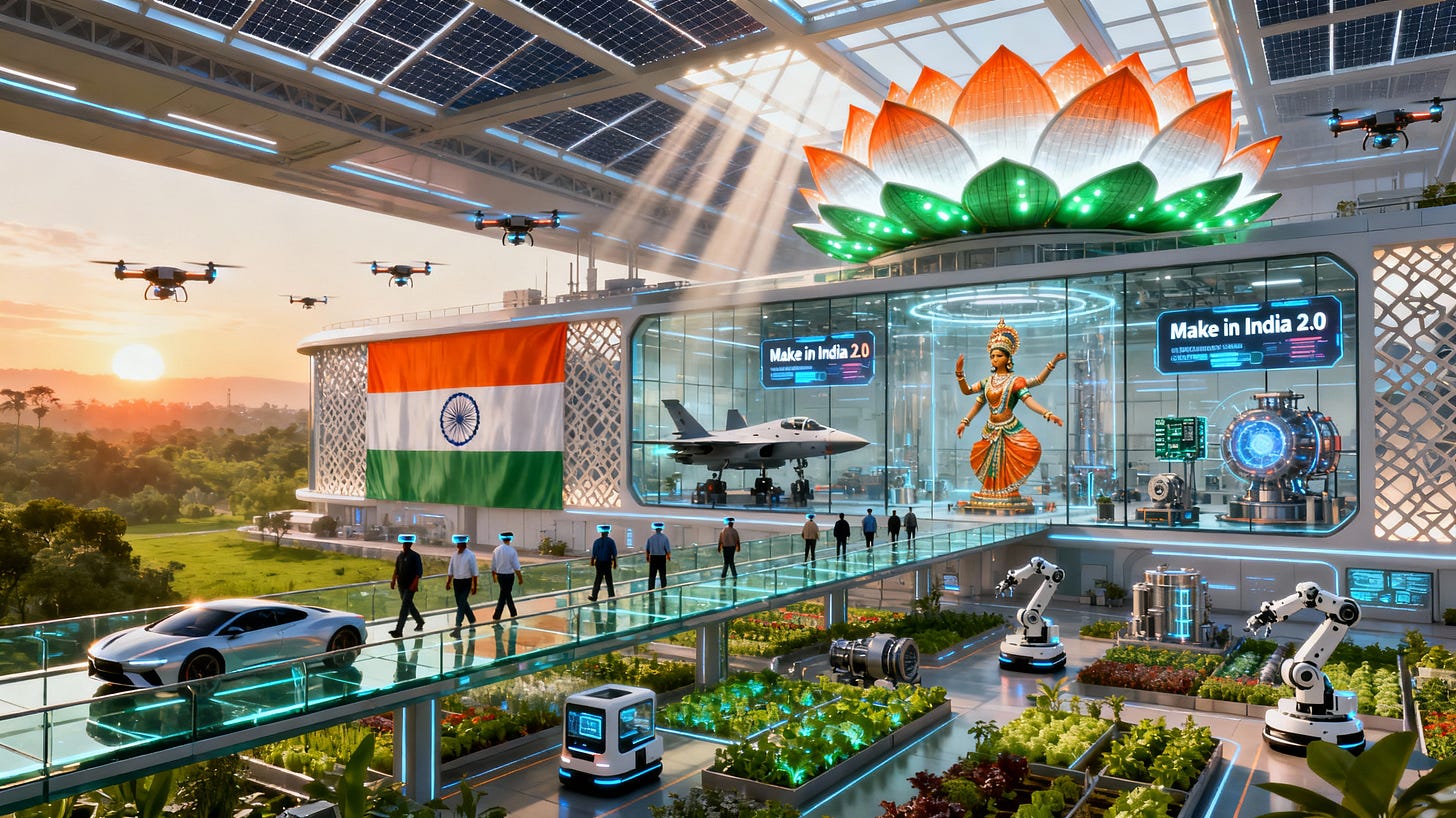
India’s pathway reflects a different constraint: risk. For decades, policy regimes increased entrepreneurial risk, prompting families to focus on creating safety nets rather than scaling ventures. That is changing. A new generation of risk-takers is emerging as policy attitudes shift from anti-wealth to pro-entrepreneurship. In the next two decades, Indian industry can craft its own pathway to manufacturing excellencetrying, failing, learning, and ultimately building a globally distinctive model of design, engineering, and operations.
Achieving this outcome requires adapting global best practices to Indian strengths rather than importing methods wholesale. Employment models, organizational design, and supply-chain strategies may look different from global norms. Apprenticeship systems that honor workmanship, shop-floor autonomy with accountability, and design-thinking embedded in operations can anchor a quality-first culture. When aligned with reliable logistics and data-rich feedback loops, these practices bolster export competitiveness and international trade.
This arc toward excellence aligns naturally with dharmic traditions common to Hinduism, Buddhism, Jainism, and Sikhism. Principles such as shraddha (devoted attention), tapas (disciplined effort), ahimsa in workmanship (care that avoids harm through defects), and seva (service to end-users and society) reinforce integrity, precision, and compassion in production. These shared values unify teams across backgrounds, strengthen accountability, and sustain the long-term commitment that world-class quality demands.
Practical levers are clear: institutionalize Kaizen and statistical quality control; revive craft-based learning through modern apprenticeships; integrate design and engineering with operations from concept to ramp; develop supplier quality partnerships; and leverage digital public infrastructure for transparent, real-time performance data. Together, these steps convert “jugaad” ingenuity into disciplined innovation without losing speed or frugality.
India can matchand in some sectors, redefineglobal quality benchmarks. The shift is not from creativity to conformity, but from improvisation alone to mastery anchored in systems, science, and shared dharmic values. With patience, practice, and purpose, the destination is not merely parity with Japanese quality; it is a distinctive Indian excellence that wins on reliability, beauty, and trust.
Inspired by this post on RightViews.