-
Syama Prasad Mookerjee’s Bold Blueprint for a United, Strong and Inclusive Bharat

Syama Prasad Mookerjee envisioned Bharat as one sovereign constitutional community in which cultural diversity and equal citizenship could reinforce each other. His best-documented arguments on Jammu and Kashmir appear in the Lok Sabha debate of 7 August 1952, where he combined support for peaceful accommodation with opposition to competing sovereignties. This analysis explains the Instrument…
-
West Bengal’s Nine-Member UCC Review Panel: What the High-Stakes Reform Means

West Bengal has constituted a nine-member committee led by retired Supreme Court judge Justice Ranjana Prakash Desai to review its draft Uniform Civil Code Bill, 2026. The panel is expected to examine marriage, divorce, maintenance, succession, adoption, child custody, live-in relationships and related family-law questions. This analysis explains Article 44, state legislative competence under the…
-
RSS Registration Debate: A Powerful Test of Freedom, Transparency, and the Rule of Law

The RSS registration controversy is a major constitutional test involving freedom of association, financial transparency and equal application of Indian law. Article 19(1)(c) protects the right to form associations, while Article 19(4) permits only legally grounded and reasonable restrictions. The absence of a universal registration requirement does not place any organisation beyond tax, criminal, property,…
-
Why Imported Secularism Still Fails India’s Dharmic Civilizational Reality

This essay examines why Western secularism does not map neatly onto India’s dharmic civilizational experience. It traces the term “secular” to European Christian conflicts between Church and State and contrasts that history with India’s decentralized traditions of Dharma, Rajadharma, sampradaya, and sacred plurality. The discussion explains how the 42nd Amendment inserted “secular” into the Preamble…
-
Constitutional Confusion: The Urgent Case for Fair Religious Studies in India

Article 28 of the Indian Constitution is often read as a strict barrier between religion and State-funded education, but the deeper issue is the difference between religious instruction and academic religious studies. This article explains why a secular republic can prohibit coercive religious teaching while still supporting rigorous scholarship on religion, philosophy, and civilization. It…
-
West Bengal Restores Pre‑2010 OBC List; 7% Quota Reset Prioritizes Lawful, Data‑Driven Equity

West Bengal has restored its pre‑2010 OBC list and reset the OBC quota to 7%, presenting the change as a law‑aligned, interim framework pending a fresh, data‑driven review. The move foregrounds constitutional compliance under Articles 15(4) and 16(4), adherence to Indra Sawhney benchmarks, and the need for quantifiable evidence of social and educational backwardness. By…
-
Virat Hindu Sammelan, Pune: A Bold Call for a Constitutional Hindu RashtraAnd Its Pathways

At a Virat Hindu Sammelan near Pune, Sunil Ghanwat called for collective, democratic efforts to pursue a constitutional Hindu Rashtra. This analysis clarifies what “Hindu Rashtra” can mean within India’s legal framework, distinguishing a civilizational, dharma-guided ethic from any theocratic model. It explains constitutional constraintsArticles 25–28, equality provisions, and the basic structure doctrinewhile mapping lawful,…
-
A Vision for Bharat: Shivamogga Sammelan Calls for Dharmic, Constitutional, Unifying Governance

At a provincial Hindu Rashtra Sammelan in Shivamogga on April 6, 2026, the Hindu Janajagruti Samiti (HJS) called for “Hindu Ideology-Based Governance” in Bharat. Read through a constitutional and inclusive lens, this can be translated into a broader, dharmic governance model that upholds pluralism, compassion, and rule of law for Hindus, Buddhists, Jains, Sikhs, and…
-
Patna’s ‘Hindu Rashtra Adhiveshan’: Bold Resolutions, Constitutional Debate, and Dharmic Unity

A State-level Hindu Rashtra Adhiveshan in Patna, organized by HJS, adopted three headline resolutions: removing “secular” from the Constitution, instituting a nationwide ban on cow slaughter, and creating national anti-conversion laws. This analysis situates each proposal within India’s constitutional framework, federal structure, and Supreme Court jurisprudence. Readers gain clear context on the Preamble’s evolution, Article…
-
Gujarat’s Uniform Civil Code Push: A Rights-First, Gender-Just Blueprint After Uttarakhand

Gujarat is moving toward a state-level Uniform Civil Code (UCC) after Uttarakhand, with a reported draft that mandates registration of marriages and live-in relationships, uniformly prohibits polygamy, and restricts practices described as halala. Anchored in Article 44 of the Directive Principles, the reform leverages state competence over family law while preserving freedom of religion by…
-
Shankhnad Mahotsav grant: constitutional tests, political critique, and dharmic unity

A ₹63 lakh Union grant to the Sanatan Rashtra Shankhnad Mahotsav sparked charges of unconstitutionality and hate speech risks. This analysis clarifies the constitutional position under Articles 14, 25–27, and 282, explains Indian hate speech jurisprudence, and sets out administrative safeguards under the General Financial Rules. Readers gain a standards-based checklist to assess whether cultural…
-
Revisiting ‘Secular’ in India’s Constitution: Sadguru Nilesh Singbal’s Call for Dharmic Unity
Sadguru Nilesh Singbal’s position challenges readers to re-examine how “secular” functions within India’s constitutional framework while calling for reform through Article 368. The analysis situates the debate within the 42nd Amendment and the Supreme Court’s basic structure doctrine, noting that secularism has been judicially recognized as intrinsic to the Constitution. It presents an inclusive, dharmic…
-
Essential Blueprint to Safeguard Dharma: Discover a Complete Strategy for Cultural Renewal

This essay presents an essential, academically grounded blueprint to strengthen dharmic unity and cultural confidence across Hinduism, Buddhism, Jainism, and Sikhism. It reframes Ghar-Wapsi (Parāvartana) as a voluntary, dignified reconnection within a broader strategy that includes lawful responses to coercive proselytisation, restoration of family-centered practices, and a forward-looking, entrepreneurial mindset. Drawing on P. V. Kane’s…
-
Proven Roadmap: Former Top Officials Urge Equal Religious Rights for Hindus in Hyderabad

A Hyderabad convening on 14 October 2025 brought together former senior officialsincluding M. Nageswar Rao, Dr. K. Aravinda Rao, and L. V. Subramanyamto advocate equal religious rights for Hindus under the Indian Constitution. The discussion emphasized constitutional parity, citing Articles 14, 15, and 25–28 as the bedrock of non-discriminatory religious freedom. Speakers argued that fair,…
-
Discover the Complete, Historically Accurate Origins of India’s ConstitutionBeyond Ambedkar

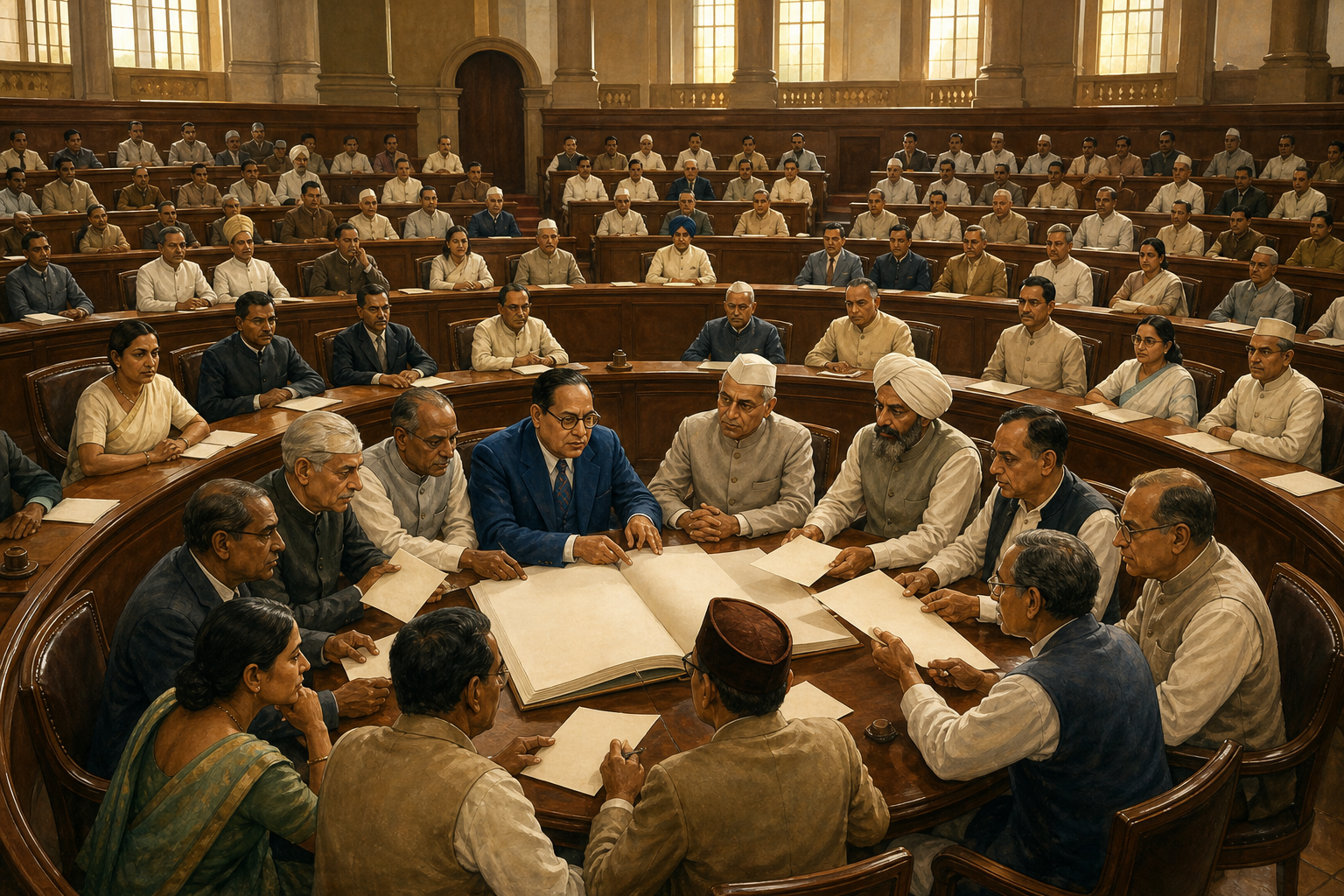
A recent public letter to the Hon’ble Chief Justice of India, Shri B. R. Gavai, urges retiring the shorthand “Babasaheb’s Constitution” in favor of historically accurate terminology. The analysis explains how the Constitution was framed by the Constituent Assembly, drafted under Dr. B. R. Ambedkar’s chairmanship, and informed by diverse Indian and comparative sources. It…