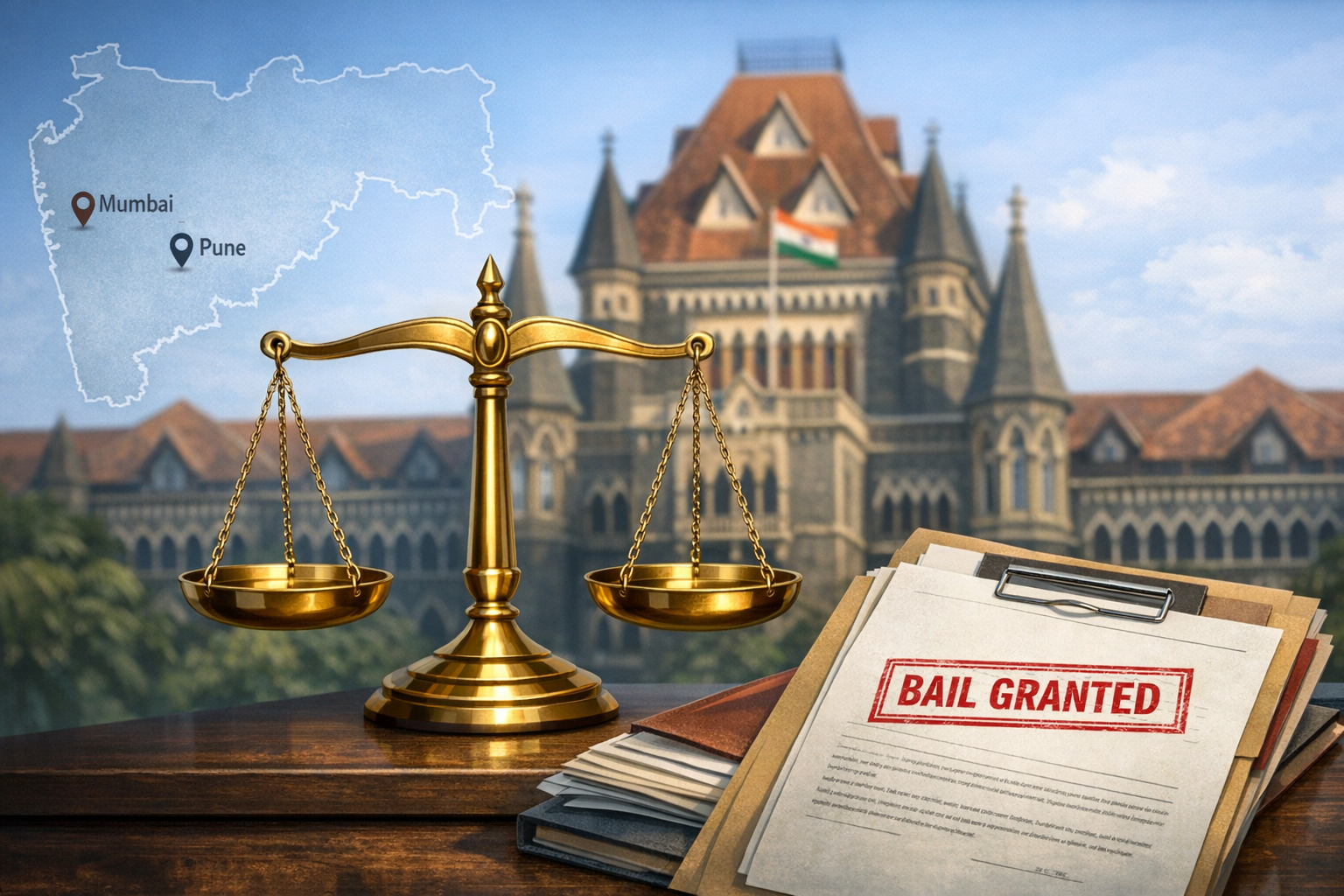
The Bombay High Court has granted bail to Sharad Kalaskar, an accused in the 2013 murder of Dr Narendra Dabholkar in Pune. The order marks a significant procedural development in a complex investigation and prosecution that has sustained public attention in Maharashtra and across India.
In Indian criminal jurisprudence, bail is a conditional release pending trial and not an adjudication on guilt or innocence. The decision reflects the principle that deprivation of liberty must be narrowly tailored and justified, consistent with the constitutional guarantee under Article 21. While the prosecution continues its case before the trial court, the High Court has determined that further incarceration is not necessary at this stage subject to court-imposed conditions. The order does not absolve the accused; it preserves the presumption of innocence while enabling the trial to proceed on evidence and law.
Dr Narendra Dabholkar, a well-known rationalist and founder of the Maharashtra Andhashraddha Nirmoolan Samiti (MANS), was shot dead during a morning walk in Pune on 20 August 2013. The killing triggered a nationwide conversation on civic values, the rule of law, and the responsibility of institutions to protect life and liberty. The case also intersected with policy debates in Maharashtra regarding the regulation of exploitative and violent practices, culminating in legislative action later that year.
The investigation, initially handled by local authorities, was later taken over by the Central Bureau of Investigation (CBI), reflecting the matter’s complexity and public importance. Multiple charge sheets have been filed over time, and several accused have been brought within the ambit of the prosecution. The trial remains the forum where the veracity of allegations, the reliability of forensic and testimonial evidence, and the legal culpability of each accused will ultimately be adjudicated.
Bail determinations in serious offences under Sections such as 302 (murder) and 120B (criminal conspiracy) of the Indian Penal Code are governed by Sections 437 and 439 of the Criminal Procedure Code. Courts weigh the gravity of the offence, the strength of the prima facie case as it appears at the bail stage, the likelihood of tampering with evidence or influencing witnesses, the risk of flight, parity with similarly placed co-accused, and the length of pre-trial incarceration. Supreme Court jurisprudence has consistently emphasized that “bail is the rule and jail the exception,” notably in decisions such as Sanjay Chandra v. CBI (2012), Kalyan Chandra Sarkar v. Rajesh Ranjan (2004), and Satender Kumar Antil v. CBI (2022), while also cautioning courts to calibrate liberty with the needs of justice and trial integrity.
High Courts typically impose safeguards while granting bailsuch as sureties, periodic attendance, restrictions on contact with witnesses, and travel limitationsto reduce risks to the trial process. If any condition is breached or fresh material emerges indicating interference with the administration of justice, the prosecution may seek cancellation of bail. This two-way framework protects individual liberty while preserving the court’s ability to ensure a fair, expeditious, and evidence-led adjudication.
For the public, especially those who admired Dr Dabholkar’s civic engagement, a bail order in a high-profile case can evoke unease. That response is understandable. Yet, the stability of the Justice System depends on the careful separation of two stages: a preliminary liberty assessment (bail) and the final determination of culpability (verdict). Maintaining this distinction strengthens due process, prevents prejudice, and upholds equality before lawvalues that ultimately serve victims, accused persons, and society at large.
From a broader societal perspective, moments like this call for restraint, civility, and unity. Across dharmic traditionsHinduism, Buddhism, Jainism, and Sikhismnon-violence, compassion, and truth-seeking are shared ideals. Allowing courts to function without polarization or presumption, and supporting a fair trial anchored in evidence, reflects these common values. Justice is best served when communities stand together for the rule of law and against any form of hatred or vigilantism.
Procedurally, the case now returns to the trial court, where the prosecution will continue to present witnesses and material evidence, and the defence will test that evidence through cross-examination. The court can revisit bail upon credible proof of violations, while also working to ensure a speedy trial, robust witness protection where needed, and adherence to evidentiary standards. The outcome will depend on the quality of the record built in court and the application of settled legal principles.
The key takeaway is precise: granting bail to Sharad Kalaskar is a legal determination about custodial necessity at this stage, not an exoneration on the merits. The Bombay High Court’s order underscores the balance Indian courts seek between personal liberty and the integrity of ongoing prosecutions. Sustained public faith in institutionsand a shared societal commitment to non-violence and constitutionalismwill be decisive as the Pune trial moves forward under judicial scrutiny.
Inspired by this post on Hindu Jagruti Samiti.