-
Congress, Khilafat, and the Crucial Question of Defending India Under British Rule

This study examines how Congress, the Khilafat leadership, the Muslim League, and British authorities approached national defence during the crises of 1921 and the Second World War. It explains why opposition to colonial rule did not remove India’s need to resist foreign conquest. Statements attributed to Maulana Abul Kalam Azad and Lala Lajpat Rai are…
-
Haldighati to Iran: Powerful Lessons on Why Battlefield Victories Still Fail

The Battle of Haldighati remains powerful because it separates battlefield victory from civilizational legitimacy. Maharana Pratap’s resistance shows that a ruler may lose a military encounter yet preserve moral authority for centuries. The article examines how Mughal expansion, Rajput alliances, and imperial statecraft must be studied with nuance rather than simplified as automatic nation-building. It…
-
Bharat Before 1947: Powerful Historical Evidence Against a Colonial Myth

The modern Republic of India began with independence in 1947 and constitutional consolidation in 1950, but Bharat as a civilizational idea is far older. This article separates modern statehood from cultural geography, sacred memory, political history, and dharmic continuity. It examines Bharatavarsha, the Constitution’s phrase ‘India, that is Bharat,’ the mahajanapadas, Ashokan inscriptions, pilgrimage networks,…
-
Vande Mataram at 150 (1875–2025): The stirring anthem that forged India’s unity

On 7 November 2025, India commemorates 150 years of Vande Mataram, the National Song that inspired the Indian independence movement and affirmed a shared civilizational identity. Composed by Bankim Chandra Chattopadhyay and later sung by Rabindranath Tagore, the hymn’s ethical vocabulary aligns with the values of Hinduism, Buddhism, Jainism, and Sikhism. Sri Aurobindo’s translation deepened…
-
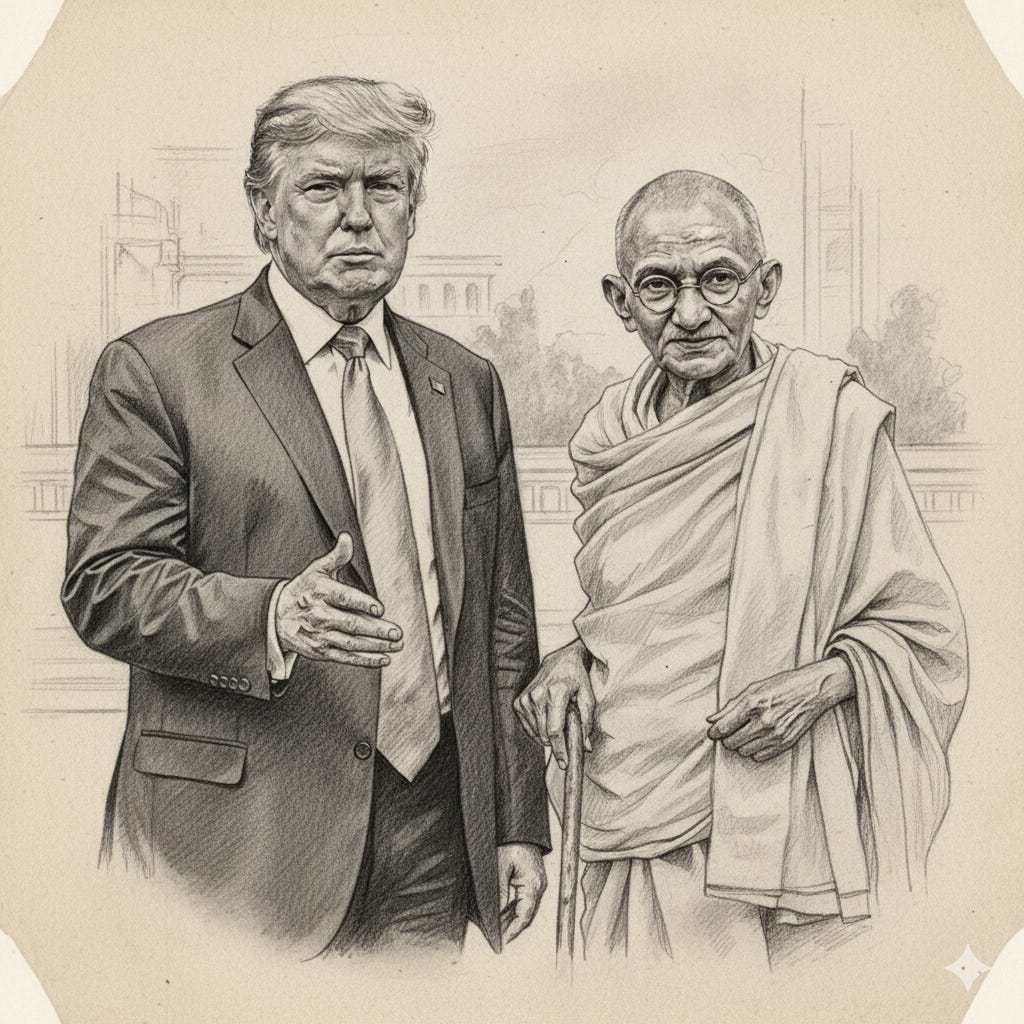
Discover Surprising Parallels: A Complete, Balanced Comparison of Trump and Mahatma Gandhi

An intergenerational conversation sparked a balanced comparison between Mahatma Gandhi and Donald Trump, examining abstinence, economic nationalism, and strategic non-cooperation across distinct historical contexts. The analysis highlights Gandhi’s Swadeshi and Satyagraha alongside MAGA-era reshoring and intraparty discipline, showing where tactics appear parallel and where they fundamentally diverge. It addresses contested leadership choices, complex stances on…
-
Déjà vu in Pakistan: The eerie similarities between 2023 and 1971

Pakistan is facing a complex set of political and economic challenges in 2023, which bear some striking similarities to the situation the country faced in 1971. In both cases, the popular electoral choice has been kept out of power, bad economic markers such as GDP and inflation have been on the rise, and regional identity…
-
US or China – Who started it?

There are many claims that it was the US, irked by China’s economic and geopolitical rise, started surrounding China with bases and military posts and thus threatened the Chinese. Is it correct? To understand the current predicament, we must understand what has happened between these two countries. Let us quickly breeze through the historical issues…
-
Understanding Manipur Dynamics

By Air Marshal Anil Khosla (Retd). Manipur was merged fully with the Indian Union on October 15, 1949, but it became a full-fledged state more than two decades later, in 1972. Manipur is known for its ethnic and cultural diversity. But the state has been plagued by internecine conflicts among different ethnic groups and tribes.…