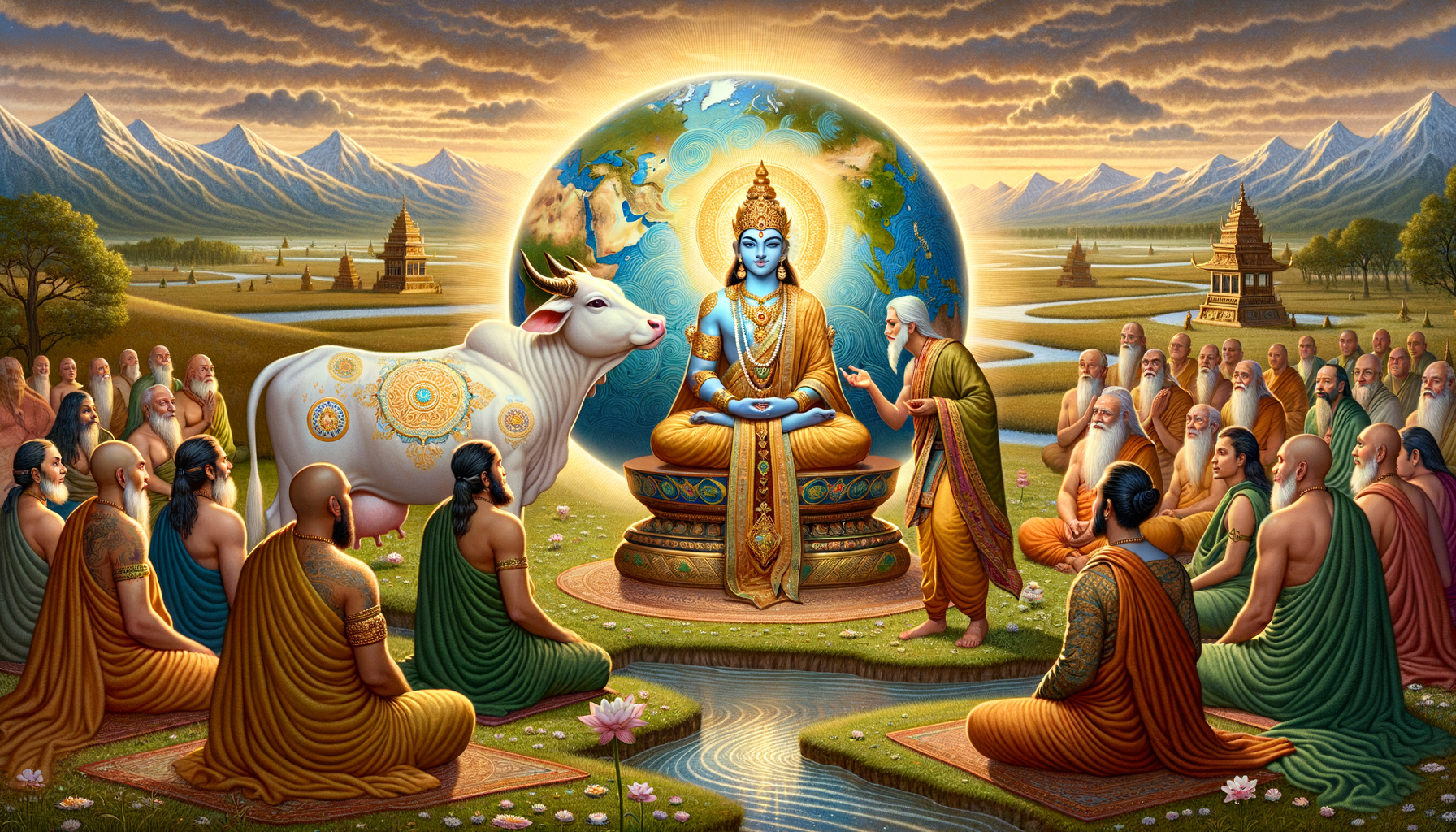
Why is the Earth called Prithvi? The Brahma Purana preserves a celebrated account of Prithu Chakravarthi, the archetype of righteous kingship, whose name became inseparable from Earth itself. The narrative, revered across Hindu scriptures, frames stewardship of Mother Earth as a sacred duty and aligns with the broader dharmic vision of ethical governance and ecological responsibility.
In this account, Bhishma enquires of Sage Pulastya regarding the mighty King Prithu, upon whom the Earth came to be known as Prithvi. Pulastya traces the lineage to Anga-Prajapati, a descendant of Swayambhuva Manu, and his queen Sunitha. Their line produced Vena, whose unrighteous rule disrupted cosmic and social order, leading the Earth to withdraw her bounty—an image that powerfully conveys how adharma undermines prosperity and harmony.
Seeking restoration, sages intervened and, through sacred rites, brought forth Prithu from Vena’s line as a divinely endowed ruler (often described as bearing a portion of Vishnu’s radiance). Enthroned to reestablish dharma, Prithu embodied the ideal of a Chakravarthi—one who governs for the welfare of all beings and the balance of the natural world.
The Purana depicts Earth personified as a cow, hesitant to yield her resources after the excesses of earlier misrule. Prithu pursued, persuaded, and ultimately assured protection, whereupon Earth consented to be “milked,” symbolizing the ethical extraction of abundance through justice, restraint, and wise policy. By leveling the land, promoting agriculture and irrigation, instituting fair measures, and codifying righteous conduct, Prithu made the world habitable and productive; hence, Earth came to be celebrated as Prithvi—honoring a kingship rooted in responsibility rather than dominion.
Beyond historical-theological detail, the narrative offers a timeless lesson on raja-dharma: leadership must be in service of life, law, and the land. Many readers find in this story a quiet awe—an emotional recognition that prosperity flowers when power is bound to duty. The imagery of Mother Earth responding to compassionate yet firm stewardship resonates deeply with contemporary concerns around environmental care and sustainable governance.
While highlighted in the Brahma Purana, the story’s motifs are echoed in the Vishnu Purana and the Srimad-Bhagavatam, illustrating a pan-puranic consensus on ethical rulership and ecological harmony. Read together, these sources illuminate a unifying dharmic insight shared across traditions: human flourishing is inseparable from reverence for nature and moral order.
For those engaged with the wider dharmic family—Hinduism, Buddhism, Jainism, and Sikhism—the account of Prithu aligns with shared principles of non-harm, responsibility, and compassionate governance. It invites reflection on how collective well-being arises when leaders and communities regard the Earth not as a mere resource but as a sacred trust. In this way, the name Prithvi becomes more than an etymology; it becomes a living reminder of dharma in action.
Inspired by this post on Hindu Pad.