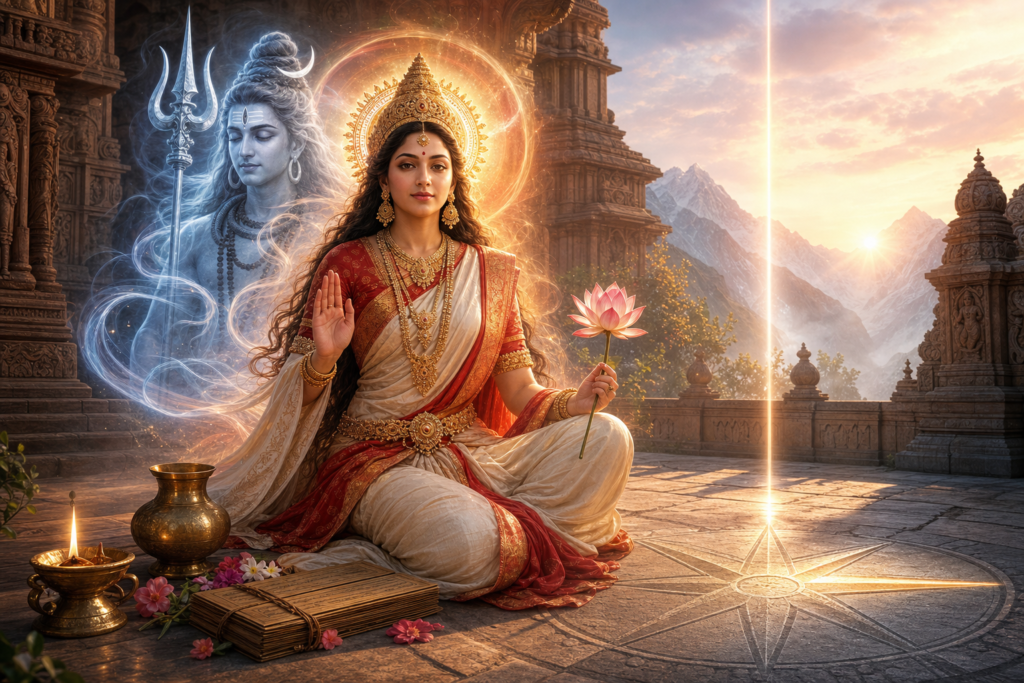
Jagadhatri (Maa Jagaddhatri) is revered as a compassionate and protective manifestation of Devi Durga, celebrated primarily in West Bengal and Odisha. In the living tapestry of Shakti traditions, Jagadhatri embodies calm strength, ethical clarity, and maternal carequalities that devotees associate with guidance through personal and collective challenges. As a Hindu Goddess, her worship affirms continuity within Hindu culture and offers a nuanced lens on devotional practice, philosophical inquiry, and cultural heritage.
A widely retold Puranic account describes Jagadhatri subduing the pride of the devas when ego eclipsed gratitude. In revealing herself as the Universal Goddess, she restores cosmic order and reminds all beings that dharma thrives in humility. This narrative serves as a meditative reflection on ahamkara (ego), illustrating a practical, ethical lesson: true power is quiet, discerning, and oriented toward the common good.
Iconographically, Jagadhatri is depicted with a serene countenance, seated upon a lion, signifying unwavering courage underlined by restraint. Four arms bearing traditional emblems convey vigilance, clarity, and steadfastness on the path of righteousness. The image functions as visual theology: the lion for moral strength, the emblems for ethical action, and the deity’s composure for inner equipoise. Together, they teach that spiritual sovereignty is inseparable from compassionate responsibility.
Jagadhatri Puja, observed after Durga Puja in many Bengali traditions, gathers communities across West Bengal and in parts of Odisha. Neighborhoods illuminate streets, artisans craft graceful murtis, and families offer aarti and bhajans with quiet devotion. The festival nurtures intergenerational bonds, safeguards intangible cultural heritage, and renews confidence in shared values. This continuity of practice, embedded in local rhythms, anchors the festival within the broader cycle of Hindu festivals and regional celebrations.
Devotees often describe the worship experience as inwardly steadying and emotionally uplifting. The soft glow of lamps, the cadence of mantra, and the collective resonance of conch and drum create a contemplative atmosphere that supports mindfulness. In many households, prasad is shared as an expression of gratitude, while community gatherings strengthen social cohesion and cultural continuity.
The ethic of overcoming ego that Jagadhatri illuminates resonates across dharmic traditions. In Buddhism, mindfulness and insights on anatta encourage freedom from self-clinging; in Jainism, aparigraha and ahimsa refine conduct through restraint and compassion; in Sikhism, the critique of haumai (ego) uplifts humility and service. These convergences affirm unity in diversity and demonstrate how Hinduism, Buddhism, Jainism, and Sikhism can walk in harmony toward wisdom and ethical living.
Practical engagement with Jagadhatri’s teaching can be contemplative and accessible. Reflective reading from Shakta texts, gentle mantra japa, and brief daily meditation on humility and compassion align inner life with dharmic action. Seva performed with sinceritysupporting community learning, cultural preservation, and interfaith dialoguetranslates devotion into shared wellbeing. Such practices strengthen personal resilience while nurturing social harmony.
Contemporary observances increasingly highlight responsible craftsmanship and environmental care in idol-making and immersion, aligning with dharmic stewardship of nature. As communities in India and the diaspora uphold Jagadhatri Puja, they reinforce cultural heritage alongside ethical innovation, ensuring that tradition remains living, relevant, and inclusive.
In essence, Jagadhatri offers a scholarly and devotional bridge between philosophy and practice. As a form of Devi Durga and an embodiment of Devi Shakti, she invites reflection on humility, service, and compassionate strengthprinciples that guide seekers toward inner clarity and collective harmony.
Inspired by this post on Hindu Pad.