
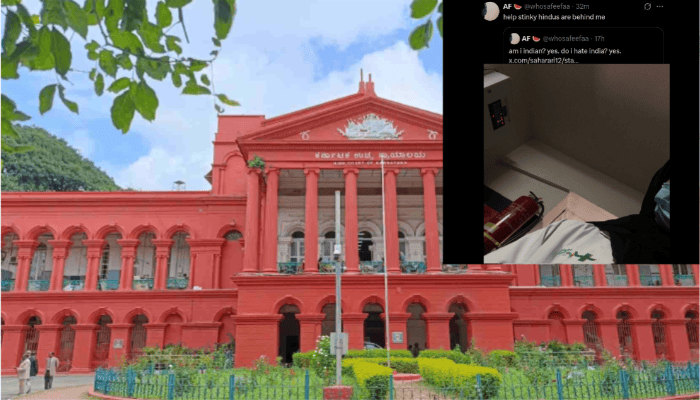
The decision in brief. The Karnataka High Court has quashed the criminal case against 24-year-old dietitian Afeefa Fathima arising from social-media posts that were alleged to disparage Hindus and express hostility toward India. Justice M. Nagaprasanna passed the order on 23 June 2026 in Afeefa Fathima v. State of Karnataka & Another, Criminal Petition No. 8108 of 2026, neutral citation 2026:KHC:31172. The relief covered Crime No. 78 of 2025 registered by Mangaluru South Police Station, also identified in contemporaneous coverage as Pandeshwar Police Station, under Sections 196(1)(a) and 353(2) of the Bharatiya Nyaya Sanhita, 2023. The case was pending before the JMFC II Court in Mangaluru. The decisive feature was an affidavit in which Fathima expressed regret over any offence or misunderstanding, promised greater restraint, and undertook not to repeat conduct giving rise to similar allegations.
The outcome is emotionally difficult for many readers because the alleged language was not a detached criticism of policy. It targeted Hindus as a community in crude terms, and such collective contempt can wound people who encounter it in an already tense public atmosphere. Yet a court proceeding must still be described through evidence, statutory ingredients, procedural safeguards, and the exact relief granted. Respect for Hindu dignity and respect for due process are not competing commitments. A constitutional legal order is tested precisely when public anger is strongest: it must take group-directed hostility seriously while refusing to convert outrage, identity, or media labels into a substitute for adjudication.
How the controversy began. Reports published in April 2025 identified Fathima as a dietitian employed by Highland Hospital in Mangaluru. Screenshots attributed to her account on X circulated widely in the days after the 22 April 2025 Pahalgam terrorist attack, when public grief and anxiety were exceptionally high. The statements reported across multiple outlets included “Help stinky Hindus are behind me” and “am I an Indian? Yes. do I hate India? yes.” Capitalisation and spelling varied among screenshots and news reports, but the substance was consistent. Because Fathima later denied making hate speech or intending to promote enmity, the careful legal description remains “alleged posts” rather than an unqualified finding that she authored every circulating image.
Highland Hospital terminated her employment after the posts went viral. Its human-resources officer, Mohammad Aslam, lodged a complaint, after which police registered the FIR under the two BNS provisions. Contemporary reporting also stated that police summoned Fathima, seized the phone said to have been used for the posts, and began forensic examination. Those investigative claims belong to the 2025 reporting; the High Court’s later quashing order did not publish a forensic finding or decide the authenticity of each screenshot. This distinction matters because a viral screenshot, an employer’s response, a police allegation, and a judicial determination are four different forms of information with different evidentiary weight.
A reporting discrepancy that should not be repeated as fact. Some later articles asserted that a second FIR was lodged against Fathima at Konaje Police Station on the complaint of Satish Kumar. Contemporaneous reports by India Today and Public TV, however, described that Konaje matter as a separate case against a Facebook user called “Nichchu Mangaluru” over a post concerning the Pahalgam attack. The reported High Court order identifies only Crime No. 78 of 2025 of Mangaluru South Police Station. On the available record, therefore, a second Konaje FIR against Fathima should not be presented as established.
What Section 196(1)(a) alleges. Section 196 of the Bharatiya Nyaya Sanhita addresses the promotion of enmity between groups and acts prejudicial to harmony. Clause 196(1)(a) covers words, signs, visible representations, electronic communications, and other means that promote or attempt to promote disharmony or feelings of enmity, hatred, or ill will between groups on grounds such as religion, race, birthplace, residence, language, caste, or community. The charged form carries imprisonment that may extend to three years, a fine, or both. It is not enough in a final criminal adjudication merely to dislike the words; the prosecution must connect the alleged communication to the statutory act, protected group ground, and required promotion or attempted promotion of the prohibited inter-group hostility.
What Section 353(2) alleges. Section 353 concerns statements conducing to public mischief. Subsection (2) applies to the making, publication, or circulation—including by electronic means—of a statement or report containing false information, rumour, or alarming news, when done with intent to create or promote, or in circumstances likely to create or promote, enmity, hatred, or ill will between specified groups or communities. It also provides a maximum three-year term, a fine, or both. The provision therefore has its own textual components, including the nature of the information and the intended or likely group-harm. It should not be collapsed into Section 196 merely because both provisions use the vocabulary of enmity and hatred.
The two charged variants carry significant procedural consequences. Under the First Schedule to the Bharatiya Nagarik Suraksha Sanhita, the relevant forms are classified as cognizable and non-bailable, although “non-bailable” does not mean that bail is impossible; it means release is not an automatic statutory entitlement and is governed by judicial discretion. A separate safeguard appears in Section 217 of the BNSS. A court may not take cognizance of an offence under Section 196 without previous sanction of the Central or State Government, while cognizance of an offence under Section 353(2) requires previous sanction of the Central Government, State Government, or District Magistrate. Sanction is a gate at the cognizance stage, not the same thing as a finding of guilt. The reported Fathima order did not rest on or decide a sanction dispute.
Why the High Court could intervene before trial. Fathima approached the High Court under Section 528 of the BNSS, which preserves the High Court’s inherent power to make orders necessary to give effect to the Sanhita, prevent abuse of a court’s process, or otherwise secure the ends of justice. This is the successor to Section 482 of the Code of Criminal Procedure. It permits a High Court, in an appropriate case, to terminate an FIR or consequential proceeding without waiting for a full trial. The jurisdiction is discretionary and exceptional; it is neither a routine appeal against an FIR nor a miniature trial in which disputed evidence is ordinarily resolved.
Fathima reportedly argued that continuation of the case would expose her to serious prejudice and irreparable hardship through coercive investigative measures. More importantly for the eventual result, she placed a sworn affidavit before the High Court. In it, she denied making hate speech or intentionally promoting enmity, hatred, or ill will and stated that she respected all religions and communities as well as India’s sovereignty and integrity. She nevertheless expressed sincere regret if any alleged post had been perceived as offensive or had caused misunderstanding. The wording is legally important: it combined denial of culpable intent with conditional regret and was not framed as an unconditional admission of the prosecution’s allegations.
The affidavit also contained a forward-looking undertaking. Fathima promised to exercise utmost care, restraint, and responsibility on social-media platforms and assured the Court that no similar situation would recur because of her conduct. Her counsel represented that the posts depicting the impugned conduct would be deleted. A sworn undertaking to a constitutional court is more consequential than a casual public-relations apology: the court may rely upon it when moulding relief, and a later breach can be brought back to judicial attention. At the same time, consequences are not self-executing; the order would still have to be invoked and any alleged breach assessed through lawful procedure.
What Justice Nagaprasanna ordered. The Court took the affidavit and counsel’s assurance on record, considered it appropriate to “obliterate the crime,” and directed deletion of the posts remaining on Fathima’s account that depicted the alleged conduct. It then allowed the petition and quashed Crime No. 78 of 2025, insofar as it concerned her, along with the proceeding pending before the JMFC II Court in Mangaluru. The Court added a clear caution that any breach of the affidavit’s undertaking would be “viewed seriously.” Accounts of the order are available from 24Law and LiveLaw.
Quashing is not the same as acquittal after trial. An acquittal normally follows adjudication in which the prosecution’s evidence is tested and guilt is found not proved. Quashing removes the criminal proceeding through the High Court’s inherent jurisdiction, often before that evidentiary process is complete. Here, the practical result is that Fathima no longer faces Crime No. 78 of 2025 and its consequential proceeding, subject to the terms recorded by the High Court. But the order should not be rewritten as a trial finding that every screenshot was fabricated, that every alleged word was lawful, or that all ingredients of the two BNS sections were affirmatively disproved.
The converse is equally important. Quashing does not supply a legal basis for describing Fathima as criminally guilty after the case has ended without conviction. The presumption of innocence was never displaced by a final verdict. A responsible account can accurately say that she was booked over alleged posts, that she denied hate-speech intent, that she gave a regretful undertaking, and that the Court quashed the FIR on that basis. It should not silently turn allegations into adjudicated facts merely because the reported words were offensive or because the initial public reaction was intense.
What the order did not decide. The brief, affidavit-centred disposition did not set out an element-by-element ruling on Sections 196(1)(a) and 353(2). It did not decide whether the “false information, rumour, or alarming news” component of Section 353(2) was satisfied; whether the posts created the required inter-group relationship; how authorship would be proved; or whether the necessary intent or likelihood could be inferred from context. It also did not announce that regret automatically cancels liability for alleged hate speech. The operative reasoning is consequently narrow and fact-specific: this petitioner, this affidavit, this promise of deletion, this warning, and this crime number.
That narrowness is central to the order’s precedential value. A reasoned judgment that interprets statutory ingredients can guide many future cases. An order that grants relief after recording a personal undertaking may still be cited, but its usefulness depends heavily on comparable facts and judicial discretion. It should not be treated as a general licence to publish group-directed insults and later obtain quashing by filing an apology. Nor should it be portrayed as holding that an affidavit must always be rejected whenever collective sentiments are implicated. The decision can be read as a reformative judicial response, not a universal formula.
“Anti-national” and “hate speech” are descriptions, not substitutes for charges. Much of the coverage called the posts “anti-national” and “anti-Hindu hate speech.” Those phrases communicate the controversy, but neither was the formal name of a free-standing charge in this FIR. Police invoked Sections 196(1)(a) and 353(2), and each has defined ingredients. A declaration of hatred toward India may be provocative and socially alienating, yet criminal liability cannot be inferred from the media adjective “anti-national” alone. Likewise, “hate speech” is an analytical category spanning several offences; courts must identify the exact statutory prohibition, mental element, target, context, and likely harm.
The constitutional framework explains why that precision matters. Article 19(1)(a) of the Constitution of India protects citizens’ freedom of speech and expression. Article 19(2) permits reasonable legal restrictions in specified interests, including India’s sovereignty and integrity, public order, defamation, and incitement to an offence. Protection of speech therefore does not mean immunity for every targeted provocation; equally, public distaste does not by itself satisfy a criminal section. The legal inquiry must remain tied to enacted restrictions, proportionality, context, and the prosecution’s burden.
The Supreme Court’s hate-speech jurisprudence reinforces that contextual approach. In Amish Devgan v. Union of India, the Court examined the target group, content, speaker, audience, context, intent, and likely consequences, and distinguished legitimate criticism from speech whose purpose is to vilify a community. These principles illuminate the broader field, but the Fathima order did not publish a full application of that framework to the screenshots. Any claim that the High Court definitively ruled the alleged words to be constitutionally protected, or definitively found them to constitute hate speech, would therefore go beyond the order.
The unusual feature of the case. Alleged offences under Sections 196 and 353 concern public harmony, not merely a private disagreement that two individuals can settle between themselves. The notable feature is thus the Court’s reliance on the accused’s own affidavit, deletion commitment, and future restraint to terminate a proceeding alleging collective harm. That approach can be read as reformative: cessation, remorse, and non-repetition were treated as capable of securing justice in the circumstances. It also leaves a legitimate policy question for legal observers—how courts can apply comparable standards consistently across speakers, ideologies, religions, and targeted communities without creating a perception of selective indulgence.
The difference between remorse and admission deserves particular care. Fathima’s statement, as reported, did not simply concede every allegation. It said, in substance, that she respected all communities and regretted any offence if content attributed to her had been perceived that way. Courts frequently distinguish an unconditional apology, a conditional expression of regret, a denial coupled with an undertaking, and an admission of facts. The High Court nevertheless considered this formulation sufficient when combined with deletion and non-repetition. Public summaries should preserve that nuance rather than claiming either that she fully confessed or that she offered no regret at all.
Deletion has practical but limited effects. Removing a post can stop the account holder from continuing to publish it and may reduce future exposure. It does not erase copies, screenshots, quotations, archives, or reposts already held by others. Nor does a deletion direction, by itself, authenticate every circulating screenshot. The reported order was directed to posts on Fathima’s account; it was not described as a general blocking order against the platform or the entire internet. For digital-evidence purposes, deletion and preservation are distinct questions, but because the FIR itself was quashed, the order prioritised removal and future restraint over continued criminal investigation.
The employment consequence also remains legally separate. Highland Hospital’s termination occurred in response to the 2025 controversy. Quashing the FIR does not automatically reinstate Fathima, invalidate the hospital’s decision, or award employment relief; the criminal petition did not adjudicate those matters. Conversely, an employer’s disciplinary action does not prove a criminal offence. This separation between workplace governance and criminal liability is essential in online-speech cases, where reputational and professional consequences often arrive within hours while forensic verification and legal proceedings take far longer.
Why the alleged insult still matters. Hindus are entitled to equal protection from demeaning group stereotypes and calls to hatred. The law loses legitimacy if hostility is minimised because of the target’s majority status, just as it loses legitimacy if allegations against a minority individual are used to stigmatise an entire religious population. The most defensible principle is neutral enforcement: the same statutory threshold, evidentiary care, opportunity to be heard, and proportionality should apply whether the targeted people are Hindu, Buddhist, Jain, Sikh, Muslim, Christian, or members of any other community. Equality before law requires consistency both in registering serious cases and in granting relief.
A dharmic commitment to dignity can coexist with that neutrality. Hindu, Buddhist, Jain, and Sikh traditions contain distinct philosophies and histories, yet each has resources for disciplined speech, non-hatred, responsibility, and restoration after wrongdoing. Unity among these traditions is not strengthened by collective retaliation against another faith, and the conduct alleged against one person cannot rationally be imputed to millions who share some aspect of her identity. The better response condemns contempt directed at Hindus, insists on accurate legal accountability, and refuses to reproduce the same logic of communal generalisation that made the alleged post objectionable.
Lessons for social-media users. A short post can produce employment loss, police investigation, device seizure, years of litigation, and an enduring digital record. Irony, private-audience assumptions, deleted context, or impulsive anger may not survive screenshot circulation. Anyone commenting on religion or national identity should assume that words can be detached from their original thread and assessed by employers, police, courts, and strangers. The safest civic norm is not compelled silence but deliberate specificity: criticise conduct, institutions, or ideas with evidence; avoid degrading an entire people; verify claims; and pause when a traumatic event has made the audience especially receptive to fear or hostility.
Lessons for institutions. Police should identify the precise statutory ingredients rather than rely on broad labels, preserve original account data, distinguish an insult from false or alarming information, and document the context relevant to intent and likely public-order harm. Employers should use fair internal procedures proportionate to the role and verified conduct. Courts should explain why quashing serves justice in public-harm cases and how undertakings will be treated across comparable disputes. Newsrooms should separate allegation from proof, identify case numbers and statutory sections, and correct contradictions such as the Konaje-FIR confusion. These disciplines protect both vulnerable communities and accused persons.
The Court’s warning gives the order continuing moral and procedural weight even though the FIR has ended. Fathima obtained relief because the Court relied on her promise of caution and non-repetition. A future allegation would be assessed on its own facts and under the law then applicable, but the recorded undertaking could become relevant; the judgment expressly signalled that breach would be taken seriously. The order therefore cannot fairly be summarised as consequence-free. In practical terms, the relief was accompanied by deletion, restraint, and a representation made on oath to the High Court.
Final assessment. The Karnataka High Court did not endorse the alleged slur, pronounce it harmless, or conduct a trial that exonerated Fathima on every factual issue. It exercised inherent jurisdiction to end a specific FIR after receiving a sworn statement of regret, respect, caution, deletion, and non-repetition. Readers may reasonably debate whether that response was sufficiently rigorous for allegations affecting public harmony. That debate is strongest when anchored in the actual order: Crime No. 78 of 2025 was quashed; the posts were to be deleted; the undertaking was recorded; breach was warned against; and no broad merits ruling on the BNS provisions was delivered.
This account draws on the case identifiers and operative details reported by 24Law and LiveLaw, the detailed source report from OpIndia, contemporaneous 2025 reporting, and the official texts of the BNS, BNSS, Constitution, and Supreme Court jurisprudence linked above. Where news reports conflict, the narrower proposition supported by the identified High Court proceeding has been used.
Inspired by this post on Hindu Post.







Leave a Reply
You must be logged in to post a comment.