
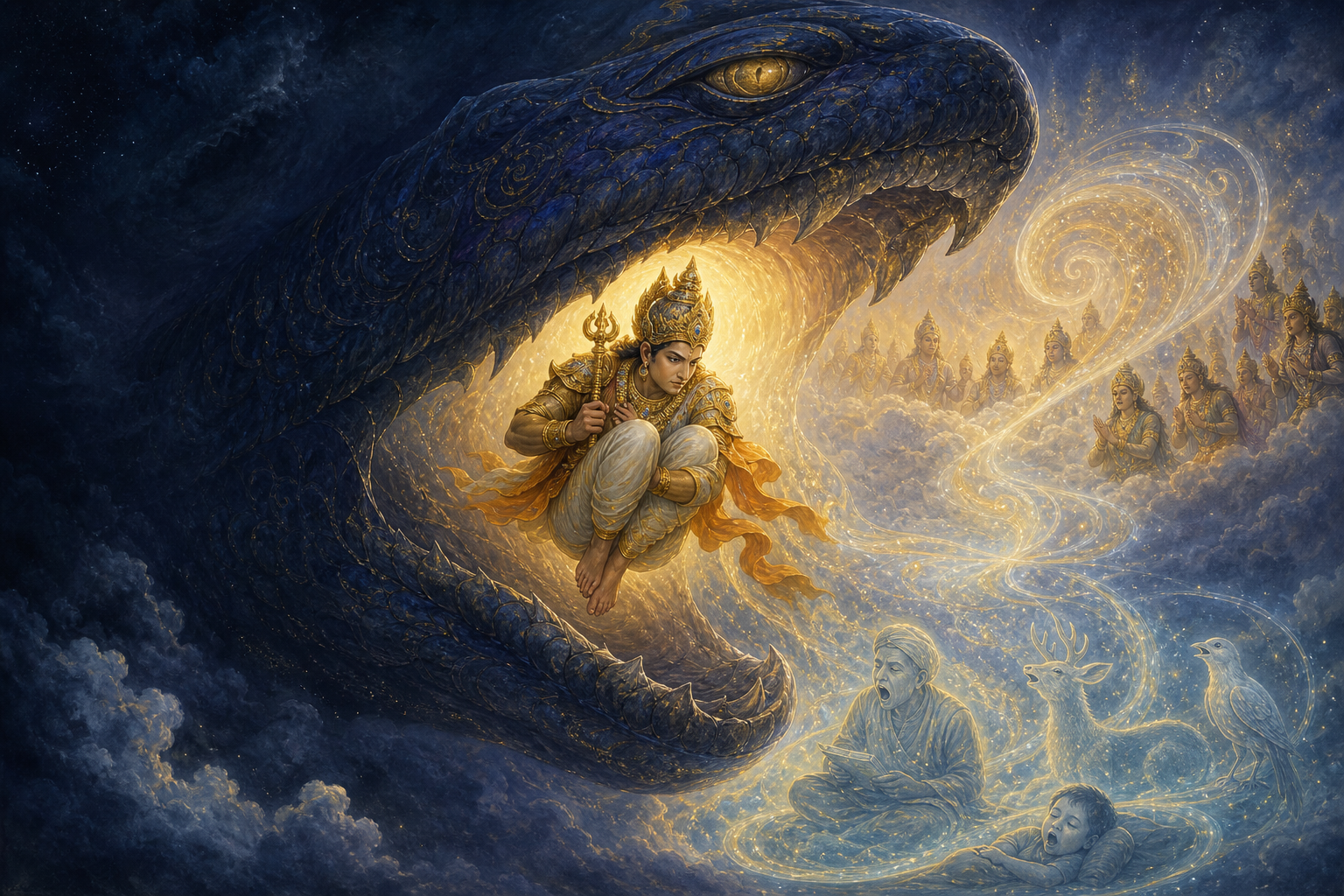
Few bodily actions feel as ordinary, involuntary, and universally recognizable as a yawn. It appears beside a lamp during late-night study, in a child resting on a parent’s shoulder, and in an animal stretching at dawn. Yet the Mahabharata gives this modest action a cosmic biography. In the Udyoga Parva, a yawn opens the jaws of Vritra at the precise moment when Indra, ruler of the Devas, is trapped inside him. What follows is more than an entertaining explanation of yawning: it is a tightly constructed reflection on fear, vulnerability, intelligent action, moral consequence, and recovery after apparent defeat.
The account is best understood as a sacred literary etiology—an origin narrative that connects an everyday feature of embodied life with an event in the divine realm. It does not attempt to provide a physiological theory in the modern scientific sense. Its subject is the meaningful place of yawning within a moral and cosmic story. When this distinction is preserved, the legend can be studied both respectfully and critically, without reducing scripture to biology or treating modern biology as a substitute for literary and philosophical interpretation.
Where the origin-of-yawning story appears
The central episode occurs in Book 5 of the Mahabharata, the Udyoga Parva. In the chapter numbering commonly used by Sanskrit editions, the decisive passage is found in 5.9.47–48; in the English prose translation associated with Kisari Mohan Ganguli, it appears in Section IX. Numbering and spelling can differ among editions, so readers may encounter Śalya as Shalya or Salya, Tvaṣṭṛ as Twashtri, Vṛtra as Vritra, and Jṛmbhikā as Jrimbhika. These variations generally reflect transliteration systems rather than different characters.
The two verses about yawning belong to a much longer narrative extending across several sections. The wider account begins with Shalya’s arrival during preparations for the Kurukshetra conflict and ends only after Indra’s restoration to sovereignty. Isolating the yawn from that frame produces a charming anecdote; restoring the frame reveals a sophisticated meditation on leadership, accountability, and endurance.
Why Shalya tells Yudhishthira this ancient history
Shalya, king of Madra and maternal uncle of Nakula and Sahadeva, initially travels with the intention of supporting the Pandavas. Duryodhana arranges lavish hospitality along his route without immediately disclosing who has sponsored it. Pleased by the reception and believing it to have come from Yudhishthira’s side, Shalya offers a boon. When Duryodhana reveals himself, he claims that promise and secures Shalya’s military support. Shalya considers himself bound by his word, although his familial affection remains with the Pandavas.
After informing Yudhishthira of this development, Shalya agrees to assist indirectly when he becomes Karna’s charioteer. The conversation then turns from political strategy to emotional fortitude. Shalya acknowledges the exile, humiliation, concealment, and suffering endured by Yudhishthira, Draupadi, and the Pandavas. He argues that even the greatest beings can pass through periods of distress and apparent powerlessness. Indra’s ordeal is introduced as the paradigmatic example.
Yudhishthira asks how Indra and his queen could have experienced such terrible misery. Shalya replies by offering an itihāsaṃ purātanam, an ancient account. His purpose is not merely to promise victory. He seeks to show that present suffering need not define the final outcome, that power can be lost and recovered, and that courage includes the ability to remain composed while circumstances appear irreversible.
The conflict begins before Vritra appears
The chain of events begins with Tvaṣṭṛ, a divine artisan and Prajāpati, and his three-headed son Triśiras, who is also identified as Viśvarūpa in the passage. Triśiras undertakes formidable austerities. The text describes him as disciplined, restrained, gentle, and devoted to religious practice. His growing ascetic power alarms Indra, who fears that the ascetic may eventually displace him from the celestial throne.
Indra first sends celestial nymphs to distract Triśiras from his austerities. Their efforts fail because he maintains control over his senses. Indra then chooses violence, striking him with the Vajra. Even after Triśiras falls, Indra remains afraid of his radiance and persuades a carpenter to sever the three heads. The carpenter initially objects that the act is condemned by the righteous and raises the problem of killing a Brahmana. Indra promises both protection and a ritual share in return for compliance.
This opening matters because it prevents the later conflict from becoming a simple contest between an entirely innocent champion and an inexplicably evil opponent. Vritra emerges from grief, anger, and an earlier misuse of power. When Tvaṣṭṛ learns that his self-controlled son has been killed, he performs a rite, makes an offering into the fire, and creates the formidable Vritra. He commands the new being to grow through the strength of his austerities and to kill Indra.
The name Vṛtra is commonly associated with the Sanskrit verbal root conveying covering, enclosing, or obstructing. That semantic field suits both the older Vedic image of Vritra restraining the waters and the epic image of his body enclosing Indra. In the Mahabharata episode, obstruction becomes startlingly physical: the ruler of heaven is not merely defeated but swallowed.
Indra disappears into Vritra’s mouth
Vritra grows until his form seems to fill the sky, then enters the celestial realm in obedience to Tvaṣṭṛ’s command. A fierce battle begins between Vritra and Indra. The confrontation initially overturns the expected hierarchy. Vritra seizes Indra—here called Śatakratu, the performer of a hundred sacrifices—opens his mouth, and swallows him. The cosmic ruler is reduced to a living body trapped inside another body.
The gods become bewildered when Śakra, another name for Indra, vanishes into Vritra. Their response is neither resignation nor a direct assault. They create Jṛmbhikā, the power of yawning. Vritra’s mouth opens as he yawns, and Indra contracts or draws together his limbs so that he can pass through the opening. He emerges alive. The text then states that from that time onward Jṛmbhikā came to abide among living beings in the worlds.
The relevant Sanskrit reads:
ग्रस्ते वृत्रेण शक्रे तु संभ्रान्तास्त्रिदशास्तदा ।
असृजंस्ते महासत्त्वा जृम्भिकां वृत्रनाशिनीम् ॥४७॥
विजृम्भमाणस्य ततो वृत्रस्यास्यादपावृतात् ।
स्वान्यङ्गान्यभिसंक्षिप्य निष्क्रान्तो बलसूदनः ।
ततः प्रभृति लोकेषु जृम्भिका प्राणिसंश्रिता ॥४८॥
A close working translation is: When Śakra had been swallowed by Vritra, the gods became bewildered. Those mighty beings created Jṛmbhikā, the destroyer of Vritra. Then, as Vritra yawned, the slayer of Bala emerged from his opened mouth after drawing together his own limbs. From that time onward, Jṛmbhikā came to dwell among living creatures throughout the worlds.
The immediate result is rescue, not final victory. The gods rejoice when Indra emerges, but the battle resumes and continues for a long time. Vritra again gains the advantage through his own strength and the ascetic force of Tvaṣṭṛ. Indra retreats. This detail corrects a frequent simplification: the yawn does not kill Vritra, and Indra does not win the war merely by escaping through the opened jaws. Jṛmbhikā creates a possibility of survival; subsequent victory requires further deliberation and divine cooperation.
What Jṛmbhikā means in Sanskrit
Jṛmbhikā is a feminine Sanskrit noun related to the verbal root jṛmbh, which carries the sense of yawning, gaping, opening the mouth, or stretching. The grammar allows the phenomenon to be presented as an active, almost personified power. English retellings consequently describe Jṛmbhikā in different ways: as Yawning itself, a being created by the gods, a force directed against Vritra, or a yawn-inducing agency.
The passage does not supply Jṛmbhikā with a separate genealogy, personality, cult, or extended biography. It is therefore more precise to describe Jṛmbhikā as the personified power or event of yawning than to construct an elaborate goddess narrative unsupported by these verses. Mythic personification enables an involuntary bodily action to enter the story as an intentional participant.
Several grammatical details sharpen the scene. Asṛjan is plural: the gods create Jṛmbhikā collectively. Vijṛmbhamāṇasya depicts Vritra in the act of yawning. Āsyād apāvṛtāt indicates emergence from the opened mouth. Aṅgāny abhisaṃkṣipya emphasizes Indra gathering or contracting his limbs, while niṣkrāntaḥ marks his exit. Rescue therefore depends on both the opening supplied by Jṛmbhikā and Indra’s disciplined bodily response.
The expression prāṇisaṃśritā combines prāṇin, an animate or living creature, with a form conveying dwelling in, resorting to, or becoming associated with. Lokeṣu means in the worlds. Popular summaries often expand the line into the claim that every living being began to yawn. The Sanskrit makes a broad collective statement about yawning taking up residence among living creatures; it is not framed as a quantified claim about every organism recognized by modern biological taxonomy.
Indra’s many epithets can also cause confusion in translation. Within a few verses he may be called Indra, Śakra, Vāsava, Śatakratu, Devendra, or Balasūdana. The final title means the slayer of Bala and identifies the emerging figure as Indra. It should not be mistaken for a new combatant or taken to mean that Vritra is slain at the moment of escape.
The battle after the yawn
After Indra retreats, the gods and sages assemble on Mount Mandara and seek Vishnu’s assistance. Vishnu proposes conciliation as the preliminary strategy and promises to enter Indra’s Vajra invisibly at the appropriate time. The sages approach Vritra and encourage peace between the two enemies. Vritra agrees only after obtaining protections designed to make his death nearly impossible.
His conditions specify that Indra and the gods must not kill him with anything dry or wet, with stone or wood, with a weapon used at close range or a missile, or during day or night. Indra accepts the peace but continues searching for an opening within its terms. One evening, at a time understood as neither full day nor full night, he sees an immense mass of sea foam. Foam appears neither conventionally dry nor conventionally wet, and it is not ordinarily classified as a weapon.
Indra hurls the foam, joined with the power of the Vajra, while Vishnu enters it. Vritra is killed. This victory is built upon liminal categories: twilight between day and night, foam between water and air, and a substance between weapon and non-weapon. The pattern echoes the earlier escape through a mouth poised between closure and opening. The epic repeatedly locates transformation at boundaries where rigid categories become unstable.
Victory, however, does not erase moral consequence. The narrative says that Indra is overcome by the burden of falsehood and by the sin associated with killing Tvaṣṭṛ’s three-headed son. He withdraws and hides in the waters, and the worlds suffer in the absence of their ruler. Nahusha is elevated to the celestial throne, becomes corrupted by power, and threatens Indra’s queen, Sachi. Through a further sequence involving Sachi, Brihaspati, the gods, the sages, and Vishnu, Nahusha falls and Indra is eventually purified and restored.
Shalya completes the account by making its relevance explicit. Indra endured loss, fear, concealment, separation from his queen, and displacement from sovereignty, yet he eventually recovered his position. Yudhishthira likewise endured exile and concealment with Draupadi and his brothers. Shalya presents the divine precedent as reassurance that prolonged suffering can end and rightful order can return.
The analogy is rhetorically powerful but morally unequal. Yudhishthira is primarily portrayed as one who has suffered injustice, whereas Indra’s crisis partly arises from his own fear-driven actions. That difference enriches the instruction. Restoration is possible for the wronged, but even a celestial ruler cannot escape accountability for decisions made while protecting power. Courage and ethical scrutiny must remain together.
How the epic retells an older Vedic conflict
The Indra–Vritra conflict is much older than this episode of the Mahabharata. A foundational form appears in Rigveda 1.32, where Indra strikes Vritra, frequently represented as a serpent or enclosing obstacle, and releases the waters that had been held back. Tvaṣṭṛ fashions Indra’s weapon in that hymn, and the liberation of waters stands at the center of the praise. The yawn, Indra’s swallowing, and Jṛmbhikā do not form part of that particular Rigvedic narration.
The epic version should therefore be read as a creative reshaping of a durable mythic complex, not as a simple prose expansion of one Vedic hymn. It adds Triśiras’s death, Tvaṣṭṛ’s vengeance, Vritra’s swallowing of Indra, the origin of yawning, a negotiated truce, the sea-foam stratagem, Indra’s moral burden, Nahusha’s temporary kingship, and Sachi’s role in recovering divine order. The older theme of obstruction and release remains, but it is redirected through political, ethical, and bodily imagery.
This transformation demonstrates how an epic tradition preserves continuity without remaining static. Vritra still encloses; Indra still seeks release; cosmic order still depends on overcoming obstruction. Yet the Mahabharata turns the conflict into a study of anxious kingship, the consequences of pre-emptive violence, negotiated protections, ambiguous strategy, and restoration after moral injury.
Why an ordinary yawn receives a cosmic origin
An etiological story explains why a familiar feature of the world exists by locating its beginning in a formative event. Such narratives do more than answer a question of cause. They place the ordinary within a meaningful order. In this case, every familiar opening of the mouth can recall the instant when enclosure failed and life escaped apparent annihilation.
The movement from the cosmic to the bodily is especially elegant. The gods create Jṛmbhikā to solve an emergency in heaven, but the solution does not disappear when the crisis ends. It descends into the shared condition of living creatures. The body becomes a kind of archive: an involuntary action preserves the memory of a divine rescue even when the creature performing it knows nothing of the ancient battle.
The tale also reverses common expectations about heroic power. Indra does not escape by expanding, striking, or displaying overwhelming force. He escapes by making himself smaller. The decisive act is contraction rather than conquest. The opened jaws provide opportunity, but survival requires immediate awareness and adaptive control.
Literary and philosophical dimensions of the opened jaws
Vritra’s mouth functions as an image of total enclosure. Once Indra is swallowed, the visible ruler of heaven is absent and the normal structure of command seems to collapse. The yawn interrupts that apparent finality. A space regarded as sealed becomes permeable. Read at the literary level, the scene suggests that even a complete defeat may contain an unrecognized opening.
Indra’s contraction of his limbs adds a second dimension. Escape is not passive. The gods can create the opening, but Indra must recognize it and alter his own form. The scene thereby joins external assistance with self-command. Neither element is sufficient alone: opportunity without readiness can close unused, while effort without an opening can remain trapped.
Liminality links the yawn episode with Vritra’s eventual death. The first turning point occurs at the threshold of an opened mouth; the second occurs at twilight with sea foam. In both cases, survival or victory depends on something difficult to classify. The narrative imagination is drawn toward margins, transitions, and overlooked states rather than straightforward displays of superior strength.
The episode also qualifies the idea of the solitary hero. Indra is indispensable, but he does not save himself unaided. The gods create Jṛmbhikā, the sages deliberate, Vishnu supplies decisive power, and later figures contribute to the restoration of celestial order. Leadership in this account is relational. Even the ruler of the Devas depends upon counsel, community, and capacities beyond his own.
At an emotional level, the swallowed Indra embodies a fear recognizable far beyond a battlefield: the feeling that a crisis has become larger than the person facing it. The scene does not deny that fear. It dramatizes it at a cosmic scale and then identifies a narrow but real path through it. This is one reason the legend remains compelling even for readers who approach it primarily as literature.
Fear, violence, and the complexity of dharma
The narrative’s ethical chain begins with anticipation rather than actual attack. Indra fears what Triśiras might become. Attempts at distraction fail, so fear hardens into pre-emptive violence. That killing produces Tvaṣṭṛ’s grief and anger; the anger produces Vritra; Vritra’s rise produces war; and the war leads to further deception and suffering. The crisis is therefore generated not by a single isolated villain but by interacting choices, injuries, powers, and reactions.
This structure is characteristic of the Mahabharata’s resistance to simple moral arithmetic. Defeating a dangerous opponent may restore order while still leaving an ethical burden. Possession of divine office does not make every action righteous, and victory does not retroactively purify every means used to obtain it. Indra’s disappearance after Vritra’s death ensures that accountability remains part of the triumph.
Shalya’s lesson to Yudhishthira consequently contains more than a promise that the powerful eventually win. It teaches that catastrophe is survivable, that wise assistance matters, and that rightful restoration may follow concealment and loss. At the same time, the surrounding narrative warns leaders against allowing insecurity to become injustice. Courage without self-examination can merely begin the next cycle of conflict.
The Mahabharata’s origin of yawning and modern physiology
The epic’s sacred etiology should not be confused with a medical account. Modern research describes a yawn as a stereotyped, coordinated motor pattern involving a gradual inspiratory phase, substantial opening or stretching around the jaw and pharynx, a brief climax, and an expiratory phase with muscular relaxation. Neural control involves brainstem networks as well as modulation from hypothalamic, limbic, and cortical regions. Even with these anatomical observations, researchers have not reached a single consensus about yawning’s principal function.
Proposed functions include regulation of arousal during transitions between waking and sleep, thermoregulatory effects, stretching or repositioning of muscles associated with the airway, and forms of social communication or behavioral synchronization. These hypotheses need not all describe the same aspect of the behavior, and evidence remains under discussion. The once-common idea that yawning is simply a response to insufficient oxygen does not provide a complete explanation of its timing, neural organization, or social contagion.
Spontaneous and contagious yawning must also be distinguished. A spontaneous yawn can occur without observing another individual, especially around changes in vigilance or sleep state. A contagious yawn is triggered by perceiving or even thinking about yawning and has been investigated in relation to attention, social processing, and group coordination. The Mahabharata passage concerns the primordial appearance of yawning among living beings; it does not separately theorize these behavioral categories.
Modern zoological evidence finds yawning or yawn-like stereotyped movements across many vertebrate species, but this does not mean that every organism classified as living performs a yawn. Plants, microorganisms, and numerous other forms of life fall outside the ordinary behavioral category. The Sanskrit prāṇin is most naturally read here as animate or breathing creature within the epic’s world, not as a technical equivalent of every member of the modern biological kingdoms.
The scientific and epic accounts answer different kinds of questions. Neuroscience asks how a yawn is generated and what functions its motor pattern may serve. The epic asks how yawning entered the meaningful history of living creatures and what that history reveals about danger, rescue, and cosmic order. Their methods are different, and neither gains from being forced into the other’s category.
Enduring lessons from the Indra–Vritra legend
The first lesson is that courage is not identical with invulnerability. Indra is seized, swallowed, forced to retreat, displaced from office, and driven into concealment. Shalya selects this very figure to encourage Yudhishthira because recovery carries greater emotional force when the depth of the preceding crisis is acknowledged.
The second lesson concerns readiness. Jṛmbhikā creates only a momentary opening. Indra survives because he responds immediately and adapts his body to the available path. In ordinary life, opportunities for resolution are often similarly narrow: assistance may appear, but attentiveness and disciplined action remain necessary.
The third lesson is that strategy must be evaluated together with ethics. The episode admires intelligence, timing, and the recognition of overlooked possibilities. Yet the wider narrative refuses to make cleverness self-justifying. Indra’s use of ambiguous categories defeats Vritra, but the moral burden of falsehood and earlier violence does not vanish.
The fourth lesson is the importance of collective wisdom. The gods create Jṛmbhikā; the sages deliberate; Vishnu empowers the decisive action; Sachi and Brihaspati later help reverse Nahusha’s abuse of authority. The narrative repeatedly shows that no office, however elevated, makes cooperation unnecessary.
The fifth lesson is humility before shared embodiment. A yawn crosses distinctions of rank and prestige. A ruler, scholar, laborer, child, and animal may all be interrupted by the same involuntary movement. The epic turns that commonality into sacred memory. The smallest bodily gesture can remind a powerful being that life is dependent, vulnerable, and connected.
A unity-oriented Dharmic reading
This narrative belongs specifically to the Sanskrit Mahabharata and should not be reassigned indiscriminately to Buddhism, Jainism, or Sikhism. Genuine unity among Dharmic traditions does not require their scriptures, doctrines, or historical identities to be collapsed into one another. It grows through accurate representation, respectful study, and recognition of areas in which distinct traditions sustain meaningful conversations about restraint, responsibility, suffering, awareness, compassion, and liberation from harmful cycles.
From that perspective, the Indra–Vritra legend offers a constructive point of reflection. Fear produces harm when it escapes ethical discipline; power remains answerable for its effects; assistance can arise through community; and an apparently sealed condition may contain an opening. Readers from different Dharmic backgrounds can engage these themes without claiming that every tradition interprets the characters or cosmology in the same way.
Four points that careful retellings should preserve
A textually careful retelling should preserve four distinctions. In this passage, the gods collectively create Jṛmbhikā; Brahma is not named as its sole creator. The yawn enables Indra’s escape but does not immediately kill Vritra. Vritra is later slain through the twilight-and-sea-foam strategy empowered by Vishnu. Finally, the origin statement belongs to sacred epic narration and should not be presented as a substitute for biological research.
It is also important to read beyond the spectacular moment. The yawn occupies only a few lines, while its meaning depends on Triśiras’s death, Tvaṣṭṛ’s response, Indra’s fear, Vritra’s strength, the resumed battle, the negotiated protections, and Indra’s later suffering. The surrounding material transforms a curious origin story into a study of how crises begin, how beings survive them, and why victory alone cannot settle the question of dharma.
Primary texts and research for further reading
The central Sanskrit verses, their grammatical forms, and the surrounding chapter can be examined in Mahabharata 5.9. The older English prose rendering is available in Udyoga Parva, Section IX. Shalya’s political and emotional framing appears in Section VIII, while the truce, sea foam, Vishnu’s intervention, and Indra’s withdrawal continue in Section X. Shalya’s final application of the narrative to Yudhishthira appears in Section XVIII.
For comparison with the older Vedic form of the conflict, Rigveda 1.32 should be consulted in a reliable Sanskrit edition and modern scholarly translation. For the current scientific state of the question, the peer-reviewed review Yawning and Airway Physiology describes the motor pattern and emphasizes the absence of consensus about its principal function, while Yawning—Its Anatomy, Chemistry, Role, and Pathological Considerations surveys its neural organization and clinical dimensions.
The cosmic memory inside an everyday breath
The origin of yawning in the Mahabharata lasts only a moment: Vritra’s jaws open, Indra gathers his limbs, and the captive ruler slips back into the worlds. Yet that moment carries the weight of the entire surrounding narrative. It remembers injury and consequence, terror and assistance, vulnerability and intelligent response. The next ordinary yawn can therefore be read, within the epic imagination, as an echo of a cosmic opening—the instant when what appeared to be an ending became a path of escape.
Inspired by this post on Hindu Blog.



Leave a Reply
You must be logged in to post a comment.