
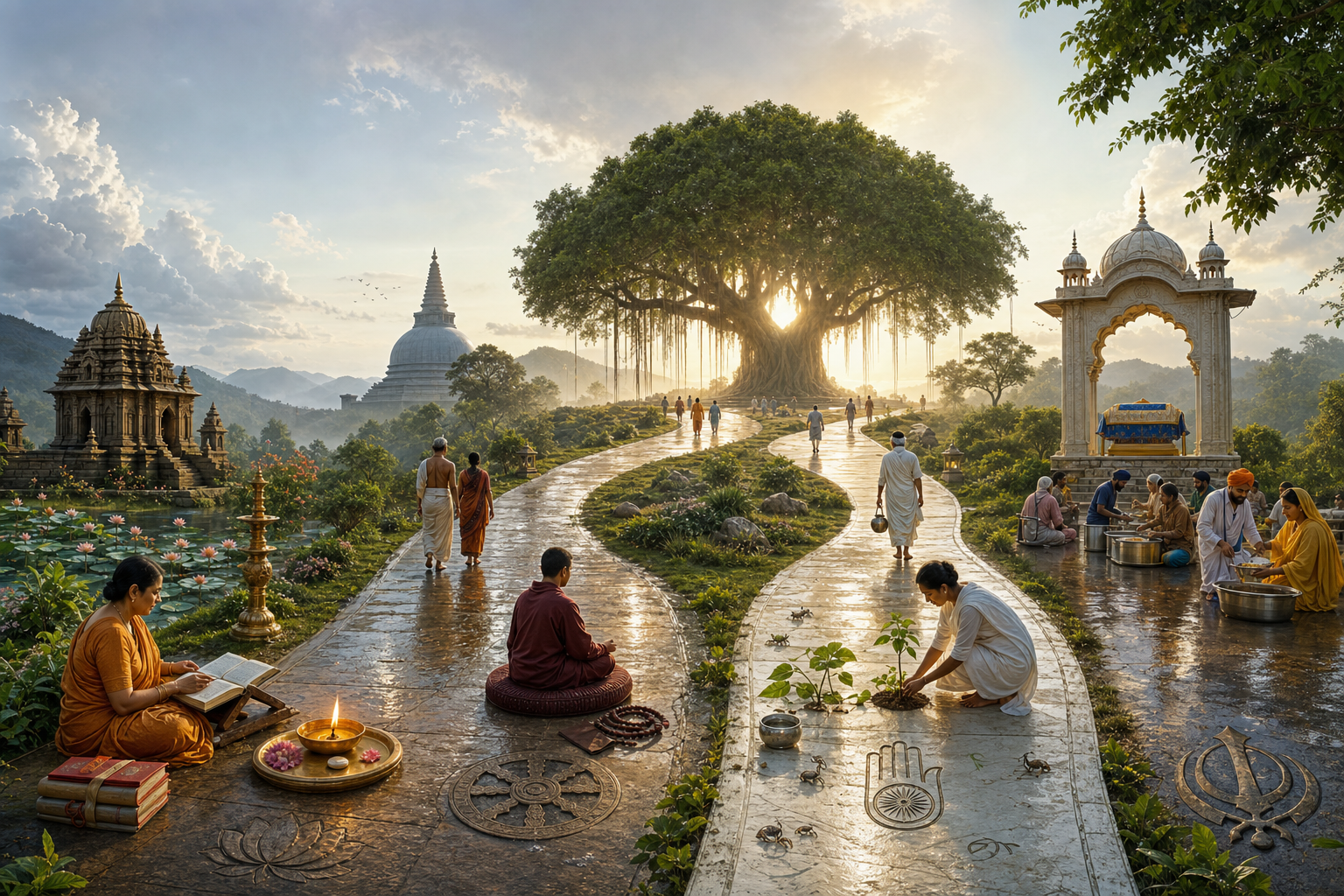

The meaning of “The Aim is One.” The phrase presents a powerful invitation to examine unity without demanding uniformity. Within the Dharmic traditions of Hinduism, Buddhism, Jainism and Sikhism, spiritual life is described through different scriptures, metaphysical systems, disciplines and communities. Yet each tradition asks human beings to confront ignorance, selfishness, harmful conduct and the instability of ordinary life. Each also proposes a disciplined path toward greater freedom, moral clarity and responsibility. The shared aim is therefore best understood as a direction of ethical and spiritual transformation, not as a claim that every doctrine is identical.
This distinction matters. A shallow account of unity says that all paths teach precisely the same thing and that their differences can be ignored. A more rigorous account recognizes that differences carry philosophical, historical and devotional significance. Buddhist anātman cannot simply be equated with the Hindu ātman; Jain jīva has a distinct ontological meaning; and the Sikh understanding of Ik Oṅkār, hukam and the Guru belongs to a theological framework of its own. Genuine unity protects these distinctions while identifying areas in which communities can learn, serve and coexist together.
A comparative framework. Academic comparison becomes clearer when four levels are kept separate. The first is diagnosis: what causes suffering, bondage or moral disorder? The second is goal: what constitutes liberation, awakening or union with the highest reality? The third is method: which forms of knowledge, meditation, devotion, conduct and service produce transformation? The fourth is social expression: how should an awakened or disciplined person treat other beings? Similarities frequently appear at the levels of practice and ethics even when the metaphysical explanations remain different.
Why July offers a meaningful setting. In much of South Asia, July overlaps with Āṣāḍha or Śrāvaṇa, depending on the regional lunisolar calendar. The monsoon historically encouraged periods of reduced travel, intensified study, teaching and contemplative discipline. Hindu and Jain communities developed forms of Chaturmas observance, while Buddhist communities maintained the related but distinct rains retreat known as vassa. These traditions did not create one interchangeable institution, but they responded to a shared ecological rhythm: when travel became difficult and small forms of life multiplied, restraint, study and non-harm acquired renewed practical importance.
July also commonly brings observances associated with teachers, pilgrimage, sacred narratives and community gathering. Guru Purnima has particular importance in several Hindu, Buddhist and Jain settings, although its meanings vary. Sikh tradition approaches Guruship through the unique authority of the ten historical Gurus, Guru Granth Sahib and the Guru Panth; it should not be absorbed casually into another tradition’s festival structure. The month therefore offers an ideal lesson in unity with precision: reverence for guidance is widely shared, but the identity and authority of the Guru are understood differently.
A shared civilizational conversation. Hindu, Buddhist, Jain and Sikh traditions emerged within the Indian subcontinent and developed through centuries of debate, adaptation and mutual influence. They inherited or engaged overlapping vocabularies concerning dharma, karma, meditation, liberation, renunciation, household responsibility and disciplined conduct. These terms never possessed a single fixed definition. Their meanings changed across Sanskrit, Pali, Prakrit, Apabhramsha, Punjabi and numerous regional languages. Shared vocabulary is evidence of a sustained intellectual conversation, not proof of doctrinal sameness.
The word dharma itself demonstrates this complexity. Depending on context, it can refer to duty, sustaining order, ethical conduct, teaching, truth, a quality of existence or the constitutive elements analyzed by a philosophical system. Sikh usage often employs dharam within a scriptural and ethical world shaped by devotion to the One, truthful living and divine hukam. Buddhist texts use dhamma for the Buddha’s teaching and, in technical contexts, for phenomena. Jain and Hindu sources employ dharma in still other legal, ethical, cosmological and soteriological senses. Respectful dialogue begins by asking what a term means within its own tradition before translating it into a universal formula.
Hindu approaches to liberation. Hinduism contains many sampradāyas and philosophical schools rather than a single theory of the ultimate aim. Advaita Vedānta describes liberation through realization of the non-duality of ātman and Brahman. Viśiṣṭādvaita emphasizes a qualified non-dual relation among the Divine, individual selves and the cosmos, with devotion and surrender playing central roles. Dvaita preserves an enduring distinction between the individual soul and the Supreme. Yoga, Sāṅkhya, Nyāya, Mīmāṃsā, Śaiva, Śākta and bhakti traditions add further accounts of knowledge, grace, disciplined action and divine relationship. Moksha is a recurrent aspiration, but its interpretation is genuinely plural.
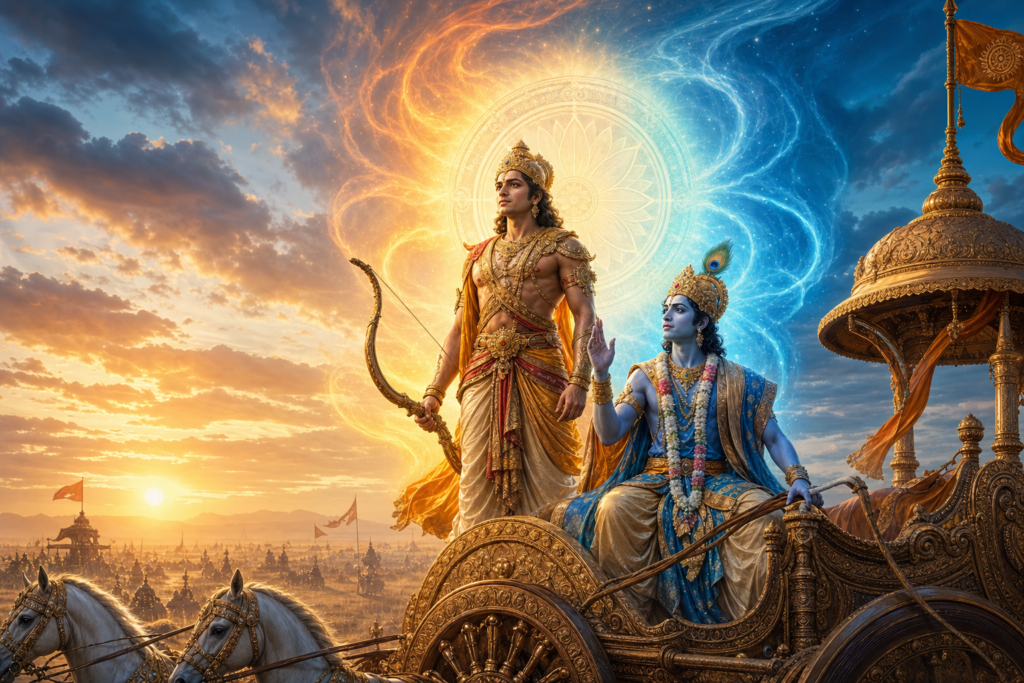
The Bhagavad Gita gives this plurality a practical shape by coordinating disciplined action, knowledge and devotion. It does not reduce every path to an identical technique. Instead, it addresses different dispositions and responsibilities while insisting that spiritual insight must transform conduct. The doctrine of karma yoga is especially relevant to social unity: action can be performed without possessive attachment to its fruits, allowing duty and service to become means of inner purification rather than instruments of ego.
The Buddhist path of awakening. Buddhism begins with the problem of dukkha, a term encompassing suffering, dissatisfaction and the unreliability of conditioned existence. It analyzes this condition through impermanence, dependent origination and the absence of an independent, permanent self. The Noble Eightfold Path integrates ethical conduct, mental cultivation and wisdom. Nirvana is not adequately described as absorption into Brahman or the liberation of an eternal soul, because those formulations conflict with central Buddhist analyses. Theravāda, Mahāyāna and Vajrayāna traditions also differ in doctrine and practice, although all place transformative insight and disciplined conduct at the heart of the path.
The bodhisattva ideal gives Mahāyāna Buddhism a particularly expansive social orientation. Wisdom is joined to compassion, and awakening is pursued with concern for all sentient beings. This concern does not erase the need for individual discipline; it deepens it. Anger, craving and delusion are treated not merely as private emotions but as forces that shape relationships and institutions. Buddhist contributions to a shared Dharmic ethic therefore include careful attention to intention, interdependence, compassionate action and the training of awareness.
The Jain science of non-harm. Jain philosophy describes reality through a precise distinction between jīva, living consciousness, and ajīva, non-living categories of existence. Karma is treated as a subtle material bondage that adheres to the soul through passion and action. Liberation requires stopping new karmic influx and removing accumulated karma through right faith, right knowledge and right conduct. This framework differs substantially from both Buddhist non-self and Hindu accounts of ātman, even though all three traditions discuss karma and release.
Jainism’s disciplined treatment of ahimsa has had an enduring influence on Indian ethics. Non-harm extends beyond avoiding obvious violence; it requires attention to speech, intention, consumption, livelihood and the effects of carelessness on living beings. Aparigraha, or non-possession, challenges the belief that security can be achieved through limitless acquisition. Anekāntavāda teaches that complex realities cannot be exhausted by one finite standpoint. It is not an invitation to believe that every statement is equally true. It is a disciplined warning against intellectual arrogance and an encouragement to examine conditions, perspectives and limitations.
The Sikh path of truthful participation. Sikh philosophy begins with Ik Oṅkār, affirming the oneness of ultimate reality. Human bondage is closely associated with haumai, the self-centered orientation that produces separation, pride and possessiveness. Liberation, or mukti, is pursued through the Guru’s wisdom, divine grace, nām simran, truthful conduct, honest work, sharing and seva. Sikh spirituality does not require withdrawal from ordinary responsibilities. The householder, worker and citizen can live spiritually through remembrance, courage, equality and service.
The institutions of sangat and langar translate theology into community practice. Sangat gathers people in a shared discipline of listening, remembrance and fellowship. Langar places equality into an embodied social form by inviting people to sit and receive food without distinctions of status. These practices show that unity is not achieved by slogans alone. It becomes credible when dignity is organized into everyday habits, spaces and institutions.
A common structure of transformation. Despite major doctrinal differences, the four traditions repeatedly identify a gap between ordinary perception and liberated understanding. Hindu texts speak in varied ways about avidyā, attachment and misidentification. Buddhist teachings analyze ignorance, craving and aversion. Jain sources examine delusion, passions and karmic bondage. Sikh teachings confront haumai and forgetfulness of the Divine. In every case, the untrained human condition is not treated as morally or cognitively complete. Transformation requires sustained practice rather than mere affiliation.
Karma also functions as a shared language of moral causation, but its meanings should remain differentiated. Some Hindu systems connect karma to rebirth, duty and the continuity of an enduring self. Buddhist accounts emphasize intention and conditioned continuity without positing a permanent ātman. Jainism presents karma through a distinctive material theory of bondage. Sikh scripture recognizes the moral consequences of action while placing liberation within divine grace and the overcoming of ego. The common insight is that actions matter; the philosophical explanation of how they matter is not identical.
Liberation as freedom from domination by the ego. Moksha, nirvana, kevala-jñāna and mukti cannot be translated into one interchangeable concept. Nevertheless, each challenges the assumption that freedom means unlimited satisfaction of personal desire. Dharmic freedom is repeatedly associated with release from compulsive attachment, ignorance, fear and self-centeredness. This produces a striking ethical consequence: genuine spiritual development should make a person less exploitative, less arrogant and more capable of truth, restraint and compassion.
Knowledge must become practice. None of these traditions treats liberation as the accumulation of information alone. Hindu darśanas combine study with reasoning, contemplation, devotion or yogic discipline. Buddhism tests understanding through ethical conduct and meditative insight. Jainism binds right knowledge to right faith and right conduct. Sikh tradition connects scriptural wisdom to remembrance, honest labour and service. Intellectual precision remains essential, but knowledge becomes spiritually meaningful only when it alters attention, character and action.
Meditation provides another field of both convergence and difference. Hindu traditions include mantra, dhyāna, self-inquiry, deity contemplation, breath discipline and devotional absorption. Buddhist systems cultivate practices such as mindfulness, concentration, loving-kindness and insight into impermanence and dependent origination. Jain meditation may involve equanimity, repentance, contemplation and purification from passions. Sikh nām simran centers remembrance of the Divine Name within the authority of the Guru. The techniques cannot be exchanged carelessly, yet all demonstrate that attention can be educated.
Devotion and sacred sound. Bhakti, Buddhist chanting, Jain recitation and Sikh kirtan arise from different theological worlds, but each recognizes that human beings are shaped by repeated speech, music, memory and emotion. Sacred sound can steady attention, preserve teachings and bind communities across generations. Its purpose is not merely aesthetic. Properly practiced, it redirects desire, softens egocentric habits and places the individual within a lineage of disciplined remembrance.
Ahimsa, compassion and courage. Non-harm is among the clearest areas of Dharmic ethical convergence, although its scope and application differ. Jainism gives ahimsa an exceptionally systematic and demanding form. Buddhism joins non-harming to compassion and the analysis of intention. Hindu traditions treat ahimsa as a major virtue while also debating duty, justice and legitimate protection in difficult circumstances. Sikh ethics combines compassion with the responsibility to resist oppression. Unity therefore cannot mean passive indifference to harm; it requires both restraint and morally disciplined courage.
Service gives this ethic a public form. Seva appears prominently in Hindu and Sikh settings and has close functional parallels in Buddhist and Jain traditions of generosity, care and support for religious and social institutions. Feeding the hungry, protecting the vulnerable, educating children, caring for animals and responding to disasters create cooperation without forcing theological agreement. Shared service is one of the strongest foundations for peaceful coexistence because it turns mutual respect into visible benefit.
Pluralism without relativism. Several celebrated concepts are often recruited into modern discussions of unity. The Vedic affirmation that reality is spoken of in multiple ways can encourage humility, but it should not be removed from its textual context and used to declare every proposition identical. Jain anekāntavāda encourages perspectival discipline, not the abandonment of truth. The Buddhist Middle Way is a specific method of avoiding destructive extremes, not a generic compromise between religions. Sikh affirmation of the One grounds equality and devotion within Sikh revelation; it is not a claim that distinctions are meaningless. Each concept can support dialogue when interpreted responsibly.
History records exchange as well as disagreement. Dharmic communities shared cities, courts, pilgrimage routes, trade networks and intellectual institutions. Philosophers debated logic, language, perception, selfhood, causation and liberation. Rulers and merchants supported temples, monasteries, derasars, gurdwaras, manuscripts and public works. Narratives, artistic forms and ritual technologies crossed boundaries and acquired new meanings. This long interaction produced creativity, but it also included competition and conflict. An academic account should neither romanticize the past nor reduce it to antagonism.
Historical honesty strengthens unity because reconciliation cannot be built on selective memory. Communities should be free to preserve accounts of persecution, exclusion, debate and resilience. At the same time, inherited grievances should not be converted into hostility toward present-day neighbours. The mature use of history identifies causes, institutions and consequences while refusing collective blame against people who did not commit past wrongs.
Unity is not syncretism. Cooperation does not require the construction of a new blended religion. A Hindu can remain fully committed to a chosen sampradāya, a Buddhist to the Triple Gem, a Jain to the teachings of the Jinas and a Sikh to the Guru, while all participate in civic friendship. Boundaries can protect meaning without becoming walls of contempt. The healthiest unity resembles a well-composed dialogue: each voice remains recognizable, yet all listen closely enough to create harmony.
Responsible dialogue follows several rules. Each tradition should be represented through its primary texts, qualified scholars and living practitioners. Internal diversity should be acknowledged rather than hidden. Shared terms should be compared only after their specific definitions are established. No community should be treated as a preliminary or incomplete version of another. Criticism should address ideas and institutions without dehumanizing adherents. These practices make interfaith dialogue intellectually serious and emotionally safe.
The relevance in 2026. Digital communication has made religious knowledge widely available, but it has also rewarded outrage, simplification and decontextualized quotation. A short clip can make a philosophical disagreement appear to be civilizational hatred. Anonymous accounts can circulate fabricated history or inflammatory claims faster than careful scholarship can respond. Dharmic unity therefore requires media literacy: sources must be verified, translations compared, dates checked and emotionally provocative claims examined before they are shared.
This responsibility applies equally to internal criticism. Questions about caste, gender, institutional authority, sectarian exclusion and access to sacred spaces should not be dismissed merely because they are uncomfortable. Dharmic traditions contain extensive resources for reform, dignity and self-correction, but those resources become credible only through application. Unity cannot ask marginalized people to remain silent for the sake of appearances. It should create conditions in which truth can be spoken without hatred and reform can occur without cultural self-contempt.
Education is the long-term foundation. Comparative study should begin with accurate introductions to Hinduism, Buddhism, Jainism and Sikhism rather than a collection of stereotypes. Students should encounter the Upanishads and Bhagavad Gita alongside Buddhist suttas and sutras, Jain āgamas and philosophical works, and Guru Granth Sahib in reliable translations and appropriate contexts. They should also learn that every tradition contains regional, linguistic, monastic, household, philosophical and devotional diversity. Such education replaces vague tolerance with informed respect.
Community institutions can reinforce this learning through carefully designed encounters. A temple, vihara, derasar and gurdwara can host discussions on non-harm, mental discipline, care for elders, ecological responsibility or ethical technology without staging a contest over superiority. Shared meals and service projects often build trust more effectively than ceremonial declarations. The aim is not to suppress disagreement but to establish enough goodwill for disagreement to remain humane.
A household practice of unity. The principle can enter daily life through a simple sequence: study one teaching carefully, examine one habitual reaction, perform one act of service and end the day with honest reflection. Different communities will frame these actions through their own disciplines, but the practical movement is comparable. Knowledge corrects confusion, observation reveals attachment, service weakens self-absorption and reflection supports accountability. Repeated consistently, these small acts produce the character required for larger social harmony.
Families can also cultivate unity by teaching children the difference between confidence and contempt. Confidence allows a person to love a tradition deeply, ask difficult questions and preserve inherited practices. Contempt requires an enemy and usually depends on caricature. A child who learns why a neighbour visits a vihara, temple, derasar or gurdwara is less vulnerable to propaganda. Familiarity does not eliminate theological difference; it prevents difference from being manipulated into fear.
An ecological dimension. The July monsoon context makes interdependence especially visible. Rain, soil, rivers, crops, animals and human settlements participate in one vulnerable system. Hindu reverence for sacred geography, Buddhist attention to interdependence, Jain radical sensitivity toward living beings and Sikh teachings about creation as an expression of divine order can motivate environmental responsibility. These foundations differ, but they converge in rejecting careless domination of nature. Water conservation, reduced waste, compassionate consumption and habitat protection can become forms of shared Dharma Seva.
Four layers of meaningful unity. Ethical unity appears in commitments to truthfulness, restraint, generosity and reduced harm. Contemplative unity appears in the conviction that attention and character can be trained. Civic unity appears in service, hospitality, education and defence of human dignity. Civilizational unity appears in the recognition that these traditions participated in a long Indian conversation while developing independent identities. Metaphysical unity, by contrast, cannot simply be presumed; it remains a matter of philosophical argument within and among the traditions. Keeping these layers distinct prevents both hostility and false equivalence.
The most productive reading of “The Aim is One” therefore operates at two levels. At the ultimate level, each tradition must be allowed to define liberation and reality in its own terms. At the shared human level, the aim is unmistakably close: to reduce ignorance and cruelty, discipline desire, cultivate wisdom, serve others and live with greater freedom from ego. This formulation is strong enough to support solidarity and precise enough to preserve doctrine.
A disciplined hope for the future. Spiritual unity is not achieved by pretending that difficult differences have disappeared. It grows when truth is pursued without arrogance, identity is preserved without hostility and service is offered without expectation of conversion or reward. Hinduism, Buddhism, Jainism and Sikhism provide distinct paths, but their finest ethical resources can help communities resist polarization and recover a culture of thoughtful coexistence. The aim is one wherever wisdom becomes humility, devotion becomes service, strength protects dignity and spiritual practice enlarges compassion.
Inspired by this post on Dandavats.








Leave a Reply
You must be logged in to post a comment.