
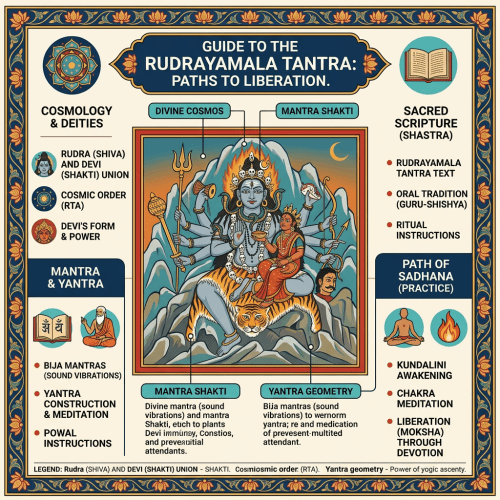
The Rudrayamala Tantra (रुद्रयामल तन्त्र) occupies an exceptional place in Hindu Tantric literature. It is remembered as an authoritative revelation connected with Bhairava, Shakti worship, Kaula practice, mantra, Kundalini, and subtle-body yoga. Its influence is easier to recognize than its original literary form, however, because the name Rudrayamala does not lead to one complete, uniform book preserved in a single uncontested edition. It points instead to a complex textual family: an older and largely lost Rudrayamala known through citations and related revelations, a surviving Uttaratantra transmitted in divergent recensions, and numerous manuscript sections whose contents do not always correspond to the printed work.
That distinction is the key to understanding the scripture responsibly. Popular summaries often combine every hymn, meditation, ritual, and doctrinal statement attributed to Rudrayamala as though all belonged to one stable ancient volume. Manuscript evidence does not support such simplicity. A historically careful account must preserve the tradition’s reverence for the text while also acknowledging incomplete witnesses, variant chapter counts, uncertain dates, and layers of transmission.
Why the Rudrayamala Tantra still matters
The Rudrayamala matters because it stands at a meeting point of Shaiva and Shakta Tantra. Its dialogical structure places Rudra or Bhairava and the Goddess in a relationship through which consciousness and power, stillness and manifestation, teaching and realization become inseparable. The textual traditions bearing its name connect metaphysical reflection with embodied disciplines: breath is interpreted as a movement of Shakti, the body becomes a sacred geography, phonemes become forms of divine power, and ritual is understood as a method of transforming perception rather than merely presenting offerings to an external deity.
A contemporary reader may first encounter the name through a stotra, kavaca, mantra manual, account of Kumari Puja, discussion of Kundalini, or reference in a later Tantric compilation. That fragmented encounter mirrors the actual history of the text. Rudrayamala has survived not only as a book title but also as an authority invoked by ritual specialists, compilers, commentators, and manuscript copyists. Its legacy therefore belongs as much to the history of reception as to the reconstruction of a lost archetype.
What the name Rudrayamala means
Rudra is a powerful name of Shiva, while yāmala can signify a pair, twin, or coupled form. In Tantric literary usage, a Yāmala commonly presents revelation through a divine pair, often Bhairava and Bhairavi or Shiva and Shakti. The pair is simultaneously literary and theological. One member asks, the other answers, yet both express a single field of sacred knowledge. The dialogue dramatizes a central Tantric insight: consciousness does not become manifest without power, and power is not intelligible apart from consciousness.
The direction of speech can also carry a technical classification. In many texts called āgama, Shiva teaches and the Goddess receives the teaching; in works classified as nigama, the Goddess teaches and Shiva asks. The surviving Rudrayamala Uttaratantra prominently uses the second arrangement, with Anandabhairava questioning Anandabhairavi. This reversal is significant for Shakti worship because the Goddess appears not merely as a listener or consort but as the source who articulates ritual, yoga, initiation, and liberating knowledge.
Not one text, but a layered textual history
The expression Rudrayamala Tantra is used in at least four overlapping senses. It may refer to an early, prestigious Yāmala revelation that is no longer recoverable in full; to Rudrayamala-related teachings preserved in works such as the Vijñānabhairava; to the later Rudrayamala Uttaratantra available in printed Sanskrit editions; or to independently circulating chapters, hymns, ritual manuals, and compilations carrying Rudrayamala colophons. These senses should not be treated as interchangeable without textual comparison.
Traditional and modern descriptions consequently give different dimensions for the work. A commonly discussed printed recension has approximately 6,000 verses in 66 chapters, mainly in the anuṣṭubh metre. Some manuscript traditions contain 69 chapters, while other reports add still more material. A much larger figure of 125,000 verses appears in traditional bibliographic references. These numbers describe different claims or recensions; they do not prove that a single 125,000-verse composition once circulated everywhere in precisely the same form.
The term Uttaratantra means a later or concluding tantra and implies a corresponding earlier section, often called the Pūrva portion. The earlier portion associated with the printed Uttaratantra is generally reported as unavailable. Even the surviving later section is not textually uniform. The bibliographic record for the two-volume Sanskrit edition edited by Rāmaprasāda Tripāṭhī and issued by Sampurnanand Sanskrit University from 1991 to 1996 explicitly identifies it as the Uttaratantra and notes that the first part is said to be lost. The edition is documented in the CiNii academic library catalogue.
What the manuscripts reveal
A particularly instructive witness is catalogued by the Institut Français de Pondichéry as manuscript transcript T0992b. It consists of only 31 folios, is explicitly incomplete, and preserves the 366th upadeśa of a recension identifying itself with a thirty-nine-thousand-unit Rudrayamala tradition. Its contents concern the procedure for a chariot festival, defects in ritual sprouting, and expiation. The transcript was copied from a Tulu-script manuscript and is described in the Institut Français de Pondichéry manuscript record. This material differs markedly from the familiar summaries of the 66-chapter Uttaratantra.
A second incomplete witness, preserved in Nepal and catalogued as NAK 4/2725, contains 89 folios in Devanagari. Its colophons associate it with a Devīrahasya section of the Rudrayamala, and its surviving thirty-eighth chapter concerns a Lakshminarayana protective rite. The opening places speech in the mouth of Bhairava, unlike the Goddess-led dialogue emphasized in the printed Uttaratantra. The Nepal-German Manuscript Cataloguing Project record therefore supplies concrete evidence that substantially different materials circulated under the Rudrayamala name.
Catalogues of Sanskrit manuscripts from eastern India add another layer of complexity. They describe palm-leaf witnesses in Bengali script that preserve only selected chapters, disagree with printed editions, or combine Rudrayamala passages with extracts from other Tantras. One catalogue notes that two printed versions contained 66 and 69 chapters respectively, while an incomplete manuscript covering chapters 16 to 26 did not agree with the printed text. Such evidence makes the Rudrayamala a classic case for textual criticism: titles and final colophons must be compared with openings, chapter sequences, vocabulary, metre, ritual systems, and manuscript provenance.
The variation does not diminish the text’s religious importance. It shows how premodern Sanskrit works could live through recitation, copying, extraction, rearrangement, and incorporation into ritual handbooks. A sacred work was not always transmitted like a modern publication with a fixed table of contents. Its identity could reside in lineage, revealed authority, doctrinal affiliation, or a remembered source even when particular textual units moved between compilations.
When was the Rudrayamala composed?
No single secure date can be assigned to every work or fragment carrying this name. Rudrayamala-related teachings were known in the early medieval development of Bhairava and Trika traditions, while the surviving Uttaratantra reflects later layers and a different ritual environment. Its concentration on a developed six-centre Kundalini system, extensive goddess worship, initiation diagrams, and eastern Indian forms of Kaula practice is consistent with a long history of compilation and redaction. A date proposed for one recension should therefore not be transferred automatically to the lost Yāmala, the Uttaratantra, the Vijñānabhairava, or every manuscript with a Rudrayamala colophon.
Who composed the Rudrayamala Tantra?
No identifiable human composer has been established. Within the traditional framework, the teachings are divine revelation spoken through Rudra or Bhairava and Shakti or Bhairavi. Historical study, by contrast, sees evidence of multiple transmitters, compilers, redactors, and regional manuscript lineages. These perspectives answer different questions: the first explains sacred authority within a living tradition, while the second examines how words reached their surviving material forms. Named modern editors organized particular printed recensions; they did not compose the ancient or medieval teachings attributed to the Rudrayamala.
Shakti as the foundation of manifestation
The Rudrayamala’s deepest contribution to Shakti worship is its refusal to treat the Goddess as a secondary divine figure. Shakti is the power through which consciousness reveals, differentiates, and recognizes itself. She can be approached as a personal deity, mantra, breath, Kundalini, sacred speech, ritual diagram, cosmic order, or the living power within the practitioner. These modes are not merely decorative symbols placed around an otherwise independent Shiva. They provide the means through which Shiva becomes knowable and the universe becomes spiritually intelligible.
In nondual interpretations, Shiva and Shakti are distinguishable for the purpose of explanation but never truly separable. Shiva represents the luminous ground of awareness, while Shakti represents awareness reflecting upon and expressing itself. Other passages and recensions are more ritualistic than philosophical, and the entire Rudrayamala corpus should not be forced into one systematic doctrine. Nevertheless, the divine pair gives the traditions bearing this name a durable theological centre.
Kundalini and the sacred body
The surviving Uttaratantra is especially important for its identification of the Goddess with Kundalini. Kundalini is portrayed as a latent yet all-pervading form of Shakti, associated with the base of the subtle body and capable of ascending through the central channel. She is also related to inhalation, exhalation, vital power, time, sound, and awakened knowledge. A hymn commonly called the Kundalinistava survives as a text attributed to the Rudrayamala Uttaratantra, providing further evidence for this devotional and yogic identification.
The technical map includes the central suṣumṇā channel, vital winds, subtle pathways or nāḍīs, six principal centres with four, six, ten, twelve, sixteen, and two petals, and a thousand-petalled lotus above the ordinary sequence. Breath retention, concentration, visualization, mantra, and inner worship are coordinated within this map. The aim is not simply to move an imagined substance upward. It is to refine attention until body, breath, phoneme, deity, and cosmos are experienced as expressions of one sacred power.
The body consequently becomes a microcosm. Sacred sites, deities, letters, lunar divisions, elements, and cosmic regions can be installed or contemplated within it. A pilgrimage that ordinarily unfolds across physical geography is mirrored as an inward journey. This is one reason Tantric practice can be both temple-oriented and intensely interior: external worship and internal realization are corresponding arrangements of the same divine reality.
This subtle-body language belongs to a theological and contemplative system, not to modern biomedical anatomy. Nāḍīs should not be equated casually with nerves, and chakras should not be presented as physical organs detectable by contemporary instruments. The system can be studied as a disciplined map of ritual embodiment and contemplative experience without making unsupported scientific claims. That distinction protects both academic accuracy and the integrity of the tradition.
The technical grammar of Tantric practice
Rudrayamala materials organize practice through an interconnected grammar of mantra, vidyā, bīja, nyāsa, yantra, mudrā, dhyāna, japa, pūjā, homa, and dīkṣā. A mantra is not treated as an ordinary sentence. Its phonemes are held to embody divine presence, while a bīja condenses a deity’s power into a seed syllable. A vidyā is both sacred formula and transformative knowledge. Japa repeats the formula according to prescribed conditions, and dhyāna establishes the deity’s form in contemplative awareness.
Nyāsa ritually places phonemes, mantras, or divine powers upon the body, converting ordinary embodiment into a consecrated field. Mudrā employs gesture or ritual configuration. Pūjā structures offerings and acts of presence, while homa places offerings into consecrated fire. A yantra gives geometric form to the same ordered power expressed by mantra. These practices work as a system: sound, image, body, intention, and offering mutually reinforce one another.
The word chakra requires particular care. In one passage it can mean a subtle-body centre; elsewhere it may designate a ritual diagram, a circle of deities or practitioners, or a grid used to test the compatibility of a mantra and an initiate. The Uttaratantra discusses several initiatory chakras associated with letters, zodiacal signs, lunar mansions, deities, gain and loss, and other classifications. Reading every occurrence as a spinal energy centre creates serious confusion.
Guru, initiation, and eligibility
The prominence of the guru is one of the clearest features of the surviving text. The guru is not merely a lecturer who explains vocabulary. Within the ritual system, the guru transmits a mantra, evaluates eligibility, performs initiation, establishes a lineage relationship, and supervises disciplines whose meaning depends on context. Some Tantric traditions recognize spiritually qualified teachers of more than one gender, reflecting the principle that Shakti can operate through different human forms.
Dīkṣā, or initiation, creates ritual authorization and a transformed identity. The several chapters devoted to initiatory diagrams, mantra suitability, purification, and signs of ritual success show that transmission was not imagined as casual access to a powerful formula. Secrecy served multiple purposes: it protected lineage knowledge, preserved ritual precision, limited misuse, and distinguished textual information from embodied competence. In a modern setting, secrecy should not excuse coercion, exploitation, financial manipulation, or abuse; ethical accountability remains indispensable.
The classifications pāśu, vīra, and divya describe three dispositions or levels of ritual eligibility. Pāśu indicates a practitioner still strongly bound by conventional limitation, vīra describes the disciplined heroic practitioner capable of confronting fear and dualistic conditioning, and divya signifies a more inwardly refined or divine disposition. These terms should not be converted into permanent judgments about human worth. Their practical function is to match a method to a practitioner’s capacity and stage of formation.
Kumari Puja and the living presence of the Goddess
Several chapters of the Uttaratantra discuss Kumari Puja, in which girls are ritually honoured as embodied forms of the Goddess. The text associates them with different social and occupational backgrounds and prescribes respectful reception, offerings, hymns, protective formulae, and fire rites. Historically, this ritual could relocate sacred presence from an icon into a living human person and could temporarily reconfigure social hierarchy around the recognition of Shakti.
That ritual elevation should not be romanticized as proof of complete social equality, nor should an old prescription be reproduced without modern safeguards. Any contemporary observance involving children must be nonsexual, transparent, age-appropriate, legally compliant, and centred on dignity, guardian consent, and the child’s comfort. Historical study can explain the ritual’s theology without turning a textual description into unsupervised instruction.
Vāmācāra and the five ritual substances
The Rudrayamala tradition is also associated with vāmācāra and the pañcamakāra, conventionally enumerated as wine, meat, fish, grain or ritual gesture, and sexual union. Their meanings and actual uses vary considerably among lineages. Some traditions interpret them literally under strict consecration; others employ substitutes, internal visualizations, or symbolic readings. Their theological purpose is commonly explained as transforming attachment, fear, disgust, and rigid dualism rather than licensing ordinary indulgence.
Tantric sources themselves distinguish disciplined ritual from uncontrolled consumption. Initiation, consecration, mantra, eligibility, and awareness are what make an act part of a sādhanā. Removing those conditions leaves no basis for calling private gratification a liberating rite. Modern ethical standards add non-negotiable requirements concerning informed adult consent, sobriety of judgment, personal safety, and freedom from pressure. The historical material is therefore best approached through qualified scholarship and accountable lineages, not through sensational online summaries.
Worldly accomplishment and liberation
Rudrayamala manuscripts frequently promise both bhoga and apavarga or moksha: meaningful participation in embodied life and ultimate liberation. This pairing is characteristically Tantric. The world is not rejected merely because it is manifested; it becomes a field in which Shakti can be recognized. Ritual texts also promise siddhi, a word whose meaning ranges from successful completion and ritual efficacy to extraordinary accomplishment. Such claims should be reported as the text’s religious promises rather than presented as experimentally established effects.
A relatable insight follows from this union of goals. Spiritual growth is not portrayed as an escape from every ordinary responsibility. Attention, speech, breath, relationship, place, and daily action can all be disciplined. The demanding element is transformation of motive: the same act can reinforce attachment when performed mechanically or become a vehicle of awareness when integrated with ethical restraint, knowledge, and devotion.
The Atharvaveda and negotiations with Vedic tradition
The surviving Uttaratantra gives exceptional praise to the Atharvaveda and associates it with the path of Shakti. This does not make every Rudrayamala rite identical with Vedic ritual. It shows how Tantric communities situated themselves in relation to older and prestigious bodies of revelation. The text can affirm Vedic authority while reorganizing ritual around mantra initiation, the Goddess, subtle physiology, and Kaula discipline. The relationship is therefore best understood as interpretation and negotiation, not a simple opposition between Vedic and Tantric religion.
Many goddesses within one Shakti
Materials transmitted under the Rudrayamala name engage a wide field of goddess traditions, including forms related to Kali, Bhairavi, Kumari, Lalita, Kubjika, Tara, and other vidyās. These forms are not interchangeable in ritual detail, yet they can be interpreted as differentiated expressions of one divine power. The result is a scripture with importance across more than one Shakta current rather than an exclusive manual for a single modern sect.
This plurality also warns against constructing one universal Rudrayamala practice. A Kali-oriented passage, a Sri Vidya element, a Kubjika rite, and a Kundalini hymn may belong to different ritual strata or lines of reception. Their presence under one prestigious title illustrates interaction among traditions, but responsible interpretation still asks which manuscript, chapter, region, and lineage transmits each teaching.
Sacred geography turned inward
Rudrayamala-related passages contribute to traditions of Shakti Peethas and map sacred places onto the subtle body. Centres such as Kamarupa, Jalandhara, Purnagiri, and Varanasi can be correlated with bodily locations in a contemplative geography. Different Tantric works preserve different lists and arrangements, so no isolated recension should be treated as the sole timeless map of every Shakti Peetha. The broader principle is more stable: the land, temple, body, and Goddess reflect one another.
This correspondence helps explain the emotional power of pilgrimage. A sacred site is experienced not only as a destination on a map but also as an external manifestation of an inward possibility. Conversely, internal meditation is not detached from community and place; it carries memories of temples, landscapes, lineages, and festivals into the practitioner’s embodied awareness.
The Vijñānabhairava connection
The Vijñānabhairava explicitly places its teaching in relation to the Rudrayamala. Its opening refers to the Trika teaching arising from Rudrayamala, and its conclusion identifies the instruction as the essence of that revelation. This relationship is historically important, but it does not mean that the Vijñānabhairava appears as an ordinary chapter in the currently printed 66-chapter Uttaratantra. It testifies instead to an older Rudrayamala identity or remembered scriptural source within the Bhairava and Trika world.
The Vijñānabhairava is celebrated for a series of 112 dhāraṇās, or contemplative methods. They employ breath, sound, sensory intensity, spatial awareness, emptiness, transitions between mental states, and sudden recognition. Their diversity expresses a powerful Tantric principle: ordinary experience can disclose Bhairava when attention is freed from habitual contraction. A reviewed World Sanskrit Conference study available through the University of British Columbia repository examines these means of realization in explicit relation to the Rudrayamala tradition.
Another Trika revelation, the Parātriṃśikā, is likewise transmitted in a Rudrayamala-related setting. Its concern with phonemic power, mantra, and the emergence of manifestation helped shape sophisticated Kashmir Shaiva reflection on sacred language. Together, these associated works explain why the Rudrayamala name carries philosophical weight far beyond the particular contents of the later Uttaratantra.
Influence on Shaivism, Shaktism, and Kaula traditions
Within Shaiva traditions, Rudrayamala authority is connected with Bhairava revelation, Trika teachings, mantra cosmology, and contemplative recognition. Within Shaktism, it supports the supremacy of the Goddess, Kundalini yoga, Kumari worship, multiple goddess vidyās, and the correspondence between cosmic and bodily Shakti. Within Kaula traditions, it reinforces initiation, the guru-disciple lineage, ritual transformation of conventional categories, and the disciplined integration of embodiment with liberation.
Its influence is therefore not measured only by direct quotation. Later compilers could draw upon its ritual vocabulary, claim its authority in a colophon, preserve a hymn as Rudrayamala material, or reinterpret an associated revelation through a regional lineage. Such reception is one reason the title appears across manuscripts containing very different subjects, from goddess worship and protective rites to temple procedure and alchemical material.
The Mahachina narrative and Dharmic exchange
A famous narrative in the Uttaratantra describes the sage Vashistha seeking a method associated with Mahachina and receiving instruction in a setting connected with Buddha. The episode places Buddhist and Shakta imagery within a Kaula account of revelation. It should not be read as a reliable biography of the historical Buddha or as proof that every Buddhist community practised the rites described by a later Shakta text. Its primary value is literary and theological: it legitimizes a disputed path by locating wisdom beyond familiar social and ritual boundaries.
The narrative also offers evidence of a religious environment in which Hindu and Buddhist Tantric communities were aware of one another and shared elements of mantra, mandala, goddess devotion, initiation, and yogic discipline. Similarity does not erase difference, and direct lines of borrowing require careful philological evidence. A respectful reading recognizes exchange without turning the episode into sectarian accusation or an artificial claim that all Dharmic traditions are identical.
Hindu, Buddhist, Jain, and Sikh traditions retain distinct scriptures, metaphysical positions, disciplines, and communal histories. Unity is strengthened when those differences are studied accurately rather than flattened. The Rudrayamala is specifically a Shaiva-Shakta Tantric inheritance, yet its emphasis on disciplined transmission, transformation of consciousness, reverence for sacred speech, and liberation can support thoughtful comparison with other Dharmic paths.
How the Rudrayamala should be read today
A sound reading begins by identifying the actual textual witness. The questions should include whether a passage comes from the printed Uttaratantra, a manuscript fragment, a later ritual digest, the Vijñānabhairava, a stotra attributed through its colophon, or a modern paraphrase. Sanskrit titles alone are insufficient because prestigious names were sometimes used to organize, authorize, or absorb materials from more than one source.
Translations should be checked against the Sanskrit whenever possible. Technical terms resist one-word equivalents. Siddhi may mean accomplishment rather than supernatural power; chakra may be a diagram rather than a bodily centre; vidyā may be both knowledge and mantra; bhāva may indicate ritual disposition rather than emotion alone; and yāmala may refer simultaneously to a textual class, a divine pair, and a metaphysical union. Careful translation prevents attractive but misleading generalizations.
Historical description must also be separated from practical authorization. Reading about breath retention, bīja mantras, sexual rites, intoxicants, fire offerings, or Kundalini does not establish competence to perform them. Some practices may carry psychological, interpersonal, or physical risks when removed from preparation and supervision. General study, devotional reflection, ethical self-discipline, and non-secret forms of worship remain different from specialized initiation-based sādhanā.
Several recurring misconceptions can then be avoided. The Rudrayamala is not available as one universally complete ancient book; the printed Uttaratantra is not automatically identical with the lost early Yāmala; every work attributed to it does not belong to the same period; Kundalini terminology is not a substitute for medical science; vāmācāra is not permission for indulgence; and divine attribution is not the same category as modern historical composition. These clarifications deepen rather than weaken appreciation.
Enduring significance
The Rudrayamala Tantra remains foundational because it preserves a powerful vision of spiritual life in which Shakti is present in consciousness, speech, breath, body, ritual, landscape, and relationship. Its teachings connect temple worship with internal yoga, devotion with technical discipline, and worldly life with the possibility of liberation. Its divine dialogue makes the act of questioning sacred: realization unfolds not through passive belief but through inquiry guided by transmission and practice.
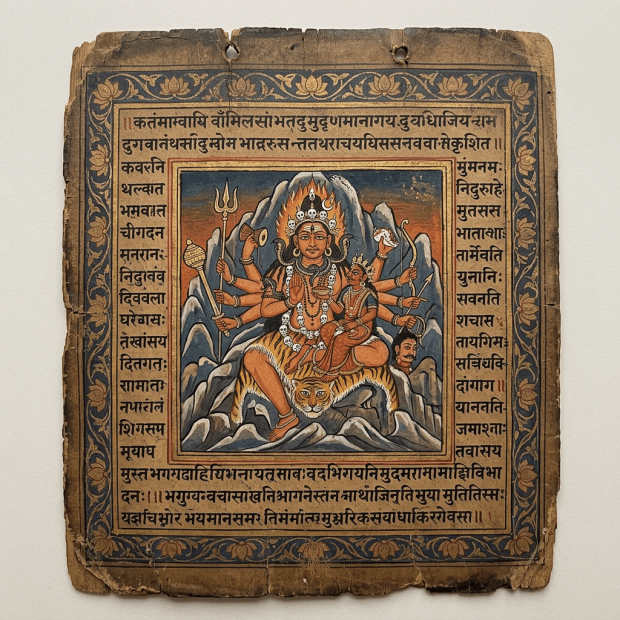
Its fragmented condition carries a second lesson. Sacred heritage survives through vulnerable material objects—paper, palm leaf, regional scripts, damaged folios, transcripts, catalogues, and the labour of preservation. The gaps encourage intellectual humility. No summary can restore every lost verse, but careful comparison can distinguish evidence from assumption and preserve the richness of the traditions that continued to transmit the Rudrayamala name.
For Shakti worship, the lasting message is neither sensational ritual nor abstract philosophy alone. It is the disciplined recognition that divine power permeates the entire field of experience. For scholarship, the text is a reminder that influence can remain immense even when an original literary form has become elusive. Held together, those insights reveal why the Rudrayamala Tantra continues to command reverence, curiosity, and serious study.
Selected textual resources
Reliable study can begin with the two-volume Sampurnanand Sanskrit University edition documented by CiNii, the incomplete T0992b transcript catalogued by the Institut Français de Pondichéry, the Nepalese NAK 4/2725 witness described by the Nepal-German Manuscript Cataloguing Project, and the work-level references assembled by the PANDiT prosopographical and textual database. These records should be used alongside critical studies of Shaiva, Shakta, Kaula, and Trika Tantra rather than isolated online claims.
Inspired by this post on Hindu Pad.
