
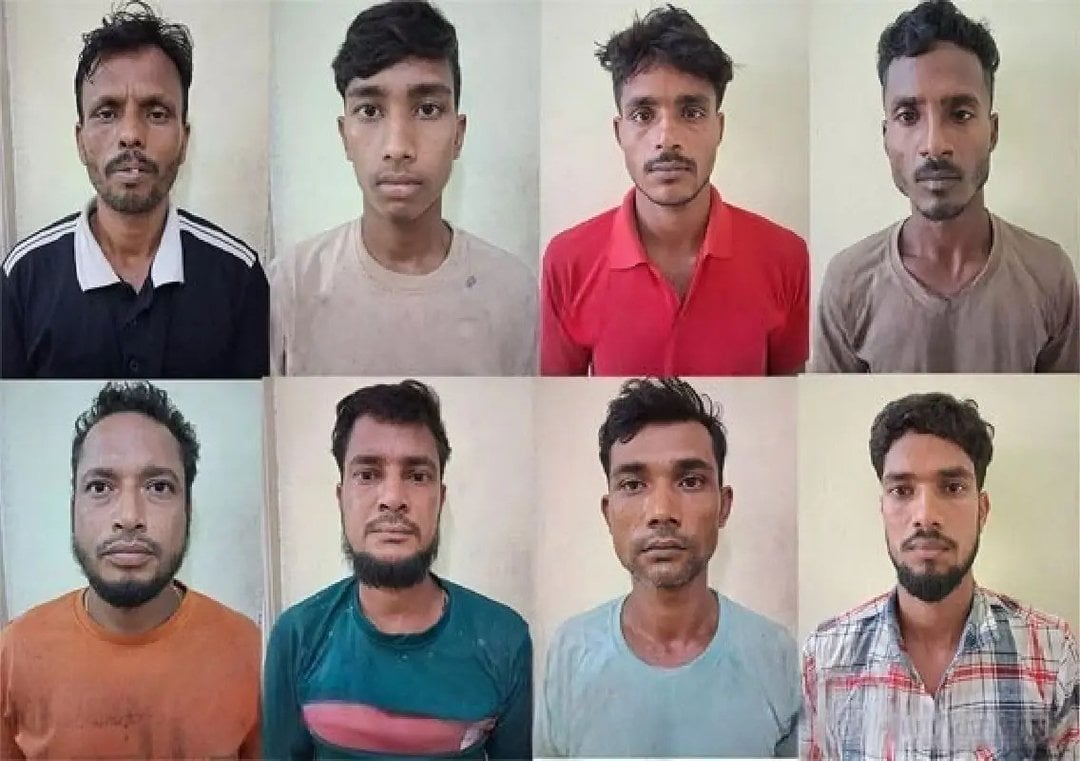
A focused enforcement action with wider significance. Mangaluru City Police detained 11 people whom officers identified as Bangladeshi nationals, including four minors, at two construction sites within the Urva police-station limits. The following day, police announced the arrest of three men accused of facilitating their movement and employment. The operation, reported on 13 and 14 July 2026, sits at the intersection of immigration control, document fraud, informal labour contracting, interstate policing and child protection. It warrants firm legal scrutiny, but it also demands careful terminology: detention is not conviction, an allegation is not a proved fact, and nationality or religion cannot substitute for evidence.
The immediate operation. According to the Organiser report and subsequent local coverage, officers found three people at one under-construction property and eight at another. Police identified the seven adults as M.D. Kousar Ali, M.D. Noor Ameen, M.D. Nahidul Islam, Humayun Kabir, Romjan Ali, Abdul Rahman Royel, and Noyan. Other publications use slightly different English transliterations of several names. The remaining four detainees were reported to be between 15 and 17 years old; their identities should remain protected because they are minors. Police said all 11 came from villages in Bangladesh’s Rajshahi district.
The alleged route into India. Preliminary inquiries cited by The New Indian Express indicate that the group crossed the international border through the Murshidabad sector of West Bengal before travelling to coastal Karnataka. Some members had reportedly been in Mangaluru for approximately three to five months. Investigators allege that false or forged identity particulars bearing West Bengal addresses were used during their onward movement and employment. The route, dates and provenance of every document nevertheless remain matters for corroboration through travel records, device analysis, witness statements and official verification.
Three alleged facilitators were arrested. Police Commissioner Sudheer Kumar Reddy identified the accused intermediaries as Moyiddin Islam, Dilwar Hussain, and Rasul Islam, all from West Bengal. Their names also appear with spelling variations in different reports. Two were arrested in Mangaluru, while Rasul Islam was traced and arrested in Kolkata with assistance from West Bengal police. A Mangaluru police team was expected to bring him to Karnataka under a transit warrant for questioning. As The Indian Express reported, all three are accused of helping arrange movement and employment; their individual knowledge, intent and legal liability remain to be established in court.
How the alleged network operated. Investigators believe the intermediaries recruited legitimate workers from northern Indian states and placed undocumented Bangladeshi nationals within the same labour groups. Transportation, accommodation and construction-site placement were allegedly arranged through the ordinary subcontracting chain, making the foreign workers less conspicuous. This model is operationally plausible because construction labour is often mobile, dispersed among subcontractors and subject to high turnover. It does not, however, establish that Indian migrant workers knew about the alleged scheme, nor does it prove that every contractor, supervisor or property developer associated with a site was complicit.
The recovered documents are important but require forensic authentication. Police reported seizing Bangladeshi national identity records, birth certificates and family documents, as well as identity material linked to West Bengal addresses. Authentic Bangladeshi records could support a nationality determination, but they would not independently prove when or how a person entered India. Suspected Indian documents could indicate identity manipulation only after investigators establish whether they are fabricated copies, altered genuine records or credentials obtained through fraudulent supporting material. A sound prosecution therefore requires documented seizure, an unbroken chain of custody, issuer-level verification, comparison of photographs and biometrics, and analysis of who created, supplied or knowingly used each record.
Aadhaar must be interpreted correctly. The Unique Identification Authority of India states that Aadhaar is proof of identity but does not confer citizenship or domicile. Consequently, an Aadhaar number or copy cannot by itself establish Indian citizenship, while the absence of Aadhaar cannot by itself prove foreign nationality. A West Bengal address is similarly not conclusive because it identifies an asserted place of residence rather than nationality. If photographs were substituted on colour photocopies, as police reports suggest, investigators must compare those copies with UIDAI authentication data and the underlying enrolment record. That distinction protects the integrity of the case while preventing genuine Indian workers from being misclassified.
The cumulative detention count is disputed. The Organiser placed the recent total under the Mangaluru Police Commissionerate at 17, apparently combining the latest 11 with an earlier report involving six people. However, The Times of India, The New Indian Express and The Indian Express reported that eight people had been identified during the preceding Surathkal operation, producing a cumulative figure of 19. Early operational numbers are sometimes revised after document verification, but reports should not alternate between 17 and 19 without explanation. The firmest event-level figures are 11 detainees in the Urva operation and three accused facilitators arrested; any broader total should be treated as provisional and time-stamped.
Detention, arrest and conviction are different legal stages. The 11 workers were detained as people suspected of entering or remaining in India without lawful authorization. The three alleged facilitators were arrested as accused persons in a criminal investigation. Neither group has been convicted merely because police announced an operation or news outlets published names. Nationality confirmation, immigration-status verification, the filing of charges, judicial proceedings and any eventual repatriation are distinct processes. Precise language is not a concession to illegality; it is essential to making enforcement decisions durable, reviewable and consistent with the rule of law.
The governing law changed in 2025. The relevant central statute is now the Immigration and Foreigners Act, 2025, which came into force on 1 September 2025. Section 3 generally requires a foreign national entering or staying in India to possess a valid passport or other travel document and a valid visa unless a lawful exemption applies. Sections 7 and 29 provide authority to regulate a foreigner’s continued presence and direct removal, while the Bureau of Immigration operates with assistance from FRROs and other designated officers. Under the 2025 Rules, a foreigner may be required to produce identity or travel documents within 24 hours, subject to a limited extension for sufficient cause.
Potential offences depend on the evidence actually proved. Section 21 of the 2025 Act addresses entry without the required passport, travel document or visa and permits imprisonment of up to five years, a fine of up to ₹5 lakh, or both. Section 23 covers unlawful stay and other contraventions, while Section 24 addresses abetment. Section 22 imposes more severe punishment for knowingly using or supplying a forged passport, travel document or visa. Its wording does not automatically classify a suspect Aadhaar photocopy as a forged travel document; separate forgery, conspiracy or identity-fraud provisions may be relevant depending on the FIR and forensic findings. The final charges should therefore be reported only after police disclose the invoked provisions.
FRRO referral begins a process rather than completing one. Mangaluru police said a detailed report and the collected records were being forwarded to the Foreigners Regional Registration Office in Bengaluru. The ensuing process ordinarily requires confirmation of identity and nationality, assessment of immigration status, an appropriate restriction or removal order, coordination over travel documentation and arrangements for lawful repatriation. A press statement that deportation has been initiated is not equivalent to a completed deportation. Interpreters, access to legal assistance and written records of each decision are particularly important when detainees cannot readily understand the language or basis of the proceedings.
The four minors require a separate protection response. People aged 15 to 17 are adolescents under India’s Child and Adolescent Labour (Prohibition and Regulation) Act. That law prohibits adolescents from working in listed hazardous occupations and processes, making the precise tasks, machinery, materials, hours and safety conditions at the construction sites relevant. Authorities should verify age, identify parents or guardians, examine possible coercion or wage withholding, and involve appropriate child-protection institutions. International UNICEF guidance recommends non-custodial, child-sensitive alternatives to immigration detention. The minors’ identities should not be publicized, and any return decision should account for safety, family unity and reintegration.
Migrant smuggling and human trafficking are not interchangeable terms. Under the UN Protocol on trafficking in persons, adult trafficking requires an act such as recruitment or transport, specified means such as coercion, deception or abuse of vulnerability, and a purpose of exploitation. In a child case, the prohibited means need not be proved, but an exploitative purpose is still required. Migrant smuggling ordinarily concerns facilitating unauthorized border entry for financial or material benefit. The public record supports an alleged irregular-entry and employment-facilitation scheme; it does not yet disclose enough evidence to determine conclusively whether every case constitutes trafficking. The minors’ employment makes that inquiry especially important.
No reported evidence supports an ideological label. Some republished headlines described the detainees as Islamists, yet the police accounts and mainstream reports reviewed for this account allege unauthorized entry, irregular stay, suspect documents and unlawful employment facilitation. They do not allege membership in an Islamist organization, terrorist activity, anti-Hindu conduct or an ideologically motivated offence. A person’s name, presumed religion or nationality cannot establish political ideology. Removing that unsupported descriptor does not minimize the immigration allegations; it keeps the report factual and prevents a criminal investigation involving particular individuals from becoming an accusation against a wider religious community.
The security and labour concerns are real but should not be exaggerated. Unauthorized entry and fraudulent documentation can weaken immigration controls, obscure a person’s movements and make enforcement more difficult. Undocumented workers can also be exposed to debt, wage theft, unsafe housing and dangerous work while non-compliant contractors gain an unfair cost advantage over law-abiding businesses. Nevertheless, one operation does not establish the number of undocumented migrants across Karnataka, quantify displacement of local workers or prove a demographic or extremist conspiracy. Those broader conclusions require transparent population estimates, wage data, crime evidence and network analysis rather than extrapolation from surnames or a single construction-site raid.
Employer compliance is a central preventive measure. Builders and principal employers should maintain a current register linking every worker to the responsible contractor, verified identity records, age documentation, contact details, wage payments and lawful work authorization where a foreign national is involved. Subcontract agreements should permit audits and require prompt reporting of suspect records. Verification should use authorized digital or issuer channels rather than visual inspection of photocopies alone. The same onboarding standard must apply to every worker, regardless of language, state of origin or religion. Records should also be collected proportionately, stored securely and accessed only for legitimate employment or law-enforcement purposes.
Verification must not become communal or linguistic profiling. The Indian Express reported that police had checked more than 300 suspected individuals and found the majority to be Indian citizens. Commissioner Reddy had also previously warned that baselessly portraying an Indian as Bangladeshi can invite legal action. Bengali speech, Muslim identity, poverty or employment in construction is not evidence of foreign nationality. False accusations can expose innocent interstate workers to assault, fracture community trust and divert police resources. Evidence-led verification therefore protects national borders and Indian citizens at the same time.
Statewide figures require disciplined interpretation. In February 2026, Karnataka Home Minister G. Parameshwara said that 196 people had been deported since the government took office and 370 had been identified. A later April report quoted him as saying that 427 foreign nationals had been deported during 2026, including 286 Bangladeshi nationals. These numbers cover different periods and populations and cannot simply be added together. They are administrative outputs, not estimates of the total undocumented population. Political claims extending into hundreds of thousands lack a published enumeration method and should not be presented as established fact.
Accountability is shared across institutions. International-border surveillance and national immigration policy are central responsibilities, while local detection, investigation and enforcement involve state and city authorities. The Union Home Ministry has confirmed that powers to detect, restrict and remove foreign nationals staying unlawfully have been entrusted to state governments, Union territories and the Bureau of Immigration. The Mangaluru case also required cooperation between Karnataka and West Bengal police and may eventually require nationality confirmation by Bangladeshi authorities. Assigning the entire problem to one political party oversimplifies an operational chain that crosses borders, jurisdictions and levels of government.
A technically complete identity investigation should proceed in layers. Officers should first establish a unique identity for each person by reconciling names, alternative spellings, dates of birth, photographs, biometrics and family details. They should then authenticate every original or copy with the purported issuing authority, record translation and transliteration decisions, and preserve a verifiable chain of custody. The next layer is immigration status: passport and visa history, entry records, exemptions, overstays and prior encounters with authorities. Finally, investigators should compare those findings with residence, employment, mobile-phone and financial records. This layered method reduces both false positives and opportunities for an organized document supplier to conceal its role.
The alleged network should be mapped by function. Investigators need separate timelines for the international crossing, transport through West Bengal, interstate travel, accommodation in Karnataka, workplace placement and wage collection. Call-detail records, travel bookings, lawful device extractions, bank or cash-payment evidence and contractor communications may identify who controlled each stage. A border guide, document supplier, interstate recruiter, local labour supervisor and employer may have different knowledge and legal exposure; they should not be treated as a single undifferentiated category. Establishing payments, intent and command relationships will determine whether the evidence supports isolated facilitation, a recurring smuggling enterprise, document fraud, labour exploitation or trafficking.
Worker and victim interviews are equally important. Each detainee should be interviewed separately with a qualified interpreter, while the minors require trained child-protection personnel. Questions should cover recruitment promises, fees and debts, control of identity papers, freedom to leave, wage deductions, threats, working hours, injuries, accommodation conditions and contact with family. These facts can distinguish a voluntary but unlawful migration arrangement from deception, forced labour or trafficking. A rigorous inquiry can therefore prosecute organizers while recognizing that an undocumented person may simultaneously have violated immigration law and suffered exploitation.
Public reporting needs standardized metrics. Authorities should distinguish the number screened from the number suspected, nationality-confirmed, detained, arrested, charged, ordered removed and actually repatriated. Reports should clarify whether totals count unique people or enforcement events, provide the date at which a figure was accurate, and anonymize minors. They should also separate Indian citizens cleared during verification from foreign nationals whose status remains unresolved. Such reporting would explain the present 17-versus-19 discrepancy, improve democratic oversight and prevent provisional police information from becoming either political propaganda or a source of panic.
The human dimension should not be lost. For local workers, an opaque labour market can raise understandable concerns about wages, safety and unfair competition. For Bengali-speaking Indian migrants, indiscriminate suspicion can turn an ordinary workday into a threat to dignity or physical security. For minors moved across a border and placed on construction sites, the experience may involve separation, debt, fear and dependence on adults whose motives remain unknown. A credible public response can hold all these realities together: enforce immigration law, investigate profiteers, protect vulnerable people and refuse collective blame.
The operation is a significant investigative lead, not proof of every wider claim made around it. Its lasting value will depend on whether authorities authenticate the documents, establish the route, identify every knowing facilitator, determine whether exploitation occurred and complete any removal process lawfully. Effective enforcement should be measured by evidence that survives judicial scrutiny, networks that can no longer recruit or conceal workers, safer construction-sector practices and protection for minors. Coordinated action by state police, the Bureau of Immigration, FRRO authorities, employers and other jurisdictions can strengthen border security and the labour market while preserving due process, social cohesion and equal treatment under law.
Inspired by this post on Hindu Post.
