
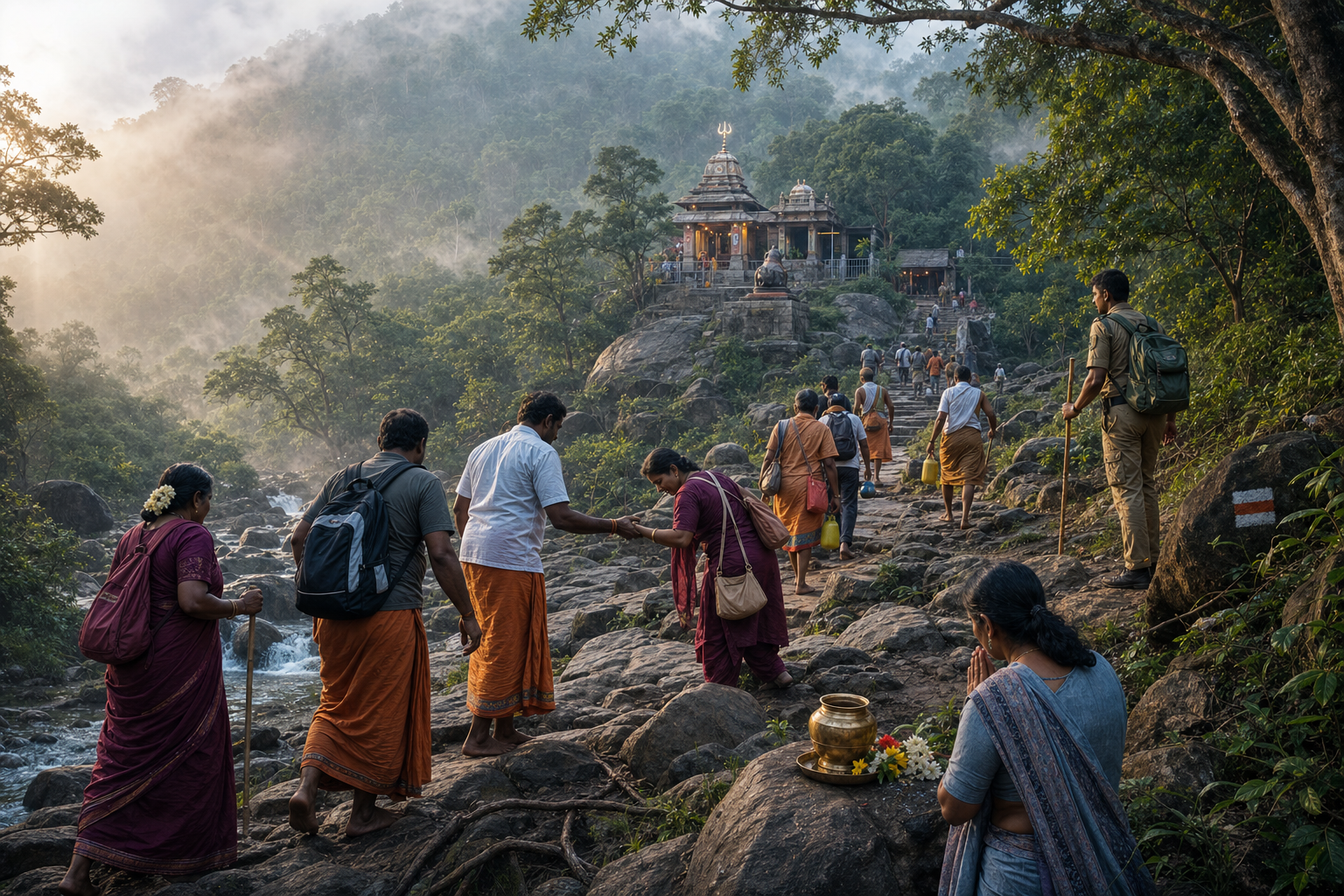
Sathuragiri Aadi Amavasai 2026 at a glance. Wednesday, 12 August 2026, is the principal date for Aadi Amavasai at Sathuragiri, the revered hill pilgrimage associated with Sri Sundara Mahalingam Swamy and Sri Sandhana Mahalingam Swamy near Srivilliputhur in Tamil Nadu. The occasion brings together ancestral remembrance, Shaiva worship, community service and a physically demanding journey through a protected Western Ghats landscape. A responsible guide must therefore distinguish calendrical facts, temple traditions, administrative rules and practical safety requirements.
Date and tithi for 2026. Aadi Amavasai falls on Wednesday, 12 August 2026, corresponding to Aadi 27 in the Tamil solar calendar. A location-based panchanga calculation for Vellore records Amavasya Tithi from approximately 1:52 a.m. until 11:06 p.m. IST on 12 August. The published Aadi Amavasai 2026 source gives the same starting time but lists the conclusion at 11:16 p.m. The date is consistent across these references, while the ten-minute variation illustrates why a family following a precise ritual timetable should consult its customary panchangam or priest.
Why panchanga timings can differ. A tithi is not a fixed civil day beginning at midnight. It is calculated from successive 12-degree changes in the longitudinal separation of the Sun and Moon, and its displayed clock time can depend on location, astronomical method, rounding and calendrical convention. The 2026 Amavasya calculation for Vellore places the entire tithi on 12 August. This makes the observance date unambiguous even though published ending times differ slightly.
Aadi in the Tamil calendar. Aadi is the fourth month of the traditional Tamil solar year. In 2026, it extends from 17 July to 17 August. The month contains several important observances, including Aadi Velli, Aadi Chevvai, Aadi Perukku, Aadi Krithigai, Aadi Amavasai and Aadi Pooram. These observances are not interchangeable: each has its own theological, familial and regional emphasis. Aadi Amavasai is distinguished by its particular association with departed ancestors.
The meaning of Aadi Amavasai. Within many Tamil Hindu communities, the new-moon day of Aadi is dedicated to remembering forebears and acknowledging Pitru Rina, the inherited obligation of gratitude toward previous generations. Families may perform Tarpanam, Shraddha, charitable service, food offerings or prayers according to lineage and sampradaya. Water and sesame commonly appear in ancestral rites, but no single procedure applies to every household. The observance is best understood as a disciplined act of memory rather than as a mechanical promise of material reward.
Ritual practice varies by family. The appropriate mantras, eligibility rules, sequence of offerings and time of performance can vary across Vedic shakhas, regional customs and family traditions. A household that has inherited a particular practice should follow qualified guidance rather than assemble a ritual from unrelated online instructions. Those unable to travel may still observe the day through prayer, remembrance, food offered with reverence, charity or another practice recognized within their tradition.
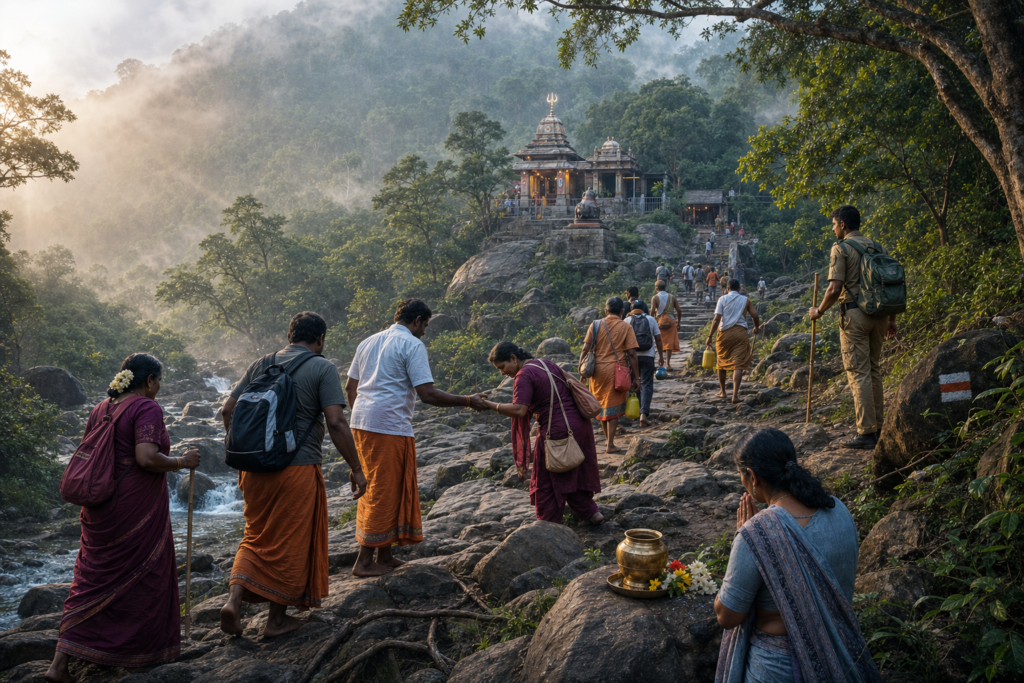
Why Sathuragiri gives the day a distinctive character. At Sathuragiri, remembrance of ancestors is joined to darshan of Shiva in a sacred hill environment. The ascent requires time, restraint and physical effort, turning devotion into an embodied practice. For a family carrying the memory of a parent, grandparent or teacher, the climb can make gratitude feel immediate: each careful step, shared container of water and act of assistance becomes part of the observance.
Location and administrative geography. Sathuragiri is approached from Thaniparai, also written Thaaniparai or Dhaniparai, near Watrap or Vathirairuppu and Srivilliputhur. Descriptions sometimes place the pilgrimage in Virudhunagar district and sometimes in Madurai district. Both usages reflect the local administrative geography: the commonly used foothill approach lies on the Virudhunagar side, while the temple enclosure and part of the surrounding Saptur forest are recorded on the Madurai side. The Madras High Court’s detailed 2024 judgment specifically notes the need for coordination between the two districts.
How Sathuragiri received its name. One widely repeated interpretation connects chathur, meaning four, with giri, meaning hill. The judicial record describes the site as surrounded by Sivagiri, Krishnagiri, Brammagiri and Siddhagiri and associates the name with the square-like arrangement of the hills. Another devotional explanation holds that the four Vedas meet here. These should be presented as complementary traditions of sacred interpretation rather than as experimentally demonstrated etymologies.
The principal shrines. The hill complex is centred on Sri Sundara Mahalingam Swamy Temple and Sri Sandhana Mahalingam Swamy Temple, the latter also transliterated as Santhana Mahalingam. Anandavalli Amman is worshipped in an associated shrine behind the Sundara Mahalingam temple. Local tradition regards the principal lingams as Svayambhu, or self-manifested. Other sacred points encountered on the customary route contribute to the sense that the pilgrimage encompasses a ritual landscape rather than a single isolated building.
Tradition and historical evidence should remain distinct. Devotional accounts describe the temples as extremely ancient and sometimes assign an age exceeding 2,500 years. The cited court record summarizes this belief but does not establish an archaeological construction date. An academically responsible account can honour the continuity of worship while acknowledging that sacred antiquity, oral memory, documentary history and archaeological dating are different categories of evidence.
“Siddargal boomi” and the Siddha tradition. Sathuragiri is popularly called “Siddargal boomi,” the land of Siddhas. Devotees believe that eighteen renowned Siddhas remain spiritually present in the hills and continue to worship Shiva. Sundara Mahalingam is also described in local tradition as an Anidai Lingam worshipped by Siddhas. Claims about invisible sages, spiritually charged caves and healing herbs belong to the devotional world of the pilgrimage; they should be identified as beliefs rather than presented as scientific findings.
The character of the Aadi festival. Aadi Amavasai is among Sathuragiri’s largest annual gatherings, alongside Thai Amavasai, Chitra Pournami and Maha Shivrathri. Temple worship, ancestral remembrance, collective chanting, queue-based darshan and organized Annadhanam contribute to the festival atmosphere. The emotional intensity comes not merely from crowd size but from the convergence of family memory, Shaiva devotion and the demanding ascent.
A ten-day festival does not mean ten days of unrestricted trekking. Earlier descriptions of the Sathuragiri Aadi festival commonly refer to a period of about ten days. The source article also contains older language suggesting unrestricted climbing. That wording should not be treated as current visitor guidance. Ritual observances may extend across several days, but forest entry is governed separately by court directions and announcements from the Forest Department, temple administration and district authorities.
The latest 2026 access framework. Public reporting dated 22 June 2026 states that daily climbing was discontinued and that the earlier system of limited access around Amavasai, Pournami and Pradosham was restored. Under that reported framework, pilgrims are ordinarily admitted on eight days per month: four associated with the new-moon period and four with the full-moon period. The June 2026 access update is more recent than pages that still describe all-day or daily public entry.
What the July 2026 notice reveals. For the preceding Aani Amavasai period, authorities permitted climbing from 12 to 15 July. Reported entry was generally from 6:00 a.m. to noon, with a shorter 6:00 a.m. to 10:00 a.m. window on the final day. The same July 2026 pilgrimage notice warned that rain could cancel entry, prohibited plastic and easily combustible materials, barred overnight stays and reported age restrictions. These details demonstrate the current approach to safety, but they do not constitute the final timetable for Aadi Amavasai in August.
What a 2026 pilgrim should assume. The festival date is fixed for 12 August, but the permitted climbing dates and checkpoint hours must be confirmed from the Aadi-specific government or temple announcement. No journey should be planned on the assumption that the hill will remain open throughout a traditional festival period. Authorities may shorten hours, cap entry, change transport arrangements or close the route at short notice.
Weather overrides the calendar. Permission on a published date is conditional when rain, a severe forecast, high stream flow or another safety threat develops. A clear morning at a pilgrim’s place of departure does not establish safe conditions on Sathuragiri. The operational decision at Thaniparai is made for the hill and watershed, and pilgrims must accept a closure without attempting an unofficial path.
Why the regulations are strict. The 2024 court record states that heavy rain and a flash flood on 17 May 2015 stranded about 4,000 pilgrims and caused fifteen deaths. Regulations introduced afterward included checkpoint screening, weather-based cancellation, use of the permitted footpath and deployment of Forest, Police and Fire personnel at vulnerable sections. The tragedy explains why an apparently inconvenient restriction is, in reality, a life-safety measure.
A pilgrimage inside a protected landscape. The approach passes through Saptur Reserve Forest. The wider landscape was notified as the Srivilliputhur Grizzled Squirrel Wildlife Sanctuary and later became part of the Srivilliputhur–Megamalai Tiger Reserve, with Sathuragiri described in the court record as lying within the buffer setting. The area supports sensitive wildlife and forest habitat, so pilgrim access must balance the right to worship with ecological protection and prevention of human–wildlife conflict.
Crowd capacity is an administrative issue. A Tamil Nadu Forest Department filing cites earlier committee planning figures of 2,778 pilgrims per day on ordinary pilgrimage days and 15,624 on special Aadi Amavasai days. These figures indicate the exceptional scale of the festival; they are not a promise that every person reaching Thaniparai in 2026 will be admitted. Actual entry remains subject to the operative order, staffing, weather, path condition and crowd management on the day.
The customary route begins at Thaniparai. Pilgrims normally assemble at the foothill checkpoint and proceed on foot along the authorized forest path. Entry screening is not a formality: it helps authorities keep prohibited materials out of the reserve, monitor the number of walkers and prevent people from entering after the safe departure window. Leaving the recognized route can expose a person to steep ground, wildlife, disorientation and legal consequences.
Published route distances vary. The judicial record describes the temple as about 5.5 kilometres from the plains of Thaniparai, while the Srivilliputhur municipal visitor page describes an uphill journey of roughly eight kilometres. Some popular accounts measure an even longer distance by using different start and end points. The sensible conclusion is that Sathuragiri is a substantial mountain walk, not that one estimate must be forced into agreement with every other.
Sacred landmarks on the ascent. The municipal route description identifies Kudhiraiootru, Vazhakkuparai, Sangali Parai, Gorakkar or Goraknath Cave, Irattai Lingam, Vana Durgai and Pilavadi Karuppasamy before the principal temple area. These names function as both route markers and elements of sacred geography. Conditions around rocks and streambeds can change after rainfall, so a familiar devotional name should never be mistaken for evidence that a section is physically easy.
How demanding is the trek? The path includes uneven stone, inclines, exposed roots, slippery rock and watercourse crossings. The ascent can take several hours, and festival congestion may slow progress considerably. The return requires its own reserve of strength; reaching darshan is only half the journey. A pilgrim who uses all available energy on the ascent can create risk for companions, volunteers and rescue personnel during the descent.
Reaching the foothills. Srivilliputhur is the nearest major railway point for the Thaniparai approach. Regular road transport connects Srivilliputhur with Watrap or Vathirairuppu, after which local transport is required for Thaniparai. The municipal guide places Thaniparai at roughly 28 kilometres from Srivilliputhur and about 80 kilometres from Madurai. Festival-day bus routes, parking areas and traffic diversions should be confirmed shortly before departure.
A realistic day plan begins early. Pilgrims benefit from reaching the foothills before the authorized opening time, while still allowing for queues and screening. An early ascent provides more daylight and a larger safety margin for descent. The controlling deadline is not merely the last time at which a person may enter; authorities may also require everyone to return to the foothills by a specified hour.
What to carry. A compact load should prioritize water in containers permitted at the checkpoint, simple food in compliant packaging, prescribed medication, basic first-aid material, sun protection, a lightweight rain layer and a fully charged phone. Clothing should be modest, breathable and suitable for climbing. Footwear needs reliable grip and should already be broken in; new footwear can cause blisters during a long ascent.
What should remain behind. Recent notices prohibit plastic materials and easily combustible items. Open flames, unauthorized cooking, fireworks, discarded camphor, cigarettes and similar fire risks are incompatible with a dry or crowded forest. Excess packaging, disposable plates and offerings likely to become litter should also be avoided. Checkpoint instructions take precedence over any generic packing recommendation.
Age and health require honest assessment. Recent July 2026 reporting stated that children below ten and adults above sixty were not permitted to climb during that access period. The Aadi-specific notice must be checked to determine whether the same limits apply in August. Independently of a legal age limit, anyone with significant cardiac, respiratory, balance, mobility or heat-related risk should obtain appropriate medical advice and avoid treating devotional determination as a substitute for physical capacity.
Facilities are limited. Mobile reception, electrical access, drinking-water availability and food supply can be unreliable on the hill, especially during a large festival. A phone is useful but should not be treated as a guaranteed rescue connection. Pilgrims should remain with their group, agree on meeting points and keep essential medication on the person rather than in another companion’s bag.
Water and food demand balance. Carrying too little water creates avoidable risk, while an oversized load makes the climb harder. Reusable containers that satisfy current forest rules offer the best balance. Simple food should be sufficient for the full journey because Annadhanam or commercial availability may be delayed by crowds. Food should remain sealed until needed, and every permitted wrapper must return to the foothills.
Wildlife must remain undisturbed. Pilgrims should never feed monkeys, approach an animal for a photograph, collect plants or enter the forest in search of reputed medicinal herbs. Feeding changes animal behaviour and increases conflict, while plant removal damages a habitat valued precisely for its biodiversity. Silence, controlled movement and use of the designated path are forms of both personal safety and environmental conservation.
Streams are not recreational bathing areas. Water levels can rise rapidly in a mountain catchment even when rain falls out of sight upstream. Recent reports have described restrictions on bathing in hill streams. A shallow-looking crossing should be approached only as directed by personnel, and no pilgrim should enter flowing water to wash, take photographs or perform an improvised ritual.
Crowd discipline is part of worship. Queue jumping, pushing on narrow sections, loud entertainment and pressure on slower walkers can transform devotion into danger. Families should keep children within immediate reach whenever children are permitted, allow space around elderly or unsteady pilgrims, and follow one-way movement where imposed. Assistance should be offered without obstructing the path or creating a second crowd around the person being helped.
Temple etiquette remains simple. Pilgrims should wear respectful clothing, remove footwear where instructed, maintain the darshan queue and follow restrictions on photography, offerings and access to sanctum areas. Special puja or abhishekam arrangements should be confirmed with the authorized temple administration. No unofficial intermediary can guarantee faster darshan during a regulated high-crowd festival.
Planning ancestral rites at Sathuragiri. A family intending to perform Tarpanam or another ancestral observance should determine in advance whether the rite will occur at home, at an authorized foothill location or under recognized guidance connected with the pilgrimage. Ritual materials must comply with forest rules, and nothing should be released into a stream or left on the path. Sacred intention does not exempt an offering from ecological responsibility.
Annadhanam as disciplined seva. The offering of food is an important expression of community care during major pilgrimages. Its value depends on cleanliness, authorization, orderly distribution and complete waste removal. Individual pilgrims should use designated services where available and should not establish unauthorized cooking fires or distribution points inside the forest. Service is most meaningful when it reduces hardship without creating another safety or sanitation problem.
Darshan within the temple landscape. The customary pilgrimage centres first on Sri Sundara Mahalingam Swamy, with Sri Sandhana Mahalingam Swamy reached farther within the sacred area. Anandavalli Amman and the route’s guardian shrines add distinct devotional dimensions. On Aadi Amavasai, crowd controls may limit the time available at each point, so a brief and attentive darshan is more realistic than an extended private observance.
The deeper discipline of the journey. Sathuragiri’s power does not depend on conquering a mountain or collecting dramatic photographs. Its enduring lesson lies in the relationship among memory, humility and restraint. The ancestors are honoured not only by words and offerings but also by protecting the inherited landscape, assisting another pilgrim and returning without leaving a trace.
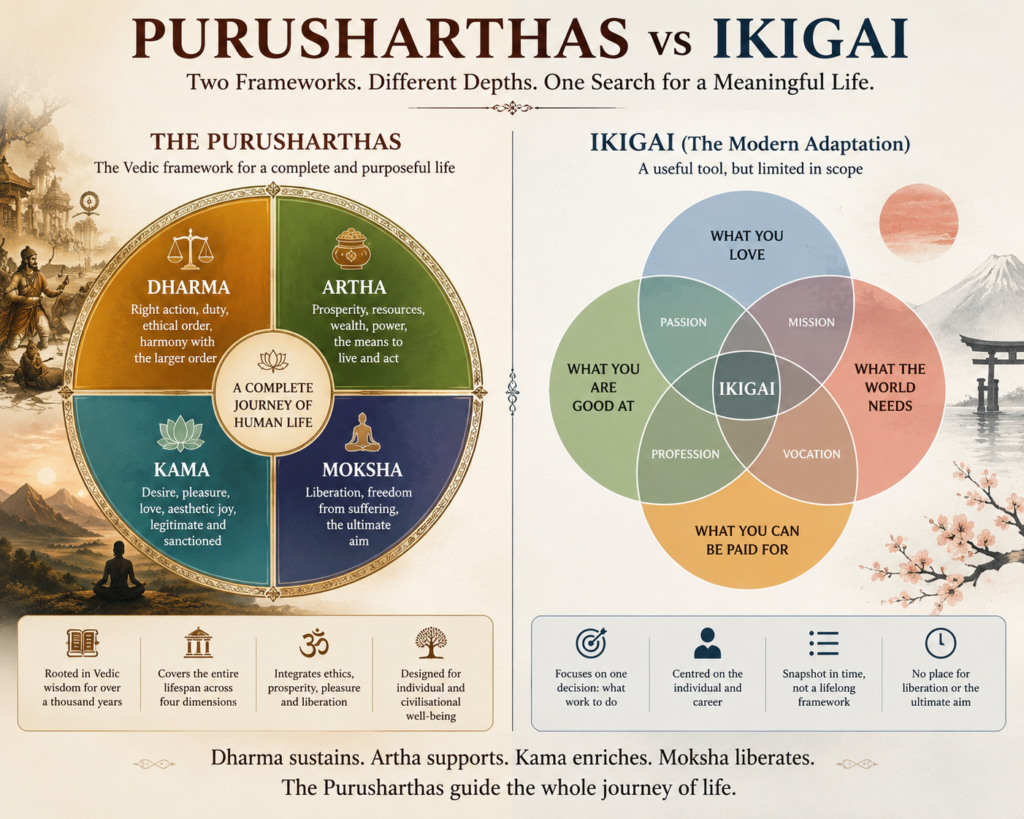
A shared Dharmic ethic. Sathuragiri is specifically a Hindu and Shaiva pilgrimage, and its identity should not be diluted. At the same time, its emphasis on seva, disciplined conduct, non-injury and reverence for living landscapes supports respectful unity among Hindu, Buddhist, Jain and Sikh communities. Such unity does not require collapsing their distinct teachings; it arises through mutual respect and responsible action.
Frequently asked question: What is the exact Sathuragiri Aadi Amavasai 2026 date? The observance falls on Wednesday, 12 August 2026. It is Aadi 27 in the Tamil calendar. This date refers to the religious observance; the permitted trekking period may include a limited number of surrounding days announced separately.
Frequently asked question: What are the Amavasya timings? One widely used location-based calculation gives approximately 1:52 a.m. to 11:06 p.m. IST on 12 August, while the source page lists an ending time of 11:16 p.m. Families requiring a ritual muhurta should use a panchangam calculated for their location and follow their inherited practice.
Frequently asked question: Is Sathuragiri open for the entire ten-day festival? It should not be assumed so. A traditional festival span and legal forest-entry dates are separate matters. The June 2026 framework restored limited monthly access, and the final Aadi notice will determine the authorized dates and checkpoint hours.
Frequently asked question: Can pilgrims stay overnight? Recent rules prohibit unauthorized overnight stays on the hill. Pilgrims should plan a same-day ascent, darshan and descent and obey the return deadline stated by officials. Lodging, if required, should be arranged outside the restricted forest area.
Frequently asked question: What happens if it rains? Entry may be delayed or cancelled even on a formally permitted day. A closure can follow rainfall, a forecast warning, high water or unsafe trail conditions. Tickets, travel distance or prior vows do not override an on-site safety order.
Frequently asked question: May children and senior citizens climb? A July 2026 notice reported that children below ten and adults above sixty were not permitted for that access period. Pilgrims must verify whether the Aadi order repeats or modifies those limits. Physical suitability should be considered even when a person falls within the permitted age range.
Frequently asked question: How long and difficult is the route? Published measurements differ according to the points used, with core-route descriptions ranging from about 5.5 to eight kilometres. The uneven ascent and descent require several hours, and festival queues can extend the day. It is a strenuous pilgrimage through forest terrain rather than a casual temple visit.
Frequently asked question: How is Thaniparai reached? The usual journey is through Srivilliputhur and Watrap or Vathirairuppu, followed by local transport to the Thaniparai foothills. Srivilliputhur is the nearest major railway station for this approach. Festival-specific bus operations, parking and road closures should be checked before travel.
Frequently asked question: What is the most important item to carry? No single object replaces preparation. Permitted drinking water, suitable footwear, prescribed medication, weather protection and a light load work together. Equally important are an early start, willingness to turn back and respect for checkpoint instructions.
Final planning checklist in one paragraph. Confirm the Aadi-specific opening notice; verify the authorized date and entry hours; check the weather and transport plan; review age and health restrictions; pack only permitted essentials; reach Thaniparai early; remain on the official path; avoid streams, wildlife and prohibited materials; complete darshan without delaying crowd movement; and return to the foothills within the stated deadline.
A pilgrimage of memory and responsibility. Sathuragiri Aadi Amavasai 2026 offers a profound meeting of ancestral gratitude, Shiva bhakti and sacred geography. Its spiritual force is strengthened, not diminished, by careful regulation. When pilgrims prepare honestly, follow the authorities, protect the forest and assist one another, the journey reflects the values it seeks to honour.
Research and verification note. Festival details were checked against the source article, the 2026 Aadi calendar pages, location-based panchanga data, the Srivilliputhur municipal visitor guide, Tamil Nadu forest documentation, the 2024 Madras High Court record and June–July 2026 access reporting. Operational information remains time-sensitive and should be reconfirmed with the Forest Department, temple administration and district authorities immediately before travel.
Inspired by this post on Hindu Pad.









Leave a Reply
You must be logged in to post a comment.