
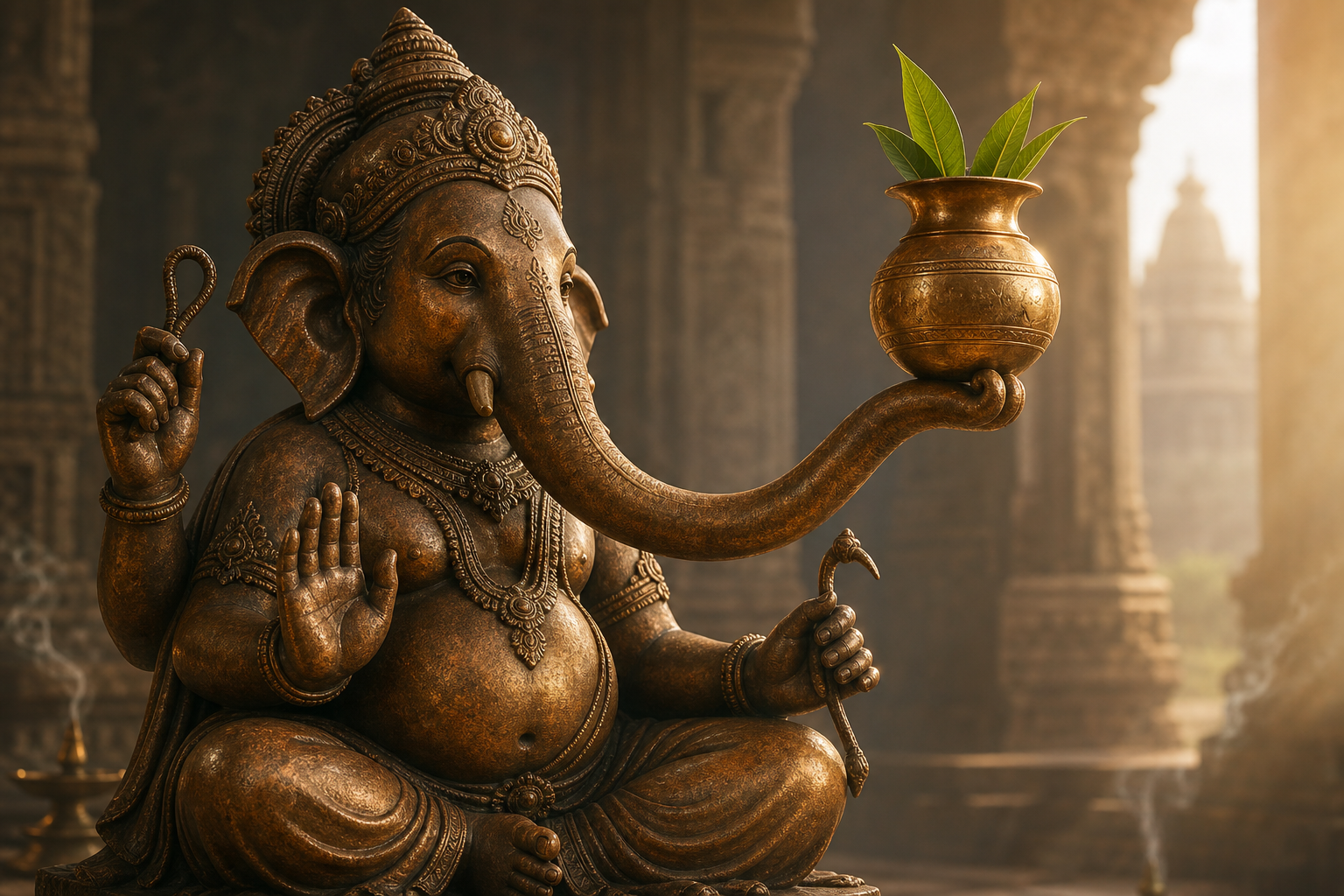
A small object can change the reading of an entire sacred image. In some South Indian sculptures of Ganesha, the eye is first drawn to the elephant head, rounded abdomen, broken tusk, noose, goad, or bowl of sweets. Only after a slower look does another detail emerge: the trunk bends with remarkable control and supports a ritual vessel. That vessel is the kalasha, and its position at the trunk’s tip creates one of the most concentrated statements of abundance, auspiciousness, and disciplined power in Ganesha iconography.
The attribute is often called the sundagra patra. In scholarly transliteration, the compound may be rendered śuṇḍāgra-pātra: śuṇḍā denotes an elephant’s trunk, agra means the point or extremity, and pātra is a vessel or receptacle. The expression therefore means a vessel at, or held by, the tip of the trunk. Kalaśa identifies the more specific pot form. The two labels perform different tasks: sundagra patra describes position and function, while kalasha identifies the vessel’s ritual and visual type.
A descriptive term, not a separate deity or legend
The term is best understood as technical iconographic vocabulary rather than the name of an independent mythic object. It tells a cataloguer, sculptor, conservator, or attentive viewer where the receptacle appears. This distinction matters because pātra is broad: it can mean a cup, bowl, dish, or container. A vessel located at the trunk’s tip is not automatically a full ceremonial kalasha unless its shape and context support that identification.
The spelling sundagra patra is useful in ordinary English-language discussion, but the form without diacritics conceals several Sanskrit sounds. The normalized śuṇḍāgra-pātra makes the compound’s structure clearer. Neither spelling should be treated as proof that every workshop, temple community, or historical text used exactly the same label. Indian iconographic terminology developed through Sanskrit treatises, regional languages, inscriptions, workshop practice, museum cataloguing, and living oral traditions, so parallel names and variable spellings are normal.
How the kalasha can be recognized
A kalasha generally has a swelling or globular body, a narrower neck, and a defined mouth or rim. In ritual arrangements it may be filled with water and crowned with leaves, a coconut, flowers, thread, or other auspicious materials. In sculpture, those additions may be rendered as a pointed cap, a cluster of leaves, a bud-like form, or a simplified mass. Scale, medium, age, and ritual wear can reduce these signs to a few carefully chosen contours.
Identification becomes more secure when several features agree. A rounded belly plus a constricted neck suggests a pot; a clearly flared rim strengthens the reading; foliage or a coconut-like crown points toward a pūrṇa-kalaśa or pūrṇa-kumbha, the full vessel. The trunk may curl around the neck, rest against the rim, or cradle the body of the pot. Because projecting metal or stone elements are vulnerable, the trunk and vessel are sometimes joined to one another or to Ganesha’s torso for physical support.
The most common source of confusion is the modaka. Many Ganesha images show the trunk reaching toward a single sweet or dipping into a bowl of sweets. A modaka is usually compact, rounded, or pointed, without a neck and rim. A fruit such as the citron or wood apple is similarly solid. A bowl of sweets tends to be open and shallow, often held in a hand, whereas a kalasha is usually deeper and architecturally shaped. Damage can erase these differences, so an uncertain object should be described cautiously rather than assigned a symbolic meaning too quickly.
A kamandalu presents another possible confusion. It is also a water vessel, often associated with ascetics and creator figures, but may have a handle, spout, or differently proportioned body. A generic pot, a jewel vessel, an amṛta vessel, and a kalasha can overlap visually without being identical in every text. Iconographic analysis therefore works by comparison: outline, location, the deity’s other attributes, regional parallels, date, and ritual context must be considered together.
Ganesha’s visual grammar
Sacred images communicate through organized combinations of body, posture, gesture, ornament, vehicle, and attribute. Ganesha’s elephant head establishes identity immediately, but the surrounding details specify aspect and function. The pāśa or noose can signify restraint and the gathering of what has strayed. The aṅkuśa or goad evokes guidance and directed force. The broken tusk marks sacrifice, resolve, authorship, or victory in different narrative traditions. Sweets and fruits express nourishment, fulfillment, and the attractive sweetness of a worthy goal.
The trunk is especially important because it behaves almost like an additional hand while remaining the unmistakable sign of Ganesha’s elephant form. It can turn toward food, lift a lotus, touch a vessel, or participate in the image’s rhythm. Its placement is therefore not incidental anatomy. It directs the viewer’s attention, links the head to a lower attribute, and can complete a compositional circuit across the body.
The natural capabilities of an elephant’s trunk make this symbolism unusually persuasive. The same organ can move substantial weight and perform delicate acts of grasping. In a Ganesha image, that observed union of strength and sensitivity supports a theological reading of intelligent power: obstacles are not overcome by force alone, but by force governed through discrimination, timing, and care. This is a compelling interpretation rather than a single mandatory doctrine, and it should be presented as such.
When the trunk carries a kalasha, two already auspicious signs reinforce one another. Ganesha presides over beginnings, transitions, learning, and the removal or placement of obstacles; the full vessel signifies prepared abundance and life held in readiness. Their conjunction does not merely promise acquisition. It presents the capacity to receive, preserve, direct, and distribute what is beneficial.
The kalasha between ritual, art, and architecture
The kalasha is not only an image carved in stone or cast in metal. It is a material ritual object used across many Hindu settings. A pot may be filled with sanctified water and furnished with leaves, coconut, flowers, grains, thread, or cloth according to region and rite. It can serve as a temporary seat of invoked divine presence, a sign of welcome, or a reservoir from which consecrated water is later poured. Its meaning is produced by form, contents, mantra, placement, and ritual action together.
The adjective pūrṇa, meaning full or complete, is crucial to the pūrṇa-kalaśa, pūrṇa-kumbha, and pūrṇa-ghaṭa concepts. Fullness here is not simply volume. It encompasses fertility, nourishment, continuity, prosperity, and the latent possibility of growth. Foliage emerging from the vessel makes that idea visible: contained water becomes vegetation, and hidden potential becomes manifest life. Impart’s art-historical overview of the kalasha traces this association with plenitude and good fortune across South Asian ritual, iconography, and architecture.
Kalashas appear at domestic ceremonies, temple observances, rites of passage, festival installations, and acts of consecration. Their exact contents and theological explanations vary among sampradayas and regions. That variation is not a defect in the tradition. It demonstrates a stable symbolic grammar capable of local expression: a prepared vessel, ritually filled and set apart, becomes a concentrated image of welcome, presence, and auspicious possibility.
The same form rises above the human scale in temple architecture. Pot-shaped finials crown temple superstructures, while pūrṇa-kumbha motifs mark bases, thresholds, pillars, and ornamental bands. During kumbhābhiṣeka, sanctified water is poured over the crowning finials in the renewal or consecration of a temple. A kalasha held by Ganesha’s trunk can therefore resonate simultaneously with the household altar, the ritual pavilion, and the temple’s highest point, although no single sculpture needs to encode all three associations deliberately.
The motif also belongs to a wider Dharmic visual vocabulary. Hindu, Buddhist, and Jain art all employ full vessels as signs of auspiciousness, longevity, abundance, consecration, or spiritual treasure, with meanings adapted to their respective traditions. An Indira Gandhi National Centre for the Arts discussion explicitly notes the pūrṇa-kumbha’s use in Hindu, Buddhist, and Jaina worship. Shared imagery does not erase doctrinal differences; it reveals long histories of artistic exchange and a common reverence for life, generosity, and sacred preparation.
Seven interlocking meanings of the trunk-held vessel
First, the vessel signifies auspicious fullness. Ganesha is invoked before undertakings because beginnings require more than enthusiasm: they require conditions in which an action can mature. A filled kalasha visualizes such readiness. Water is present, the container is stable, and the possibility of nourishment has been gathered before the journey begins.
Second, it signifies life and regeneration. Water stored in a vessel can sustain a household, nourish seed, and make ritual purification possible. When leaves or a coconut crown the pot, the image joins containment to organic growth. The trunk’s contact adds agency: abundance is not static wealth but life carried, protected, and placed where it can become fruitful.
Third, the kalasha may evoke amṛta, the nectar of immortality, especially when a text, inscription, or iconographic context identifies it as an amṛta-ghaṭa. That association should not be imposed on every small pot. A water vessel, jewel pot, and nectar vase can resemble one another, and traditional sources do not always assign the same contents. The academically responsible formulation is that the kalasha can activate a semantic field that includes vitality, longevity, and immortality, not that every example literally contains amṛta.
Fourth, the combination intensifies maṅgala, or auspiciousness. Ganesha and the kalasha are each associated with the threshold between what has not yet begun and what is about to unfold. Together they create a visual prologue. The image is particularly resonant in spaces of entry, procession, marriage, education, artistic performance, or temple renewal, where communities seek an orderly transition into a new phase.
Fifth, the vessel offers a philosophical image of form and content. A pot has a finite boundary, yet it can hold water that reflects the open sky. Indian philosophical traditions use vessel imagery in several different ways, and no one analogy should be declared the official explanation of this attribute. Even so, the relationship between container and contained provides a disciplined interpretive lens: embodied life becomes capable of holding knowledge, grace, or sacred intention without claiming to exhaust the infinite.
Sixth, the trunk suggests discernment in the handling of abundance. A full pot can be spilled, hoarded, shared, consecrated, or used to nourish. Ganesha’s controlled grasp implies that prosperity becomes auspicious only when governed well. The image thus supports an ethical reading in which success is joined to responsibility, knowledge to humility, and power to restraint.
Seventh, the vessel bridges divine gift and human reception. The kalasha is at once something Ganesha holds and something devotees themselves prepare in ritual. That reciprocity is important. Sacred art does not place all action on one side. The worshipper fills, offers, invokes, and receives; the deity protects, redirects, and blesses. The object at the trunk’s tip becomes the meeting point between ritual labor and grace.
Historical evidence and necessary caution
Ganesha’s iconography did not emerge as one fixed diagram. Across centuries, sculptors represented him standing, seated, dancing, accompanied, solitary, two-armed, four-armed, or many-armed. Attributes changed with region, sectarian setting, text, patron, and workshop. The trunk frequently reaches toward a sweet or fruit in early and medieval images, establishing a long visual tradition in which the elephant feature actively engages an attribute rather than hanging passively.
South Indian stone sculpture gives Ganesha a durable place in temple programs, while copper-alloy images allow the deity to appear in processions and festival movement. Under the Cholas, especially between the tenth and thirteenth centuries, Tamil workshops produced sophisticated images in the round for temple worship. Their poised modeling and controlled shifts of weight made the trunk an expressive line capable of binding the composition together.
The early twentieth-century survey South-Indian Images of Gods and Goddesses records several relevant traditions. Its summary states that Ganesha’s front attributes can vary, with a water-pot appearing as an alternative in a general four-armed type; it also notes seated and dancing Ganapati images installed at the Brihadisvara temple in the Chola period. Those observations establish the water vessel and multiple postures within South Indian iconographic practice, but they do not by themselves prove that every historical water-pot was carried specifically by the trunk.
Well-documented Chola-period images often show a different trunk action. A twelfth-century Tamil Nadu Ganesha at The Metropolitan Museum of Art holds the noose, battle-axe, sweet, and broken tusk. A circa 1070 Chola bronze at the Cleveland Museum of Art brings a spherical object into contact with the trunk. Such examples are important controls: the familiar trunk-and-sweet motif must not be relabeled as a kalasha merely because the object is rounded.
At the same time, the trunk-held vessel is not a modern verbal invention. A catalogued nineteenth-century South Indian dancing Ganesha bronze is explicitly described with a small vessel held by the trunk, alongside the broken tusk, axe, noose, and sweetmeats. Contemporary hereditary and commercial bronze workshops also continue to produce seated and dancing Ganeshas whose trunks cradle a kalasha, demonstrating the motif’s vitality in current South Indian sacred-art practice.
The label Chola bronze requires particular care. It can refer to an object actually made during the Chola period, but it is also used in the market for a modern image made in a Chola-inspired Tamil style. Date, provenance, alloy analysis, casting technique, inscriptions, wear, and documented collection history must be assessed before a historical claim is made. A modern devotional bronze can be iconographically meaningful without being misrepresented as a medieval antiquity.
Regional variation should likewise be expected. Tamil Nadu, Karnataka, Andhra-Telangana, and Kerala share extensive networks of artisanship and worship, yet their images are not interchangeable. A form prominent in a nineteenth-century Mysore manuscript may not match an eleventh-century Tamil bronze; a current Swamimalai casting may preserve old conventions while introducing a workshop-specific solution. South Indian iconography is best understood as a connected field of traditions rather than a single unchanging code.
The vessel and Nritya Ganapati
The sundagra patra is especially striking in images of dancing Ganesha, often called Nritya Ganapati or Nṛtta Gaṇapati. The raised foot, flexed supporting leg, swaying abdomen, radiating arms, and curling trunk create a complex rhythm. A small pot at the trunk’s end becomes both an attribute and a visual counterweight. It steadies the composition conceptually even as the body appears to move.
No single list of attributes governs every dancing Ganesha. The nineteenth-century Mysore compendium Śrītattvanidhi describes a golden dancing form under the wish-fulfilling tree with attributes that include the noose, goad, axe, and tusk, while surviving images and later workshop traditions vary. A study of Nritya Ganapati in literature, iconography, and Bharatanatyam illustrates the gap between textual prescription and the wider sculptural record. The presence of a trunk-held vessel may therefore identify a regional or workshop variant, but it should not be treated as the universal test for Nritya Ganapati.
Dance changes the vessel’s meaning. In a static seated image, the kalasha can emphasize stability and stored plenitude. In a dancing image, the same pot is carried without spilling, turning fullness into balance under motion. Theologically, the image can suggest that wisdom is not withdrawal from change but composure within it. The reading is especially relatable because ordinary life also tests whether attention can remain steady while circumstances move.
The dancing form also resists a narrow opposition between spiritual seriousness and joy. Ganesha’s movement is playful, but the attribute system remains precise. The pot, noose, goad, tusk, and sweet are not random accessories; each participates in an ordered field. Sacred joy here is disciplined rather than chaotic, and abundance is carried through rhythm rather than displayed as excess.
What the sculptor had to solve
In stone, the trunk and vessel must be legible without becoming too fragile. A relief sculptor can keep the pot close to the abdomen or another arm, leaving a supporting bridge of stone. Deep shadow around the rim may distinguish vessel from fruit, while incised bands can clarify neck and body. Weathering often attacks precisely these projecting details, so surviving contours may represent only part of the original design.
In a copper-alloy image made by the lost-wax process, the sculptor first resolves the full form in wax. The wax model is invested in a clay mold, the wax is removed through heating, molten metal occupies the void, and the mold is broken after cooling. Chasing and finishing refine the surface. Because the model and mold do not function like a reusable modern production mold, each traditional casting retains individual differences. The British Museum’s Chola-period Nataraja record, for example, identifies lost-wax casting and a copper alloy often described as pañcaloha in this broader South Indian tradition.
The trunk-held pot poses a technical problem within that process. A thin trunk projecting away from the core may cast poorly, bend, or break; a heavy vessel at its end increases stress. Artisans can thicken the curve, fuse the vessel to a hand or torso, shorten the projection, or use ornament to disguise a structural join. What appears to be a purely theological gesture is therefore also an elegant solution in materials engineering.
Surface treatment further affects interpretation. Temple bronzes may receive oil, sandal paste, vermilion, flowers, cloth, jewelry, and repeated touch. These acts can soften details, create accretions, or polish high points. Corrosion alters excavated or long-stored metal differently. An iconographer should distinguish ritual wear from casting flaws and modern artificial patination, while recognizing that a worshipped image’s changing surface is part of its living history.
Stone and metal also produce different experiences. A fixed stone Ganesha belongs to a particular architectural route and is encountered as the devotee moves. A processional bronze moves toward the community, changing distance, light, dress, and setting. The kalasha at the trunk’s tip participates in both modes: in stone it can mark a threshold permanently; in bronze it can carry auspicious fullness into public space.
A disciplined method for reading an unfamiliar image
The first step is to record before interpreting. Posture, number of arms, headgear, trunk direction, vehicle, attendants, pedestal, backplate, and every surviving object should be described in neutral language. Terms such as globular vessel, shallow bowl, pointed sweet, or damaged rounded object are more useful at this stage than an immediate theological conclusion.
The second step is to read the complete attribute set. A pot-like object gains meaning from its neighbors. Noose and goad may support a standard Ganesha type; an array of agricultural produce may indicate a prosperity-oriented form; musical movement may suggest a dancing aspect; a goddess on the lap may place the image in a different tantric or household theology. An isolated attribute rarely identifies a form by itself.
The third step is to use proper orientation. In art history, Ganesha’s proper left means the deity’s own left, which appears on the viewer’s right in a frontal image. Popular explanations frequently reverse these viewpoints. A catalog should state whether a direction belongs to the deity or the viewer. Even then, trunk direction should not be assigned a universal spiritual value, because regional customs and modern advice differ.
The fourth step is comparison. Securely dated museum objects, temple photographs with known locations, inscriptions, historical catalogues, and relevant śilpa or āgama passages can be placed beside the image. Visual similarity alone is insufficient if the proposed parallel comes from another century or region. Texts are equally not blueprints that every sculptor followed literally; they are one body of evidence within a larger visual and ritual ecology.
The fifth step is to preserve uncertainty. If damage leaves open the possibility of a modaka, fruit, or vessel, that ambiguity belongs in the description. Responsible language might state that the trunk touches a rounded object, possibly a small kalasha, rather than converting possibility into fact. Such caution does not weaken the sacred reading. It respects the object enough to separate observation from inference.
Devotional experience and academic interpretation
A museum label and a devotee’s darshan ask different but compatible questions. The label seeks date, region, medium, style, and identification. Darshan concerns a reciprocal encounter with sacred presence. Academic analysis becomes reductive if it treats a consecrated murti as only an artifact; devotional interpretation becomes historically fragile if every modern explanation is projected unchanged into the distant past. A fuller approach allows material evidence, textual tradition, and living reverence to illuminate one another.
For a devotee familiar with a household kalasha, the trunk-held pot can feel immediately intimate. The cosmic and domestic meet in a vessel that can be prepared on an ordinary floor, placed on an altar, carved on a temple, and held by Ganesha. That continuity explains much of the motif’s emotional force. Sacred abundance is not pictured as remote treasure but as water gathered carefully, life welcomed respectfully, and blessing made ready to circulate.
For a museum visitor, the same detail rewards patient looking. The first glance recognizes Ganesha; the second identifies the vessel; the third notices how the trunk bears its weight. The image gradually shifts from a collection of symbols into a meditation on how power behaves. Strength becomes most admirable when it can carry something full without crushing or spilling it.
The shared history of the full vessel across Hindu, Buddhist, and Jain art offers another important insight. Unity among Dharmic traditions need not depend on claiming that every symbol means exactly the same thing. A more accurate unity arises from recognizing conversation, adaptation, and mutual intelligibility. The kalasha can hold distinct teachings while continuing to signify auspicious preparation, ethical abundance, and life-giving possibility across communities.
Common misreadings to avoid
The first misreading is that every Ganesha holds a kalasha. He does not. The trunk may be empty, touch a sweet, lift a lotus, grasp a fruit, approach a goddess, or curve independently. The vessel is a meaningful variant within a much larger iconographic repertoire.
The second is that the vessel proves material wealth alone. Prosperity is one layer, but ritual fullness also includes health, knowledge, continuity, fertility, hospitality, spiritual attainment, and the capacity to serve. Reducing the kalasha to a money symbol strips it of the ecological, ethical, and consecratory meanings that give it depth.
The third is that a trunk-held pot automatically identifies one of the thirty-two named forms of Ganesha. Named forms overlap, textual lists vary, and artists adapt prescriptions. Identification requires the complete configuration, not one attractive detail. In some dancing bronzes the vessel may belong to a regional variant rather than the defining description of Nṛtta Gaṇapati.
The fourth is that trunk direction alone determines whether an image is safe, dangerous, domestic, or temple-only. Such rules circulate widely, but they are not uniform across time and region. The direction should be recorded and interpreted within a known sampradaya or local practice, not converted into a universal law of Hindu iconography.
The fifth is that the pot is merely decorative. Even when a workshop introduces the feature without following a surviving textual prescription, decoration in sacred art is not necessarily empty ornament. Shape, placement, ritual familiarity, and the deity’s identity generate meaning. The more precise conclusion is that the degree of textual standardization may vary, while the motif remains symbolically intelligible.
The deepest lesson at the trunk’s tip
The sundagra patra condenses a broad sacred world into a compact gesture. The kalasha gathers water, fertility, welcome, consecration, abundance, and the possibility of renewal. Ganesha gathers intelligence, threshold power, humor, protection, and disciplined action. The trunk brings those fields together through an organ capable of immense force and minute control.
The resulting image offers a demanding definition of success. Success is not possession without measure; it is the ability to hold fullness without losing balance. Knowledge is not display; it is the discrimination required to place each force correctly. Auspiciousness is not passive luck; it is a prepared condition in which right action can begin.
That is why the vessel at the trunk’s tip deserves close attention in South Indian Ganesha iconography. It is small enough to be missed and rich enough to reorganize the entire sculpture. Once recognized, it reveals how Hindu sacred art makes philosophy tangible: a pot becomes the world’s stored potential, a trunk becomes wise agency, and Ganesha becomes the guardian of abundance that is received with humility, carried with steadiness, and released for the good of life.
Inspired by this post on Hindu Blog.





Leave a Reply
You must be logged in to post a comment.