
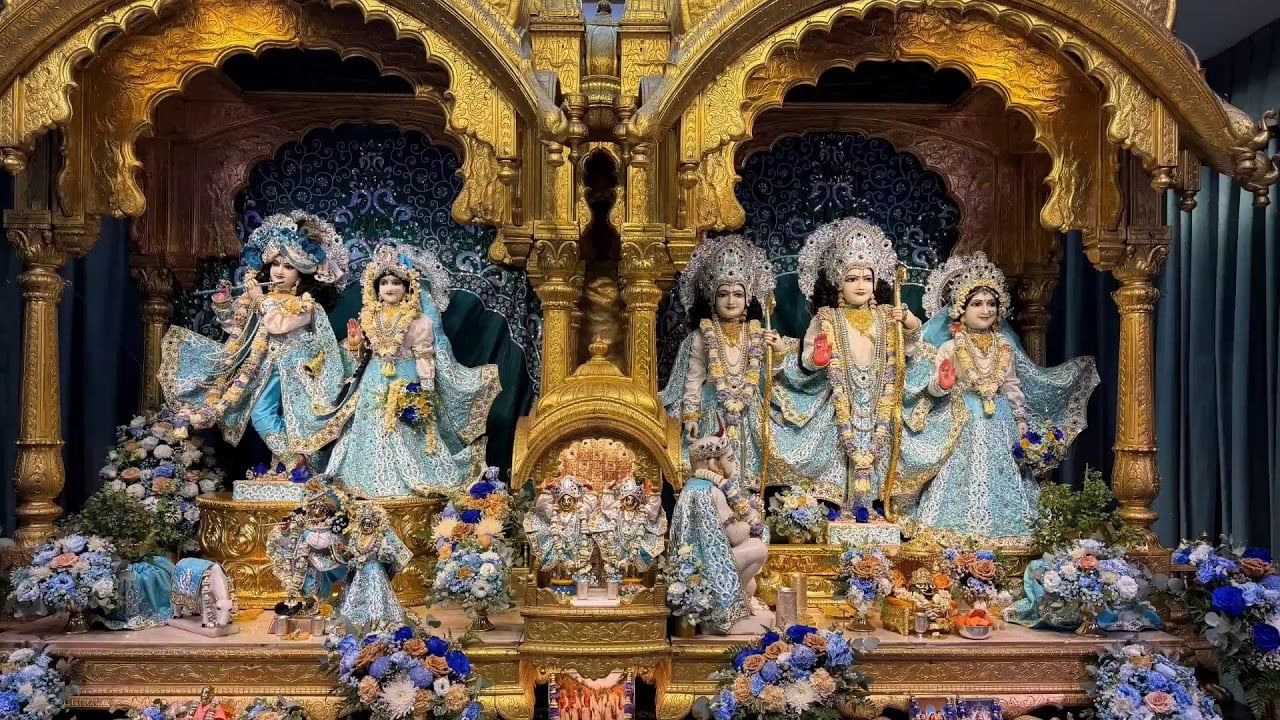
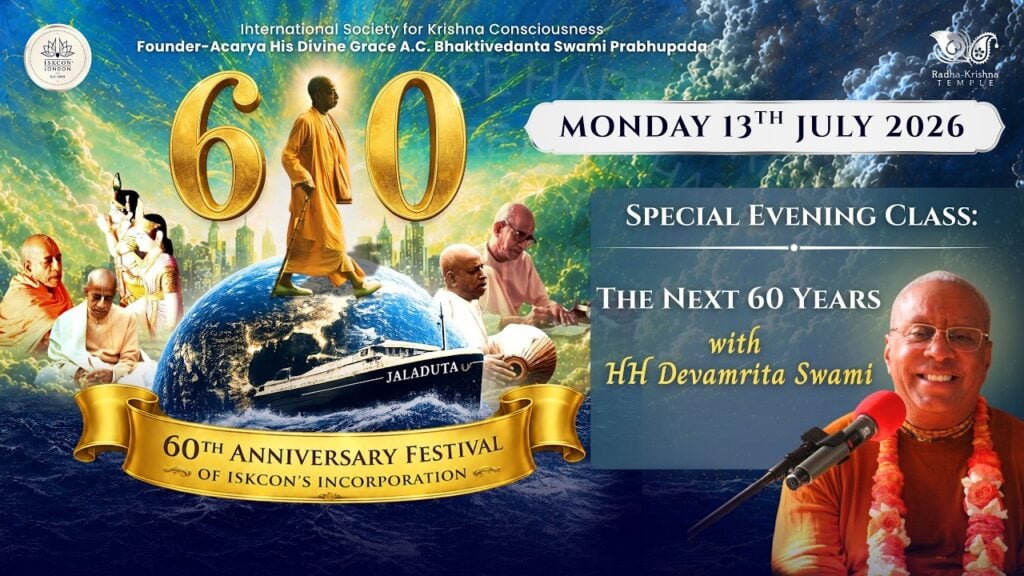
A sixty-year milestone with a precise historical centre. Bhaktivedanta Manor’s ISKCON 60th Anniversary Celebration on Monday, 13 July 2026, marks six decades since the International Society for Krishna Consciousness was formally incorporated in New York. The official programme places the observance at Sri Krishna Haveli, on the Bhaktivedanta Manor estate near Watford, from 4:45 p.m. to 9:00 p.m. local UK time. The accompanying Bhaktivedanta Manor broadcast, presented by the ISKCON Bhaktivedanta Manor – Hare Krishna Temple Watford channel, extends the occasion beyond the physical venue and gives it value as a digital record of a major anniversary in modern Vaishnava history.
Why 13 July matters. The date is not an arbitrary point in a year-long jubilee. ISKCON’s official historical account identifies July 1966 as the period in which A. C. Bhaktivedanta Swami Prabhupada established the society while working from a small storefront on New York City’s Lower East Side. Its incorporation documents were filed on 13 July 1966, and the new institution was organized around seven stated purposes. Sixty years later, the commemoration at Bhaktivedanta Manor deliberately returns to those purposes, making the evening both an anniversary celebration and an exercise in institutional memory. The programme therefore asks a deeper question: what has endured from the original mission, and how can its principles remain intelligible in a very different social and technological world?
A modern institution rooted in an older tradition. Academic clarity requires a distinction between ISKCON’s legal age and the age of its religious inheritance. ISKCON began as an incorporated organization in 1966, but it identifies with the Gaudiya Vaishnava sampradāya within the broader Hindu tradition. Gaudiya Vaishnavism developed around the teachings of Sri Chaitanya Mahaprabhu in early modern eastern India and places loving devotion to Krishna at the centre of religious life. Its principal scriptural foundations include the Bhagavad-gītā and the Śrīmad-Bhāgavatam. The anniversary thus commemorates sixty years of a particular global institution rather than sixty years of bhakti, Vaishnavism or Krishna worship. ISKCON’s current institutional overview makes this lineage central to its own identity.
Srila Prabhupada and the journey behind the anniversary. Born in Calcutta in 1896, A. C. Bhaktivedanta Swami Prabhupada travelled to the United States in 1965 at the age of sixty-nine. He arrived with his Sanskrit commentaries and a mission to communicate Gaudiya Vaishnava teachings in English. His early lectures, discussions and kirtans attracted a small circle of participants in New York, from which the incorporated society emerged. During the following eleven years, ISKCON expanded internationally through temples, publications, festivals, rural communities and educational activity. The scale of that expansion explains why the anniversary can be felt simultaneously as institutional history, sacred remembrance and the story of an elderly teacher whose work began under materially difficult conditions.
The Seven Purposes as an interpretive framework. The celebration’s scheduled commemoration of the Seven Purposes of ISKCON is especially significant because these purposes connect theology with practical organization. They address spiritual education, Krishna consciousness, relationships among souls and the divine, congregational chanting, sacred places, simpler living and religious publishing. Rather than functioning only as a historical charter, they continue to provide a framework through which ISKCON evaluates worship, community formation, environmental practice, communications and public service. Their official wording and institutional context are available through ISKCON’s mission and vision statement.
Purpose one: spiritual education and the balance of values. The first purpose proposes systematic spiritual education as a response to imbalance in individual and collective life. Its language reflects a conviction that social peace cannot be secured through material organization alone; habits, motivations and concepts of the good life must also be examined. In contemporary terms, this purpose supports structured study, ethical reflection and practices intended to discipline attention. The claim is theological rather than a substitute for social science, medicine or public policy. Its importance lies in presenting spiritual formation as something teachable and sustained, not merely as a momentary feeling generated by a festival.
Purpose two: Krishna consciousness through scripture. The second purpose locates Krishna consciousness in the Bhagavad-gītā and Śrīmad-Bhāgavatam. This scriptural emphasis helps explain why lectures, translations, commentaries and study groups became as important to ISKCON as temples and festivals. Within Gaudiya Vaishnava theology, bhakti is not treated as emotion without knowledge; it involves a disciplined understanding of the relationship among Krishna, the individual self, the material world and devotional action. The anniversary’s historical presentations consequently belong to a larger educational culture in which narrative, philosophical explanation and textual interpretation work together.
Purpose three: community and spiritual identity. The third purpose joins two movements: bringing members closer to one another and bringing them nearer to Krishna. It rests on the Vaishnava teaching that living beings possess an enduring spiritual identity and a relationship with the divine. This is a confessional proposition belonging to the tradition’s theology, but it also has a visible institutional consequence. Community is understood not merely as a social convenience but as an environment for mutual encouragement, accountability and seva, or service. The anniversary’s collective meals, music, drama and remembrance make this principle tangible without reducing it to an abstract statement.
Purpose four: sankirtana and participatory sacred sound. The fourth purpose advances sankirtana, the congregational chanting of divine names associated especially with Sri Chaitanya Mahaprabhu. Kirtan generally follows a call-and-response structure in which a leader sings a mantra or devotional line and the assembly answers. Instruments such as the mṛdaṅga drum, hand cymbals and harmonium often support the singing, although the published programme does not specify which instruments are used in this event. ISKCON’s explanation of kirtan presents it as devotional music, collective meditation and embodied participation. This combination is why kirtan can engage a newcomer immediately while retaining a defined theological purpose for experienced practitioners.
Purpose five: creating and sustaining sacred places. The fifth purpose concerns places dedicated to Krishna and made available to both members and wider society. Bhaktivedanta Manor offers an unusually concrete illustration. Its temple rooms, gardens, farm, educational facilities and gathering spaces form a sacred landscape rather than a single worship hall. Such a place supports ritual continuity, teaching, hospitality and intergenerational memory. Sacred space is therefore produced through architecture, repeated worship and community stewardship. The anniversary at Sri Krishna Haveli demonstrates how a historical estate can be adapted to contemporary religious needs while remaining connected to the older Manor building.
Purpose six: a simpler and more natural way of life. The sixth purpose has informed ISKCON’s interest in rural communities, agriculture, cow care, vegetarian food and reduced dependence on highly consumptive patterns of living. These practices should not be romanticized as effortless solutions to modern ecological problems; farms and community institutions require land, expertise, labour, finance and responsible governance. Nevertheless, the principle remains relevant to discussions of sustainability, restraint and the moral status of animals. At Bhaktivedanta Manor, the farm and goshala give this purpose a practical setting alongside the estate’s devotional and educational functions.
Purpose seven: publication and communication. The final purpose authorizes the production and distribution of books, periodicals and other writings in support of the preceding aims. Prabhupada’s translations and commentaries became one of the movement’s principal means of international transmission, while later generations added audio, film, websites, social media and livestreaming. The 2026 broadcast is therefore more than a technical convenience. It represents a contemporary extension of the same communicative impulse: religious teaching and memory are translated into the media available to a particular time. Digital access expands reach, although it cannot reproduce every sensory and social dimension of physical attendance.
Why the charter still matters after sixty years. Anniversaries can easily become nostalgic, but the focus on the Seven Purposes introduces a standard against which continuity can be examined. A large international institution must continually distinguish foundational aims from customs created by particular times and places. It must also consider how authority, education, care, safeguarding, ecological responsibility and digital communication relate to its mission. The charter does not automatically resolve those questions. It supplies a vocabulary through which members can debate them while remaining connected to the society’s founding vision.
Bhaktivedanta Manor’s place in British Hindu history. The estate predates ISKCON by centuries, while the present mock-Tudor building largely dates to the late nineteenth century. During the twentieth century it served, at different times, wartime and nursing-related functions. In 1973, George Harrison enabled its acquisition and donated it for ISKCON’s use. The property was renamed Bhaktivedanta Manor in honour of Srila Prabhupada, who regarded it as an important European centre for the movement. The Manor’s official historical account records this transition from an English country estate into a major centre of Krishna worship and community life.
George Harrison’s contribution was cultural as well as material. Harrison’s connection with Hare Krishna devotees helped bring Vaishnava sacred sound into British popular awareness during a period of intense interest in Indian spirituality. His support for the Manor gave an emerging religious community a durable home near London. Yet the estate’s later history cannot be reduced to celebrity patronage. Its continuity has depended on decades of daily worship, volunteer labour, teaching, food preparation, maintenance and negotiation with public institutions. The anniversary consequently honours a network of visible and largely unseen service rather than one famous act alone.
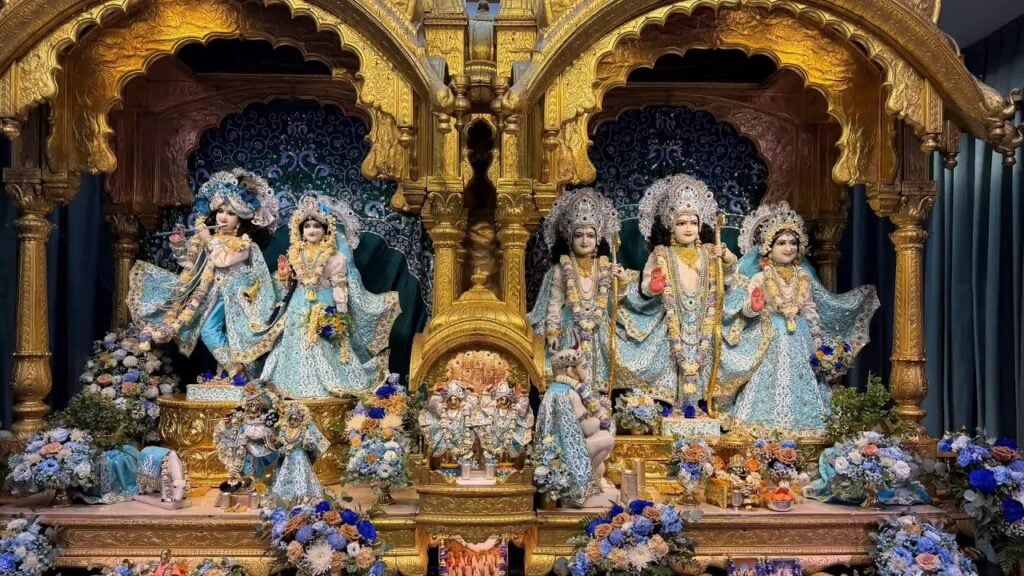
A living centre rather than a museum. Srila Prabhupada installed Sri Sri Radha Gokulananda at the Manor in 1973, anchoring the estate in a continuing cycle of Vaishnava worship. As attendance grew, questions of access, traffic, planning and the rights of a minority religious community became part of the Manor’s public history. Planning permission granted in 1996 enabled the site to continue as a place of worship and major festivals. This history gives the sixtieth-anniversary celebration an additional emotional resonance: the venue embodies both devotional continuity and the practical work required to preserve a religious home in Britain.
Sri Krishna Haveli and the architecture of community. Completed in 2020, Sri Krishna Haveli was developed to address the estate’s need for larger, purpose-built gathering and educational spaces. Its design combines materials associated with Hertfordshire with decorative references to Indian haveli architecture. The building contains spaces for kirtan, stage performances, learning and the service of prasad. Bhaktivedanta Manor’s account of the Haveli describes a design intended to complement rather than overshadow the historic Manor. Holding the anniversary there connects architectural adaptation with the fifth purpose of maintaining sacred places for worship and society.
The programme is structured as a journey. According to the official event schedule, the evening begins with prasad in the Seva Hall at 4:45 p.m., with food service continuing until 6:00 p.m. Kirtan begins at 5:30 p.m., followed by a welcome and introduction at 6:30 p.m. The Seven Purposes are commemorated at 6:45 p.m.; drama and historical presentation then occupy the central part of the programme. A special cake presentation at 8:30 p.m. precedes distribution and the scheduled conclusion at 8:45 p.m. The published event window extends to 9:00 p.m.
Prasad establishes hospitality before formal commemoration. The official listing uses the word prasad, while prasāda or prasadam commonly denotes food prepared and offered to Krishna before it is shared. In devotional understanding, it is sanctified food and an expression of divine grace; socially, its distribution creates a setting in which strangers, families, volunteers and long-standing members participate in the same act of receiving and eating. Beginning the anniversary with food places care and hospitality before speeches. The schedule does not publish a menu, so no particular dishes or service arrangements should be inferred from the listing.
Kirtan moves the gathering from reception to participation. Because prasad service continues after the scheduled start of kirtan, the programme allows a gradual transition rather than an abrupt division between meal and worship. Kirtan changes the audience’s role: people are no longer only recipients of information but potential participants in a shared rhythm and response. Repetition lowers the barrier to participation, while tempo, melody and collective voice can produce a strong sense of emotional cohesion. From an academic perspective, this is an example of embodied religious learning, in which doctrine is encountered through breath, sound, memory and coordinated action.
The welcome leads directly to institutional memory. The formal welcome at 6:30 p.m. is followed only fifteen minutes later by the commemoration of ISKCON’s Seven Purposes. This sequencing prevents the anniversary from resting entirely on spectacle. It draws attention back to the legal and ideological framework established in 1966. For long-standing members, the purposes may function as a renewal of commitment; for newer viewers, they provide a concise explanation of why the organization exists. The transition from kirtan to charter also demonstrates how devotional experience and institutional structure coexist within ISKCON rather than belonging to separate worlds.
The Junior Bhaktivedanta Players bring sacred narrative to the stage. At 6:50 p.m., the schedule names the drama ‘Advent of Lord Jagannatha’. Jagannatha is worshipped within Vaishnava traditions as a form of Krishna and is especially associated with the temple culture of Puri and the Ratha Yatra tradition. Dramatic performance allows younger participants to learn theology, narrative sequence, speech, music and coordinated service simultaneously. The programme does not provide a synopsis, so it would be inaccurate to assign a specific version of Jagannatha’s advent narrative to the performance before examining the production itself.
Six decades are condensed into a focused historical presentation. At 7:15 p.m., Praghosa Das is scheduled to present ‘6 decades of ISKCON’. The title signals a survey of institutional development from 1966 to 2026, but the event listing does not publish the presentation’s arguments, sources or selected episodes. Its placement between two dramas is revealing: factual narration is framed by sacred storytelling, giving the audience alternating modes of attention. A serious historical survey must hold together expansion, translation, public festivals, community service and religious education while recognizing that institutional history also contains adaptation, debate and the responsibilities that accompany growth.
‘Your Ever Well Wisher’ returns attention to personal relationship. The Bhaktivedanta Players are scheduled to present this drama at 7:45 p.m. The title invokes the expression closely associated with the way Srila Prabhupada concluded many letters, and it has become a concise symbol of pastoral care, instruction and responsibility within ISKCON memory. A dramatic treatment can render correspondence and biography emotionally immediate without requiring the audience to know every historical detail in advance. Since no full synopsis accompanies the programme, the title should guide interpretation without being treated as evidence of particular scenes or dialogue.
The concluding cake ceremony joins sacred memory with a modern anniversary custom. A special cake presentation is scheduled for 8:30 p.m., followed by distribution at 8:45 p.m. Cake is not an ancient Gaudiya Vaishnava ritual form, yet its inclusion illustrates how religious communities adopt familiar social conventions and place them within their own devotional ethic. Presentation makes the anniversary visible; distribution converts a symbolic object into shared hospitality. The sequence echoes the evening’s opening movement from food to fellowship and ensures that commemoration concludes through sharing rather than through a speech alone.
Music, drama, presentation and food form a complete pedagogy. The programme’s elements are not interchangeable entertainment segments. Each communicates differently. Kirtan teaches through repetition and participation; drama gives narrative a body, voice and emotional arc; presentation organizes chronology and explicit information; prasad connects religious meaning with hospitality; and commemoration links present participants to an inherited mission. Together, these forms address intellectual, sensory, social and affective dimensions of learning. This helps explain why festivals can transmit complex religious identity more effectively than a lecture operating by itself.
Intergenerational participation is part of the message. The presence of Junior Bhaktivedanta Players alongside adult presenters and performers makes succession visible. A movement reaches sixty years only when knowledge passes beyond its founding generation. Children and young people do not merely symbolize the future; through rehearsal and performance, they become interpreters of tradition in the present. At the same time, responsible transmission requires more than repeating inherited forms. It depends on education, safeguarding, opportunities for questions and the capacity to explain why a practice matters. The anniversary’s intergenerational structure therefore points toward both continuity and accountability.
The livestream creates a hybrid religious event. The supplied broadcast allows viewers outside Watford to witness the programme in real time or encounter it later as an archive. This changes the scale of participation: distance, mobility, health and national borders become less restrictive, while a local celebration can enter a global network of homes and communities. Online viewers can hear kirtan and follow presentations, but they do not share the same acoustics, physical congregation or distribution of prasad. Digital participation is therefore neither unreal nor identical to presence at the Haveli; it is a distinct mode of access with its own strengths and limits.
Archiving matters as much as transmission. A livestream initially serves the present, but a retained recording can become a primary source for future histories of ISKCON. Researchers may use it to examine language, performance, dress, leadership, music, audience participation and the way an institution narrated itself at sixty. Careful interpretation must separate what the video directly shows from contextual information supplied by event pages and later commentary. It must also avoid treating a single celebration as representative of every ISKCON community, since local cultures and institutional experiences vary considerably across countries and generations.
From one storefront to a global religious network. ISKCON’s current self-description reports hundreds of major centres, temples and rural communities, alongside vegetarian restaurants, local meeting groups and varied community projects. Such figures demonstrate reach, but numerical expansion alone does not measure religious depth or institutional health. The sixtieth anniversary is more meaningful when scale is considered together with the quality of education, worship, service, care and governance. The original Seven Purposes offer precisely this broader measure by asking what the network exists to accomplish, not merely how large it has become.
Bhaktivedanta Manor embodies several purposes at once. Daily worship supports devotional continuity; classes and school visits provide education; kirtan enacts congregational sacred sound; publications and digital media communicate beyond the estate; the farm and cow-care facilities engage questions of simpler living; and food sharing makes hospitality practical. These activities are best understood as an ecosystem of religious practice rather than isolated departments. The anniversary gathers this ecosystem into a single evening, allowing a community to see its routines as part of a sixty-year history.
Service is the less visible foundation of celebration. Public programmes depend on cooks, cleaners, technicians, stage teams, musicians, teachers, administrators, gardeners, transport coordinators and many other volunteers. Their labour gives institutional form to seva. This is an important corrective to histories centred only on prominent leaders or dramatic moments. Religious continuity is ordinarily maintained through repeated tasks performed when no anniversary audience is present. The emotional power of a jubilee rests partly on recognizing how many such acts must accumulate before a community can truthfully speak of six decades.
An academic reading distinguishes description from belief. Statements about dates, schedules, buildings and incorporation can be assessed as historical claims. Teachings about Krishna, the soul, sacred sound and prasadam express the community’s theological self-understanding. A factual account can explain those teachings accurately without demanding that every reader accept them, and it can acknowledge participants’ faith without dismissing it as merely subjective. This distinction creates room for devotional readers, interested visitors and scholars to engage the same event at different levels while preserving intellectual honesty.
Dharmic unity does not require doctrinal sameness. This celebration is specifically Gaudiya Vaishnava and should not be misrepresented as a generic event for every Indian religion. Hindu, Buddhist, Jain and Sikh traditions differ significantly in their accounts of selfhood, divinity, revelation, liberation and religious authority. Yet their communities can still meet through mutual respect, ethical discipline, compassion, sacred learning, hospitality and service. Many also employ chanting, pilgrimage, communal food or disciplined remembrance in forms particular to their own lineages. Genuine dharmic solidarity protects these distinctions while opposing prejudice and encouraging cooperation.
The anniversary offers a useful model of unity within particularity. Bhaktivedanta Manor does not need to dilute Krishna devotion in order to contribute to wider social harmony. A tradition becomes a stronger partner in dialogue when it can explain its own commitments clearly, listen to others and recognize shared civic responsibilities. The first of ISKCON’s Seven Purposes explicitly connects spiritual education with unity and peace, but those goals acquire credibility through conduct: respectful engagement, care for vulnerable people, responsible stewardship and freedom from coercion. The celebration’s most durable value will therefore lie not only in remembering expansion but in renewing these responsibilities.
What viewers can observe critically. The broadcast can be approached through several connected questions. How does the evening move from hospitality to music, from music to institutional history and from history to drama? Which parts assume prior devotional knowledge, and which explain the tradition to newcomers? How are children, elders, performers and speakers positioned within the narrative of continuity? How does the Haveli’s stage environment shape a practice historically associated with temples, streets and homes? These questions deepen attention without reducing the celebration to either promotion or detached spectacle.
What the available sources do not establish. The published material provides a title, venue, timetable and programme description, but it does not supply attendance figures, a transcript, post-event outcomes or full synopses of the presentations and dramas. Those details should not be invented. Likewise, the historical importance of ISKCON does not mean that every local experience has been uniform. A comprehensive account remains strongest when it states the limits of its evidence and allows the audiovisual record to support any later claims about what was actually said or performed.
A commemoration oriented toward the future. Bhaktivedanta Manor’s 13 July 2026 programme brings legal history, Vaishnava theology, British Hindu heritage, artistic performance and digital communication into one carefully ordered evening. Its deepest subject is continuity: how a mission articulated in a New York incorporation document became embodied in temples, books, meals, songs, farms, classrooms and communities across generations. The celebration honours that inheritance while implicitly asking whether its founding purposes can continue to guide service with clarity, compassion and integrity. That question gives the sixtieth anniversary significance far beyond the passing excitement of a single night.
Source basis. Event-specific details derive from Bhaktivedanta Manor’s official ISKCON 60th Anniversary Celebration listing and the supplied YouTube broadcast. Historical and theological context has been checked against ISKCON’s official history, its Seven Purposes, Bhaktivedanta Manor’s estate history and the Manor’s account of Sri Krishna Haveli. These are primarily institutional sources, so claims about religious meaning are presented as Vaishnava and ISKCON self-understanding rather than as universally accepted propositions.
Inspired by this post on Dandavats.





Leave a Reply
You must be logged in to post a comment.