
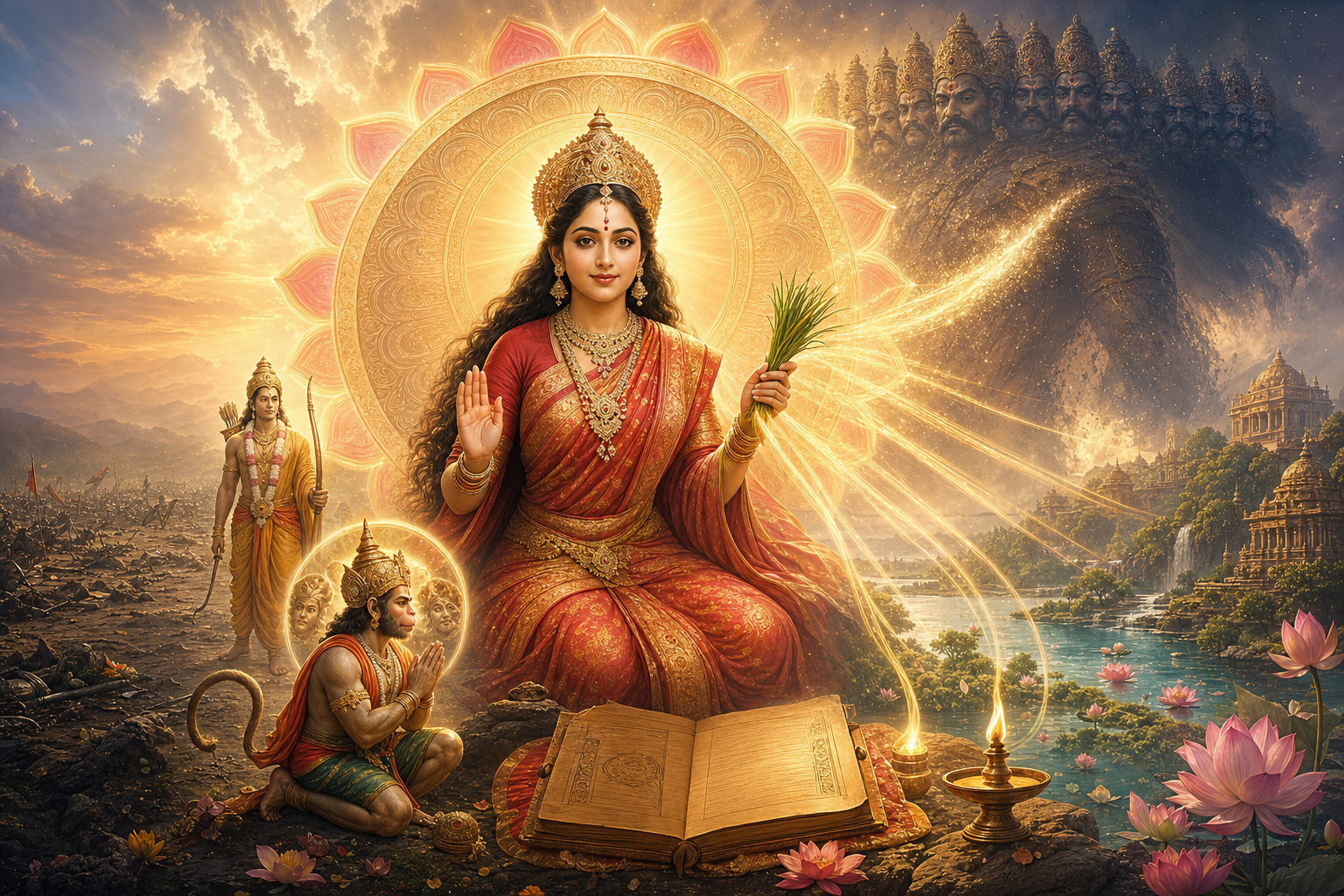
Sita Stavam opens a less familiar but theologically powerful window onto Janaki. In this hymn, Sita is not confined to a supporting place beside Rama. She is praised as the Supreme Divine Mother, the primordial Shakti whose powers sustain creation, protect dharma, awaken wisdom, and overcome forces that even the gods cannot subdue. The hymn therefore invites readers to encounter Goddess Sita not only through the virtues of fidelity, patience, and sacrifice, but also through sovereignty, cosmic intelligence, and decisive action.
This portrayal can be emotionally striking because it changes the angle from which a familiar sacred figure is viewed. The compassionate princess of Mithila, the courageous companion of Rama, and the invincible Adi Shakti are not presented as competing identities. They are dimensions of one sacred personality. Her gentleness does not cancel her strength, and her strength does not diminish her compassion. The result is a richer understanding of Sita in which endurance is never confused with helplessness.
What is the Sita Stavam?
The Sanskrit term stava, often rendered in English as praise, eulogy, or hymn, denotes devotional speech that celebrates the nature and attributes of a deity. A stava does more than list honorific names. Its sequence of epithets creates a theological portrait. In Sita Stavam, that portrait identifies Janaki with multiple expressions of the Divine Feminine, including Yogamaya, Vaishnavi, Durga, Lakshmi, Gauri, Saraswati, Varahi, and Bhadrakali.
As transmitted in the Sita Vijaya tradition, the hymn occurs in chapter 48 of a work that presents itself as part of the Ashramavasa Parva of the Jaiminiya Mahabharata. It is voiced by Brahma after Sita annihilates Sahasramukha Ravana. The placement matters: Brahma does not praise her in the abstract. His hymn interprets what the narrative has just revealed—Sita is the power through whom an apparently impossible restoration of cosmic order becomes possible.
The description of Sita as Adi Shakti is best understood as a theological summary of the hymn’s vision. It does not depend upon one isolated epithet appearing identically in every manuscript. The accumulated names, powers, and cosmic functions establish the point: Janaki is treated as the primordial Divine Energy behind manifestation, protection, knowledge, sacrifice, prosperity, and transformative force.
A necessary note about the textual tradition
The Sita Vijaya account should not be confused with an episode in the widely read Valmiki Ramayana or with the familiar critical and vulgate recensions of the Mahabharata. The work is also known as Sahasramukharavanacharitam, meaning the account of the thousand-faced Ravana. It belongs to a less familiar stream of Ramakatha literature transmitted in Sanskrit manuscripts written in the Grantha script.
The manuscripts were critically edited and translated by Pradip Bhattacharya and Sekhar Kumar Sen, with the work published in 2017 alongside Mairavanacharitam. The texts claim affiliation with a lost or fragmentary Jaiminiya Mahabharata tradition. That claim is historically important, but it remains a claim made by the texts and should not be converted into certainty about authorship or antiquity. Academic care requires distinguishing traditional attribution from conclusions established through manuscript comparison, linguistic analysis, and reception history.
This caution does not reduce the spiritual or literary value of the hymn. It clarifies the kind of source being read. Sacred literature often survives through layered recensions, regional retellings, manuscript discoveries, oral performance, and sectarian interpretation. Recognizing those layers allows devotion and scholarship to coexist without forcing every Ramakatha into a single textual genealogy.
How Sita Vijaya enters the Jaiminiya narrative
The framing story begins within a Mahabharata setting. While describing the conflict between Arjuna and his son Babhruvahana, Jaimini compares that encounter with an earlier battle involving Rama and his sons Kusha and Lava. Janamejaya asks to hear the older account in detail, and the resulting narration expands into the story associated with Sahasramukha Ravana. Because its climax belongs unmistakably to Sita, the narrative is also called Sita Vijaya—the victory of Sita.
Early in this account, destructive powers associated with the sons of the sage Durvasa disturb the cosmic order. The gods, including Brahma, Vishnu, and Shiva, turn to Yogamaya, the supreme cosmic power from whom manifestation proceeds. Yogamaya promises protection. Vishnu will descend in human form, and she will be born as his wife. In that embodied relationship, the ten-headed Ravana will first be destroyed, and Sahasramukha Ravana will later meet his end.
Yogamaya is accordingly born as Sita while Vishnu appears as Rama. The familiar defeat of the ten-headed Ravana does not conclude this particular Ramakatha. When Sahasramukha learns of that death, a new crisis unfolds. He abducts Bharata and Shatrughna while they sleep, mistaking them for Rama and Lakshmana, and confines them within his domain. Rama eventually advances upon Sahasramukha’s city of Visala with Hanuman and a combined force of humans, vanaras, and rakshasas. The gods also join the campaign.
The expected heroic victory does not occur. Sahasramukha overwhelms the assembled armies and defeats the divine powers who oppose him. Even the combined presence of Brahma, Vishnu, Shiva, Rama, Hanuman, and their allies proves insufficient at that moment. The narrative deliberately drives conventional power to exhaustion before revealing the force that has remained present but not yet fully manifested.
Sita watches from the Pushpaka as the battlefield collapses and Rama falls. Her grief is not treated as weakness. It becomes the threshold of revelation. Heavenly sages address her as the one Goddess appearing through many sacred forms. They invoke names and functions such as Svaha, Svadha, Sri, Pushti, Saraswati, Rudrani, Visalakshi, Tushti, Medha, Dhriti, and Kshama, and they appeal to her to restore the defeated gods.
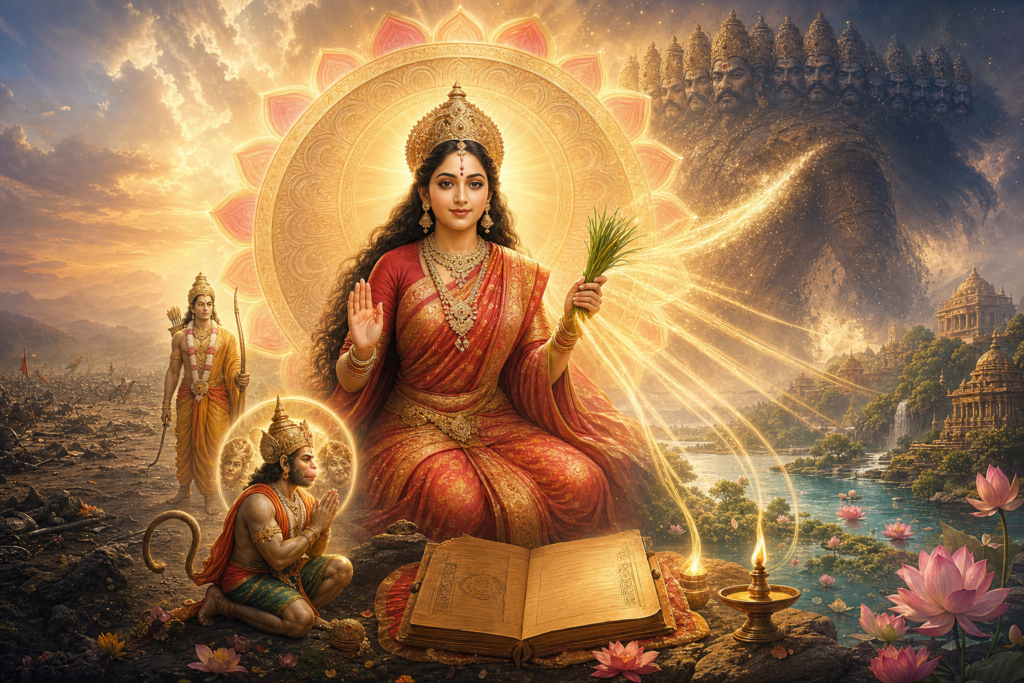
Sita then assumes an extraordinary divine form. She also empowers Hanuman to manifest a five-faced form suited to the battle. This detail places grace and service in a reciprocal relationship: Hanuman remains the exemplary servant of Sita and Rama, yet his expanded power is conferred by Sita. Devotion does not erase agency; it becomes a channel through which sacred power is expressed.
The annihilation of Sahasramukha Ravana
The battle overturns ordinary expectations about divine weaponry. Sita does not depend upon an elaborate arsenal. She uses blades of darbha, the sacred grass associated with Vedic ritual. In her hands, these apparently fragile blades become blazing columns of power. Sahasramukha breaks them into countless fragments and swallows them, apparently neutralizing the attack. Inside him, however, the fiery pieces reunite and consume him from within.
The scene can be read symbolically without pretending that one interpretation exhausts it. Darbha belongs to ritual order, purification, discipline, and consecrated intention. Its transformation into an irresistible force suggests that sacred power does not depend on outward grandeur. What appears small may become decisive when aligned with dharma. The demon’s attempt to absorb and dominate that power only carries the cause of his destruction into his own body.
Sahasramukha’s defeat is therefore more than the removal of a physically powerful enemy. His apparently limitless external force cannot overcome the power operating at the level of his inner constitution. The narrative turns conquest inward: adharma collapses through the very energy it imagines it has swallowed and controlled.
After the victory, Brahma praises Sita. He invokes her through a sweeping series of goddess names, including Maya, Vaishnavi, Durga, Lakshmi, Gauri, Saraswati, Svaha, Svadha, Dhriti, Medha, Hri, Sri, Varahi, and Bhadrakali. At his request, she withdraws her overwhelming radiance and resumes her recognizable human form. Hanuman likewise relinquishes his five-faced manifestation.
Why Brahma’s many names are technically significant
The hymn communicates theology through accumulation. Each name highlights a function, relationship, virtue, or mode of divine activity. The names are not merely interchangeable synonyms, nor do they erase the distinctive histories of the goddesses they evoke. Together they assert that the powers honored separately in different devotional settings can be recognized as expressions of one Supreme Divine Mother.
Vaishnavi, Lakshmi, and Sri locate Sita within the sustaining and auspicious power associated with Vishnu. This cluster is especially appropriate because Sita accompanies Rama, the human manifestation of Vishnu in the narrative. Lakshmi signifies prosperity and auspicious order, while Sri carries meanings that include radiance, dignity, abundance, and sacred excellence. Sita’s sovereignty is consequently not detached from Rama; it is the active Shakti through which divine preservation becomes effective.
Durga, Bhadrakali, and Varahi reveal protective and formidable dimensions. Durga is the power who crosses difficulty and rescues beings from danger. Bhadrakali joins fierceness with auspicious purpose, showing that a terrifying appearance can serve restoration rather than cruelty. Varahi evokes another martial and protective manifestation of Devi. These names interpret Sita’s destruction of Sahasramukha as disciplined protection of the cosmos, not uncontrolled rage.
Gauri and Rudrani bring Shaiva goddess language into the praise of Janaki. Their presence prevents the hymn from being reduced to a narrowly isolated Vaishnava catalogue. Sita’s identity is expressed across established devotional vocabularies, creating a theological bridge among Vaishnava, Shakta, and Shaiva understandings of divine power. Difference remains visible, but it is held within a deeper unity.
Saraswati, Medha, and Dhriti emphasize dimensions that raw military power cannot explain. Saraswati represents learning, speech, and cultivated knowledge. Medha signifies intelligence and the capacity to comprehend, while Dhriti conveys firmness, constancy, and sustaining resolve. Sita’s power is thus cognitive and ethical as well as martial. She overcomes chaos because she embodies ordered awareness, not because she simply possesses a greater quantity of force.
Hri, Kshama, Pushti, and Tushti further complicate any simplistic opposition between gentleness and power. Hri can denote moral reserve or modesty; Kshama includes patience, forbearance, and forgiveness; Pushti signifies nourishment or flourishing; and Tushti conveys contentment. These qualities belong to the same goddess who destroys Sahasramukha. The hymn therefore refuses to divide the Divine Feminine into one harmless, nurturing form and another unrelated, violent form.
Svaha and Svadha connect Sita with sacrificial order. Svaha is associated with offerings made to the gods, while Svadha is associated with offerings to the ancestors. By identifying Sita with both, the praise places her within the circulation that joins human worship, divine reception, ancestral continuity, and cosmic reciprocity. She is not only the object of devotion; she is also the sacred power that enables an offering to reach its proper destination.
Adi Shakti, Yogamaya, and the relation between Sita and Rama
Adi Shakti means primordial power: the foundational capacity through which the cosmos appears, functions, transforms, and returns to its source. Within this framework, Shakti is not an optional possession added to an otherwise complete deity. Power and the bearer of power are conceptually distinguishable but existentially inseparable. Fire cannot be separated from its capacity to burn, and divine consciousness cannot act without its Shakti.
This principle helps prevent the story from becoming a competition between Sita and Rama. The narrative does show Sita accomplishing what Rama and the assembled gods cannot accomplish in that crisis. Yet its deeper theological movement is relational. Rama and Sita disclose complementary dimensions of divine reality. Sita’s victory reveals a power that was never truly absent from their union, even when it had not yet become visible on the battlefield.
Yogamaya should likewise not be reduced to illusion in the everyday sense of falsehood. In many Hindu theological contexts, Yogamaya is the divine capacity that orders manifestation, conceals or reveals divine identity, and makes sacred participation in the world possible. When Yogamaya becomes Sita, transcendence does not merely wear a disposable disguise. The cosmic and human dimensions coexist within Janaki’s embodied life.
Her return to a gentle human appearance after the battle should therefore not be interpreted as the suppression of her real power. The narrative presents concealment and revelation as alternating modes. The Sita who shares exile, experiences grief, speaks with moral clarity, and stands beside Rama is not less authentic than the radiant goddess who annihilates Sahasramukha. The same sacred reality is encountered under different conditions.
Sita Stavam and the wider theology of Goddess Sita
The vision of Sita as primordial power is not confined to this hymn. The Sita Upanishad, an independent and comparatively late Upanishadic text, identifies Sita with mula-prakriti, the foundational matrix of manifestation. It associates her with will, knowledge, and action, and describes her as the power present in sacred knowledge, cosmic processes, nourishment, time, and the protection of the worlds.
The comparison is illuminating but must be used carefully. Similar theology does not prove that one text directly borrowed from the other, nor does it establish a single date for the development of Sita worship. It demonstrates that more than one Sanskrit tradition understood Sita as far more than a royal heroine. Janaki could be contemplated as Prakriti, Lakshmi, cosmic power, and the ground of sacred activity.
A related but distinct narrative appears in the Adbhuta Ramayana. There too, a thousand-headed Ravana overpowers Rama, and Sita manifests a fearsome form associated with Mahakali to destroy him. The resemblance reveals a shared Ramakatha motif in which Sita’s concealed cosmic power becomes visible only after conventional heroism reaches its limit.
The two works should nevertheless not be merged. Their narrative frames, battle mechanics, theological speeches, and sequences of events differ. In the Adbhuta Ramayana, Sita’s Mahakali manifestation and Rama’s subsequent praise receive a distinctive treatment. In Sita Vijaya, the darbha-grass battle, Sita’s empowerment of five-faced Hanuman, and Brahma’s stavam belong to the work’s own literary design.
The Valmiki Ramayana offers another distinct presentation. Its Sita displays agency through choice, moral reasoning, fearless speech, endurance, and refusal to surrender her integrity, but it does not narrate this battle with Sahasramukha Ravana. Later and regional Ramakathas often amplify different dimensions already available within the cultural memory of Sita. Textual plurality should be studied as plurality, not flattened into a claim that every version narrates the same events.
Reading the central symbols
Sahasramukha’s thousand faces magnify the symbolism of uncontrolled power. The number need not be converted into a literal psychological formula, but it naturally evokes excess, multiplication, and a threat too vast for ordinary measurement. The demon’s many faces contrast with the hymn’s many names for Sita. His multiplicity fragments and dominates; her multiplicity integrates, nourishes, protects, and restores.
Darbha grass creates a second contrast. Sahasramukha possesses immense destructive resources, while Sita selects a material associated with ritual simplicity. The narrative thereby challenges the assumption that visible scale determines real strength. Consecrated purpose, disciplined intelligence, and alignment with dharma prove more decisive than spectacle.
Sita’s movement from witness to warrior is equally important. She does not enter the conflict because compassion has failed; compassion is precisely what makes intervention necessary. Her grief at the fall of Rama and the gods becomes protective action. The story presents emotion, discernment, and power as a continuum rather than as incompatible states.
Hanuman’s five-faced manifestation adds a relational dimension to the symbolism. His expanded capacity is granted within Sita’s revelation, yet he remains devoted rather than self-exalting. Spiritual strength is shown as something received, disciplined, and directed toward service. Once the crisis ends, he releases the extraordinary form instead of turning temporary empowerment into a permanent claim to supremacy.
Why this portrayal remains relevant
For readers who have encountered Sita only as a symbol of quiet endurance, Sita Stavam supplies an important corrective. Patience is not passivity. Modesty is not lack of authority. Love is not dependence, and compassion is not an inability to confront harm. Sita waits when patience serves dharma and acts when intervention becomes necessary. Both responses arise from discernment.
The story may feel especially close to people whose strength has been underestimated because it was expressed through care, restraint, or service. Janaki’s transformation suggests that power need not advertise itself continuously in order to be real. The moment of revelation does not create her strength; it makes visible what was present all along.
The battle must also be read ethically. Mythic descriptions of divine violence are not permissions for hostility in ordinary human life. Within the narrative, the fierce act occurs after cosmic order has been devastated and all other resistance has failed. Its object is the removal of destructive domination, followed by restoration and withdrawal of the terrible form. The sequence emphasizes responsibility, proportion, and the return of balance.
The hymn also offers a valuable model of unity within Hindu traditions. Vaishnava, Shaiva, and Shakta names meet in one praise without requiring every sampradaya to abandon its distinctive language. Unity here does not mean uniformity. It means recognizing that different devotional approaches may illuminate related dimensions of sacred reality.
That principle can support respectful relations across the wider Dharmic family as well. Sita Stavam remains a specifically Hindu text and should not be made to speak artificially for Buddhist, Jain, or Sikh traditions. Yet its integration of wisdom, courage, restraint, compassion, and service provides an ethical basis for mutual regard. Dharmic unity is strengthened when genuine differences are honored without turning them into hostility.
Approaching Sita Stavam as study and spiritual practice
A responsible reading begins with context. The hymn becomes clearer when the surrounding Sita Vijaya narrative is understood, because each divine name interprets the crisis that precedes it. The names can then be contemplated individually: Yogamaya as the power of manifestation, Durga as protection through difficulty, Saraswati as disciplined knowledge, Dhriti as resolve, Kshama as forbearance, and Bhadrakali as fierce but auspicious transformation.
Devotional and academic readings need not cancel one another. Devotion asks how the hymn can deepen reverence and ethical practice. Scholarship asks which manuscript, recension, vocabulary, and historical context are being examined. Devotion without textual care can create unsupported claims, while scholarship without sensitivity can miss why a hymn has remained meaningful. Together they encourage disciplined appreciation.
Anyone reciting the Sanskrit should use a reliable edition and, where possible, guidance from a knowledgeable teacher. Variant transliterations should not be silently combined into a reconstructed hymn. Claims about guaranteed material rewards, cures, or ritual results should likewise be avoided unless a clearly identified recension contains an applicable phala-shruti and the tradition transmitting it explains the claim responsibly.
The most practical fruit of the hymn lies in ethical embodiment. Praise of Medha can encourage careful thought; praise of Dhriti can strengthen perseverance; praise of Kshama can cultivate restraint; praise of Durga can inspire protection of those placed at risk; and praise of Sri can deepen gratitude for the conditions that allow life to flourish. In this way, recitation becomes more than admiration—it becomes a discipline of character.
The enduring revelation of Janaki
Sita Stavam ultimately presents a vision in which the humanly intimate and cosmically immense meet in one figure. Janaki remains the daughter of Janaka and beloved companion of Rama, yet she is simultaneously Yogamaya, Lakshmi, Durga, Saraswati, Gauri, Bhadrakali, and the power sustaining sacred order. Her victory does not replace the familiar Sita; it reveals the depth that the familiar form contains.
The hymn’s most enduring insight is therefore not that gentleness must become violent in order to matter. It is that authentic power can nourish, endure, teach, forgive, protect, and, when dharma requires it, decisively remove oppression. Sita as Adi Shakti unites those capacities without contradiction. Her story leaves readers with a demanding but hopeful principle: the deepest strength is power governed by wisdom, compassion, and responsibility.
Textual references: The narrative and manuscript context are discussed in Satya Chaitanya’s review of the Jaiminiya Mahabharata texts. The theological comparison with primordial Prakriti, sacred knowledge, and divine power can be checked against the Sanskrit Sita Upanishad. These sources illuminate different textual traditions and should be compared without assuming that they are identical recensions.
Inspired by this post on Hindu Blog.


Leave a Reply
You must be logged in to post a comment.