
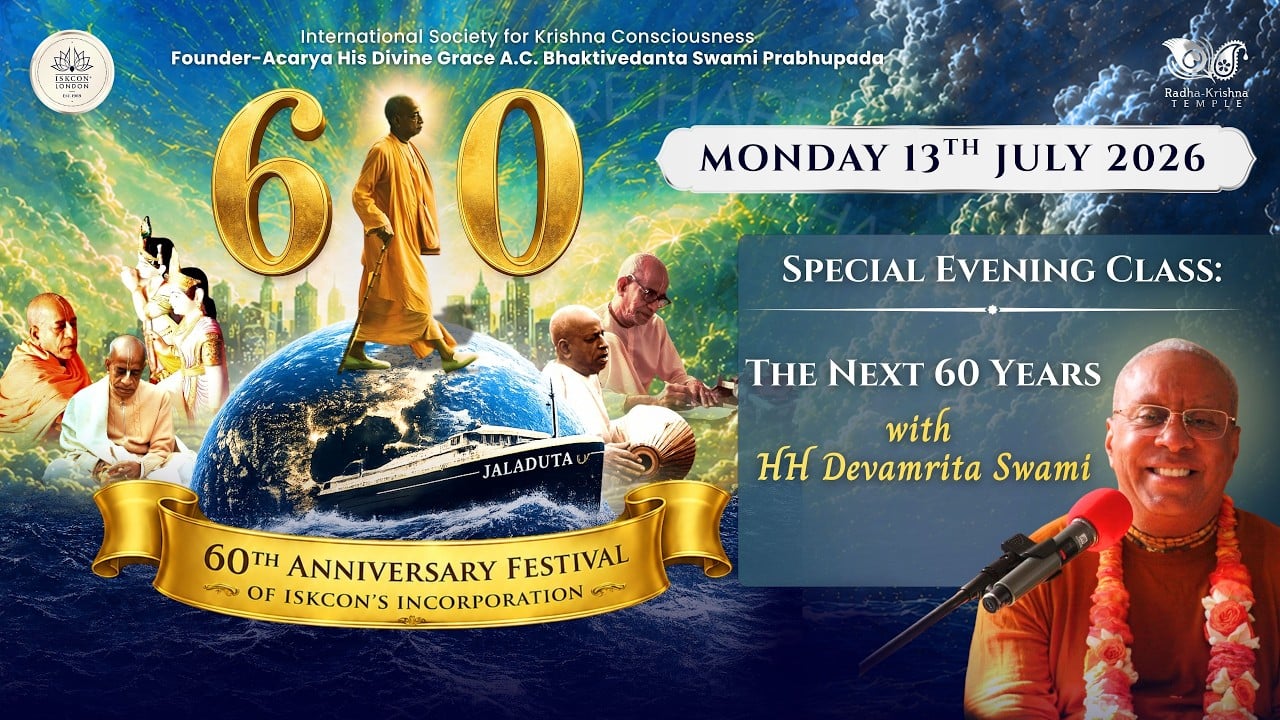
ISKCON at sixty: an anniversary that opens onto the future. Monday, 13 July 2026, marks sixty years since the International Society for Krishna Consciousness was formally incorporated in New York. ISKCON London Radha-Krishna Temple commemorates that milestone with a special evening class titled “The Next 60 Years,” presented by His Holiness Devamrita Swami. The occasion is more than a retrospective celebration of 1966–2026. It raises a demanding institutional and spiritual question: how can a global Gaudiya Vaishnava movement preserve its theological identity while responding intelligently, compassionately, and responsibly to the conditions of the twenty-first century?
Programme and factual scope. The special evening class may be viewed on the ISKCON London Radha-Krishna Temple channel. The supplied source contains the programme details, thumbnail, and embedded video rather than a written transcript. Consequently, the analysis below uses “The Next 60 Years” as its organizing question without presenting unverified statements as quotations or specific arguments made by Devamrita Swami. It provides the historical, theological, organizational, and social context needed to engage the class critically and appreciatively.
Why 13 July matters. ISKCON’s incorporation document was filed in New York on 13 July 1966, as confirmed by the movement’s official Constitution FAQ. That legal act gave institutional form to the mission of A. C. Bhaktivedanta Swami Prabhupada, known within ISKCON as its Founder-Ācārya. Incorporation did not create Gaudiya Vaishnava theology; that tradition had developed over centuries through the teachings associated with Sri Caitanya Mahaprabhu and later Vaiṣṇava theologians. What incorporation supplied was a durable public structure through which teaching, worship, publishing, community formation, and devotional service could be coordinated internationally.
From a small storefront to an international movement. According to ISKCON’s official historical account, Srila Prabhupada travelled from India to the United States in 1965 and spent his first year in New York lecturing, translating, leading kīrtana, and gradually gathering a community. The society established in July 1966 subsequently developed temples, rural communities, publishing institutions, educational programmes, festivals, vegetarian food initiatives, and congregations across many countries. The scale of that growth is historically significant, but scale alone cannot define the meaning of the anniversary. The more difficult measure is whether expansion has deepened spiritual practice, ethical maturity, knowledge, community care, and service.
London gives the anniversary a distinctive setting. ISKCON London records that three married couples—Gurudasa and Yamuna, Syamasundara and Malati with their daughter Sarasvati, and Mukunda and Janaki—came from San Francisco in 1968 to establish Krishna consciousness in the city at Srila Prabhupada’s request. Their work eventually produced a lasting Gaudiya Vaishnava presence in central London. The Radha-Krishna Temple’s account of its history therefore connects the 2026 observance with nearly six decades of local practice, migration, cultural exchange, public kīrtana, scriptural education, and community service.
The emotional meaning of institutional time. A sixtieth anniversary is experienced differently across generations. An early participant may remember risk, improvisation, sacrifice, and direct contact with founding figures. A second-generation member may experience ISKCON as an inherited religious home, complete with both cherished memories and unresolved questions. A newcomer may encounter it first through a festival, a meal, a book, a university programme, or a short digital video. These perspectives do not need to compete. Together, they reveal that a tradition remains alive only when memory can be transmitted without becoming nostalgia and when change can occur without dissolving identity.
Why Devamrita Swami is a relevant voice for this discussion. The official Governing Body Commission biography states that he studied at Yale University, entered temple life in 1972, received initiation from Srila Prabhupada in 1974, and accepted sannyāsa in 1982. His service has included work with the Bhaktivedanta Book Trust, teaching under difficult conditions in the former communist Eastern Bloc, and membership in ISKCON’s Governing Body Commission since 2001. His documented interests include presenting bhakti-yoga in contemporary Western settings and examining spiritually grounded approaches to economics, sustainability, and environmental responsibility.
The seven purposes remain the movement’s primary strategic charter. The strongest starting point for discussing ISKCON’s future is not a fashionable slogan but the purposes recorded at incorporation. The official mission statement identifies seven interrelated aims: systematic spiritual education; the presentation of Krishna consciousness through Bhagavad-gita and Śrīmad-Bhāgavatam; bringing members nearer to one another and to Krishna; encouraging congregational chanting; establishing sacred places; teaching a simpler and more natural way of life; and publishing and distributing literature. These purposes are concise, but they contain the architecture of an entire religious institution.
A technical reading of the seven purposes reveals four systems. The first, second, and seventh purposes form an epistemic system concerned with knowledge, interpretation, education, and publication. The third creates a relational system joining individual devotion with community formation. The fourth and fifth establish a performative and place-based system through chanting, worship, festival, and sacred space. The sixth introduces a socio-ecological system concerned with habits, consumption, land, food, and the organization of daily life. A credible plan for the next sixty years must keep these systems connected; emphasizing visibility while neglecting education, or preserving texts while neglecting people, would produce an incomplete mission.
The future therefore concerns translation rather than reinvention. Translation in this context does not mean changing foundational teachings whenever social preferences shift. It means distinguishing enduring principles from historically contingent methods and applying those principles with attention to time, place, audience, and consequence. The technology used to publish a book, the language of a course, the legal form of a temple, and the medium of public communication can change. The need for intellectual honesty, disciplined practice, compassion, accountability, and loving service cannot be treated as disposable.
The theological centre must remain intelligible. Within Gaudiya Vaishnava theology, Krishna is understood as the Supreme Person, the individual self or jīva is eternal, and the relationship between the self, the world, and the Divine is explained through acintya-bhedābheda—the doctrine of inconceivable simultaneous distinction and unity. Bhakti is not merely an emotion or cultural identity. It is an integrated path of knowledge, disciplined practice, ethical formation, remembrance, worship, service, and love. If these concepts are reduced to slogans, future generations may inherit a recognizable brand without receiving the intellectual and contemplative depth of the tradition.
Practice is the mechanism of transmission. A classic formulation in Śrīmad-Bhāgavatam 7.5.23–24 enumerates nine devotional processes: śravaṇa, hearing; kīrtana, chanting or speaking about the Divine; smaraṇa, remembrance; pāda-sevana, service; arcana, worship; vandana, prayer; dāsya, servitude; sakhya, friendship; and ātma-nivedana, self-offering. These practices engage speech, attention, memory, body, relationship, and intention. Their diversity also shows why bhakti cannot be measured by attendance at a single ritual or agreement with an abstract proposition.
Chanting illustrates the union of personal discipline and shared life. Personal japa cultivates sustained attention and regularity, while congregational saṅkīrtana creates a public and relational form of remembrance. The Hare Krishna mahā-mantra—Hare Krishna, Hare Krishna, Krishna Krishna, Hare Hare / Hare Rama, Hare Rama, Rama Rama, Hare Hare—can be recited in solitude or sung collectively. The next generation will need more than exposure to its sound. It will need careful instruction in pronunciation, attention, intention, theology, musical responsibility, and the relationship between devotional experience and ethical conduct.
Scriptural fidelity requires sophisticated education. Bhagavad-gita and Śrīmad-Bhāgavatam occupy foundational positions within ISKCON, but access to a book is not identical to comprehension. Serious education must teach textual context, Sanskrit terminology, the role of commentary, the history of the Gaudiya lineage, and methods for distinguishing primary texts from later interpretation. It should also show learners how to ask difficult questions without treating inquiry as disloyalty. A tradition becomes intellectually stronger when students can identify evidence, understand interpretive assumptions, and explain competing readings fairly.
A layered educational model would serve different levels of commitment. Introductory material can explain basic concepts in accessible language; structured courses can develop scriptural literacy and practice; advanced programmes can train teachers, translators, chaplains, researchers, and community leaders. Assessment should examine comprehension and application rather than the ability to repeat memorized phrases. Teacher formation should include theology, pedagogy, pastoral boundaries, communication, safeguarding, and the humility to acknowledge uncertainty or refer a question beyond one’s expertise.
Multilingual transmission is both a spiritual and technical task. A global movement cannot assume that English will remain the default language of serious study. Translation programmes need terminology databases, editorial standards, peer review, version control, and consultation with practitioners who understand local idiom. Audio description, captions, searchable transcripts, readable typography, and accessible digital formats should be treated as part of education rather than optional additions. Accurate translation enables cultural adaptation while reducing the risk that key theological distinctions will be flattened or distorted.
The digital attention economy creates unprecedented reach and unusual risk. A lecture can now cross continents within minutes, yet platforms reward speed, novelty, conflict, and emotional intensity. Short clips may introduce a seeker to bhakti, but they can also remove qualifications, historical context, or pastoral nuance. A resilient digital strategy would connect brief material to full lectures, verified transcripts, primary sources, courses, local communities, and qualified mentors. It would measure success by meaningful learning and practice rather than views alone.
Artificial intelligence will test standards of authenticity. Generative systems can assist with transcription, indexing, translation, accessibility, and archival discovery. They can also fabricate quotations, confuse a commentator’s opinion with an ācārya’s teaching, reproduce biased datasets, or generate confident explanations unsupported by scripture. Responsible use requires source traceability, human theological review, clear labelling of machine-generated material, privacy protections, and correction procedures. No synthetic voice or image should be presented as an authentic historical recording, and no automated summary should replace consultation of the complete source.
Preserving memory now requires professional digital stewardship. Lectures, letters, photographs, editions, temple records, oral histories, and community publications should be catalogued with consistent metadata and persistent identifiers. Important files need open or well-documented formats, checksum-based integrity checks, geographically separate backups, rights documentation, and migration plans for obsolete media. Optical character recognition and automated transcripts should receive human review, especially where Sanskrit and Bengali terms are involved. Without this work, a digitally abundant generation could still inherit a fragmented and unreliable historical record.
Intergenerational transfer is one of the central tests of the next era. The movement’s earliest decades benefited from the living memories of Srila Prabhupada’s direct disciples. As that generation ages, oral testimony must be preserved, but institutional life cannot depend solely upon proximity to founding personalities. Authority increasingly needs to rest on demonstrable learning, character, accountable service, and fidelity to clearly articulated principles. Younger members require meaningful responsibility, not merely symbolic inclusion, while elders deserve respect that does not prevent careful historical inquiry.
Youth engagement must address the whole person. Young people negotiate education, employment, family expectations, mental health, digital identity, ecological anxiety, and religious pluralism. Effective mentorship cannot answer every difficulty with a single formula. It must combine spiritual practice with attentive listening, appropriate professional referral, freedom from manipulation, and room for gradual development. A young adult who can ask an uncomfortable question without humiliation is more likely to develop mature conviction than one trained only to conceal doubt.
Governance is a spiritual issue because power affects people. ISKCON’s Constitution project history records the development, approval, legal review, and 2026 publication of a global framework addressing membership, rights, duties, organizational responsibilities, and the authority of the Governing Body Commission. A constitution can improve clarity and continuity, particularly as leadership becomes more geographically and generationally diverse. A document, however, cannot produce trust by itself. Trust grows when rules are understandable, consistently applied, open to legitimate review, and embodied by leaders.
Accountability should be measurable rather than ceremonial. Long-term legitimacy depends upon transparent financial controls, conflict-of-interest policies, safeguarding procedures, confidential reporting channels, timely responses, fair investigations, and protection against retaliation. Children and vulnerable adults require trained personnel and clearly defined boundaries. Communities also need credible processes for mediation, appeal, restoration where appropriate, and decisive protection where harm is ongoing. These systems do not compete with devotion; they help prevent sacred language from being used to evade ordinary moral responsibility.
Participation should draw upon the full competence of the community. Women and men, householders and monastics, elders and young adults, converts and those raised within the tradition all carry different forms of knowledge. Institutional resilience improves when service is assigned through competence, character, training, and accountable commitment rather than informal status alone. Theological differences concerning roles should be studied carefully and discussed without caricature, while every participant should be treated with dignity and protected by the same ethical standards.
Temples function as both sacred spaces and human infrastructure. Worship, teaching, music, festivals, meals, counselling, volunteering, and friendship often coexist under one roof. The strength of such a centre is revealed in ordinary encounters: whether a newcomer is welcomed without pressure, whether an elderly member remains connected, whether a family receives support during crisis, and whether service is offered without exploiting vulnerability. Community meals and food-relief work have particular social value when conducted with nutritional care, food safety, respect, and no condition of religious conformity.
A simpler and more natural way of life must become operational. This phrase appears in ISKCON’s original purposes and connects directly with Devamrita Swami’s documented interest in sustainability. In the next sixty years, ecological responsibility cannot remain a decorative theme. Farms, temples, kitchens, festivals, and offices can monitor energy use, water consumption, soil health, procurement, transport, waste, biodiversity, and standards of animal care. Transparent baselines and periodic reporting would allow spiritual commitments to be evaluated through material consequences.
Spiritually informed economics requires both values and competence. Restraint, generosity, stewardship, and freedom from compulsive consumption can challenge economic models that equate wellbeing with acquisition. Nevertheless, devotional language cannot replace budgets, audits, fair employment practices, risk management, and lawful administration. Rural communities need realistic plans for soil, housing, education, healthcare, livelihoods, and succession. Urban temples need sustainable operating models that do not exhaust volunteers or place opaque burdens on congregants. Good intentions become durable service only when joined to professional execution.
Dharmic unity should be pursued without erasing difference. ISKCON belongs to a particular Gaudiya Vaishnava lineage within the broad and internally diverse world of Hindu traditions. Confidence in that identity need not require the diminishment of Śaiva, Śākta, Smārta, or other Vaiṣṇava traditions. Respectful encounter begins by describing another community in terms its practitioners can recognize. Unity grows through truthful representation, freedom of worship, hospitality, shared service, and principled disagreement rather than through claims that every tradition teaches precisely the same doctrine.
Dialogue with Buddhist, Jain, and Sikh traditions can follow the same discipline. These traditions differ on major questions concerning selfhood, ultimate reality, liberation, scripture, grace, ritual, and the role of a creator or supreme deity. Those differences should not be hidden. At the same time, communities can cooperate around ahiṃsā, compassion, seva, ethical self-restraint, care for living beings, environmental responsibility, religious literacy, and the defence of human dignity. Dharmic solidarity is strongest when it protects theological particularity while refusing contempt and sectarian hostility.
Public scholarship can strengthen both dialogue and self-understanding. Partnerships with historians, linguists, theologians, sociologists, psychologists, environmental researchers, and digital archivists can help ISKCON examine its development with methodological seriousness. Theological claims should be identified as theological claims; historical claims should be supported by records; and empirical claims about health, education, agriculture, or social impact should be tested with appropriate evidence. This distinction protects faith from pseudo-scientific exaggeration and protects scholarship from dismissing religious experience before studying it.
Communication must favour accuracy over outrage. In polarized media environments, religious content can gain attention by intensifying fear, grievance, or partisan identity. Such visibility may produce short-term engagement while damaging long-term credibility and intercommunity trust. Responsible communication distinguishes reporting from commentary, links claims to sources, corrects errors visibly, and avoids presenting isolated incidents as evidence about an entire population. Krishna consciousness can enter public debate with moral confidence while resisting the temptation to turn spiritual identity into a weapon against other dharmic or religious communities.
Success needs a balanced set of indicators. Temples opened, books distributed, meals served, courses delivered, and digital views are useful outputs, but they do not reveal the whole result. Outcomes might include scriptural comprehension, continuity of personal practice, volunteer wellbeing, youth participation, leadership development, community trust, grievance-response quality, ecological performance, and constructive relations with neighbours. Privacy-preserving surveys, independent evaluations, qualitative interviews, and transparent annual reports can support learning without pretending that devotion itself can be reduced to a numerical score.
A practical first phase, 2026–2036, would establish trustworthy foundations. Priorities could include completing archival inventories, strengthening safeguarding and governance training, building multilingual digital infrastructure, documenting environmental baselines, and improving teacher accreditation. Local centres could map which of the seven purposes their programmes actually serve and identify neglected areas. This phase would favour reliability over spectacle: accurate records, clear policies, well-supported volunteers, accessible education, and repair of institutional weaknesses.
A second phase, 2036–2056, would consolidate intergenerational capacity. Leadership would increasingly pass to people with no living memory of ISKCON’s founding decades. Strong institutions would therefore need mature succession systems, regional educational centres, research partnerships, tested ecological models, and networks connecting temples with families, universities, farms, and service organizations. The central challenge would be to preserve a shared mission without forcing every culture into an identical administrative or communicative form.
A third phase, 2056–2086, would test long-term resilience. Climate disruption, migration, demographic change, artificial intelligence, altered work patterns, and new forms of social isolation may transform the environments in which religious communities operate. Precise conditions cannot be predicted sixty years in advance. Resilience will depend upon institutions that can learn, preserve trustworthy sources, decentralize appropriate decisions, protect vulnerable people, and maintain embodied practices even when technologies and political circumstances change.
The governing principle is adaptive fidelity. Mission drift and rigid immobility are not the only choices. A movement can remain faithful to its theological centre while revising ineffective methods, correcting harmful practices, and learning from evidence. It can honour founders without turning history into legend, welcome innovation without treating novelty as inherently superior, and cooperate across traditions without dissolving doctrinal identity. Adaptive fidelity asks of every proposal two questions: which enduring purpose does it serve, and what evidence shows that its method serves that purpose well?
London is an appropriate laboratory for that future. The city brings religious diversity, secular institutions, global migration, concentrated wealth, social isolation, technological innovation, and severe economic pressures into close proximity. A temple in such an environment must communicate across cultural boundaries while sustaining disciplined internal practice. Its ability to combine sacred worship, informed education, ethical governance, community care, and respectful dialogue offers a concrete test of whether an inherited tradition can remain rooted and publicly constructive.
The class can be approached with a disciplined set of questions. Viewers can ask which of ISKCON’s seven purposes a proposed future direction advances; which theological principle is being preserved; which application is open to adaptation; whose experience has informed the proposal; who carries its risks; how feedback will be heard; and what evidence would indicate spiritual, ethical, social, and ecological health. They can also ask whether the proposed future strengthens respect within the wider family of Hindu, Buddhist, Jain, and Sikh traditions.
The next sixty years will ultimately be built through ordinary acts. Historical anniversaries provide symbols, but institutions endure through repeated choices: a text translated carefully, a child protected, a question received without contempt, a leader held accountable, a meal shared with dignity, a community conflict resolved fairly, a field cultivated responsibly, and the holy name approached with attention. ISKCON’s first sixty years demonstrate the extraordinary reach that can grow from conviction and service. Its next sixty will be judged by whether that reach matures into deeper wisdom, trustworthy care, dharmic cooperation, and lived devotion.
Inspired by this post on Dandavats.








Leave a Reply
You must be logged in to post a comment.