


A verse about what cannot be lost. Śrīmad-Bhāgavatam 1.6.24 is brief, yet it addresses an immense spiritual question: can devotion endure when memory, identity, circumstances, and even the created world appear to dissolve? In the narrative of Nārada Muni, the Supreme Lord answers with an assurance that reaches beyond ordinary psychological resilience. Intelligence fixed in the Divine will not ultimately fail, and remembrance will continue through divine grace.
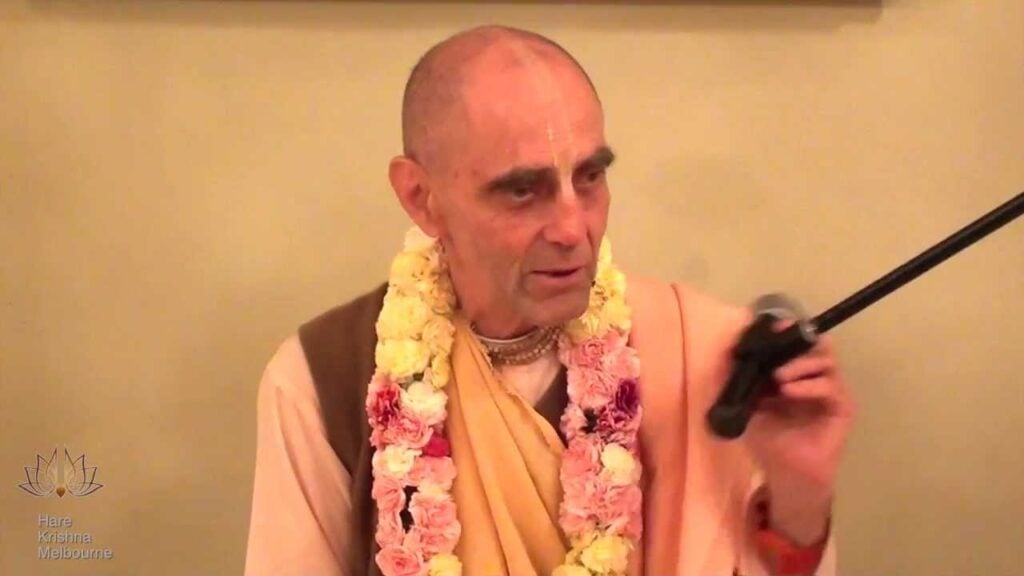
The supplied title identifies His Holiness Janananda Goswami Maharaja as the speaker and Śrīmad-Bhāgavatam 1.6.24 as the subject. Because the supplied source contains a video thumbnail rather than a transcript, no unverified statement is attributed to the speaker. The discussion that follows is therefore a text-centred study of the verse, its narrative setting, its Sanskrit vocabulary, its Gauḍīya Vaiṣṇava interpretation, and its practical relevance to bhakti yoga and Krishna consciousness.
The narrative setting. The verse occurs in the opening canto of the Śrīmad-Bhāgavatam, where Nārada explains to Vyāsa how devotion developed during his previous life. Born as the son of a maidservant, the young Nārada had no social power, inherited scholarship, or institutional status. His transformation began through humble service to travelling sages during the rainy season, attentive hearing of their discussions, and respectful participation in a community shaped by devotion.
This background is essential. Nārada’s later spiritual stability does not emerge from abstract speculation alone. It grows through association, service, hearing, disciplined attention, and the gradual purification of desire. The narrative presents bhakti as an embodied education: conduct affects attention, attention shapes affection, affection directs memory, and repeated remembrance forms character.
After the sages departed, Nārada remained with his mother, whose livelihood and emotional dependence restricted his freedom. Her sudden death from a snakebite removed that attachment in a painful and irreversible way. The text does not celebrate bereavement as intrinsically good. Instead, it records how Nārada interpreted an uncontrollable event within a providential framework and continued his search rather than becoming paralysed by resentment.
Nārada travelled alone, passed through settlements and wilderness, and eventually sat beneath a tree in an uninhabited forest. Following the instructions he had received, he controlled his senses, focused his mind, and meditated upon the indwelling Lord. A vision of the Divine arose within his heart, filling him with an intensity of joy that exceeded his previous experience. The vision then disappeared.
The disappearance is one of the chapter’s most psychologically perceptive moments. Nārada attempts to recover the experience but cannot reproduce it by force. The episode distinguishes spiritual realization from a sensation that the ego can summon on demand. A divine voice explains that the momentary vision was given to deepen longing and loosen material desire. Verse 1.6.24 then provides the crucial promise that the devotion already awakened within him will not be wasted.
The Sanskrit text.
matir mayi nibaddheyaṁ
na vipadyeta karhicit
prajā-sarga-nirodhe ’pi
smṛtiś ca mad-anugrahāt
A close translation reads: this intelligence, bound to the Supreme, will never be lost at any time; even amid the creation and withdrawal of living beings, remembrance will continue through divine grace. The verse moves from disciplined orientation to enduring remembrance and finally identifies grace as the ground of that continuity.
How the Sanskrit carries the argument. The opening word matiḥ, appearing as matir through sandhi, can mean intelligence, understanding, intention, mental orientation, or settled conviction. It is broader than the modern idea of raw intellectual ability. In this context, it describes the whole inner faculty by which a person understands, values, chooses, and directs attention.
The phrase nibaddhā iyam appears in combination as nibaddheyaṁ. Derived from a verbal root associated with binding or fastening, nibaddhā conveys more than a passing preference. Nārada’s intelligence has become firmly connected to its object. Devotion is therefore presented not as a temporary mood but as an established orientation of consciousness.
The locative pronoun mayi, meaning in or upon Me, gives the verse its personal and relational character. The mind is not merely stabilized through concentration upon an impersonal technique. Within the Bhāgavatam’s theology, it is fixed upon the Supreme Person. The stability of devotion arises through relationship: the devotee remembers, serves, trusts, and responds to one who is understood to possess consciousness and grace.
Na vipadyeta karhicit expresses radical non-loss. The verb vipadyeta can suggest failing, falling away, being destroyed, or coming to ruin, while karhicit means at any time. The assurance is not that Nārada will never face grief, distraction, bodily death, or cosmic disruption. It is that the devotional intelligence established by sincere contact with the Divine will not end in ultimate failure.
The compact expression prajā-sarga-nirodhe ’pi places this promise against a cosmic horizon. Prajā refers to living beings or created populations, sarga to manifestation or creation, and nirodha to restraint, cessation, or withdrawal. Traditional translations accordingly describe remembrance as continuing through creation and annihilation. The statement belongs to the Bhāgavatam’s cyclical cosmology, in which universes undergo repeated manifestation and dissolution.
The final expression, smṛtiś ca mad-anugrahāt, identifies remembrance as the result of divine favour. Smṛti means memory or recollection, but devotional remembrance is not reducible to the storage of information. It is the renewed presence of a meaningful relationship in consciousness. Mad-anugrahāt means through My grace, indicating that the continuity promised to Nārada cannot be explained solely by personal willpower.
From intelligence to remembrance. The sequence of the verse is significant. First, intelligence becomes bound to the Divine. Second, that orientation is declared imperishable. Third, remembrance survives conditions that would normally erase continuity. Finally, grace is named as the sustaining cause. Bhakti thus includes cognition, intention, affection, practice, and divine reciprocity rather than belonging exclusively to either emotion or philosophy.
This structure prevents two opposite misunderstandings. Devotion is not portrayed as passive waiting, because Nārada has served, listened, travelled, meditated, and persevered. Yet it is not portrayed as a self-manufactured achievement, because its final continuity depends upon grace. Human effort prepares, receives, and expresses devotion; grace exceeds what effort can independently secure.
Remembrance as a form of bhakti. Later in the Bhāgavatam, Prahlāda describes nine modes of devotion: hearing, chanting, remembering, serving the Lord’s feet, worship, prayer, servitude, friendship, and complete self-offering. In that framework, smaraṇam, or remembrance, is not an isolated mental exercise. It is nourished by hearing and chanting, embodied through service, and deepened by surrender.
Nārada’s history illustrates this sequence with unusual clarity. He first hears sacred discourse from realized practitioners. That hearing awakens taste. Taste reorganizes desire. Desire guides meditation. Meditation culminates in a moment of direct encounter, and the encounter produces longing that remains after the vision disappears. Remembrance is therefore the fruit of an entire devotional ecology rather than a command imposed upon an unprepared mind.
Devotional remembrance also differs from nostalgia. Nostalgia attempts to revisit a pleasant past, often idealizing what has been lost. Smṛti in this verse is forward-moving. It draws consciousness toward its enduring object and reshapes present conduct. A genuine memory of Krishna should influence speech, judgment, relationships, and responsibility rather than merely recreate a cherished emotional state.
The meaning of continuity. Within Gauḍīya Vaiṣṇava thought, the self is not identical with the temporary body or the changing stream of mental impressions. Nārada’s enduring remembrance therefore supports a larger account of personal continuity grounded in the soul’s relationship with the Supreme. The verse is not principally promising the survival of every ordinary autobiographical detail. It is promising the preservation of the spiritually decisive orientation that defines Nārada’s awakened life.
The chapter later presents the fulfilment of this promise. Nārada leaves his temporary body, receives a form suited to divine service, and remains connected to the Lord across a cosmic dissolution. When creation unfolds again, his remembrance and vocation continue. The narrative thus does not leave verse 1.6.24 as an isolated theological maxim; it integrates the assurance into Nārada’s continuing identity as teacher, musician, traveller, and servant of the Divine.
An academic reading should distinguish the text’s theological claim from an empirical claim available to ordinary measurement. The Bhāgavatam speaks from within a sacred cosmology and asks to be interpreted on those terms. Its account can still carry existential insight for readers who approach its cosmology differently, but the existential application should not erase or replace the literal theological meaning intended by the narrative.
Creation and dissolution at a human scale. Cosmic dissolution is the verse’s explicit horizon, yet the pattern also illuminates smaller endings: bereavement, migration, illness, ageing, retirement, the collapse of a career, or the loss of a familiar community. This is an analogy rather than a substitute translation. Every major transition can unsettle the memories and roles through which a person previously understood life.
A reader may recognize the quiet fear beneath such transitions: if everything familiar changes, will anything meaningful remain? Nārada’s story answers by relocating security. Circumstances are not promised permanence, and emotional pain is not denied. Stability rests instead in a cultivated relationship whose deepest continuity is received as grace. That distinction gives the verse emotional force without turning it into a simplistic promise of worldly protection.
The spiritual purpose of longing. The Lord’s disappearance from Nārada’s meditation can initially seem severe. In narrative terms, however, the temporary vision prevents premature satisfaction. Longing keeps devotion dynamic and exposes the difference between love of the Divine and attachment to an extraordinary experience. Nārada must learn to seek the Lord rather than merely seek the pleasure produced by seeing the Lord.
This principle should be handled carefully. The episode does not justify spiritual neglect, manipulation, or the romanticization of suffering. Human teachers cannot claim divine authority for withholding care or accountability. The narrative addresses a specific encounter between Nārada and the Supreme Lord. Its sound practical lesson is that fluctuations in spiritual emotion do not necessarily invalidate sincere practice.
Periods of vivid inspiration often alternate with periods of dryness. If devotion depends entirely upon an intense feeling, practice becomes fragile. Nārada is taught to continue through remembered instruction, disciplined conduct, and trust. The verse therefore offers a mature account of faith: spiritual depth is measured not only by peak experiences but also by fidelity when those experiences are absent.
Grace without arbitrariness. Anugraha is central to the verse, but grace does not appear as an arbitrary reward distributed without context. Nārada has already become receptive through service, hearing, humility, and concentrated practice. Grace remains free and cannot be forced, yet the narrative shows that receptivity can be cultivated. This balance avoids both spiritual entitlement and despair.
Entitlement assumes that a prescribed technique obliges the Divine to produce an experience. Despair assumes that imperfect effort has no value unless perfection appears immediately. Nārada’s journey rejects both conclusions. Practice matters, transformation may be gradual, and the decisive gift cannot be reduced to a transaction. Such a model preserves disciplined agency while acknowledging dependence upon a reality greater than the individual ego.
The role of the guru and sacred exposition. A discourse by a teacher such as Janananda Goswami Maharaja belongs to a long oral culture of scriptural interpretation. The spoken class does more than repeat a translation. It connects vocabulary, narrative, theology, ethical conduct, and lived practice. In ISKCON, this process is situated within the Gauḍīya Vaiṣṇava lineage transmitted internationally by Śrīla A. C. Bhaktivedanta Swami Prabhupāda.
The guru’s role is not to replace scripture or eliminate thoughtful inquiry. The teacher helps a community hear the text within a disciplined interpretive tradition and demonstrates how doctrine may become character. A responsible listener considers the textual context, the lineage of interpretation, and the ethical fruits of the teaching. Reverence and careful reasoning can therefore operate together.
The absence of a transcript in the supplied material makes that distinction especially important. The title establishes the speaker and verse, but it does not provide sufficient evidence for reconstructing the lecture’s individual examples or emphases. A reliable presentation should preserve that boundary rather than place plausible but undocumented claims in Janananda Goswami Maharaja’s voice.
Hearing as the beginning of durable memory. Nārada’s transformation begins with śravaṇa, attentive hearing. In bhakti yoga, hearing is not passive exposure to sound. It requires receptivity, discrimination, and sustained attention. The listener allows sacred language to challenge habitual assumptions rather than treating a discourse as background entertainment.
Hearing becomes especially important in an environment of fragmented attention. A person may consume hours of spiritual media while retaining little because attention repeatedly shifts between messages, notifications, and unrelated tasks. The lesson of Nārada is not simply to increase the quantity of content. It is to improve the quality of encounter through focused listening, reflection, and application.
Chanting as active recollection. The Hare Krishna practice gives remembrance an audible and repeatable form: Hare Krishna, Hare Krishna, Krishna Krishna, Hare Hare; Hare Rama, Hare Rama, Rama Rama, Hare Hare. Within the tradition, this mahā-mantra is both prayer and practice. The names provide consciousness with a sacred centre while the act of chanting repeatedly renews attention.
Repetition alone should not be confused with realization. Mechanical repetition can still establish a useful discipline, but the intended movement is toward attentive invocation, humility, and service. When the mind wanders, returning to the sound is not evidence of failure; the return is itself the training of remembrance. Over time, repeated returns can form a durable devotional disposition.
Remembrance and ethical life. The credibility of spiritual memory is tested by its effects. If remembrance of Krishna produces greater honesty, compassion, self-restraint, courage, and willingness to serve, cognition and conduct are becoming integrated. If religious recollection produces contempt, vanity, or hostility toward other sincere paths, the practice requires examination.
This ethical criterion is consistent with the Bhāgavatam’s broader vision. Devotion is not an excuse to withdraw from responsibility or disregard the dignity of living beings. Seeing life in relation to the Supreme should deepen care because other beings are no longer viewed merely as instruments of personal desire. Memory of the Divine should become visible as responsibility toward the world.
Service stabilizes what contemplation discovers. Nārada does not begin with spectacular meditation; he begins by assisting sages. Service gives devotion a bodily form and interrupts excessive self-absorption. It also provides a practical test: remembrance that cannot survive ordinary duties remains incomplete. Preparing food, cleaning a shared space, teaching, caring for vulnerable people, or offering skilled work can become vehicles of seva when joined to clear intention and ethical conduct.
Service must nevertheless retain discernment. Exploitation does not become sacred merely because it is described with devotional vocabulary. Healthy seva respects consent, capacity, accountability, and appropriate boundaries. This protects the humility of service from being confused with submission to avoidable harm.
Community and spiritual memory. Nārada’s first devotional impressions arise in association with practitioners. Communities preserve memory through recitation, music, festivals, study, food, ritual, and shared service. When an individual’s concentration weakens, collective practice can restore direction. In this sense, remembrance is personal without being merely private.
A community can also forget its purpose while preserving its external forms. Institutional memory is spiritually valuable only when rituals continue to express humility, truth, compassion, and devotion. Regular study and honest dialogue allow a tradition to distinguish living continuity from the repetition of habits whose meaning has been neglected.
A careful psychological comparison. Repetition, emotional significance, environmental cues, and focused attention generally support ordinary human memory. These observations help explain why daily chanting, sacred images, music, and scheduled worship can make remembrance more accessible. They should not be presented as scientific proof of the verse’s theological claim, which concerns continuity through divine grace and cosmic dissolution.
The distinction protects both science and theology. Psychology can examine attention, habits, recall, and behaviour under observable conditions. The Bhāgavatam addresses the soul, divine agency, and continuity beyond bodily death. Dialogue between these domains can clarify practical mechanisms, but neither should be reduced to claims it was not designed to establish.
Remembering at the final transition. Bhagavad-gītā 8.6 teaches that the state remembered at death influences the next destination, while Bhagavad-gītā 8.7 combines remembrance of Krishna with the performance of duty. Read together with Śrīmad-Bhāgavatam 1.6.24, these passages show why daily formation matters. Final remembrance is not treated as a magical phrase detached from the orientation of an entire life.
A life repeatedly directed toward the Divine makes devotional remembrance increasingly natural, although the tradition still places ultimate confidence in grace. This removes the burden of trying to control the final moment through fear. The practical emphasis falls upon how attention is formed now: what is heard, repeated, served, loved, and chosen each day.
What forgetfulness reveals. Spiritual forgetfulness is not always deliberate rejection. Fatigue, grief, illness, anxiety, and sensory overload can impair concentration. A compassionate practice recognizes human limitation. Returning gently to mantra, scripture, prayer, or service is usually more constructive than turning temporary distraction into shame.
At the same time, repeated forgetfulness can reveal competing attachments. Attention often returns to what the heart regards as urgent, pleasurable, threatening, or unfinished. Observing that pattern without denial can become a form of spiritual diagnosis. The task is not to hate the mind but to understand how desire has trained it and then patiently offer it a more enduring centre.
Sanatana Dharma and enduring orientation. The source title connects the verse with Sanatana Dharma. Within a Vaiṣṇava interpretation, sanātana points toward what is enduring rather than temporary, while dharma includes the intrinsic disposition and sustaining responsibility of a being. Nārada’s imperishable devotion illustrates this theme: social roles and cosmic structures change, but the soul’s orientation toward divine service is presented as fundamental.
Sanatana Dharma contains diverse Hindu schools, forms of worship, philosophical vocabularies, and disciplines. Śaiva, Śākta, Vaiṣṇava, Smārta, and other traditions may describe ultimate reality and liberation differently, yet each preserves practices of sacred recollection through mantra, prayer, meditation, narrative, ritual, or contemplative knowledge. Unity does not require the erasure of these differences.
Resonance across Dharmic traditions. Sikh practice gives central importance to remembrance of the Divine Name through simran and nām japnā, while gurprasād expresses the indispensable role of grace. These concepts are not identical to Gauḍīya Vaiṣṇava theology, but the shared emphasis on remembrance, humility, sacred sound, and grace provides a meaningful basis for respectful dialogue.
In Buddhist traditions, the Pāli term sati is historically related to Sanskrit smṛti and carries meanings associated with remembering, mindfulness, and non-forgetful awareness. Buddhist accounts of selfhood and ultimate reality differ substantially from the Bhāgavatam’s personalist theology. The comparison is therefore most useful at the level of disciplined attention, not as a claim that both traditions teach the same metaphysics.
Jain traditions cultivate sustained awareness through right vision, right knowledge, right conduct, contemplation, vows, and careful attention to the karmic consequences of action. Jain accounts of liberation place distinctive emphasis upon purification and disciplined nonviolence, and their understanding of grace differs from Vaiṣṇava theism. Even so, the shared refusal to let consciousness drift carelessly through life offers another point of ethical and contemplative kinship.
These comparisons support Dharmic unity precisely when differences are stated honestly. Buddhism, Jainism, Sikhism, and the many Hindu traditions need not be collapsed into a single doctrine to recognize shared commitments to disciplined awareness, ethical transformation, freedom from destructive attachment, and the preservation of sacred wisdom. Respect becomes stronger when it is informed rather than merely sentimental.
Four interpretive errors to avoid. First, the verse does not promise that every casual religious impression automatically becomes an irreversible realization. Its assurance is addressed to Nārada within a narrative of sincere transformation. Second, enduring remembrance should not be confused with the immortality of the ordinary ego. Third, the verse does not deny grief or bodily vulnerability. Fourth, devotion to Krishna need not produce antagonism toward other Dharmic paths.
A fifth error is to detach the promise from the rest of Nārada’s life. His remembrance is inseparable from service, sacred association, hearing, restraint, meditation, humility, and grace. Quoting the assurance while ignoring this formative process turns a demanding spiritual teaching into a slogan. The verse offers profound confidence, but not spiritual complacency.
A practical rhythm of remembrance. A grounded daily practice can begin with a brief morning encounter with the verse. The Sanskrit may be recited slowly, followed by a reliable translation and a minute of silent reflection. The purpose is not to complete a ritual as quickly as possible but to establish the day’s governing orientation before competing demands take control of attention.
A second step is attentive mantra practice. A realistic number of repetitions performed with care is more formative than an ambitious target approached with constant distraction. When attention wanders, the practitioner can return to the sound without self-condemnation. Each return rehearses the central movement described in the verse: intelligence becoming fastened again to the Divine.
A third step is textual reflection. One paragraph from the surrounding chapter can be read each day so that verse 1.6.24 remains connected to Nārada’s full journey. Reflection may ask what captured attention, what attachment was exposed, and what concrete action the teaching now requires. This prevents study from remaining purely informational.
A fourth step is ethical service. One intentional act of patience, generosity, truthfulness, environmental care, or assistance to another person can embody remembrance. The act need not be dramatic. Its value lies in joining sacred attention with responsibility, allowing devotion to shape the ordinary places where character is actually formed.
A fifth step is evening recollection. Before sleep, the practitioner can review moments of remembrance and forgetfulness without turning the review into either self-congratulation or shame. Gratitude recognizes grace; honest acknowledgment recognizes unfinished work. The next day then begins as a continuation rather than an isolated attempt.
Practice during upheaval. When life becomes unstable, complex routines often collapse. A minimal practice can preserve continuity: one verse, one mantra, one prayer, and one act of service. This does not trivialize crisis or replace medical, psychological, legal, or social support when those are needed. It gives the person a spiritual thread to hold while appropriate practical help is sought.
The verse’s greatest benefit may be its redirection of confidence. Human memory is fragile, emotional intensity fluctuates, institutions change, and bodies age. The Bhāgavatam does not deny any of this. It places hope in a devotional relationship whose continuity is sustained not by perfect human control but by divine grace responding to sincere orientation.
The enduring lesson of Śrīmad-Bhāgavatam 1.6.24. Nārada’s spiritual memory survives because devotion has reached deeper than a temporary mood. Hearing became understanding, understanding became affection, affection became meditation, and meditation matured into a relationship upheld by grace. The verse therefore offers both assurance and responsibility: what consciousness repeatedly serves today helps determine what it can remember when familiar supports disappear.
Janananda Goswami Maharaja’s identified topic directs attention to a verse of exceptional relevance for Krishna consciousness. Its message is neither escapist nor merely consoling. It presents bhakti yoga as the disciplined formation of an enduring spiritual identity—one capable of meeting change without surrendering its deepest allegiance.
For a reader navigating distraction, loss, or uncertainty, the practical invitation is clear: hear carefully, chant attentively, remember honestly, serve ethically, and leave room for grace. The created world continually changes, but the Bhāgavatam insists that sincere devotion is never meaningless and never finally lost.
Primary textual references. The verse, word meanings, translation, and traditional commentary may be consulted at the Bhaktivedanta Vedabase edition of Śrīmad-Bhāgavatam 1.6.24. The nine modes of devotion appear in Śrīmad-Bhāgavatam 7.5.23–24, and remembrance joined with duty is discussed in Bhagavad-gītā 8.7. The supplied media source is the recording identified as Janananda Goswami Maharaja’s discourse on SB 1.6.24.
Inspired by this post on Dandavats.









Leave a Reply
You must be logged in to post a comment.