
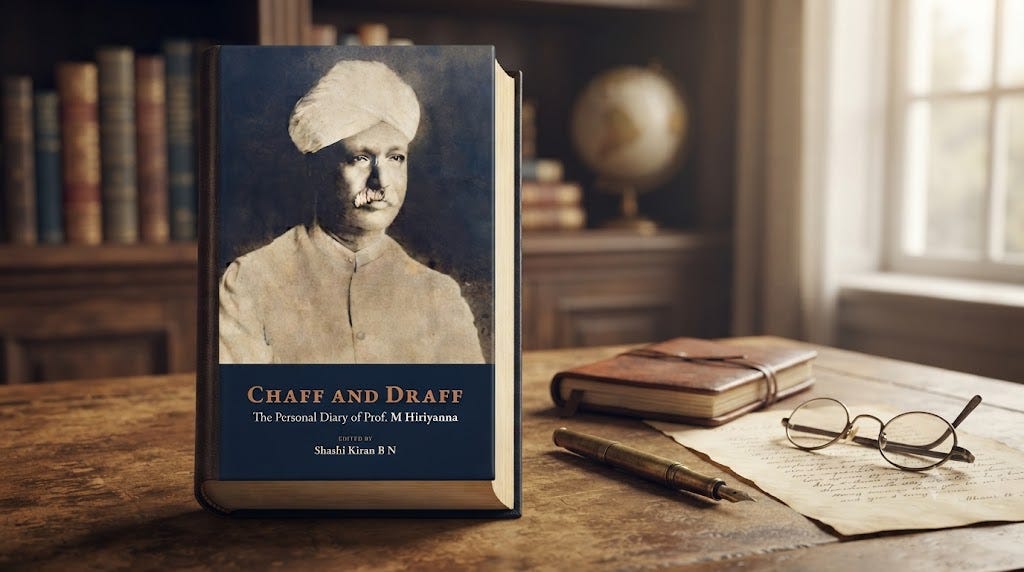
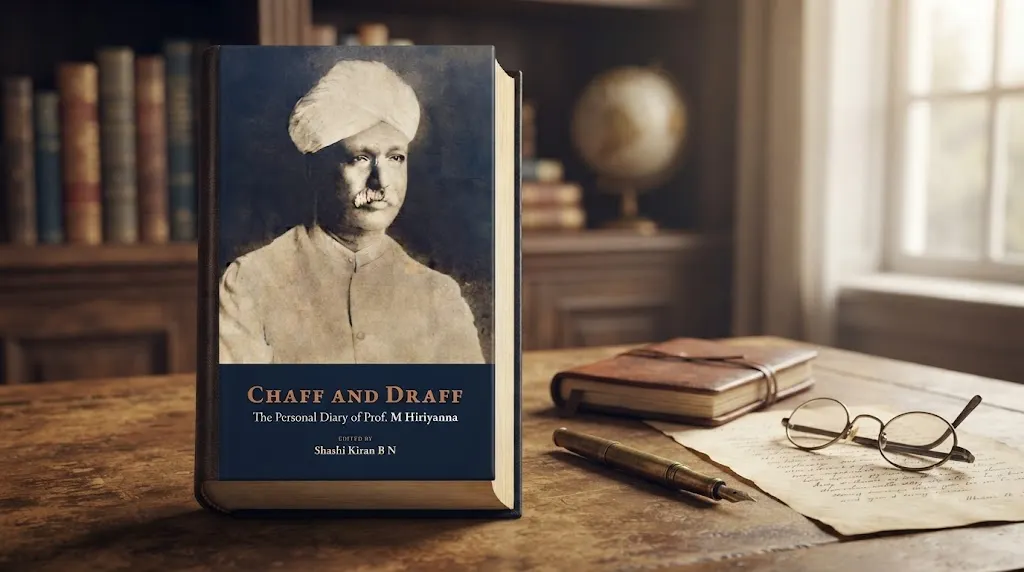
Chaff and Draff opens an unusually intimate window onto M. Hiriyanna, the distinguished scholar of Vedanta, Indian philosophy and aesthetics. Its value does not lie in scandal or confession. It lies in the quieter discovery that formidable scholarship, spiritual discipline, grief, family affection, travel, aesthetic delight and recurring self-doubt could coexist within a single life. The diary reveals neither an inaccessible saint nor a detached academic abstraction, but a reflective human being who repeatedly tested inherited wisdom against experience. For contemporary readers, that combination makes the record intellectually important and emotionally recognizable.
Why a Title About Residue Contains a Philosophy
The title initially sounds deliberately unflattering. Chaff is the dry husk separated from grain during threshing, while draff commonly denotes the damp remains of malt after brewing. Modern dictionaries describe draff as spent grain often used in animal feed, not as an inherently lethal substance. The relevant distinction is therefore symbolic rather than toxicological: both terms name what remains after something conventionally valuable has been extracted. By calling his private notes Chaff and Draff, Hiriyanna appears to classify them as scraps, husks or intellectual leftovers rather than polished contributions to philosophy.
The expression also carries a long English literary history. In Act 4, Scene 2 of Shakespeare’s The Merry Wives of Windsor, Mistress Page invokes the proverb, “Still swine eats all the draff.” The supplied transcription uses the form draugh, whereas the Folger Shakespeare Library prints draff. The proverb had circulated before Shakespeare: John Heywood’s collection, first printed in 1546 and preserved by the Oxford Text Archive, includes the form “The still sow eateth all the draff.” It warns that apparent quietness may conceal appetite, calculation or unexpected advantage.
H.L. Mencken later recorded an American variant, “The still sow gets the swill.” The substitution of swill for draff illustrates how proverbial meaning can survive after an older material vocabulary has faded. Merriam-Webster still defines draff through the practical language of brewing and animal rations, but Hiriyanna’s title activates its figurative sense: matter judged too miscellaneous, unfinished or private to deserve public attention.
A further literary resonance is especially suggestive. In Tennyson’s frame poem The Epic, associated with Morte d’Arthur, a discarded poetic project is called “Mere chaff and draff, much better burnt.” Hiriyanna’s documented affection for Tennyson and English poetry makes an allusion plausible. His reported correspondence about a difficult point in In Memoriam strengthens that possibility. No publicly available evidence proves that Tennyson supplied the diary’s title, however, so the connection is best treated as a well-grounded inference rather than a settled fact.
The title therefore performs an act of intellectual self-effacement. Material labeled worthless by its creator can become indispensable to posterity because it preserves process rather than finished doctrine. The diary’s apparent residue contains precisely what formal publications tend to remove: hesitation, emotional pressure, unfinished intuitions, changes of mind and the daily labor from which mature thought emerges.
M. Hiriyanna Beyond the Public Portrait
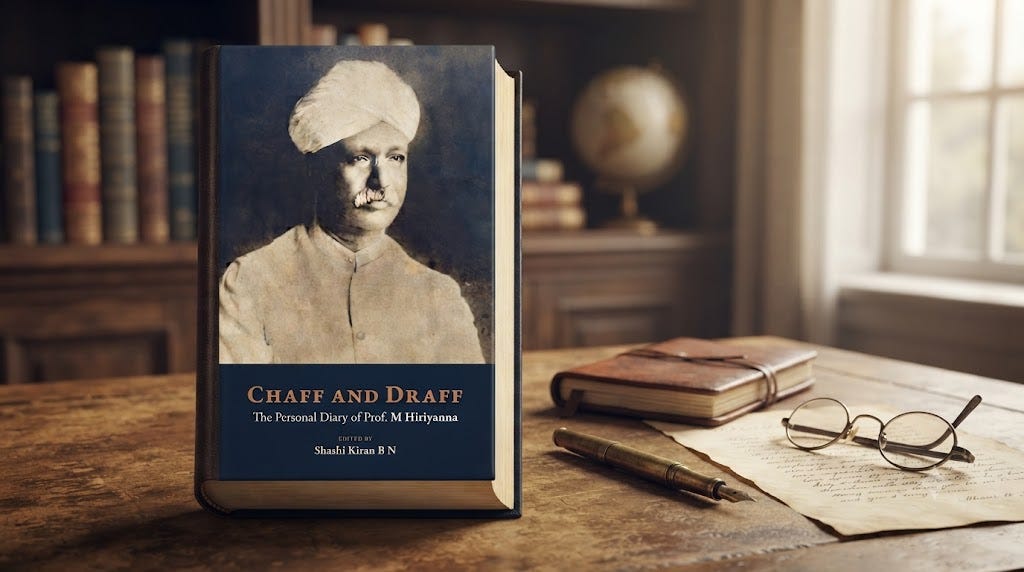
Mysore Hiriyanna lived from 1871 to 1950 and taught for many years at Mysore University. He became internationally known as a historian of Indian philosophy, a scholar of Vedanta and an interpreter of Indian aesthetics. An Oxford Academic assessment identifies his 1932 Outlines of Indian Philosophy as a standard text and emphasizes his contributions to Vedanta, ethics, aesthetics and philosophical work on truth. This broad standing is essential context: the diary belongs to a thinker whose concise published prose concealed decades of disciplined preparation.
Outlines of Indian Philosophy also demonstrates that his scholarship cannot be reduced to one sectarian compartment. Its documented contents move from Vedic and Upanishadic thought through the Bhagavad Gita, early Buddhism, later Buddhist schools, Jainism, Nyaya-Vaisesika, Sankhya-Yoga, Purva-Mimamsa and several Vedantic systems, including Advaita and Visistadvaita. The National Law School of India University catalog preserves this structure. Such organization reflects comparative rigor: traditions are examined in relation to one another without pretending that their doctrines are interchangeable.
Public recollections often presented Hiriyanna as a tranquil Guru who spoke chiefly in classrooms and scholarly forums. That portrait was not false, but it was incomplete. Chaff and Draff supplies the missing interior dimension: the reserved teacher was also a traveler, grieving husband, protective father, exacting student, lover of poetry, restrained Rasika and persistent Sadhaka. The diary does not diminish his composure. It shows the continuous inner work from which that composure arose.
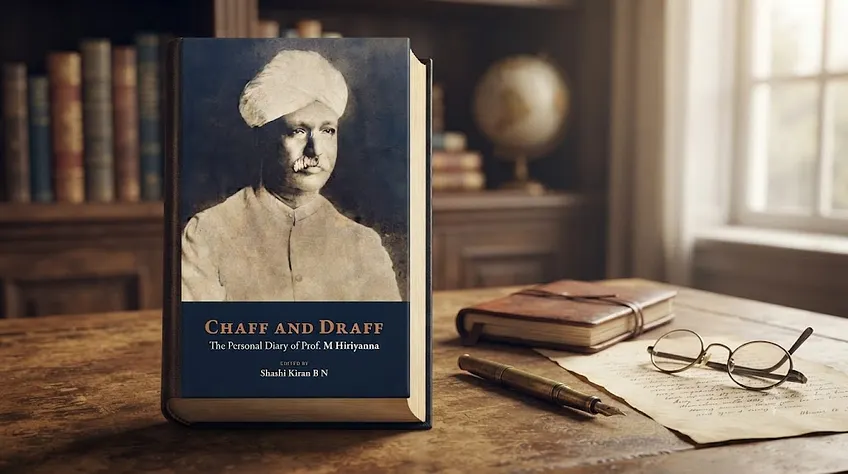
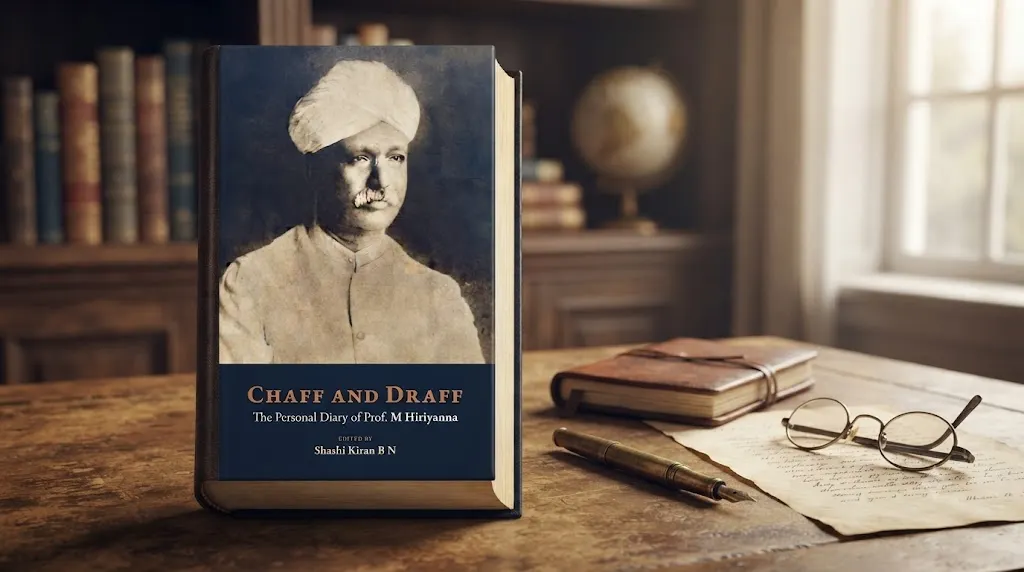
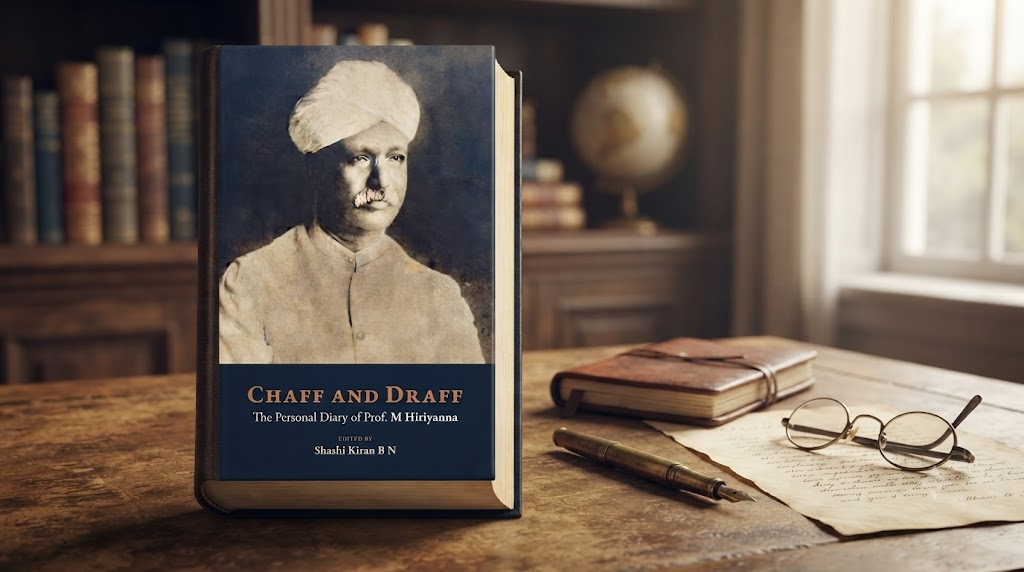
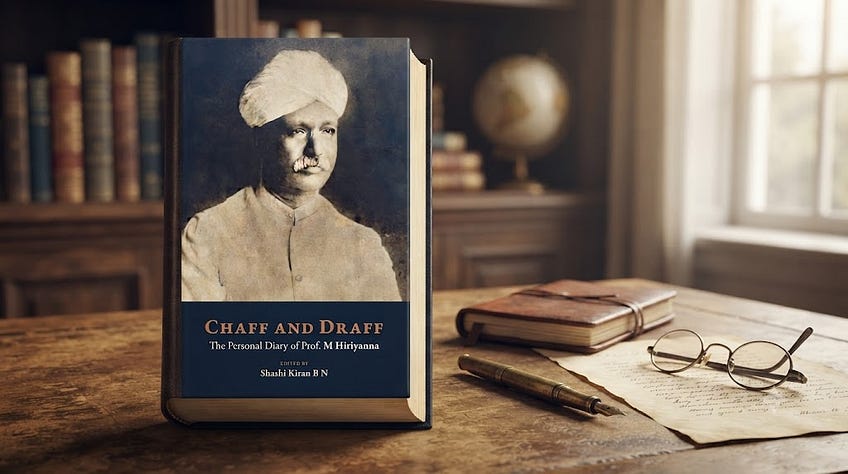
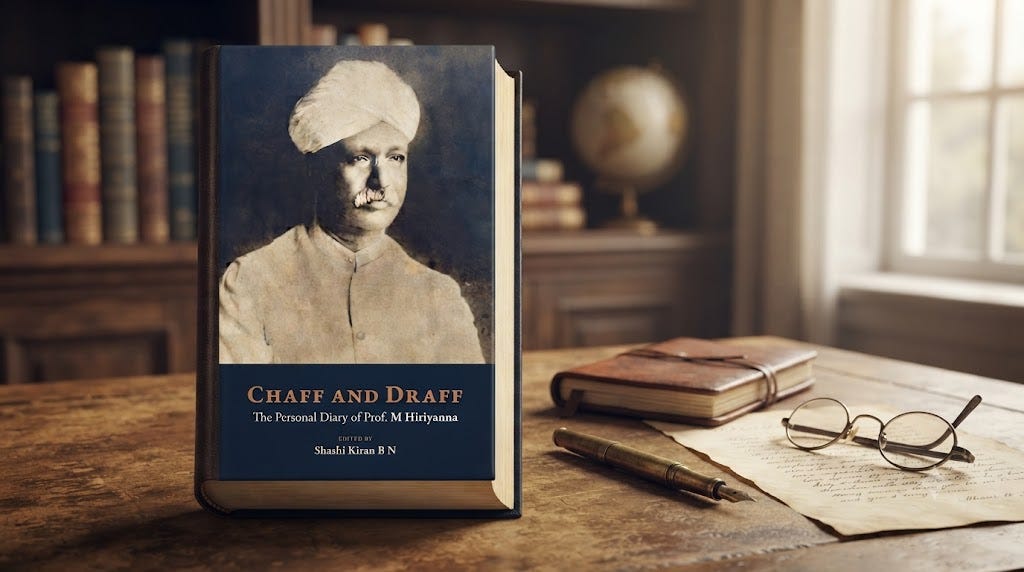
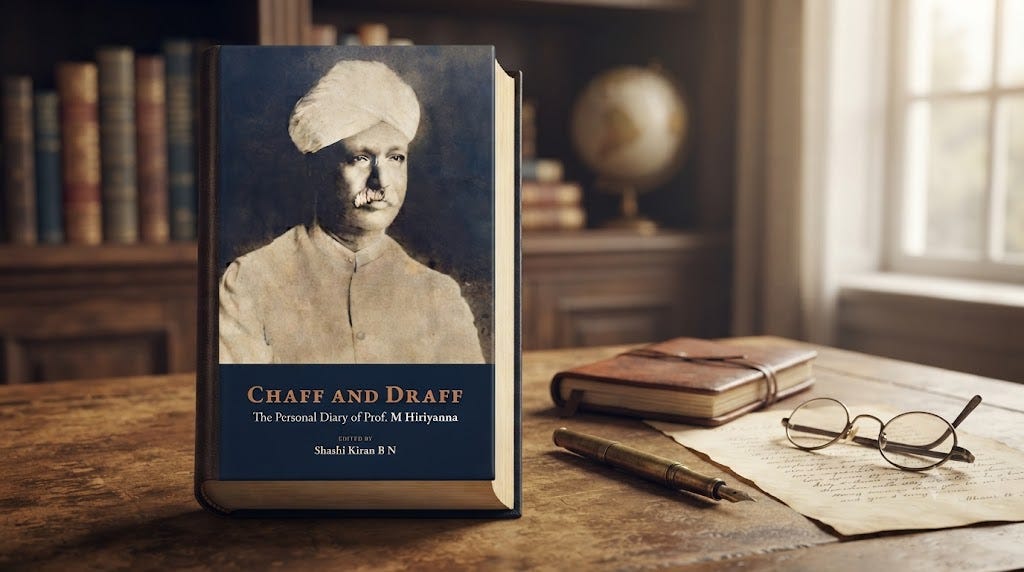
A 2026 edition, titled Chaff and Draff: The Personal Diary of Prof. M. Hiriyanna and edited by B.N. Shashi Kiran, brought this private record into public view. A release notice from Jain University’s Center for Ancient History and Culture independently confirms the title and editorial attribution. The publication is significant because the diary is not merely another collection of finished essays. It is primary biographical evidence extending across more than half a century.
“JOTTED DOWN FOR NO EYE BUT MY OWN”
Hiriyanna’s capitalized instruction, “JOTTED DOWN FOR NO EYE BUT MY OWN,” establishes the diary’s original status with unusual force. Its entries run chronologically from May 7, 1897, to March 21, 1948. The final recorded sentence is stark: “Returned to Mysore owing to illness.” The span begins when he was a young man and ends two years before his death, allowing readers to observe intellectual formation, domestic change and spiritual maturation over decades rather than through retrospective summary.
The diary should not be mistaken for an autobiography. Autobiography generally arranges a life for public comprehension, selecting episodes in light of a known outcome. A private diary records time before its outcome is known. Events remain unresolved, and insights appear before later experience confirms, modifies or abandons them. This temporal openness gives Chaff and Draff unusual evidentiary power, although it also requires caution: a diary preserves what happened to be recorded, not everything that occurred.
Four strands repeatedly converge in the entries: family life, private reflection, spiritual development and travel. They cannot be cleanly separated because each alters the meaning of the others. Bereavement sharpens philosophical inquiry; travel stimulates historical and aesthetic perception; study provides vocabulary for grief; and household responsibilities test whether contemplation can remain connected to duty. This integration is one reason the diary reads as more than a ledger of dates.
Its most striking ethical feature may be the relative absence of personal score-settling. D.V. Gundappa later lamented that Hiriyanna’s academic career did not receive rewards proportionate to his stature, yet the private record reportedly does not dwell on that grievance. Silence cannot prove that disappointment was absent, and responsible biography should not force one interpretation upon it. The silence nevertheless indicates that institutional resentment was not the organizing principle of his self-understanding.
The diary also places him within the intellectual networks of the Indian Renaissance. Its entries mention contacts or encounters involving Raja Ravi Varma, Kuppuswami Sastri, Rabindranath Tagore, D.V. Gundappa, P.D. Gune, P.K. Gode, Sarojini Naidu, Gopal Krishna Gokhale, Bhagavan Ramana Maharshi and two Sankaracharyas of Sringeri. These names reveal a cultural world in which philosophy, literature, nationalism, art, Sanskrit learning and spiritual practice overlapped through personal relationships.
The Traveler Behind the Image of a Recluse
Without Chaff and Draff, Hiriyanna might still appear to have spent nearly all his time between home, classroom and study. The diary instead traces extensive journeys from Karnataka to the United Provinces and through territories then described as the Madras and Bengal Presidencies. The longer travel entries suggest that the notebook accompanied him. They combine practical details with observation, literary memory and contemplative response, making them valuable records of both a person and a changing landscape.
His 1907 description from the summit of the “Trichinopoly hill” evokes Tiruchirappalli, the branches of the Cauvery and Srirangam surrounded by dense coconut and mango growth. The temple’s monumental scale was partly concealed by vegetation. Such passages do more than celebrate scenery. They preserve visual evidence of how sacred architecture, agriculture, rivers and settlement once occupied a shared ecological field. Comparison with present urban conditions can therefore illuminate environmental and cultural transformation, although the diary alone cannot explain every cause of that change.
At the nearby Jambukesvara temple, Hiriyanna observed renovation work and praised patrons identified in the diary as “Natukoti Chetties.” He compared the elaborate construction of a new ratha with the organization required to build a steamship. The comparison is technically revealing: temple patronage appears not as decorative nostalgia but as a coordinated system involving capital, artisanship, logistics, materials, ritual requirements and public participation. It also shows his readiness to interpret an old institution through modern industrial imagery.
His itineraries record stays in Dharmachatrams and choultries, including Lakshmi Sattram, Chettiyar Chatram, Mangamma’s Choultry, Cocanada Chatram and Kanakamma Choultry. These establishments functioned as forms of charitable lodging within older networks of pilgrimage, commerce and hospitality. Their presence demonstrates the practical infrastructure created by Dharma-oriented giving. It does not, by itself, resolve wider historical questions about social access, caste hierarchy or regional variation; it does provide concrete evidence that community-supported travel institutions remained active in his lifetime.
The journeys unfolded after railways had begun reorganizing movement across India. Rail travel shortened some routes, redirected commercial traffic and changed the relative importance of older roads, river crossings and lodging systems. Hiriyanna’s entries capture this transition from the standpoint of a passenger who still recognized traditional institutions. They are therefore useful to historians of mobility because they connect large technological change with small details: a room, a station, a view, a meal, a temple visit or a remembered verse.
His geographical vocabulary bears marks of the colonial archive. Chitaldrug appears for Chitradurga, Seringapatam for Srirangapattana, Nerbuda for Narmada, Cocanada for Kakinada, Trichinopoly for Tiruchirappalli and Vizag for Vishakhapattanam. These spellings reveal the linguistic environment of English education and administration. Yet the cultural meanings attached to the places remain deeply rooted in Indian memory. Colonial orthography and Dharmic perception coexist on the same page rather than canceling each other.
Nature repeatedly calls forth poetry. In one entry, solitude beneath a gnarled tree with Chamundi Hill in view leads him from Cardinal Newman’s Historical Sketches and Lead, Kindly Light to Kalidasa’s Megha-duta. The sequence is not an ornamental display of reading. It reveals a mind in which landscape activates a multilingual archive. English religious verse and classical Sanskrit poetry become parallel resources for attention, while the physical setting prevents reading from becoming purely abstract.
Cross-Cultural Scholarship Under Colonial Conditions
Hiriyanna’s intellectual formation occurred under British colonial rule, when education, missionary activity, administrative power and Oriental scholarship were entangled. This history cannot be reduced either to benevolent cultural exchange or to a single mechanism of domination. Archaeology, epigraphy, philology, numismatics and comparative philosophy developed through institutions shaped by unequal power, yet Indian scholars also appropriated, criticized and redirected those methods. Hiriyanna’s career belongs to this complex field of constraint and agency.
His decision to employ two tutors for German indicates awareness that major nineteenth- and early-twentieth-century work in Indology was not confined to English. German universities and presses were central to Sanskrit philology and comparative philosophy. Learning German therefore represented technical access to scholarship, not a rejection of Indian learning. His practice joined traditional Sanskrit study with the linguistic equipment required to evaluate European interpretations rather than merely receive them secondhand.
According to B.N. Shashi Kiran’s introduction, Hiriyanna wrote to A.C. Bradley about an abstruse point in Tennyson’s In Memoriam, explaining it through Indian philosophy. The episode reverses the usual colonial direction of instruction: an Indian philosopher applies Vedantic resources to a difficulty in English poetry. Whether treated as literary criticism or comparative philosophy, the exchange illustrates intellectual reciprocity rather than passive imitation.
The diary also records admiration for a Christian pastor’s discourse on the Bhagavad Gita. That response is best understood through Hiriyanna’s lifelong habit of evaluating an argument on its merits. Colonial missionary institutions require critical historical scrutiny, but the quality of one discourse cannot be decided solely by the speaker’s religious identity. This distinction supports respectful interfaith learning: appreciation need not imply conversion, doctrinal surrender or the erasure of historical power.
Such encounters are especially relevant to contemporary discussions of Dharmic unity and religious coexistence. Intellectual confidence does not require refusing every external insight, just as openness does not require treating all doctrines as identical. Hiriyanna’s example suggests a disciplined middle path: preserve conceptual precision, examine historical context and remain capable of recognizing truth or eloquence across social and religious boundaries.
The Technical Architecture of a Vedantic Inner Life
The diary presents Hiriyanna at different moments as a quasi sceptic, devout Sanatani, persistent Sadhaka and self-questioning Vedantin. These descriptions are not necessarily contradictions. Philosophical commitment can include doubt when doubt functions as examination rather than habitual negation. The entries show an effort to refine his inner life through Shravana, Manana, Nidhidhyasana and Dhyana, terms that describe a graded movement from receiving a teaching to realizing its significance.
Shravana is attentive reception of the teaching, traditionally through a qualified source and sustained engagement with the Upanishads. Manana subjects what has been heard to rational reflection, resolving objections and clarifying apparent contradictions. Nidhidhyasana is prolonged contemplative assimilation, through which a conclusion moves from intellectual assent toward stable vision. Dhyana supplies meditative concentration and disciplined inwardness. Together they form an epistemic and practical sequence: instruction, critical examination, assimilation and transformation.
This sequence explains why the diary’s study notes matter. They record philosophy in operation rather than philosophy as a completed system. Reading, translation, memorization, travel, bereavement and self-correction become parts of one inquiry. Vedanta is not treated merely as a set of metaphysical propositions about Brahman and atman; it becomes a pedagogy for examining how knowledge should alter perception, conduct and emotional response.
Private uncertainty gives this process credibility. The reserved public figure admits guilt, hesitation and the distance between aspiration and attainment. His statement “I do not live on the heights I see” is neither theatrical self-condemnation nor false modesty. It identifies a central problem in moral psychology: conceptual vision can exceed habituated character. Recognition of that gap is the beginning of discipline because it prevents philosophical vocabulary from being mistaken for realization.
The same structure helps explain his aphorism, “Do what is right to learn what is true. That is the teaching of Vedanta.” Knowledge and ethics are mutually implicated. Right action does not mechanically manufacture metaphysical truth, but it can reduce the distortions created by selfishness, fear and uncontrolled desire. In that sense, moral preparation improves the conditions of inquiry. Truth is not reduced to private feeling, yet the fitness of the knower remains philosophically relevant.
Within a wider Dharmic frame, this disciplined method offers a basis for dialogue among Hindu, Buddhist, Jain and Sikh traditions. These traditions differ substantially on atman, authority, causation, liberation, devotion and the status of revelation. Unity should not conceal those differences. It can instead arise through shared commitments to ethical cultivation, disciplined attention, freedom from destructive attachment, compassionate conduct and serious inquiry into suffering and ultimate reality.
Hiriyanna’s comparative treatment of Buddhist and Jain philosophy is particularly relevant. It demonstrates that a Vedantin can explain rival or neighboring systems carefully without treating their existence as a threat. Sikh thought is not a major focus of the diary account, so no direct influence should be invented. Nevertheless, the same habits of accurate representation, humility and experiential seriousness can support meaningful engagement with Sikh teachings and practice.
The Restrained Rasika and the Philosophy of Art
At Khusru Bagh in Prayagraj, Hiriyanna’s attention turns to dress, beauty and the visual force of faces that reminded him of heroines in Sanskrit poetry. The entry reveals the restrained Rasika behind the austere academic image. It also reflects the gender, class and regional assumptions of its period, including comparisons between northern and southern women. A private diary should be read critically rather than converted into timeless social authority. Its value lies partly in revealing such situated perception honestly.
His aesthetic sensitivity was not incidental to his philosophy. The essays collected in Art Experience, listed by the Indira Gandhi National Centre for the Arts, investigate the relationship among philosophy, art and life. Hiriyanna treats authentic aesthetic experience as intrinsically valuable: it is sought for its own sake rather than as a tool for acquiring wealth, status or practical advantage.
Two technical characteristics are central to this account. First, aesthetic experience involves a temporary recession of the private, acquisitive self. The spectator is not calculating personal gain but contemplating form, suggestion and feeling with relative disinterestedness. Second, this release produces a distinctive joy less mixed with the tension of ordinary desire. Art does not permanently abolish ego or suffering, but it discloses what experience can become when possessiveness temporarily loosens.
Hiriyanna’s analysis belongs to the intellectual world of Rasa and Dhvani. Rasa is not simply the emotion represented by a poem or performance; it is the aesthetically relished experience awakened in a receptive participant. Dhvani, or suggestion, helps explain how meaning exceeds literal statement. Personal emotion is reorganized into an experience that can be shared without remaining trapped in one person’s biography. This is why art can make grief contemplable without reducing it to either private pain or abstract doctrine.
His Vedantic interpretation emphasizes unity within variety. A successful work contains differentiated elements, yet aesthetic attention apprehends their harmony. This resembles Vedantic insight without becoming identical to Moksha. Art experience is temporary and mediated by a created form; spiritual realization claims a more radical and stable transformation. The analogy is philosophically useful only when that distinction is maintained.
The diary’s sentence “Art serves as the antechamber to God” condenses this relationship. An antechamber is neither the destination nor an irrelevant space. Art can train attention, loosen self-interest and intimate harmony without functioning as sectarian instruction. His resistance to reducing art to moral propaganda follows from the same premise: a work that merely delivers an approved lesson may sacrifice the disinterested experience that gives art its distinctive power.
Grief, Vairagya and the Formation of a Renunciate Temperament
The emotional center of Chaff and Draff is the death of Hiriyanna’s wife when he was thirty-nine. His response is compressed into the sentence, “She is safe but I shall not find her.” Elsewhere he writes, “Death has lost one of its fears for me.” The restraint intensifies rather than diminishes the grief. Anyone who has experienced bereavement can recognize the attempt to state an irreversible fact without allowing language to become theatrical.
He never remarried, and the diary connects his subsequent life with deepening vairagya and self-control. At one point he concludes that “no other course is open to us but vairagya with its attendant self-control.” Vairagya here should not be confused with numbness, hostility toward life or neglect of duty. In the Vedantic context it denotes decreasing dependence on transient objects for ultimate security, accompanied by regulation of desire and clearer discrimination between the enduring and the impermanent.
The diary does not permit a simplistic claim that loss automatically produced realization. Hiriyanna continued to register doubt, sorrow and self-criticism. Grief became a condition of practice, not proof of spiritual completion. This distinction is psychologically and philosophically important: suffering may provoke inquiry, but it can also overwhelm. Transformation depends upon the interpretive and ethical disciplines through which suffering is met.
His journeys to Kaladi, which he called his “spiritual home,” gave this discipline a sacred geography. The account associates him with the development of a philosophical library there. At Nerur he meditated at the Samadhi of Sadashiva Brahmendra and repeatedly recited Atmavidyavilasa. He studied Advaita and the Upanishads with his Guru, Mahamahopadhyaya Harihara Sastri, and received Darshana of Bhagavan Ramana Maharshi at Tiruvannamalai. Text, teacher, place and contemplative practice thus formed a single ecology of learning.
These pilgrimages also prevent vairagya from appearing as solitary withdrawal. Kaladi, Nerur and Tiruvannamalai connect individual grief with lineages, institutions and communities of memory. A person may practice inward detachment while remaining sustained by inherited spaces and relationships. The diary therefore presents renunciation less as escape from the world than as a reordering of attachment within it.
The Philosopher as a Family Man
Hiriyanna remained deeply involved in family life. He celebrated births, marriages, professional advancement and the well-being of relatives. He quietly doted on his only daughter and worried about her welfare. When his sister’s infant died, he blamed medical negligence and responded with anger. These entries complicate any image of the Vedantin as emotionally anesthetized. Self-control did not eliminate affection, responsibility or moral outrage.
The household record also preserves a social history of educated Brahmin life in late-nineteenth- and early-twentieth-century Mysore. Kinship obligations, ritual occasions, illness, employment and travel repeatedly shape the schedule of study. This context matters because philosophical production depended upon domestic arrangements often omitted from formal intellectual history. The diary restores the ordinary infrastructure behind apparently solitary achievement.
His delight at completing a translation of the Isha-Upanishad is almost childlike. After revising and fair-copying it for publication, he immediately planned to take up the Kena Upanishad. During a long railway journey, he also rendered the substance of the Isha Upanishad into English verse. The episode joins precision and play: translation required philological discipline, while versification transformed delay and boredom into contemplative exercise.
This habit reveals why his finished scholarship attained such clarity. Learning continued through repetition, translation, comparison, memorization and reformulation. A doctrine was not considered fully understood merely because it could be recognized on a page. It had to be explained, tested against another language, recalled without assistance and related to life. The diary makes visible this hidden workshop of exact scholarship.
A Treasury of Aphorisms
Many entries condense observation into aphorism. Their brevity should not be confused with casual cleverness. An effective aphorism compresses a chain of experience and reasoning into a form that can be remembered and tested. Hiriyanna’s private formulations range across education, institutions, tradition, art, moral training, modern distraction and the relation between thought and life.
“Hand-work, head-work and heart-work – this is the trinity of education” presents education as an integration of skill, intellect and cultivated feeling. The formulation rejects both narrow vocationalism and disembodied academicism. Competence without understanding is incomplete; understanding without practice is fragile; and both can become socially destructive without disciplined emotion and ethical concern.
“Reflection without corresponding experience in life is the bane of modern life” sharpens the same criticism. Reflection remains necessary, but it becomes sterile when insulated from consequence, responsibility and encounter. The claim applies to spiritual study as much as to public policy or education. A person may possess sophisticated terminology while remaining unchanged in conduct, just as an institution may possess ideals that its procedures routinely frustrate.
Other observations examine the tension between institutions and individuality, the loss of local power, the difference between cultural substance and antiquarian display, and the moral value of helping through physical effort. These themes show that Hiriyanna’s Vedanta did not exclude social analysis. He remained concerned with how structures shape memory, initiative, education and service, even when his formulations require historical qualification.
The aphorisms should therefore be approached as invitations to inquiry rather than infallible maxims. Some emerge from assumptions specific to Hiriyanna’s social location and period. Others retain broad philosophical force. Critical respect allows both possibilities: it preserves insight without converting admiration into intellectual obedience.
How a Contemporary Seeker Can Use the Diary
Observation before interpretation. Hiriyanna’s dated travel and family notes demonstrate the value of recording concrete particulars before turning them into general conclusions. Place, event, bodily condition, conversation and emotional response give later reflection an evidentiary base. A diary built only from abstractions can conceal more than it reveals.
Study as a visible process. His record tracks reading, translation, revision and unresolved questions. A contemporary journal can similarly distinguish what has been read, what has been understood, what remains doubtful and what has changed in practice. This separation reduces the temptation to confuse exposure to an idea with mastery of it.
Reflection joined to conduct. The movement from Shravana through Manana and Nidhidhyasana suggests that insight should be revisited after action. A useful entry can ask whether anger, fear, attachment or service altered after a principle was studied. The point is not perfectionist self-surveillance but honest measurement of the distance between professed values and habitual response.
Humility without self-erasure. The title Chaff and Draff and the admission about not living on perceived heights show the constructive side of humility. Genuine humility recognizes incompleteness while continuing to work. It differs from self-contempt, which treats improvement as impossible, and from performative modesty, which secretly demands praise.
Plural learning with conceptual precision. Hiriyanna moved among Sanskrit traditions, Western philosophy, English poetry and cross-religious encounters without abandoning the need for distinctions. Contemporary Dharmic dialogue benefits from the same discipline. Respect is strengthened, not weakened, when Hindu, Buddhist, Jain and Sikh positions are represented accurately before points of convergence are explored.
How the Diary Should Be Read as Historical Evidence
A private diary is a primary source, but it is not a transparent transcript of consciousness. Entries may omit painful material, compress conversations, misremember chronology or record only what seemed important at a particular moment. Editorial selection, transcription and annotation also influence the published form. Claims about Hiriyanna’s motives should therefore distinguish explicit statements from plausible inference and later interpretation.
The prohibition against outside readers creates an additional ethical tension. Publication gives scholars access to irreplaceable evidence, yet it also overrides an explicit expectation of privacy. Responsible engagement should avoid voyeurism and sensationalism. The strongest justification for reading the diary lies in careful study of intellectual formation, cultural history and spiritual practice, not in treating vulnerability as entertainment.
The diary also needs to be read beside Hiriyanna’s formal works, correspondence, institutional records and recollections by pupils and contemporaries. Each source answers different questions. Published philosophy reveals arguments intended to withstand scrutiny; the diary reveals formation and pressure; external testimony reveals public effect; archives clarify dates and institutional context. A full biography requires all four.
A detailed 2026 account of the diary rightly emphasizes its importance as source material for a comprehensive biography still awaiting completion. Its strongest contribution is the recovery of connections that finished treatises cannot supply: how grief affected practice, how travel shaped perception, how poetry accompanied solitude and how philosophical discipline developed through repeated effort.
The Enduring Significance of Chaff and Draff
Chaff and Draff transforms the apparent refuse of a life into an archive of formation. It shows that intellectual greatness is rarely produced by brilliance alone. Hiriyanna’s achievement depended on attention, revision, multilingual learning, travel, teachers, family relationships, sacred geography, aesthetic receptivity and the willingness to confront the gap between knowledge and conduct.
Its emotional power arises from restraint. The most memorable passages do not explain everything. A few words about bereavement, illness or inadequacy leave room for readers to recognize experiences that elaborate rhetoric can sometimes obscure. The diary thereby demonstrates a principle shared by philosophy and aesthetics: disciplined form can intensify meaning.
Its spiritual value is similarly practical. Hiriyanna does not appear as someone who acquired certainty once and retained it without effort. He repeatedly listened, reflected, contemplated, traveled, translated, doubted and began again. That pattern makes the diary a guide to seeking without turning it into a formula. It presents spiritual growth as sustained clarification rather than instant transformation.
For the study of Indian philosophy, the diary joins biography with intellectual history. For the study of Indian aesthetics, it reveals the lived sensibility behind theories of Rasa, Dhvani and disinterested contemplation. For the history of modern India, it preserves landscapes, travel institutions, scholarly networks and colonial-era encounters. For Dharmic traditions, it models seriousness without hostility and rootedness without intellectual isolation.
The deepest irony is therefore contained in the title. Hiriyanna classified these notes as chaff and draff because humility prevented him from assigning them public importance. Posterity can now see that the remnants preserve something finished monuments often cannot: the daily movement of a mind toward clarity. What seemed disposable has become indispensable, and what was hidden has become one of the most revealing records of a Vedantic life.
Inspired by this post on Dharma Dispatch.










Leave a Reply
You must be logged in to post a comment.