
Question 38: Why “Who am I?” matters
Human beings repeatedly encounter existential questions that ordinary descriptions cannot fully settle. Among the most persistent is “Who am I?” The question may arise during meditation, migration, bereavement, professional change, family conflict, illness, or an unexpected moment of silence. Although it appears simple, it reaches into philosophy, psychology, ethics, spirituality, and everyday conduct. It asks not merely what a person is called, but what remains when familiar labels are examined carefully.
This inquiry begins a broader series on existential questions because self-understanding affects almost every other dimension of life. A person who confuses social approval with intrinsic worth can become trapped in anxiety and comparison. Someone who mistakes a temporary emotion for a permanent identity may make decisions from fear. By contrast, a clearer understanding of identity can support ethical consistency, emotional resilience, spiritual growth, and alignment between values and actions.
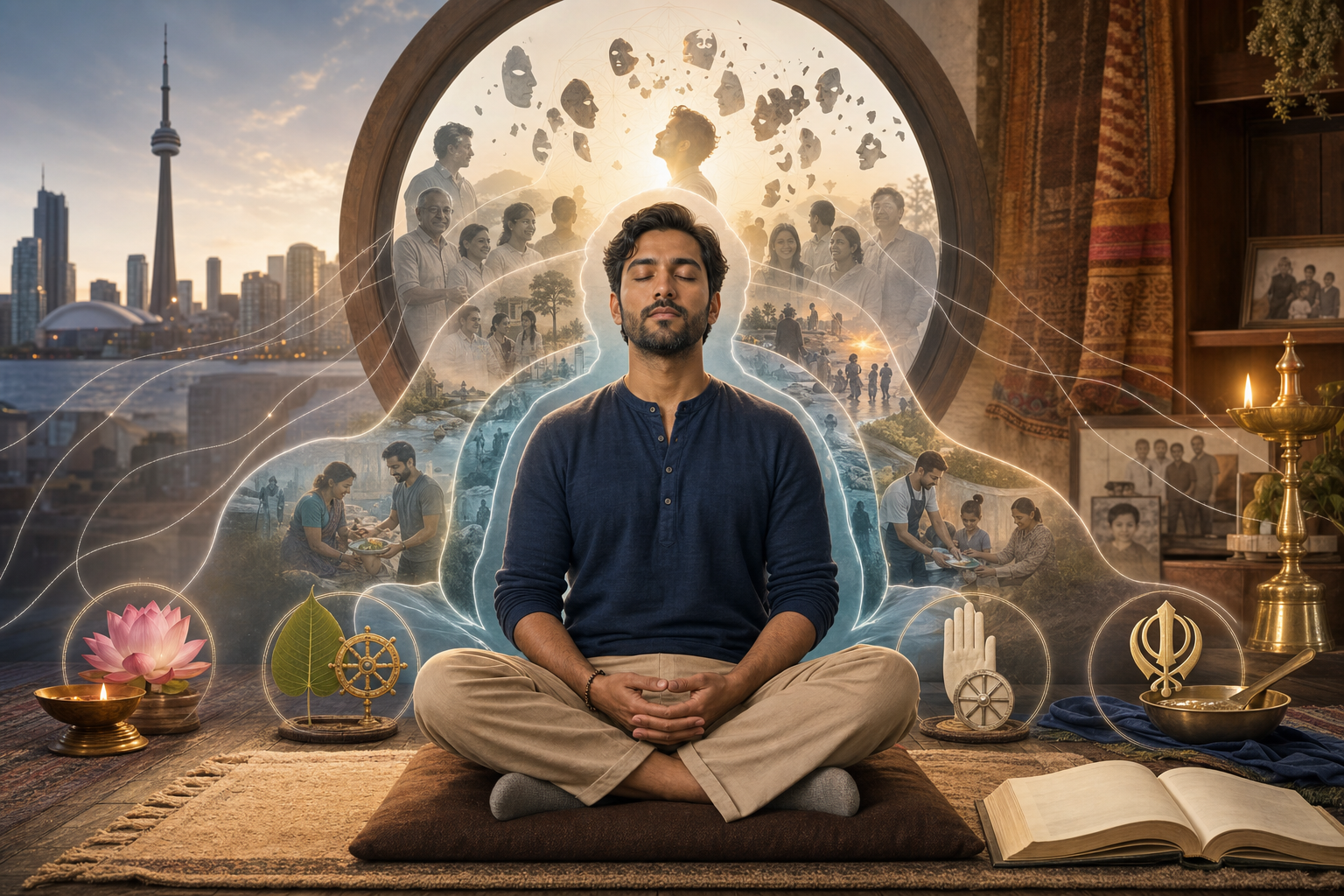
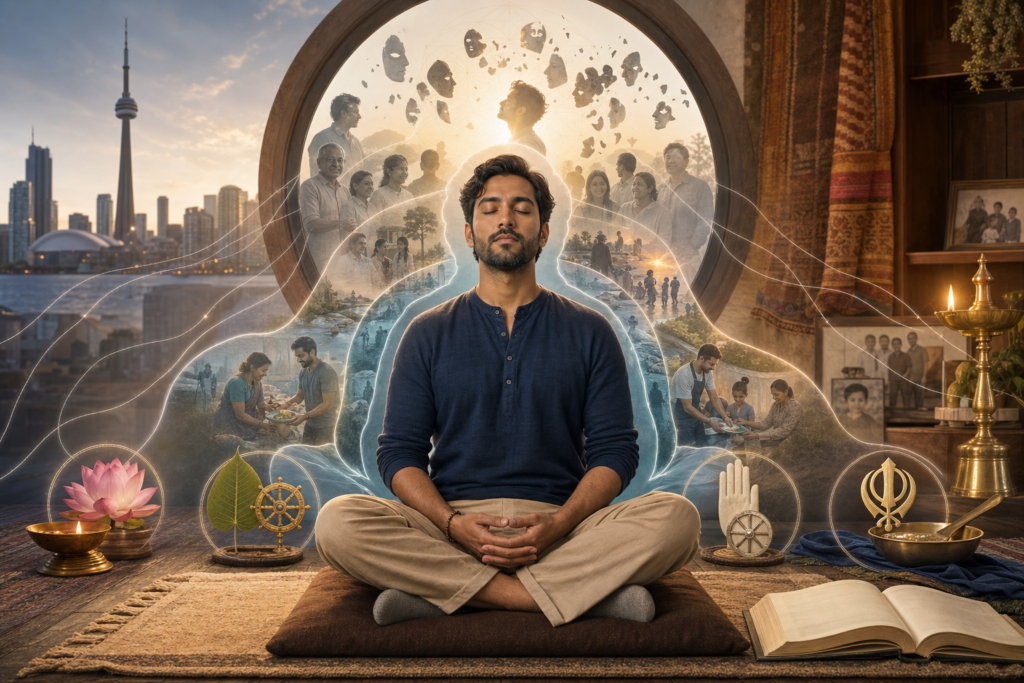
For many people in the modern diaspora, identity can feel especially fragmented. One language may be spoken at home and another at work. Family traditions may carry deep emotional meaning even when they are difficult to explain in a secular or multicultural setting. A person may be Indian, Canadian, Hindu, Buddhist, Jain, Sikh, multilingual, professionally ambitious, culturally hybrid, and spiritually uncertain at the same time. None of these descriptions is necessarily false, yet no single description appears complete.
The question therefore deserves more than a slogan. It should not be answered by dismissing the body, denying social responsibilities, or asserting a metaphysical conclusion before examining experience. A disciplined approach distinguishes several meanings of identity, studies the insights of different Dharmic traditions without erasing their differences, and tests spiritual understanding through its ethical consequences.
The many meanings hidden inside one question
“Who am I?” can refer to at least five different problems. It can ask about personal history: which events shaped this life? It can ask about social identity: which communities, relationships, and traditions provide belonging? It can ask about moral identity: which values and commitments should guide conduct? It can ask about phenomenology: what is the nature of the subject experiencing thoughts and sensations? Finally, it can ask a metaphysical question: is there an enduring self, soul, stream of consciousness, or other principle beneath changing experience?
These questions are related, but they are not interchangeable. A psychological account of autobiographical memory does not by itself prove or disprove an eternal self. A spiritual realization does not cancel citizenship, kinship, embodiment, or accountability. A religious label may identify a valued community without revealing the full nature of consciousness. Confusion begins when an answer from one level is treated as a complete answer at every level.
The pronoun “I” is also unusual. Words such as “tree” or “river” ordinarily point to observable objects, whereas “I” indicates the speaker from a first-person position. That grammatical function does not establish what the self ultimately is. It merely shows that experience is organized around a perspective. Philosophical inquiry begins when that perspective itself becomes the object of careful attention.
A practical model can distinguish the embodied self, the relational self, the narrative self, the moral self, and the contemplative self. The embodied self includes the living organism, sensations, needs, and capacities. The relational self develops through family and society. The narrative self organizes memory into a story. The moral self is expressed through commitments and choices. The contemplative self refers to whatever is discovered when attention turns toward the apparent knower of experience. Different philosophical traditions interpret that final dimension in different ways.
No layer should be rejected prematurely. The body requires care. Relationships generate real duties. Personal history can contain both inherited wisdom and unresolved pain. Social identities may protect vulnerable communities and preserve valuable traditions. Spiritual inquiry becomes distorted when it treats these realities as meaningless simply because they are impermanent or conditioned.
Identity in the diaspora: continuity without confinement
Diasporic identity is often formed through negotiation rather than simple inheritance. Children may receive rituals, foods, stories, sacred names, and family expectations from one cultural world while learning the norms of another through school, media, and work. This can produce code-switching, mixed belonging, and the feeling of being interpreted differently in different settings. Such adaptation is not automatically inauthentic; it is often a sophisticated response to multiple social environments.
Difficulty arises when adaptation becomes chronic self-erasure. A person may shorten a name to avoid embarrassment, conceal a religious practice to escape stereotyping, or perform an exaggerated version of tradition to prove loyalty. Both concealment and overperformance can make identity dependent on an audience. The central question then changes from “Who am I?” to “Which version of this person will be accepted here?”
A healthier approach treats identity as inherited, interpreted, and enacted. Heritage supplies languages, memories, symbols, and practices, but each generation must understand what those elements mean. Personal freedom does not require amnesia, and cultural continuity does not require freezing a tradition at one imagined point in history. Living traditions endure through intelligent transmission, principled adaptation, and honest debate.
Consider a professional who participates in a family puja, serves meals at a gurdwara, studies Buddhist meditation, or follows Jain dietary discipline while working in a pluralistic institution. That person need not reduce these experiences to a single public label. The more important task is to understand which commitments are devotional, ethical, familial, philosophical, or cultural—and whether they produce integrity across contexts.
Diaspora can therefore intensify self-inquiry, but it can also enrich it. Distance may encourage a more deliberate relationship with heritage. Encounters with other traditions can expose unexamined assumptions. Multilingual and multicultural lives can demonstrate that identity is capable of continuity without rigidity. The goal is neither a rootless cosmopolitanism nor a defensive essentialism, but a stable center capable of respectful participation in a diverse world.
Hindu approaches: the self beyond changing attributes
The Upanishads examine the self through dialogue, negation, introspection, and metaphysical analysis. Texts such as the Bṛhadāraṇyaka, Chāndogya, and Kaṭha Upanishads ask whether the deepest identity can be equated with the body, senses, mind, social status, or personality. Their discussions helped establish ātman as a central term in Hindu philosophy, although later schools disagree about the precise relationship between the individual self, the world, and Brahman.
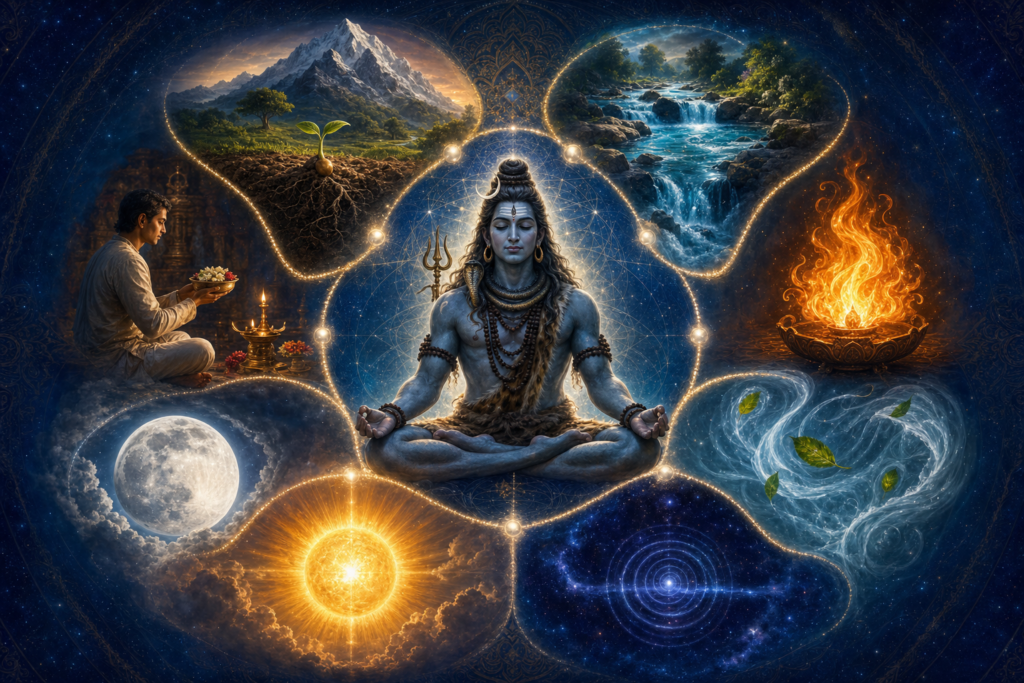
Advaita Vedānta maintains that the deepest self is not the changing body–mind complex but nondual awareness, ultimately identical with Brahman. Ignorance produces identification with limited attributes, while knowledge removes that error. The expression neti neti—“not this, not this”—supports a method of refusing to equate the self with any finite object of awareness. The method is not contempt for the world; it is an inquiry into whether anything observed can be the final observing subject.
Atma Vichara, especially associated in modern times with Ramana Maharshi, develops this inquiry through sustained attention to the sense of “I.” It is not merely the repetition of a verbal question or an exercise in constructing a better biography. When a thought arises, attention investigates to whom it appears and then turns toward the felt center of identification. Its intended movement is from conceptual description to direct examination of awareness.
Sāṅkhya and classical Yoga offer a related but distinct analysis. Sāṅkhya distinguishes puruṣa, the conscious principle, from prakṛti, the domain of material and mental processes. Classical Yoga seeks the stilling of mental fluctuations so that the seer can abide in its own nature. Unlike Advaita’s nondual conclusion, classical Sāṅkhya generally recognizes a plurality of conscious puruṣas. This difference illustrates why “Hindu philosophy” should not be presented as a single undifferentiated doctrine.
Viśiṣṭādvaita Vedānta regards the individual self as real, enduring, and wholly dependent on Brahman. Dvaita Vedānta emphasizes an enduring distinction between the individual soul and the Supreme. Bhakti traditions often understand identity relationally: the self discovers fulfillment through loving devotion, surrender, remembrance, and service to the Divine. In these traditions, liberation does not require treating relationship as an illusion; sacred relationship can be central to the self’s realization.
The Bhagavad Gita connects metaphysical insight with disciplined action. It distinguishes the embodied self from changing physical conditions while also insisting that spiritual understanding be expressed through dharma, self-mastery, devotion, wisdom, and action without possessive attachment to results. This prevents “Who am I?” from becoming a retreat into abstraction. The quality of self-knowledge is tested amid responsibility, conflict, work, and relationship.
These Hindu perspectives converge in challenging complete identification with transient roles and mental states, yet they do not offer one identical account of ultimate reality. An academically responsible inquiry preserves those differences. Unity becomes more durable when it is based on informed respect rather than forced sameness.
Buddhist approaches: examining the self as a conditioned process
Buddhist traditions approach the question through anatta or anātman, commonly translated as “not-self.” Early Buddhist analysis examines form, feeling, perception, mental formations, and consciousness—the five aggregates—and finds none fit to be regarded as a permanent, independent, fully controllable self. The analysis is therapeutic as well as philosophical: clinging to what changes produces dissatisfaction.
This teaching should not be reduced to the claim that a person does not exist in any meaningful sense. Buddhism continues to speak about action, intention, responsibility, compassion, and the continuity of causal processes. Dependent origination explains experience through conditions rather than an isolated essence. The person exists conventionally as an interdependent process, while inquiry finds no unchanging owner standing outside that process.
Mindfulness makes this analysis experiential. A sensation arises, changes, and passes. A thought appears without having been deliberately requested. An emotion influences the body and then transforms when its conditions change. Observing these events weakens the assumption that every mental occurrence is “me” or “mine.” Greater freedom becomes possible between the appearance of an impulse and the action that follows it.
The practical result is not indifference but reduced possessiveness. When identity is not defended as a fixed object, compassion can expand and criticism can become less threatening. At the same time, the doctrine of not-self must not be used to deny trauma, social injustice, or personal boundaries. Conventional persons can be harmed, and ethical responsibility remains essential even when personhood is analyzed as conditioned and impermanent.
Jain approaches: the living self and the removal of karmic obscuration
Jain philosophy offers another rigorous answer. It distinguishes jīva, the living conscious principle, from ajīva, the nonliving categories of reality. Each jīva is individual and possesses the inherent capacities of consciousness, knowledge, perception, and energy, although these capacities are obscured by karmic bondage. Liberation involves stopping new karmic influx and removing accumulated karmic matter through ethical and spiritual discipline.
The Jain inquiry into identity is inseparable from conduct. Right faith, right knowledge, and right conduct form the path of liberation. Ahimsa, truthfulness, non-stealing, chastity or responsible restraint, and non-possessiveness discipline the tendencies that bind the self. The question “Who am I?” therefore becomes concrete: does a person live as an impulsive consumer of experience, or as a conscious being capable of restraint, responsibility, and reverence for other forms of life?
Anekāntavāda, the Jain principle that reality has multiple aspects, contributes an important intellectual virtue. A finite statement may disclose one standpoint without exhausting the whole truth. This does not mean that every claim is equally valid. It means that judgment should recognize context, conditions, and the limits of a single perspective. Applied to identity, it allows personal, social, ethical, and spiritual descriptions to be partially true without making any one description absolute.
Sikh approaches: identity beyond haumai through remembrance and service
Sikh thought situates human identity within the oneness of the Divine and the presence of divine light in all. The problem is not ordinary individuality alone but haumai, the ego-centered orientation that treats the separate self as self-sufficient and turns desire, status, and possession into ultimate concerns. Life unfolds within hukam, the Divine order, and wisdom involves living in truthful alignment with it rather than attempting to make the ego sovereign.
Naam simran, prayer, kirtan, honest work, sharing, and seva reshape the sense of self through remembrance and participation. Identity is not discovered only in solitary introspection. It is also clarified while preparing food, serving a community, earning honestly, defending dignity, and recognizing the same sacred worth in others. Spirituality remains compatible with household life and social responsibility.
The Sikh tradition also demonstrates that spiritual universality need not erase visible commitment. The Khalsa identity gives disciplined public form to courage, equality, service, and remembrance. This is especially relevant in diaspora settings, where external markers may attract misunderstanding. A mature account of selfhood can honor a universal spiritual foundation while preserving concrete obligations to history, community, and justice.
Dharmic unity without philosophical erasure
Hinduism, Buddhism, Jainism, and Sikhism cannot be collapsed into a single doctrine of the self. Hindu schools debate the status and relation of ātman, jīva, Brahman, and Īśvara. Buddhism analyzes experience without affirming a permanent independent self. Jainism affirms a plurality of individual jīvas. Sikh teachings place the transformation of ego within devotion to the one Divine, remembrance, truthful living, and service.
Their differences are substantial, yet meaningful areas of ethical and contemplative kinship remain. All challenge unexamined egoism. All place discipline above mere belief. All connect insight with conduct. Compassion, non-harm, truthfulness, restraint, remembrance, service, and freedom from compulsive attachment receive distinctive but significant emphasis across these traditions. Their shared civilizational conversation is strengthened when differences are studied rather than concealed.
Unity among Dharmic traditions should therefore be dialogical. It does not demand that a Buddhist affirm ātman, that a Jain abandon the individuality of jīva, that a Sikh reduce Naam and hukam to impersonal psychology, or that diverse Hindu darśanas surrender their own metaphysical commitments. It asks each community to recognize the sincerity, depth, and ethical value of the others while cooperating in the preservation of dignity, knowledge, and freedom of practice.
What psychology and neuroscience can—and cannot—add
Contemporary psychology generally treats identity as a developing organization of memory, attachment, values, goals, social roles, and self-interpretation. The narrative self gives a sense of continuity by arranging selected memories into a coherent story. The social self responds to recognition and group membership. The embodied self integrates sensation, movement, and internal bodily signals. These systems can cooperate, but they can also conflict.
Memory is reconstructive rather than a perfect recording. Each act of recollection can be influenced by present beliefs, emotional states, and later information. This does not make biography unreal; it means that personal identity is continuously interpreted. A person can revise a harmful self-story without falsifying the past, provided the revision remains accountable to evidence and does not suppress inconvenient facts.
Neuroscience does not identify a single, isolated “self center.” Self-referential processing involves distributed networks supporting memory, bodily awareness, evaluation, attention, and social cognition. The default mode network is often associated with internally directed and self-referential thought, but it is not simply an ego switch. Brain findings describe correlations and mechanisms; they do not independently determine whether ātman, anatta, jīva, or divine presence is metaphysically true.
Contemplative practice can change attention, emotional regulation, and the felt boundaries of self, but such experiences require interpretation. A state of spacious awareness may be understood through Advaita, Buddhist, Jain, Sikh, psychological, or other frameworks. Similar descriptions of experience do not guarantee identical metaphysical conclusions. Intellectual humility is therefore as important as contemplative intensity.
Modern research and Dharmic philosophy are most useful when neither is forced to impersonate the other. Science can investigate measurable changes in behavior, attention, stress, and neural activity. Spiritual traditions can examine meaning, liberation, ultimate reality, and disciplined ways of life. Constructive dialogue respects the methods and limits of both domains.
A disciplined practice of self-inquiry
Self-inquiry is most reliable when it begins with stability. Adequate sleep, nourishment, physical safety, and supportive relationships are not obstacles to spirituality. They create conditions in which attention can examine experience without being overwhelmed. A distressed nervous system may interpret silence as danger, so the pace and method of practice should reflect the person’s actual condition.
The first exercise is descriptive rather than metaphysical. A person can write several completions of the sentence “I am…” and classify each answer as bodily, relational, professional, cultural, emotional, ethical, or spiritual. The exercise reveals which identities are chosen, inherited, imposed, or feared. It also shows which labels have been carrying more psychological weight than they can reasonably bear.
The second exercise examines change. The body has changed since childhood, beliefs have evolved, roles have appeared and disappeared, and emotions fluctuate throughout a day. Which forms of continuity remain? Memory, character, causal connection, bodily persistence, awareness, and community recognition may each provide part of the answer. The exercise should expose assumptions rather than rush toward a predetermined conclusion.
The third exercise observes experience directly. For a brief period, attention can rest on breathing and bodily sensation. When a thought appears, it can be identified simply as a thought; when an emotion appears, it can be noticed as a changing pattern of sensation, interpretation, and impulse. The essential discovery is practical: an event occurring in the mind need not issue a command.
The fourth exercise investigates the observer. If a sensation is known, what does “knowing” mean in that moment? Can the knower be found as an object, image, location, or thought? Does awareness seem stable, momentary, relational, or ungraspable? Advaita, Yoga, and Buddhist traditions interpret such investigation differently, so direct observation should be distinguished from the doctrine later used to explain it.
The fifth exercise clarifies values. A person can identify five principles that should remain operative across home, work, worship, and public life. Each principle should be translated into observable conduct. “Compassion,” for example, might require listening without humiliation, while “truth” might require correcting an advantageous falsehood. Identity becomes more coherent when professed values and repeated actions begin to match.
The sixth exercise moves from introspection to service. A person can undertake one regular act that benefits others without being used to build a superior self-image. Seva, generosity, environmental responsibility, community care, and patient attention reveal forms of egoism that solitary reflection may miss. Relationships function as a demanding laboratory of self-knowledge.
The seventh exercise returns to tradition through primary texts and qualified guidance. Useful textual anchors include the principal Upanishads and Bhagavad Gita for Hindu discussions, the early discourses on the aggregates and dependent origination for Buddhist analysis, the Tattvārtha Sūtra and Jain ethical teachings for the doctrine of jīva, and the Guru Granth Sahib for Sikh understandings of the Divine, haumai, Naam, and truthful living. Commentarial traditions should be consulted because translated terms can conceal major philosophical differences.
The eighth exercise is dialogue. A trusted teacher, elder, therapist, or informed friend can identify blind spots that private reflection protects. Dialogue is especially valuable when cultural expectations, family loyalty, and spiritual aspiration appear to conflict. The aim is not to surrender judgment to authority, but to prevent the isolated mind from treating every preference as revelation.
How genuine insight can be evaluated
A spiritual answer should be evaluated by its fruits. Does it increase clarity without producing arrogance? Does it strengthen compassion without destroying boundaries? Does it encourage courage, accountability, and truthful conduct? Does it reduce compulsive attachment while preserving the capacity to love? An experience that feels expansive but repeatedly excuses cruelty or deception has not produced mature self-knowledge.
Spiritual bypassing is a recurring danger. Statements such as “the world is unreal,” “there is no self,” or “everything happens by divine will” can be misused to avoid grief, deny abuse, excuse passivity, or silence legitimate disagreement. Each statement belongs to a complex philosophical context. Detached from discipline and ethics, it can become a defense mechanism rather than a liberating insight.
Ego inflation presents the opposite danger. A person may intellectually adopt the language of universal consciousness and then imagine being beyond criticism. Claims of realization do not cancel ordinary tests of honesty, consent, competence, and responsibility. The more elevated the claim, the more carefully its behavioral consequences should be examined.
Intense inquiry can also be destabilizing for someone experiencing trauma, severe anxiety, depersonalization, derealization, psychosis, or major depression. In such circumstances, grounding practices and qualified mental-health care may be more appropriate than prolonged attempts to dissolve the sense of self. Clinical support and spiritual practice can be complementary when their purposes are clearly understood.
A layered answer to “Who am I?”
At the conventional level, a person is an embodied human being with a history, name, family, language, culture, capabilities, wounds, duties, and relationships. These facts deserve neither worship nor denial. They provide the concrete field in which life is lived and moral responsibility becomes possible.
At the psychological level, the person is not a fixed story but a developing pattern of memory, interpretation, habit, attachment, and choice. Some inherited patterns can be retained with gratitude, some revised with care, and some relinquished when they perpetuate harm. Personal growth does not require rejecting ancestry; it requires relating to inheritance consciously.
At the ethical level, identity is revealed through repeated conduct. Values become real when they survive inconvenience. Compassion, ahimsa, truthfulness, courage, restraint, devotion, and seva are not decorative additions to self-knowledge; they are evidence of whether knowledge has entered life.
At the contemplative level, no single formulation can represent every Dharmic tradition. Advaita may direct inquiry toward nondual awareness. Yoga may distinguish the seer from mental activity. Bhakti may locate fulfillment in loving relation to the Divine. Buddhism may reveal the conditioned and selfless character of the aggregates. Jainism may uncover the jīva obscured by karmic bondage. Sikh practice may loosen haumai through Naam, hukam, truthful living, and service.
The most responsible provisional answer is therefore layered: a person is more than any passing thought or social label, yet embodied and social life remains morally significant. Identity is partly received, partly constructed, and continually enacted. Its ultimate nature remains a question for disciplined philosophical and contemplative investigation rather than casual certainty.
The question “Who am I?” does not have to produce an immediate final sentence. Its power lies in exposing false identifications, clarifying commitments, and opening a more deliberate way of living. When pursued with intellectual honesty, emotional maturity, ethical discipline, and respect for multiple Dharmic paths, self-inquiry becomes more than private introspection. It becomes a foundation for inner freedom, responsible action, and unity without uniformity.
Inspired by this post on Jainism Says.









Leave a Reply
You must be logged in to post a comment.