
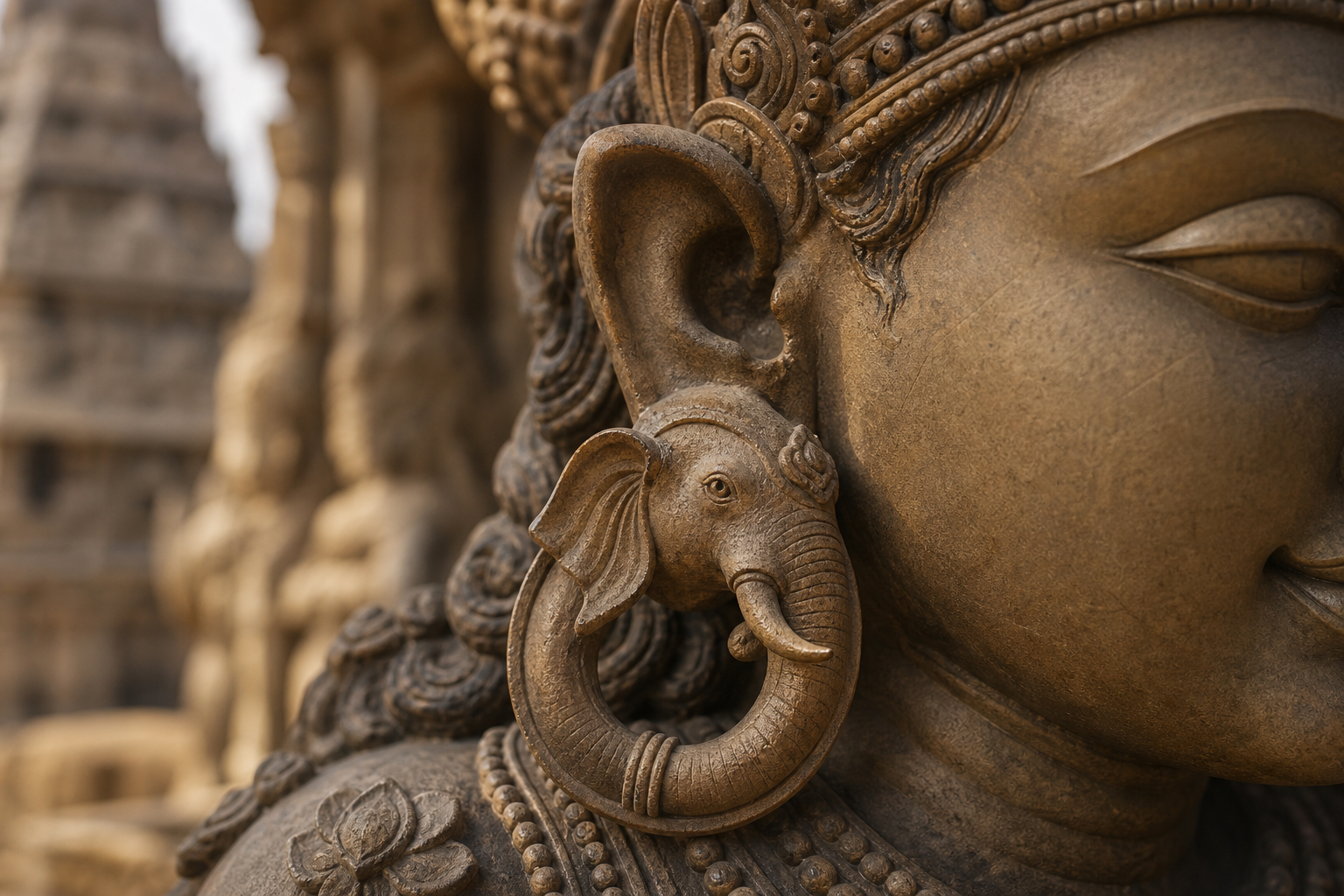
The gaja kundala, the elephant-form earring found in Hindu sacred sculpture, belongs to a highly refined world of iconographic detail where even the smallest ornament carries theological, aesthetic, and cultural meaning. At first glance, it may appear to be a decorative flourish placed near the ear of a deity, guardian, celestial being, or royal figure. A closer reading, however, shows that this ornament participates in a wider symbolic language shaped by Shilpa Shastra, temple architecture, devotional imagination, and the long continuity of Indian art.
The term itself is direct and revealing. Gaja means elephant, while kundala refers to an earring, ring, or circular ear ornament. In Hindu iconography, kundalas are not treated as casual accessories. They are part of the prescribed visual grammar through which sculptors communicate status, energy, temperament, divinity, cosmic function, and sacred beauty. The gaja kundala therefore stands at the intersection of ornament and meaning: it is a sculpted earring, but also a compact symbol of elephant-like strength, auspiciousness, abundance, and royal dignity.
Within the broader family of kundalas, the gaja kundala is especially notable because it is zoomorphic. Unlike a simple ring, floral pendant, or abstract circular form, it takes the likeness of a living being. This places it in the same artistic universe as makara kundalas, sarpa kundalas, patra kundalas, and other specialized forms that appear in Hindu art and temple sculpture. Such ornaments reveal how Indian sculptural traditions rarely separate beauty from symbolic intelligence. The ornament is beautiful because it is meaningful, and it is meaningful because it participates in a sacred visual order.
The elephant has always occupied a powerful place in Indian cultural and religious imagination. It evokes strength without crude aggression, majesty without restlessness, and memory without haste. In sacred art, the elephant is associated with royal authority, fertility, water, clouds, rain, prosperity, and protective force. These associations deepen the importance of the gaja kundala. When an elephant-form ornament is placed near the ear of a divine or semi-divine figure, it does more than adorn the body; it frames the head, the site of awareness, command, hearing, and spiritual presence.
The symbolism of the elephant is enriched by major Hindu narratives and images. Airavata, the celestial elephant associated with Indra, represents royal power and the life-giving connection between rain and cosmic order. Ganesha, whose elephant head is among the most beloved and recognizable forms in Hindu worship, embodies wisdom, auspicious beginnings, obstacle-removal, and disciplined intelligence. Gaja Lakshmi imagery presents elephants as agents of abundance and consecration, pouring water over the goddess in a gesture of prosperity and sacred sovereignty. Against this larger background, the gaja kundala becomes a small but resonant sign of a much larger symbolic field.
In temple sculpture, ornaments are often read as part of the body’s sacred architecture. The image of a deity is not merely a human-like figure enlarged in stone or metal. It is a carefully constructed presence governed by proportion, posture, gesture, weapon, vehicle, crown, garment, expression, and ornament. The ear ornament sits near the face, and therefore participates directly in the viewer’s encounter with the deity. It helps define the rhythm of the head, the balance of the shoulders, and the visual passage from crown to torso.
The ear itself has special importance in Indian religious culture. Hearing is central to sacred transmission. The Vedas are shruti, that which is heard. The guru-shishya tradition depends upon attentive listening. Mantra, discourse, instruction, music, and temple recitation all enter through the ear before they become reflection, practice, and realization. In this context, an ornament placed at the ear can be interpreted not only as decoration but also as a mark of receptivity to sacred sound. A gaja kundala, with its elephant symbolism, suggests the disciplined strength required for true listening.
Hindu sculptural canons often prescribe ornaments according to the nature of the figure being represented. A fierce form, a peaceful form, a royal form, a youthful form, an ascetic form, or a cosmic form may each require different visual treatment. These prescriptions vary by text, region, period, and workshop lineage, but the underlying principle remains stable: iconography is ordered. The artist is not simply inventing decoration. The sculptor is translating theological and cultural memory into visible form.
The gaja kundala should therefore be understood as part of the larger Indian discipline of rupa, the meaningful form. Sacred sculpture does not rely only on narrative scenes or obvious symbols. It also communicates through controlled detail. A crown may indicate sovereignty. A lotus may suggest purity and unfolding consciousness. A serpent may signal energy, danger, protection, or transcendence. A makara may evoke liminal aquatic force. An elephant-form earring adds its own register: auspicious power, grounded authority, fertility, endurance, and ceremonial grandeur.
Technically, the gaja kundala presents a sculptural challenge. The sculptor must compress the recognizable features of an elephant into the limited area of an earring while preserving clarity from a viewing distance. The trunk, head, ear, and sometimes tusk-like curves may be stylized rather than naturalistic. In stone sculpture, this requires skillful control of relief, depth, shadow, and contour. In bronze or metal images, the challenge shifts toward casting, surface refinement, and the preservation of delicate forms that can survive ritual handling and visual scrutiny.
This compression of form is one of the great achievements of Hindu sacred art. The sculptor does not need to reproduce an elephant in full anatomical detail. A few decisive lines can evoke the animal. A curled trunk, rounded head, broad ear, or pendant curve can communicate the idea. This stylization is not a limitation; it is a sophisticated visual language. The ornament remains legible as an earring while also carrying the presence of the elephant.
Regional traditions likely shaped how gaja kundalas were rendered. South Indian temple sculpture, with its elaborate treatment of jewelry, crowns, girdles, necklaces, and anklets, provides a rich context for such ornaments. Medieval bronze traditions, especially in Shaiva and Vaishnava devotional settings, demonstrate extraordinary attention to the symbolic body of the deity. North Indian sculptural idioms, too, developed their own approaches to ornament, often balancing delicacy with architectural clarity. Across regions, the shared idea remains that divine ornamentation is never merely cosmetic.
The gaja kundala also participates in the visual language of kingship. Elephants were historically associated with royal processions, military strength, temple ceremonies, and the visible authority of rulers. A ruler’s elephant was not simply an animal of transport; it was a moving emblem of state power. In sacred sculpture, elephant imagery can therefore connect divine sovereignty with earthly kingship. The deity appears as the source of authority, while the ornament quietly echoes the symbols through which royal power was recognized in society.
At the same time, the elephant is not only royal. It is also deeply connected to the natural world. Its association with forests, monsoon clouds, water, and fertility gives it ecological and emotional depth. The elephant is strong, but also sensitive; massive, yet socially intelligent. This layered cultural perception allows the gaja kundala to carry a tone of abundance and protection rather than domination alone. In sacred art, power is most meaningful when it is ordered by dharma.
The presence of gaja kundala in Hindu iconography can also be read in relation to the larger Indian habit of integrating animals into sacred symbolism. The vehicles of Hindu gods and goddesses, the animals in Puranic narratives, the guardian creatures of temple architecture, and the composite beings of sculptural imagination all reveal a worldview in which animal forms are not dismissed as inferior. They are carriers of qualities, energies, and teachings. This approach resonates across dharmic traditions, where living beings often become mirrors for ethical reflection, spiritual insight, and cosmic order.
The gaja kundala therefore offers a subtle point of unity within the dharmic imagination. Hinduism, Buddhism, Jainism, and Sikhism differ in theology, practice, scripture, and institutional history, yet all preserve a deep respect for disciplined perception, ethical refinement, and symbolic teaching. The ornamented sacred body in Hindu sculpture is one expression of this civilizational attention to meaning. It invites the viewer to see carefully, to listen inwardly, and to recognize that spiritual culture often survives through details that appear small only to the inattentive eye.
In the experience of temple viewing, such details often become powerful after repeated encounters. A devotee or student may first notice the face, the gesture, the weapon, or the main iconographic identity of the deity. Only later does the eye rest on the earrings, the necklace, the waistband, the anklet, the attendant figures, or the carved patterns around the shrine. This slow discovery is one of the pleasures of Indian temple art. The sculpture does not reveal itself all at once. It educates attention.
That educational quality is central to understanding the gaja kundala. It teaches that sacred art rewards patience. The viewer who pauses before a sculpture begins to perceive a grammar of meaning. Ornament becomes text. Texture becomes commentary. Proportion becomes theology. The elephant earring, modest in scale, becomes a reminder that divine form is built through many interdependent signs, each contributing to the total presence of the image.
From an art historical perspective, the gaja kundala also helps correct a common misunderstanding about ornament in Indian sculpture. Modern viewers trained by minimalist aesthetics sometimes treat ornament as excess. Indian sacred sculpture asks for a different lens. Ornament is often structure, not clutter. It establishes hierarchy, identifies type, animates the body, and connects the image to ritual, mythology, and social memory. The highly ornamented deity is not hidden beneath decoration; the deity is revealed through meaningful adornment.
This is especially important in the study of Hindu Sculptures, where the boundary between aesthetics and theology is porous. The sculpted body is a site of darshan, a form through which the devotee sees and is seen. The ornamented ear, crowned head, serene face, poised hand, and balanced posture all contribute to that encounter. A gaja kundala may be small, but it is located in a visually sensitive zone near the face. Its presence can subtly alter the emotional tone of the image, making it appear more majestic, auspicious, or ceremonially complete.
The gaja kundala also encourages a more responsible method of studying iconography. Instead of isolating one symbol and forcing a single meaning onto it, the better approach is contextual. The identity of the figure, the region, the period, the material, the placement within the temple, the associated mythology, and the complete set of ornaments should all be considered. An elephant-form earring on one figure may emphasize royal authority, while on another it may contribute more strongly to auspiciousness, fertility, or ceremonial grandeur.
Such caution matters because Hindu iconography developed over centuries through textual prescription, workshop practice, regional taste, patronage, and devotional use. No single explanation can exhaust the meaning of a form. The gaja kundala is best understood as a flexible but recognizable symbol within a larger canon. Its elephant shape gives it a stable symbolic center, while its specific meaning becomes richer when read alongside the entire sculptural composition.
The study of gaja kundala also opens a window into the relationship between craft and sacred knowledge. The sculptor had to know more than anatomy and technique. He had to understand proportion, iconographic convention, ritual expectation, and inherited visual vocabulary. The finished ornament reflects this layered knowledge. It is the outcome of trained hands, disciplined eyes, and a cultural world in which craft was a vehicle of devotion and intellectual precision.
For contemporary readers, the gaja kundala offers a meaningful lesson in how to look at heritage. Temples and sacred sculptures are not only monuments of the past. They are archives of thought, devotion, artistry, and social memory. Each carved ornament preserves a fragment of how earlier generations understood beauty, dharma, divinity, and the relationship between human culture and the living world. To notice an elephant earring is to enter that archive through a small but luminous doorway.
In a broader cultural sense, the gaja kundala reminds modern society that symbolic literacy is part of heritage preservation. Protecting temples and sculptures is not only a matter of conserving stone, bronze, or architecture. It also requires preserving the ability to read their meanings. Without that literacy, sacred art becomes mute decoration. With it, even a minor ornament can speak about kingship, nature, auspiciousness, spiritual hearing, divine presence, and the continuity of Hindu art and culture.
The elephant-form earring is therefore more than a decorative motif. It is a disciplined sculptural sign shaped by the Hindu sacred imagination. It condenses the grandeur of the elephant, the refinement of jewelry, the authority of iconographic tradition, and the devotional purpose of temple art into a single form. In the gaja kundala, the smallest detail becomes a serious subject, and the ornament near the ear becomes a reminder that sacred sculpture asks to be both seen and heard.
Inspired by this post on Hindu Blog.
