
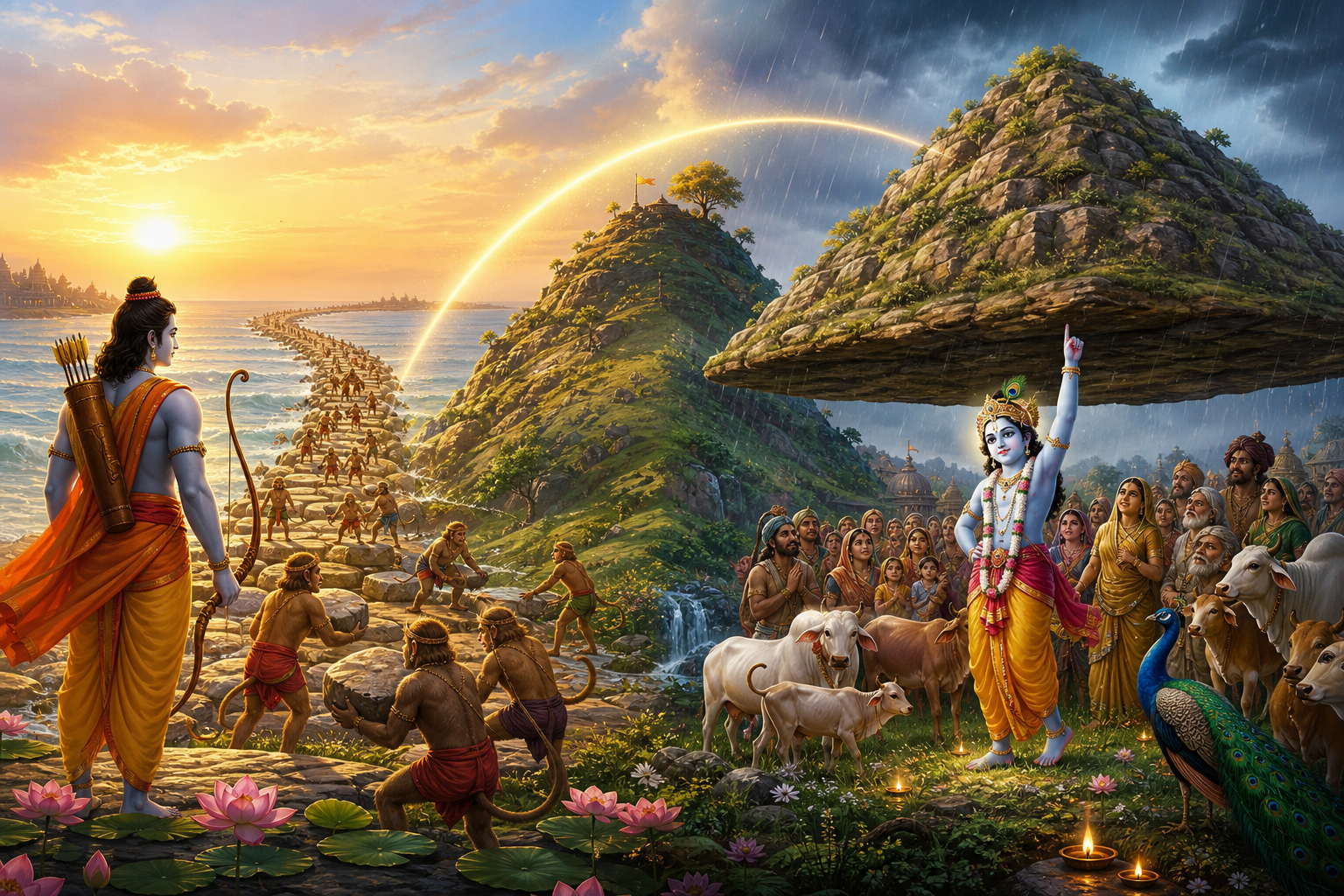
Across the sacred geography of India, hills are rarely treated as mere geological formations. In the dharmic imagination, a mountain can be a witness, a teacher, a devotee, a place of refuge, and a living symbol of divine presence. Govardhan, the celebrated hill of Braj, belongs to this category of sacred landscape. Its story is not limited to the Krishna tradition alone; devotional literature and oral memory also connect it with the earlier Ramayana cycle, creating a profound bridge between Sri Rama of Treta Yuga and Sri Krishna of Dvapara Yuga.
The narrative begins with a theme deeply embedded in Sanatana Dharma: divine promises are never lost, even when they appear delayed across time. The story of Govardhan, the Vanaras, and the vow fulfilled by Krishna expresses this principle through a memorable sacred episode. It teaches that bhakti may wait across lifetimes, that service offered with sincerity is never ignored, and that the same Supreme Reality who appears as Rama also appears as Krishna to complete unfinished bonds of grace.
In the Ramayana, the construction of the bridge to Lanka is one of the most technically and spiritually striking episodes. Sri Rama, seeking to rescue Sita and restore dharma, is assisted by the Vanara forces led by Sugriva, Hanuman, Nala, Nila, Angada, and others. The building of Rama Setu is not merely an engineering act in sacred narrative; it is a collective yajna of devotion, discipline, courage, and coordinated action. Stones, trees, rocks, and mountains become instruments in the service of dharma.
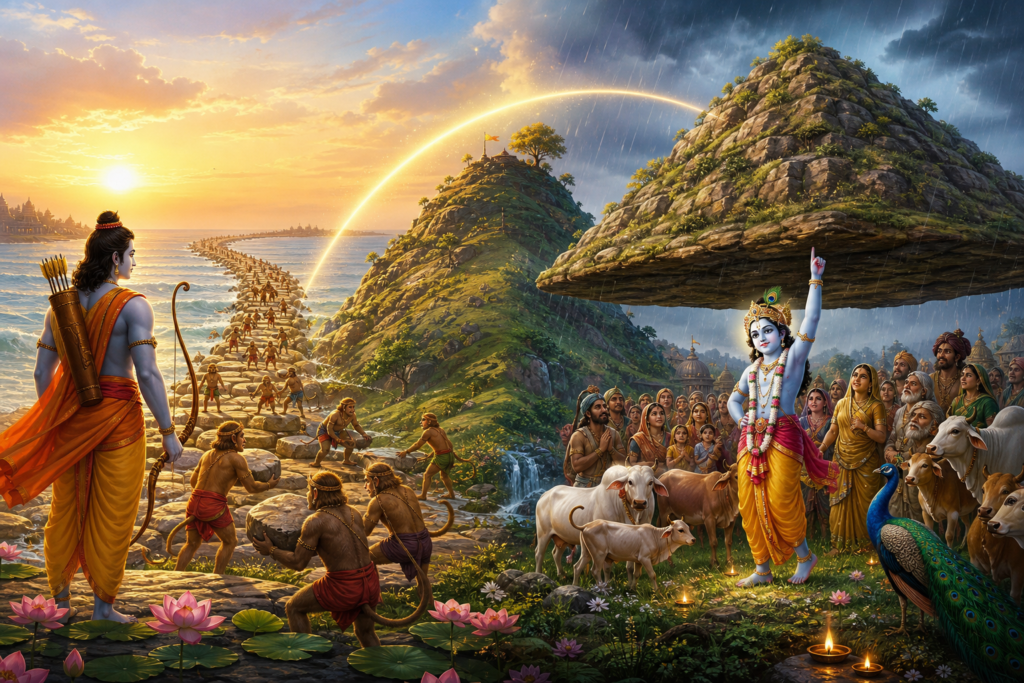
Traditional retellings describe the Vanaras as moving across forests and mountains, gathering massive rocks for the bridge. In this devotional frame, Govardhan is remembered as one such mountain prepared for service. The hill, eager to assist Rama, was carried toward the southern coast. Yet before it could be placed in the bridge, the command came that Rama Setu was complete. The Vanara carrying Govardhan had to set it down, leaving the hill unable to participate in the immediate service for which it had yearned.
The emotional power of this episode lies in Govardhan’s longing. Sacred literature often personifies rivers, mountains, trees, and animals, not as poetic excess but as a way of conveying the dharmic recognition that consciousness and sacred purpose permeate creation. Govardhan’s sorrow represents the sorrow of every devotee who arrives ready to serve but finds the moment apparently closed. The story responds to that anxiety with a luminous assurance: no sincere readiness for service is wasted.
According to the devotional tradition, Sri Rama consoled Govardhan with a promise. In a future avatara, when he would appear as Krishna in Dvapara Yuga, the hill would receive intimate service and direct worship. This vow is the theological heart of the narrative. Rama does not merely acknowledge Govardhan’s disappointment; he transforms it into destiny. The unfulfilled desire of Treta Yuga becomes the celebrated glory of Dvapara Yuga.
This connection between Rama and Krishna is not an incidental embellishment. It reflects a major Vaishnava understanding of avatara: divine forms may differ in mood, role, and historical setting, but they are not disconnected. Rama embodies maryada, royal discipline, ethical restraint, and the ideal of duty. Krishna embodies lila, intimate sweetness, pastoral tenderness, and philosophical revelation. Govardhan becomes a sacred meeting point where these two modes of divine action are brought into continuity.
In the Krishna narrative, Govardhan reaches the center of devotional memory through the famous Govardhan-lila described in the Bhagavata Purana and elaborated in later Vaishnava traditions. Krishna observes that the people of Vraja are preparing worship for Indra, the deity associated with rain. He redirects their attention toward Govardhan, the cows, the land, the forests, the pastures, and the natural order that sustains their daily life. This is not presented as rejection of cosmic order but as a profound teaching on gratitude, ecology, and direct recognition of divine support in the immediate world.
The Govardhan episode also carries a subtle critique of pride. Indra, angered by the interruption of his worship, sends destructive rains upon Vraja. Krishna then lifts Govardhan on the little finger of his left hand and shelters the entire community of cowherds, cows, elders, children, and families beneath it for seven days. The image is one of the most beloved in Hindu devotional art: the divine child standing effortlessly, the mountain raised like an umbrella, and the whole community protected through grace.
When read alongside the earlier Ramayana-linked vow, the lifting of Govardhan becomes more than an act of protection. It becomes fulfillment. In Treta Yuga, Govardhan desired to serve Rama by becoming part of the bridge to Lanka. In Dvapara Yuga, Krishna made Govardhan the very shelter of Vraja. The hill that could not be placed under Rama’s feet as part of the bridge was raised by Krishna’s own hand and honored as a divine protector. The promise was fulfilled not minimally but magnificently.
This transformation is theologically significant. Rama Setu represents the crossing from separation to reunion, from exile to restoration, and from adharma to dharma. Govardhan-lila represents the movement from fear to shelter, from ritual pride to humble devotion, and from dependence on distant power to intimate trust in Bhagavan. In both episodes, nature participates in the divine mission. Rocks become a bridge in the Ramayana; a hill becomes a canopy in the Krishna tradition. The material world is not rejected but sanctified through service.
Govardhan’s identity is therefore layered. It is a physical hill in the Braj region, a focus of pilgrimage, a symbol of Krishna’s protection, and a devotional personality remembered as Giriraj. The term Giriraj, meaning king of mountains, expresses reverence rather than mere geography. Pilgrims perform Govardhan Parikrama not simply to walk around a landmark but to enter a sacred rhythm of remembrance, humility, and embodied devotion. The feet move, the mind recalls lila, and the landscape becomes scripture in visible form.
The practice of Govardhan Puja, celebrated after Deepavali in many Hindu communities, preserves this memory in ritual form. Offerings of food, especially Annakuta, are arranged in abundance to honor Krishna, Govardhan, cows, and the sustaining generosity of the earth. The ritual brings together theology and household life. Grain, milk, vegetables, sweets, and cooked dishes become signs of gratitude. In this sense, Govardhan Puja is not only a festival of devotion but also a cultural reminder that spiritual life is inseparable from ecological responsibility and community nourishment.
The Vanaras in this narrative also deserve careful attention. In the Ramayana, they are not passive helpers but dynamic participants in the restoration of dharma. Hanuman’s devotion, Nala and Nila’s skill, Angada’s courage, and Sugriva’s alliance with Rama all show different forms of service. The Govardhan tradition extends that world of service into sacred geography. A mountain carried by a Vanara becomes a bearer of longing; a delayed act of service becomes the seed of a future revelation.
This is where the story acquires enduring psychological depth. Many people experience devotion as a mixture of effort, waiting, incompletion, and trust. A person may prepare sincerely and still feel unused, unseen, or delayed. Govardhan’s story answers this condition without sentimentality. It suggests that divine timing may not match human expectation, but sincere intent remains spiritually potent. Service may change form, but its essence is preserved.
The connection between Rama and Krishna also strengthens unity within Hindu traditions. Devotees may feel especially drawn to Rama, Krishna, Shiva, Devi, Ganesha, Skanda, Vishnu, or other forms of the Divine, yet dharmic traditions have long allowed such devotion to flourish without forcing a narrow uniformity. The Govardhan story shows continuity rather than competition. Rama’s promise and Krishna’s fulfillment belong to one sacred arc, affirming that diverse forms of worship can coexist within a larger spiritual harmony.
This inclusive insight matters beyond Vaishnava practice. The broader dharmic family, including Hinduism, Buddhism, Jainism, and Sikhism, has historically valued disciplined practice, ethical responsibility, remembrance, compassion, and liberation from ego. The Govardhan narrative speaks in a Hindu theological idiom, but its moral vocabulary is widely intelligible: humility over pride, service over self-importance, gratitude over entitlement, and protection of community over domination. Such themes support unity among dharmic traditions without erasing their distinct identities.
From an academic perspective, the story also illustrates how sacred narratives expand across time through Puranic literature, regional storytelling, pilgrimage traditions, temple practices, and oral transmission. The Ramayana and Krishna traditions are not sealed compartments. They are living narrative worlds that converse with one another. A hill associated with Krishna can be remembered through Rama; a Ramayana vow can be completed in a Bhagavata setting. This intertextual quality is one reason Hindu sacred literature has remained culturally resilient across centuries.
The geographical movement in the story is equally meaningful. The Ramayana carries attention toward the south, where Rama Setu connects the Indian mainland with Lanka in the sacred imagination. The Krishna tradition draws attention to Braj, especially Mathura, Vrindavan, Gokul, and Govardhan. By linking these worlds, the narrative produces a pan-Indian sacred map. North and south, forest and pasture, bridge and hill, Rama and Krishna are bound together through the common grammar of dharma.
Theologically, Govardhan-lila also reverses ordinary expectations of power. A mountain is usually a symbol of weight, immovability, and grandeur. Krishna, appearing as a young cowherd, lifts it effortlessly. The act does not diminish the mountain; it glorifies it. Govardhan becomes powerful not by standing above others but by becoming shelter for others. This is a distinctively dharmic model of greatness: the highest form of strength is protective, nourishing, and free from arrogance.
Indra’s role in the episode should be read with nuance. The narrative does not deny the importance of rain, cosmic order, or divine functions. Instead, it critiques pride when authority forgets its source. Krishna’s teaching to the Vrajavasis redirects devotion toward a more immediate understanding of dependence: the hill that gives grass, the cows that give milk, the soil that gives crops, and the community that lives by mutual care. The correction of Indra is therefore a correction of ego, not a rejection of cosmic interdependence.
In devotional practice, this is why Govardhan is often honored as both devotee and divine manifestation. The hill serves Krishna, shelters Krishna’s devotees, receives worship from Krishna, and becomes inseparable from Krishna’s own lila. Such layered identity is common in bhakti traditions, where the boundaries between servant, sacred object, and divine presence become spiritually rich rather than logically flat. Govardhan is loved because it serves, and it is worshipped because Krishna himself honored it.
The story also helps explain why pilgrimage in Sanatana Dharma is not merely travel. A tirtha is a crossing point: between memory and place, between human effort and divine grace, between the visible and the invisible. Govardhan Parikrama transforms the body into an instrument of remembrance. Each step becomes an act of humility, and the landscape itself becomes a teacher. For many devotees, the journey around Govardhan carries the quiet emotional force of returning to a promise that was kept across yugas.
The connection between Rama and Krishna through Govardhan also encourages a mature reading of Hindu sacred time. Yugas are not merely chronological units; they are moral and spiritual frameworks. Treta Yuga and Dvapara Yuga have different textures, but dharma flows through both. A vow made in one age can bear fruit in another. This gives sacred history a continuity that is not dependent on modern linear expectations. Divine memory, in this tradition, is perfect.
At the ethical level, the Govardhan narrative teaches that service is not measured only by immediate visibility. The hill that did not enter Rama Setu became central to Krishna’s protection of Vraja. A postponed offering became a greater honor. This principle has practical value in family life, community work, scholarship, temple service, and spiritual practice. Effort performed with sincerity may not always receive instant recognition, but dharma does not treat it as meaningless.
At the cultural level, the story preserves the dignity of land. Govardhan is not exploited as a resource; it is revered as a sustaining presence. In a time when ecological concerns have become urgent, this older sacred imagination offers a disciplined way to think about nature. Reverence does not replace environmental responsibility; it deepens it. A community that sees a hill as sacred is more likely to understand that land, water, cattle, forests, and food systems require gratitude and restraint.
At the philosophical level, the story reveals a tension between ritual formalism and living devotion. Krishna does not abolish worship; he reorients it. He asks the community to recognize the divine in the sources of their actual nourishment. This is not anti-ritual but spiritually corrective. Ritual becomes meaningful when it expresses truth, gratitude, humility, and alignment with dharma. Without those qualities, even elaborate worship can become a vehicle for pride.
At the devotional level, the sweetness of the story rests in Krishna’s intimacy. Rama promises; Krishna fulfills. Rama consoles; Krishna lifts. Rama recognizes Govardhan’s desire to serve; Krishna allows Govardhan to shelter all of Vraja. The two avataras reveal different moods of compassion, yet the compassion is one. This continuity gives the story its emotional strength and its enduring theological elegance.
For readers approaching the narrative today, Govardhan’s journey across two yugas offers a way to understand patience without passivity. The hill does not abandon its longing. The tradition does not portray delay as denial. Instead, it presents waiting as a field in which devotion matures. The divine promise may unfold in a form more expansive than the devotee first imagined.
The story therefore deserves to be read as more than a charming legend. It is a compact theological meditation on avatara, sacred geography, ecological gratitude, intertextual memory, bhakti, and dharmic unity. It links the Ramayana and Bhagavata Purana traditions through one powerful symbol: a mountain whose desire to serve was remembered by the Divine across ages.
Govardhan stands as a reminder that in Sanatana Dharma, nothing offered with devotion disappears. The bridge of Rama and the hill of Krishna belong to one sacred continuum. The Vanaras’ service, Rama’s vow, Krishna’s protection, and Vraja’s shelter all converge in a single teaching: dharma remembers, bhakti endures, and divine grace fulfills every sincere offering in its proper time.
Inspired by this post on Hindu Blog.







Leave a Reply
You must be logged in to post a comment.