
For anyone serious about spiritual progress, gambling is not merely a harmless diversion. It is a subtle assault on truthfulness, self-control, time, trust, and the deeper purpose of human life.
A crowded convenience store can sometimes reveal more about the human condition than a formal lecture. In one ordinary scene, holiday shoppers stand in a long line, buying last-minute items for dinner. A person waiting quietly in that line, softly chanting the Hare Krsna mantra, notices an elderly woman at the counter. The woman is poorly dressed, tense, and absorbed in scratching an Instant Win Bingo lottery ticket with desperate intensity.
She loses. The ticket is crumpled and pushed into her coat pocket. Another five-dollar bill appears from the other pocket, and another ticket is purchased. Again she scratches. Again she loses. The pattern continues until the money is gone. Then she walks away into the fog, visibly defeated. The scene is brief, but its moral weight is heavy. It raises uncomfortable questions that responsible societies and spiritual traditions cannot ignore: was that money needed for food, rent, medicine, or some other necessity? Was the purchase an exercise of leisure, or the symptom of bondage?
This kind of moment makes the subject of gambling more than a moral abstraction. Gambling is often marketed as entertainment, excitement, fantasy, or the democratic possibility of sudden wealth. Yet from the standpoint of dharma, psychology, family life, and social ethics, it also exposes a vulnerable point in the human mind: the desire to gain much without proportionate effort, discipline, or service. That desire can slowly weaken character, distort judgment, and replace truth with concealment.
In the Vaishnava tradition, as taught by Srila Prabhupada, one who seeks initiation and disciplined spiritual life is expected to avoid four major obstacles: intoxication, meat-eating, illicit sexual activity, and gambling. These are not treated as arbitrary prohibitions. They are understood as practices that cloud consciousness and strengthen addictive patterns. Each one attacks a foundational virtue, and gambling is especially connected with the erosion of truthfulness.
The Bull of Dharma and the Four Foundations of Religion
The Srimad-Bhagavatam presents a profound symbolic image: a bull representing religion, or dharma. The bull stands on four legs, traditionally understood as mercy, truthfulness, cleanliness, and austerity. These four principles are not sectarian markers; they are civilizational virtues found across dharmic traditions, including Hinduism, Buddhism, Jainism, and Sikhism. Without compassion, truth, purity of conduct, and restraint, spiritual life becomes sentimental, unstable, or merely performative.
In this framework, meat-eating weakens mercy by dulling sensitivity toward suffering. Illicit sexual conduct weakens cleanliness by confusing sacred responsibility with exploitation or impulsive pleasure. Intoxication weakens austerity by impairing restraint and the capacity to choose long-term welfare over immediate gratification. Gambling weakens truthfulness because it thrives on illusion, concealment, exaggeration, and the hope that reality can be bypassed through chance.
The Bhagavatam describes Kali-yuga, the present age, as a period in which dharma is greatly weakened. In traditional symbolism, the bull of religion stands precariously on one remaining leg: truthfulness. Even that leg is under constant pressure. Public life becomes filled with propaganda, private life with deception, business life with manipulation, and inner life with self-deception. Gambling is not the only cause of this decline, but it is one visible expression of a deeper civilizational disorder.
How Gambling Damages Truthfulness
The connection between gambling and falsehood becomes clear when observed in family life. A compulsive gambler rarely destroys trust in a single dramatic act. The harm usually unfolds through repeated concealment. Money disappears, time goes unexplained, promises become vague, and stories multiply. What begins as one secret trip to a casino can become a network of invented emergencies, false explanations, and emotional manipulation.
Consider the case of a man in his late thirties who had recently married and wanted his marriage to succeed. Each time he received his paycheck, he secretly went to the casinos in Atlantic City. When his wife asked where he had been, he created elaborate explanations. When money vanished, new stories appeared: a relative needed medical help, another needed rent, another faced some imagined crisis. The gambling itself was destructive, but the lies required to protect it became equally corrosive.
Eventually, the truth emerged. He was a compulsive gambler, trapped by the hope that coins could become dollars through a repeated mechanical gesture and a surge of chance. His confession came with tears, fear, and the recognition that addiction had placed his marriage in danger. This pattern is familiar in many forms of dependency: the addictive act demands secrecy, secrecy demands falsehood, and falsehood destroys the trust on which intimate life depends.
Modern psychology recognizes gambling disorder as a serious behavioral addiction. Unlike casual recreation, compulsive gambling can involve tolerance, withdrawal-like restlessness, chasing losses, lying to conceal involvement, risking relationships, and relying on others for financial rescue. The dharmic critique of gambling therefore aligns with a practical understanding of human behavior: when desire becomes compulsive, truth is often the first casualty.
An Ancient Vice in the Vedic Record
Gambling is not a modern invention. Vedic and epic literature preserve striking accounts of its moral danger. These narratives are not merely historical or mythological episodes; they function as ethical case studies. They show how even powerful, educated, and socially responsible persons can be compromised when greed, pride, or obligation intersects with wagering.
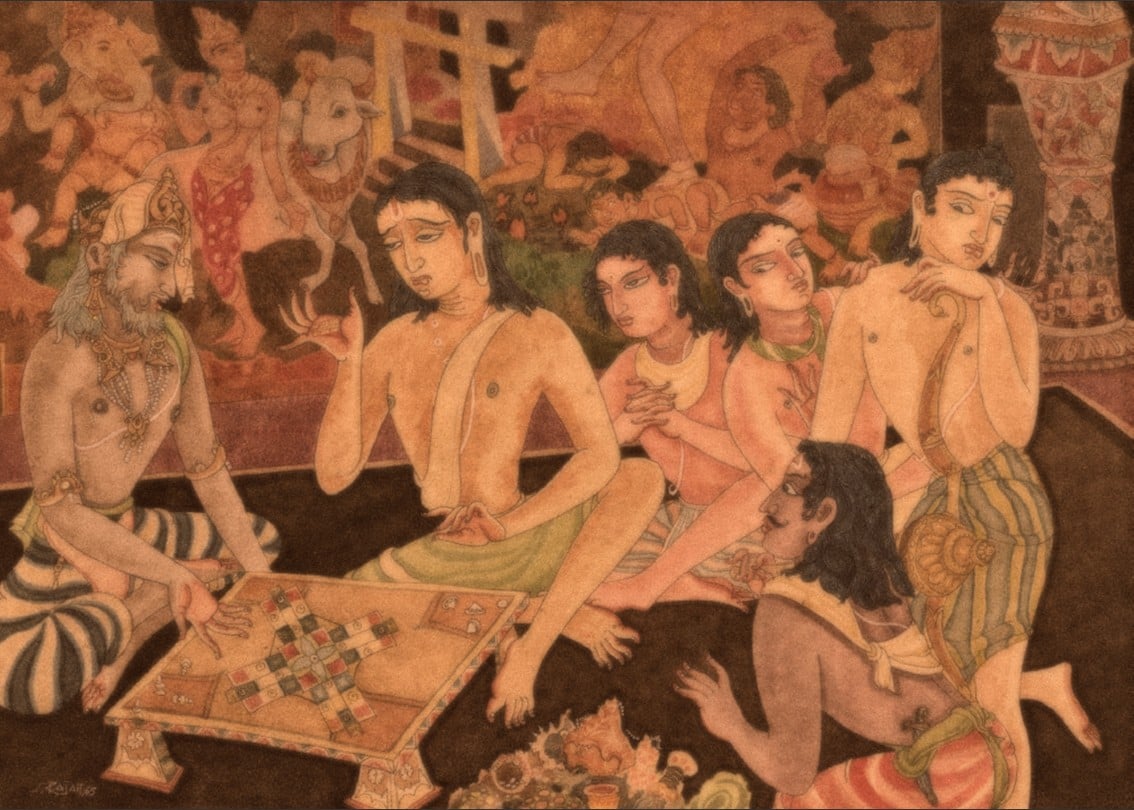
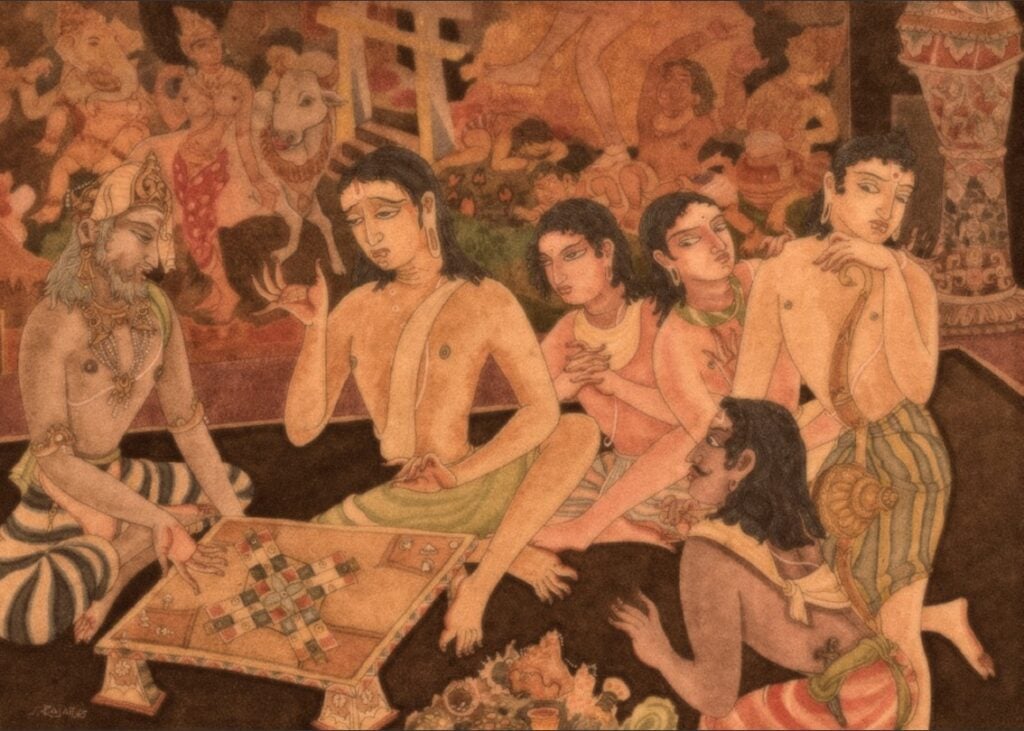
One account concerns Lord Balarama and Prince Rukmi, the brother-in-law of Krsna. Rukmi belonged to the royal order and was expected to embody noble qualities, including honor and truthfulness. During a game played for increasingly large wagers of gold, Balarama initially lost but later won a significant stake. Unable to tolerate defeat, Rukmi falsely claimed victory. Even when a celestial voice confirmed Balarama as the winner, Rukmi refused to accept the truth.
The ethical lesson is direct. Rukmi’s failure was not merely that he played for stakes. His deeper failure was that attachment to winning overpowered his commitment to truth. Gambling revealed and intensified a weakness already present in the mind: the desire to preserve prestige and wealth even at the cost of integrity. In dharmic analysis, vice often works in this manner. It does not simply create impurity from nothing; it draws out latent tendencies and gives them social permission.
The Mahabharata offers an even more consequential example in the gambling match between Yudhisthira Maharaja and Sakuni. Yudhisthira, a king known for virtue, accepted the challenge because royal duty required him to respond to another member of the ruling order. Yet the match was engineered by Duryodhana and executed through Sakuni’s deceit. Through gambling, a righteous king was placed in a situation where kingdom, wealth, family dignity, and political order were imperiled.
This episode did not remain a private moral failure. It became a catalyst for the Kurukshetra War, one of the central conflicts of the epic. The narrative shows that gambling can move from personal weakness to public disaster when power, envy, humiliation, and deceit are combined. A game becomes a political weapon. A wager becomes a crisis of justice. A violation of truth becomes a civilizational rupture.
Gambling and the Social Erosion of Trust
The wider social implications are significant. A society cannot function without trust. Families depend on truthful speech. Markets depend on honest exchange. Courts depend on reliable testimony. Teachers and students depend on intellectual sincerity. Leaders depend on public confidence. When gambling becomes normalized as a model of aspiration, the moral imagination shifts away from disciplined effort and toward sudden gain.
This does not mean every person who buys a lottery ticket is consciously immoral. The dharmic critique is subtler. It asks what habits of mind are being trained. Gambling trains the mind to romanticize chance, inflate expectation, minimize risk, and detach reward from duty. It can turn the suffering of the vulnerable into a revenue model, especially when those with the least financial security are drawn most strongly toward the dream of miraculous escape.
The elderly woman in the store is therefore not simply an isolated figure. She represents a broader human vulnerability: the hope that life’s burdens can be solved instantly, without transformation of consciousness, reform of habits, or support from community. Spiritual traditions respond to this vulnerability not with contempt, but with compassion and discipline. Compassion recognizes suffering; discipline identifies the practices that deepen it.
Gross and Subtle Forms of Gambling
Gambling has gross and subtle forms. The gross forms are easy to identify: casinos, lotteries, betting, cards played for money, racing wagers, and similar activities. These practices involve a clear risk of money or property in the hope of gain through chance. They can also generate dependency because they combine anticipation, uncertainty, and intermittent reward, a pattern known to reinforce repetitive behavior.
The subtle forms require more careful reflection. Srila Prabhupada sometimes extended the principle of gambling to mental speculation, speculative business ventures, and time-wasting pursuits. These categories are not identical in form, but they share a common structure: something valuable is risked on the basis of illusion, guessing, uncontrolled desire, or disproportionate expectation.
Mental speculation, in this context, means trying to understand ultimate reality merely by personal conjecture while ignoring disciplined spiritual knowledge, guru, sadhu, and sastra. The human mind is powerful, but it is also limited by incomplete perception, memory, language, ego, and conditioning. When speculation becomes detached from authentic guidance, it can lead to grave conclusions while appearing intellectually confident.
A painful example illustrates the danger. Before disciplined devotional practice, one may correctly understand that the self is not the temporary body and that the soul is distinct from material coverings. Yet without proper guidance, that partial insight can be twisted into the false conclusion that suicide would liberate the soul from bodily confinement. Such reasoning shows how a fragment of truth, handled speculatively, can become spiritually and morally dangerous.
Dharmic traditions consistently warn that truth must be approached through humility, ethical purification, and reliable instruction. In Hinduism, this is expressed through guru-parampara and sastra. In Buddhism, right view is cultivated through disciplined practice and insight rather than impulsive metaphysics. In Jainism, anekantavada teaches intellectual humility before the complexity of reality. In Sikhism, wisdom is inseparable from Naam, seva, and truthful living. Across these traditions, truth is not treated as a toy for egoic guessing.
Speculative Business and the Ethics of Risk
The question of business requires balance. All enterprise involves risk. Agriculture depends on weather, trade depends on demand, and entrepreneurship depends on uncertainty. Dharmic culture has never condemned honest work, responsible trade, or productive wealth creation. Srila Prabhupada encouraged practical business when it supported family duties, temples, publication, prasadam distribution, and devotional service. He himself engaged in business before dedicating his life fully to preaching Krsna consciousness.
The problem lies not in risk itself, but in speculative greed: the hope of enormous return for little value creation, little labor, and little ethical responsibility. A pyramid scheme, for example, may be presented as an investment, but its structure often depends on drawing more people into a fragile chain of expectation. Some profit only because others enter later and lose. Such arrangements resemble gambling because they appeal to greed, obscure risk, and detach gain from genuine contribution.
Responsible financial ethics require transparency, proportionality, productive purpose, and concern for consequences. A business that creates value, pays fairly, serves real needs, and accepts reasonable uncertainty is different from a scheme that thrives on hype and concealment. This distinction is especially important in modern life, where speculative markets, online betting platforms, high-risk trading cultures, and get-rich-quick narratives can blur the line between enterprise and gambling.
Time-Wasting as a Form of Gambling
One of the most demanding aspects of Srila Prabhupada’s teaching is the inclusion of frivolous time-wasting under the broader logic of gambling. At first, this may appear severe. How can idle entertainment be compared to a casino? The answer lies in the meaning of risk. Gambling risks something valuable in the hope of a return. Time-wasting risks the most valuable human resource: the limited duration of embodied life.
Money can sometimes be recovered. Reputation can sometimes be rebuilt. Health can sometimes improve. But a lost moment never returns. The dharmic view of human birth emphasizes rarity and responsibility. Human life is considered uniquely suited for self-realization, ethical refinement, and God-realisation. To spend that opportunity only in distraction is to wager the possibility of permanent spiritual gain for temporary stimulation.
This does not require harsh contempt for recreation. Rest, beauty, music, friendship, and healthy play can support a balanced life. The warning concerns absorption in activities that repeatedly weaken remembrance, duty, compassion, discipline, and self-knowledge. When entertainment becomes escapism, when curiosity becomes gossip, when leisure becomes forgetfulness of dharma, time itself has been placed on the gambling table.
Hiranyakasipu, Prahlada, and the Investment of Life
The Srimad-Bhagavatam provides a powerful contrast through Hiranyakasipu and Prahlada. Hiranyakasipu, a mighty ruler hostile to spiritual culture, performed extraordinary austerities for a hundred years. His goal was not humility, devotion, or liberation, but practical immortality and domination. He invested immense discipline in a material ambition. His austerity was real, but its intention was distorted.
Hiranyakasipu received great power and opulence, yet he did not become truly secure. In the end, the Lord appeared as Narasimha, the half-man, half-lion incarnation, and ended his tyranny. The lesson is not that effort is useless. Rather, effort directed toward egoic control is spiritually unstable. Hiranyakasipu gambled a century of austerity on the hope that he could defeat mortality, but death arrived in a form beyond his calculations.
Prahlada, his son, invested life differently. He used his time to remember and glorify the Lord. He taught his companions that childhood and youth should not be wasted in frivolity, because spiritual practice is not merely an activity for old age. Prahlada did not bargain with God for wealth, revenge, or prestige. His happiness came from devotion itself. In this contrast, the Bhagavatam presents two models of investment: one rooted in control, the other in surrender.
For contemporary readers, the contrast remains relevant. A person may invest decades in status, consumption, speculation, and anxious comparison, only to discover that none of these can protect the heart from fear. Another may steadily cultivate chanting, seva, truthfulness, compassion, study, and restraint, and gradually experience a deeper stability. The difference is not merely religious identity; it is the direction in which consciousness is trained.
Spiritual Progress as Gradual Refinement
For beginners in spiritual life, the standard set by saints such as Prahlada may appear unreachable. This is natural. A novice musician may feel discouraged while watching an advanced pianist move effortlessly across the keys. Yet mastery is not achieved by despairing over the distance between beginner and expert. It is achieved through practice, correction, humility, and perseverance.
Similarly, freedom from gambling does not end with avoiding casinos or lottery tickets. Gross renunciation is important, but subtle habits remain. A person may avoid slot machines yet gamble with attention through gossip, idle media, resentment, fantasy, or comparison. The mind may continue seeking small emotional jackpots: the thrill of scandal, the pleasure of being right, the stimulation of distraction, or the hope of effortless transformation.
This recognition should not lead to discouragement. It should lead to honesty. The dharmic path is practical because it accepts gradual purification. One learns to accept what is favorable for spiritual life and reject what is unfavorable. This principle is central to bhakti and compatible with the wider dharmic emphasis on self-discipline, mindful conduct, and purification of intention.
Chanting the Hare Krsna mantra, studying sacred texts, seeking truthful association, serving others, regulating the senses, and protecting time from waste are not merely devotional habits. They are forms of re-education. They train the mind to seek fulfillment in reality rather than fantasy, in service rather than chance, and in divine remembrance rather than restless craving.
A Compassionate Dharmic Response
The elderly woman in the convenience store should not be viewed with superiority. Her struggle is a visible version of a struggle that appears in many forms. Some gamble with money. Some gamble with health. Some gamble with relationships. Some gamble with truth. Some gamble with time. The objects differ, but the underlying pattern is similar: a precious resource is risked under the influence of hope, compulsion, illusion, or pain.
A compassionate society would not romanticize such suffering as entertainment. It would recognize addiction, regulate exploitative systems, support families, and teach ethical restraint. A compassionate spiritual culture would go further, offering practices that address the hunger beneath the habit. Human beings do not merely need to stop harmful action; they need a higher taste, a constructive community, and a truthful understanding of the self.
This is where the teaching of Srila Prabhupada remains both demanding and hopeful. The instruction not to gamble is not a narrow rule designed to suppress joy. It is an invitation to recover truthfulness, protect the mind, honor time, and redirect the longing for happiness toward devotional service. The real wager of life is unavoidable: every person must invest consciousness somewhere. The question is whether that investment will be placed in chance, illusion, and temporary gain, or in dharma, devotion, and the pursuit of love of God.
To “bet one’s life” on chanting Hare Krsna is therefore not gambling in the ordinary sense. It is a disciplined act of faith supported by practice, scripture, community, and moral transformation. Unlike a lottery ticket, it does not promise instant wealth. It offers gradual purification. It asks for sincerity rather than speculation. Its hoped-for result is not domination, escape, or sudden luxury, but prema, pure love of God.
Inspired by this post on Dandavats.







Leave a Reply
You must be logged in to post a comment.