
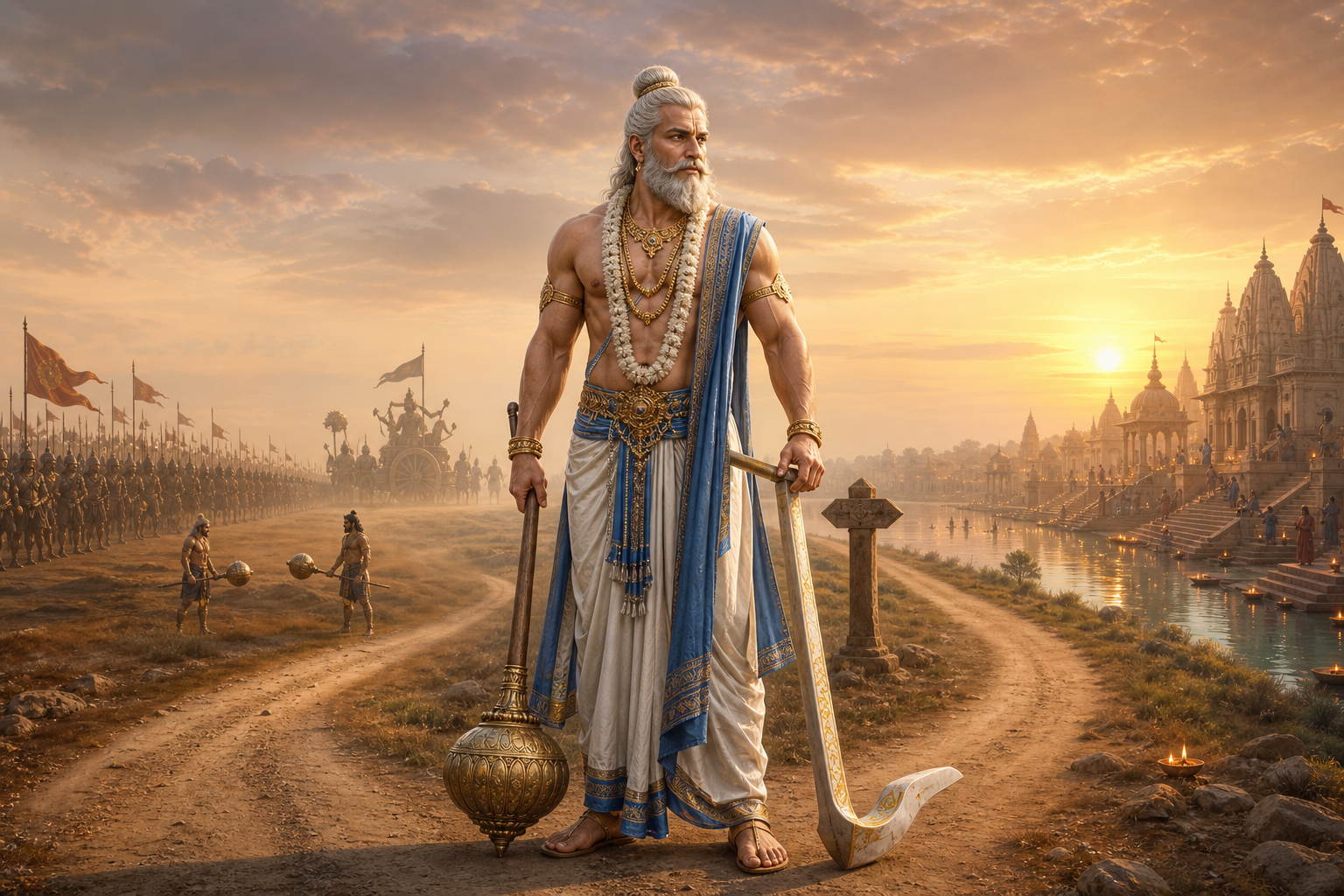
Balarama’s absence from the battlefield of Kurukshetra is one of the most revealing silences in the Mahabharata. He was not weak, uncertain, indifferent, or politically irrelevant. He was the elder brother of Krishna, the wielder of the plough, a master of mace warfare, a revered Yadava leader, and the teacher of both Bhima and Duryodhana. If he had entered the Mahabharata war, his presence would have carried enormous military, moral, and symbolic weight. Yet he chose neutrality. That decision was not an escape from dharma; it was a disciplined refusal to reduce dharma to partisan attachment.
The real reason Balarama did not participate in the Mahabharata war lies in the layered obligations he carried. He loved the Pandavas through family ties and through Krishna’s deep association with them. He also held affection for Duryodhana, who was his student in gada-yuddha, the art of mace fighting. Bhima, too, had learned from him. Balarama therefore stood at a painful intersection: if he fought for one side, he would be raising his weapon against another person bound to him through kinship, discipleship, or trust. In the Mahabharata’s moral world, such relationships were not casual; they created duties that could not be dismissed for political convenience.
The setting is crucial. After the Pandavas completed thirteen years of exile, including the final year of concealment, they gathered with their allies at Upaplavya. The marriage of Abhimanyu and Uttara had strengthened political bonds, and the question before the assembly was no longer theoretical: would the Pandavas regain their rightful share of the kingdom, or would war become inevitable? Krishna and Balarama, the sons of Vasudeva, were present in this atmosphere of deliberation, expectation, and restrained anger. The Pandavas had suffered humiliation, dispossession, and exile, yet the language of the council still moved through diplomacy before war.
In the Udyoga Parva, the Mahabharata presents the preparation for war as a moral and political process rather than a sudden eruption of violence. Envoys are sent. Alliances are formed. Arguments are made. Krishna’s peace mission to Hastinapura becomes one of the epic’s defining moments because it shows that dharma-yuddha is not merely a righteous war; it is also a war that must be preceded by sincere attempts to avoid war. Within this framework, Balarama’s neutrality must be read carefully. He did not withdraw because he failed to understand the stakes. He withdrew because he understood that his personal obligations did not allow him to become a combatant without violating another dimension of dharma.
Balarama’s relationship with Duryodhana is often overlooked because the larger narrative rightly focuses on Duryodhana’s envy, injustice, and refusal to restore the Pandavas’ kingdom. Yet the Mahabharata does not flatten characters into simple categories. Duryodhana, despite his grave moral failures, was a skilled warrior and an especially accomplished mace fighter. Balarama had trained him and admired his technical discipline. A teacher’s affection for a student does not erase the student’s errors, but it complicates the teacher’s role in a conflict where that student stands against another beloved disciple.
Bhima stood on the other side of that same obligation. He was not only a Pandava and therefore connected to Krishna’s side of the family; he was also a student of Balarama’s martial discipline. In technical terms, both Bhima and Duryodhana were exponents of the same weapon system under the same broad lineage of training. For Balarama to fight on either side would have placed the teacher’s authority in direct service of one pupil’s destruction by another. His neutrality was therefore a form of restraint rooted in the ethics of instruction, loyalty, and self-command.
This is why Balarama’s choice should not be confused with moral relativism. The epic does not portray him as saying that both sides were equally righteous in every respect. Rather, he recognizes that he personally cannot take up arms because his bonds run in both directions. Krishna’s dharma in the crisis is different: he becomes the charioteer, counsellor, strategist, and spiritual guide of Arjuna while remaining personally unarmed. Balarama’s dharma is to step away from combat. The brothers do not represent contradiction so much as two distinct responses to a civilizational crisis: engaged guidance and principled non-participation.
The famous episode in which Krishna offers a choice between himself and his Narayani army further clarifies the complexity of Yadava participation. Arjuna chooses Krishna, even though Krishna vows not to fight. Duryodhana gladly accepts the army. Other Yadava warriors and factions also become associated with different sides. The Mahabharata therefore does not present the Yadavas as a single mechanical bloc. It presents a political world in which kinship groups, martial loyalties, and personal vows interact in sophisticated ways. Balarama’s neutrality belongs to this larger pattern of distributed responsibility.
His departure on pilgrimage is especially significant. Balarama does not merely stay at home while others fight. He undertakes tirtha-yatra, a journey to sacred waters and holy places. In the Mahabharata, pilgrimage is not a recreational withdrawal from history. It is a disciplined movement through sacred geography, memory, purification, and reflection. By going on pilgrimage during the war, Balarama symbolically places himself under a different discipline from the discipline of the battlefield. While Kurukshetra becomes the field of arms, his path becomes a field of restraint.
This contrast is central to understanding his character. Balarama is associated with strength, agriculture, earthiness, the plough, physical discipline, and directness. He is not a figure of evasive softness. His neutrality therefore carries force precisely because it comes from a warrior capable of terrible violence. A powerless person’s refusal to fight may be dismissed as necessity; Balarama’s refusal cannot be. He had the ability to alter the balance of the war, and that is why his decision has ethical weight.
In many readings of the Mahabharata, neutrality is judged harshly because the war is framed as a struggle between dharma and adharma. That concern is understandable. When injustice is clear, neutrality can become complicity. However, Balarama’s neutrality is not the neutrality of cowardice, convenience, or moral laziness. It is the neutrality of a person whose direct intervention would create another ethical injury. He does not campaign for Duryodhana. He does not undermine the Pandavas. He does not use his authority to confuse the moral issue. He removes himself from combat because his participation would be compromised by his legitimate ties to both sides.
This distinction matters beyond the epic. Human life often presents conflicts in which justice, loyalty, gratitude, and institutional responsibility do not align neatly. A teacher may see two students in conflict. A family elder may know that one relative has acted wrongly while still carrying obligations toward all members of the family. A leader may recognize that entering a dispute in the wrong role can inflame the situation rather than heal it. Balarama’s example offers a subtle lesson: dharma is not always served by dramatic intervention; sometimes it is served by refusing a role one cannot perform cleanly.
The emotional depth of his decision becomes clearer when he returns near the end of the war and witnesses the mace duel between Bhima and Duryodhana. This duel is not incidental. It brings Balarama back to the precise field of his expertise and to the two disciples whose rivalry had partly shaped his neutrality. By then, the war has consumed nearly all major warriors. The grand political conflict has narrowed into a personal and technical contest between two mace fighters. Balarama arrives not as a distant commentator but as the master who understands the rules of the weapon better than almost anyone present.
When Bhima strikes Duryodhana on the thigh, Balarama is furious. From the standpoint of mace combat, striking below the waist violates the accepted discipline of the duel. His anger is therefore not arbitrary favoritism. It arises from his commitment to the integrity of martial rules. In that moment, Balarama sees not the whole political history of the Kaurava injustice but the immediate breach of combat ethics by one of his students against another. His reaction reveals the consistency of his character: he cares deeply about rules, vows, training, and honorable conduct.
Krishna’s response introduces the wider moral frame. Bhima had vowed to break Duryodhana’s thigh after the humiliation of Draupadi, when Duryodhana had insultingly exposed that thigh in the assembly. Krishna also understands that Duryodhana’s earlier actions had already shattered the moral order that formal rules were meant to protect. This exchange between Krishna and Balarama is one of the Mahabharata’s most powerful ethical tensions. Balarama defends the rule of combat; Krishna recalls the violated dignity and accumulated adharma that made the duel more than a technical contest.
Neither perspective should be reduced too quickly. Balarama’s outrage prevents readers from treating victory as a license to ignore all norms. Krishna’s explanation prevents readers from treating procedural purity as though it can erase deep injustice. Together, the brothers reveal the Mahabharata’s intellectual sophistication. Dharma is not a slogan; it is a demanding inquiry into context, intention, duty, consequence, and the preservation of moral order under conditions of collapse.
Balarama’s neutrality also illuminates the distinction between personal dharma and universal moral order. On the broader question of the kingdom, the Pandavas had a legitimate claim, and Duryodhana’s refusal to return even a minimal settlement made war unavoidable. On the narrower question of Balarama’s own participation, however, the answer was different. His personal dharma as a teacher and elder restrained him from becoming a partisan warrior. This layered structure is characteristic of the Mahabharata: the same event may demand different duties from different people depending on their role, vows, relationships, and capacities.
His choice can also be compared with other forms of non-participation in the epic. Rukmi, for example, fails to join either side after his assistance is rejected. That withdrawal does not carry the same ethical gravity as Balarama’s because it is shaped by pride and political miscalculation. Balarama’s withdrawal is different. It is principled, announced, and tied to a clear moral reason: affection and obligation toward both Bhima and Duryodhana. The epic invites readers to distinguish between wounded ego, strategic irrelevance, and genuine restraint.
The decision also reflects the ideal of self-mastery. Balarama was capable of anger, and the Mahabharata does not hide that aspect of him. Yet before the war, he does not allow anger, affection, or pressure to drag him into a role that would compromise his integrity. In dharmic traditions, strength is not only the ability to act; it is also the ability to refrain from action when action would be inwardly disordered. Balarama’s silence on the battlefield is therefore not emptiness. It is controlled power.
From a political perspective, his neutrality also prevented a deeper fracture among the Yadavas. Krishna’s alignment with the Pandavas, the deployment of the Narayani army, and the participation of other Yadava warriors already show a complex distribution of loyalties. If Balarama had openly fought, the symbolic division within the Yadava world might have intensified. His absence helped preserve a measure of internal balance, even though it could not prevent the larger destruction of the Kuru order.
From a spiritual perspective, Balarama’s pilgrimage during the war offers another lesson: when violence becomes unavoidable for some, others may still be called to preserve sacred memory, ritual continuity, and inner discipline. Dharmic civilization has never honored only one path. The warrior, the teacher, the pilgrim, the counsellor, the renunciant, the householder, and the seeker each carry distinct obligations. Balarama’s path during Kurukshetra reminds readers that Sanatana Dharma recognizes multiple forms of responsibility, including the responsibility not to misuse one’s strength.
This reading also supports unity among dharmic traditions. Hindu, Buddhist, Jain, and Sikh reflections on ethics all contain serious engagements with restraint, righteous action, discipline, compassion, and responsibility. Balarama’s neutrality should not be used to glorify passivity in the face of injustice, nor should it be dismissed as weakness. It can be understood as a case study in moral role clarity: a person must know when to fight, when to guide, when to witness, when to withdraw, and when to protect the integrity of a relationship from being consumed by conflict.
The Mahabharata’s greatness lies partly in its refusal to make every noble person behave the same way. Krishna acts through counsel and strategy. Arjuna struggles, receives the Bhagavad Gita, and fights. Bhima fulfills terrible vows. Yudhishthira bears the burden of kingship and moral hesitation. Draupadi embodies wounded dignity and uncompromising memory. Balarama stands apart, not because he is irrelevant, but because his role reveals another dimension of dharma: the courage to remain unbought by pressure when one’s conscience and obligations forbid participation.
Therefore, the real reason Balarama did not participate in the Mahabharata war was not merely that he loved both sides, though that is true. It was that his love was bound to duty. He was connected to the Pandavas through family and respect, connected to Duryodhana through discipleship and affection, and connected to Bhima through the same martial tradition. He could not turn the sacred trust of a teacher into a weapon for one student against another. His neutrality was the only path that preserved his integrity.
This does not make Balarama superior to Krishna, nor does it make Krishna’s intervention less righteous. The brothers embody different dharmic functions. Krishna enters the crisis as the guide who reveals the deeper law of action without attachment. Balarama withdraws as the elder whose strength is governed by relational duty. One shows how to act in history; the other shows how to refrain when action would betray one’s proper role. Together, they expand the moral imagination of the Mahabharata.
Balarama’s absence from Kurukshetra is thus a profound presence. It forces readers to ask difficult questions that remain relevant in every age. Is every refusal to fight a failure, or can some refusals protect dharma? Can loyalty survive when loved ones stand on opposite sides? Can rules of conduct matter even when the world has already been wounded by injustice? Can strength be measured not only by the blow delivered, but also by the blow withheld? The Mahabharata does not answer these questions simplistically. Through Balarama, it teaches that silent strength may sometimes be the most demanding form of strength.
Inspired by this post on Hindu Blog.


Leave a Reply
You must be logged in to post a comment.