
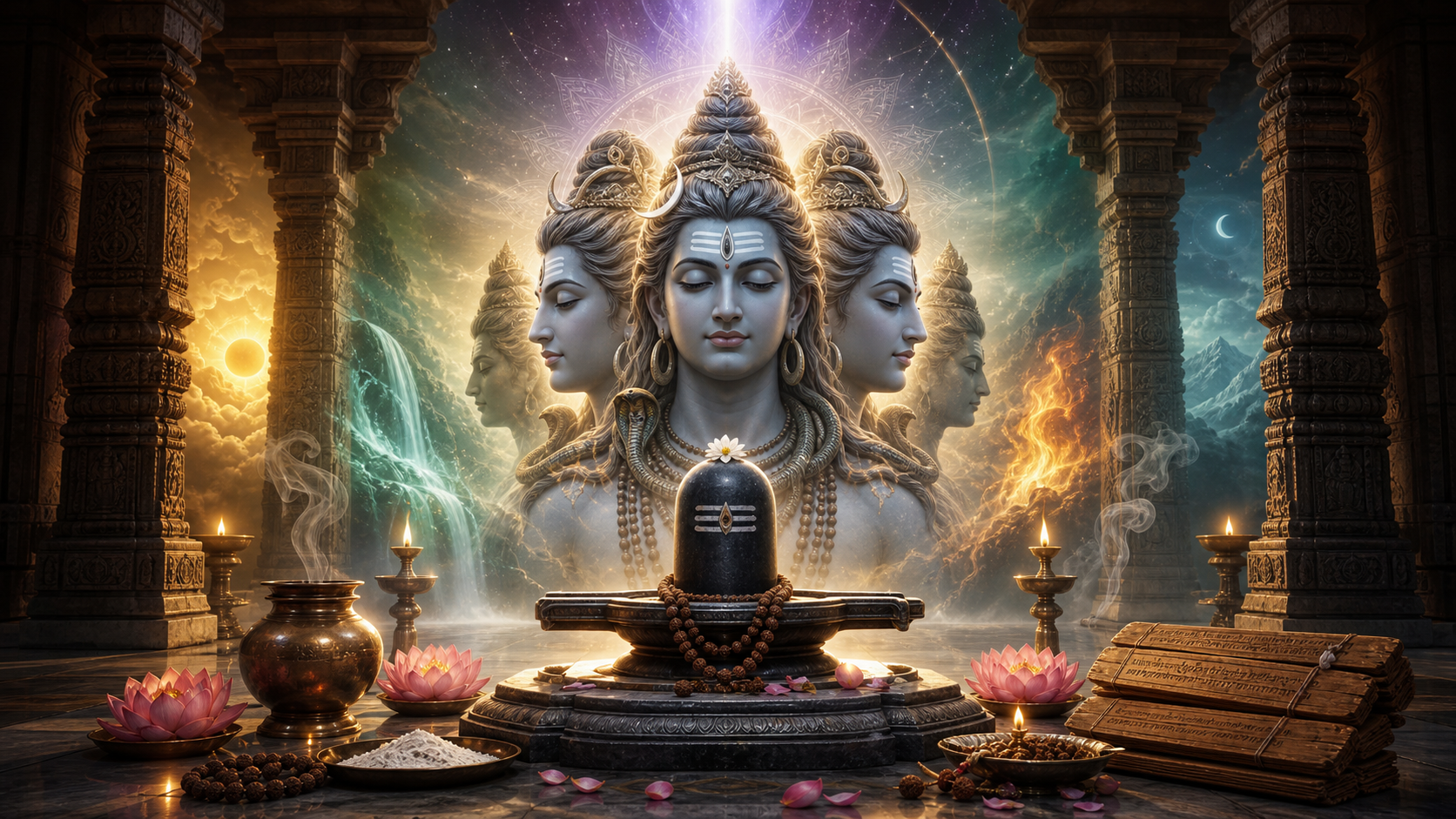
The five faces of Shiva occupy a central place in Shaiva theology, temple worship, mantra practice, and the wider spiritual imagination of Sanatana Dharma. They are not merely artistic features of a divine form; they are a sophisticated symbolic language through which the Agamas describe consciousness, creation, preservation, transformation, concealment, and grace. In this tradition, Shiva is not limited to a sectarian deity or a mythic figure. Shiva is Parameshvara, Supreme Consciousness, the still center from which knowledge, ritual, yoga, and liberation become intelligible.
The Agamas are among the most important bodies of Hindu scriptures for understanding this vision. In many Shaiva traditions, they are regarded as apaurusheya, not of ordinary human authorship, and are received as revelations flowing from Shiva to Shakti, from the divine teacher to worthy disciples, and through lineages of realized masters. Their authority is especially visible in temple architecture, murti installation, daily puja, mantra initiation, meditation, and the disciplined path toward moksha.
For many practitioners, the Agamas feel less like abstract theology and more like a living manual for sanctifying life. They explain how a temple becomes a body of the divine, how a mantra becomes a vehicle of consciousness, how ritual becomes inner discipline, and how devotion becomes knowledge. Their worldview is technical, liturgical, philosophical, and experiential at the same time. This is one reason they remain indispensable for understanding Lord Shiva, Shaiva traditions, Hindu spirituality, and the broader dharmic search for liberation.
The five faces of Shiva are traditionally known as Sadyojata, Vamadeva, Aghora, Tatpurusha, and Ishana. Together they are called the Panchabrahma forms, meaning five expressions of the supreme reality. They are connected with directions, elements, mantras, cosmic functions, and stages of spiritual refinement. Different Shaiva schools preserve different layers of interpretation, but the central insight remains consistent: the universe is not separate from Shiva, and liberation is the recognition of this deepest truth.
Sadyojata is commonly associated with creation, manifestation, and the western direction. It represents the emergence of form from the unmanifest. In spiritual terms, Sadyojata reminds the seeker that existence itself is sacred. The world is not an accidental prison but a field of experience where karma, dharma, discipline, and grace operate. To contemplate Sadyojata is to recognize that birth, embodiment, and the visible universe can become gateways to self-realization when approached with clarity.
Vamadeva is often associated with preservation, beauty, nourishment, and the northern direction. It expresses the sustaining power of Shiva, the divine presence that holds life together. Vamadeva is also linked with refinement, compassion, and the preservation of sacred order. In personal practice, this face of Shiva calls attention to the ethical and emotional dimensions of spirituality: patience, humility, reverence, and the capacity to protect what is noble in oneself and in society.
Aghora, often connected with the southern direction and transformative fire, is one of the most misunderstood aspects of Shiva. The word does not mean terrifying in a crude sense; it points to that which is beyond fear. Aghora is Shiva as the dissolver of impurity, ego, attachment, and ignorance. It is the face that stands before death, impermanence, suffering, and inner darkness without denial. In this sense, Aghora is deeply compassionate, because liberation requires the courage to see reality as it is.
Tatpurusha is frequently associated with the eastern direction, the breath, inwardness, and the discipline of yoga. It represents the divine person within, the inner witness behind the movement of mind and senses. Through Tatpurusha, the Agamic path becomes intensely practical. The seeker is asked to turn attention inward, regulate conduct, purify speech, steady the body, refine the breath, and recognize that the deepest temple is also within consciousness.
Ishana is the upward-facing and most subtle aspect of Shiva. It is associated with transcendence, grace, pure knowledge, and the power of liberation. Ishana gathers the other four faces into unity. It is not simply another direction but the opening beyond limitation. In Shaiva philosophy, this is the movement from ritual correctness to inner realization, from sacred form to formless awareness, from worship of Shiva to recognition of Shiva-consciousness.
The Agamas illuminate these five faces by presenting a complete system of practice. Many Shaiva Agamas are organized around four broad dimensions: charya, kriya, yoga, and jnana. Charya concerns conduct, service, discipline, and the devotional life of the practitioner. Kriya concerns ritual, temple worship, consecration, mantra, and sacred procedure. Yoga concerns meditation, breath, concentration, subtle body discipline, and inner worship. Jnana concerns liberating knowledge, metaphysics, and direct insight into the nature of Shiva and the soul.
This fourfold structure is one of the reasons the Agamas remain so practical. They do not reduce spirituality to belief alone, nor do they reduce it to ritual alone. They integrate body, speech, mind, community, sacred space, and inner realization. A person may begin with service in a temple, proceed through disciplined worship, mature into meditation, and finally deepen into wisdom. The path is gradual without being merely mechanical, and devotional without being anti-intellectual.
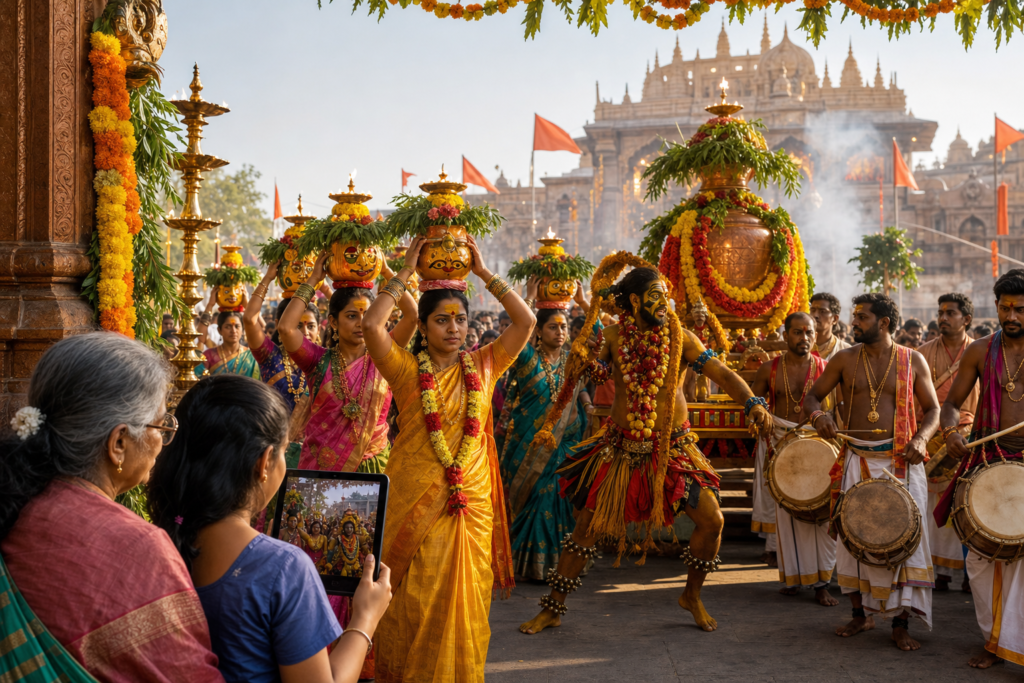
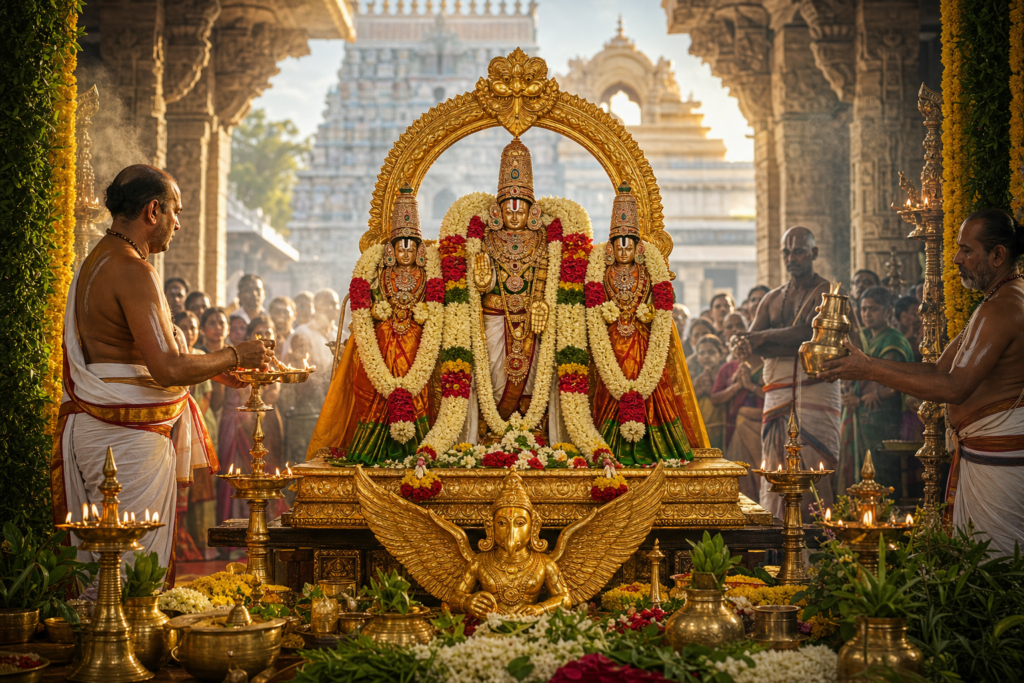
In temple culture, the Agamas are foundational. They guide the selection of sacred ground, the proportions of the temple, the installation of the linga or murti, the role of mantras, the rhythm of daily worship, and the annual cycle of festivals. A Shiva temple is therefore not only an architectural monument. It is a ritually awakened space where cosmic principles are embodied in stone, sound, gesture, flame, water, fragrance, and silence.
The Shiva linga, especially in Agamic worship, should not be misunderstood as a mere physical emblem. It is a profound symbol of the unmanifest and manifest together. The base, the axis, the sanctum, and the ritual sequence point toward the meeting of transcendence and immanence. The devotee enters the temple from the outer world, moves toward the sanctum, and symbolically travels from multiplicity toward stillness. This movement mirrors the spiritual journey from distracted identity to centered awareness.
The five faces also reveal the philosophical depth of Shaiva traditions. Shiva creates, sustains, dissolves, conceals, and grants grace. These five acts, often called panchakritya, are not remote cosmic events alone. They unfold in every human life. Thoughts arise, remain, dissolve, become obscured, and are illuminated by insight. Relationships form, change, end, and teach. Identity itself is continually created and dissolved. The Agamic vision makes these ordinary experiences spiritually meaningful.
This is where the Agamas become emotionally resonant. The seeker does not approach Shiva only in moments of strength, purity, or certainty. The path also includes confusion, grief, fear, and moral struggle. Aghora transforms fear. Vamadeva restores tenderness. Tatpurusha gathers attention. Sadyojata honors embodied life. Ishana opens the possibility of grace. The five faces therefore form a complete psychology of spiritual maturation.
The relationship between the Vedas and Agamas has been discussed for centuries. In many Hindu traditions, the Vedas provide the broad revelation of cosmic order, sacrifice, mantra, and ultimate reality, while the Agamas provide detailed systems of temple worship, deity-centered practice, initiation, and spiritual discipline. Rather than being opposed, they are often understood as complementary streams of sacred knowledge. The Vedic and Agamic currents together shaped much of Hindu ritual life as it is practiced today.
Shaiva Siddhanta, Kashmir Shaivism, and other Shaiva schools interpret the Agamas in distinctive ways. Shaiva Siddhanta often emphasizes the relationship between Pati, pashu, and pasha: the Lord, the bound soul, and the bonds that limit the soul. Kashmir Shaivism gives special emphasis to consciousness, recognition, vibration, and the non-dual nature of Shiva. These differences show the richness of Hindu philosophy, where multiple approaches can coexist within a shared reverence for liberation.
The Agamic path is also deeply disciplined. It does not treat mantra as casual sound or ritual as empty repetition. Mantra requires initiation, purity of intention, correct pronunciation, and sustained practice. Puja requires attention, order, and reverence. Meditation requires steadiness. Ethical life requires restraint and responsibility. The technical precision of the Agamas protects the sacred from becoming sentimental or arbitrary.
At the same time, the Agamas do not deny the human need for beauty. Their world is filled with lamps, flowers, bells, sacred ash, water, incense, music, mantra, and darshan. Beauty is not treated as decoration but as a mode of spiritual refinement. The senses, instead of being condemned outright, are educated and redirected toward the divine. This is one of the great strengths of Hindu spirituality: it can transform embodied experience into a path of awakening.
The five faces of Shiva also encourage unity among dharmic traditions. Hinduism, Buddhism, Jainism, and Sikhism differ in theology, metaphysics, and practice, yet they share a civilizational concern with liberation, ethical discipline, self-mastery, compassion, and freedom from ignorance. The Agamic Shaiva path contributes to this wider dharmic landscape by offering one powerful grammar of transformation. Its purpose is not hostility toward other paths but the deepening of spiritual understanding through a specific revelation of Shiva.
This inclusive perspective is important because Hindu traditions have never been intellectually flat or spiritually uniform. The worship of Shiva, Vishnu, Devi, Surya, Ganesha, and other forms has flourished alongside philosophical inquiry, yoga, bhakti, tantra, ritual orthopraxy, and contemplative renunciation. The concept of Ishta, the chosen form of the divine, allows the seeker to approach the highest truth according to temperament and lineage. The Agamas preserve this diversity while maintaining rigorous standards of practice.
Modern readers often approach the Agamas through fragments: a temple ritual, a mantra, an iconographic image, or a reference to Shiva’s five faces. Yet the tradition becomes clearer when these fragments are seen as parts of one integrated system. Theology explains the nature of reality. Ritual trains the body and senses. Mantra refines speech and mind. Yoga interiorizes worship. Jnana reveals the truth toward which all practice points.
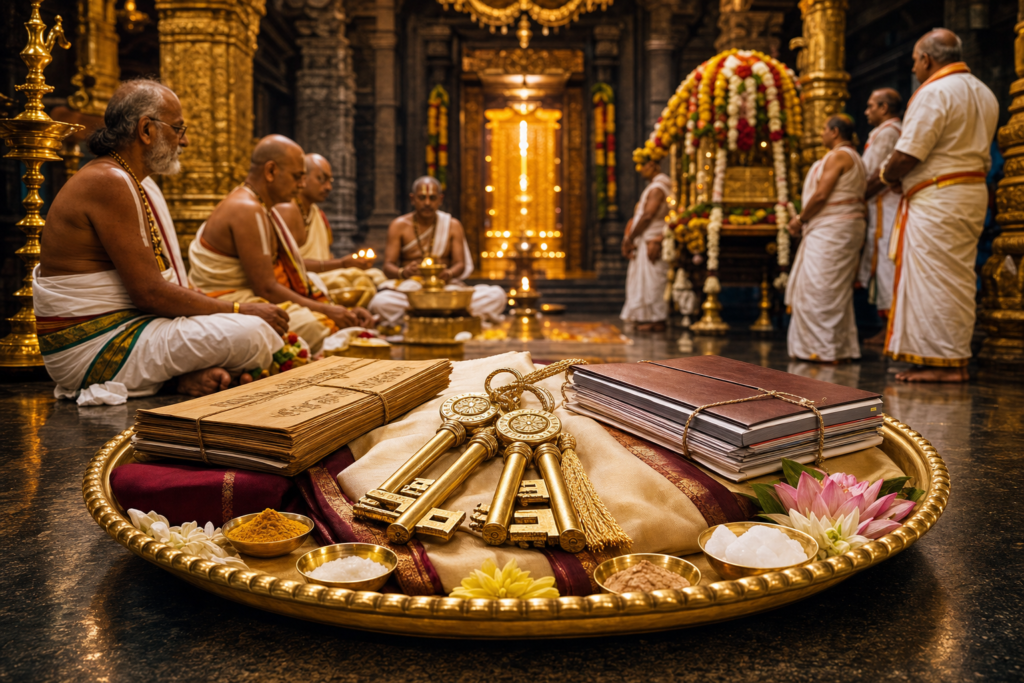
The academic study of the Agamas also requires care. These texts are not merely historical artifacts to be catalogued from a distance. They are living scriptures embedded in temple lineages, priestly traditions, monastic orders, oral transmission, and daily worship. Their meaning cannot be fully separated from practice. A purely textual reading may miss the embodied intelligence preserved by generations of acharyas, sthapatis, archakas, and sadhakas.
For contemporary Hindu communities, the Agamas carry practical relevance. They help explain why temple worship follows precise rules, why consecration matters, why sacred architecture is not arbitrary, and why inherited ritual knowledge deserves preservation. In an age of speed and simplification, the Agamas remind society that sacred culture survives through discipline, memory, and transmission. A temple is not maintained by emotion alone; it is sustained by knowledge, service, and continuity.
The five faces of Shiva, when studied through the Agamas, offer a complete spiritual map. Sadyojata teaches reverence for manifestation. Vamadeva teaches preservation and grace in life. Aghora teaches transformation beyond fear. Tatpurusha teaches inward discipline. Ishana teaches liberating knowledge. Together they show that Shiva is not confined to one mood, one function, or one image. Shiva is the totality that includes the world, transcends it, and frees the soul from bondage.
The path to moksha in this vision is neither escapism nor mere ritualism. It is the gradual purification of perception. The seeker learns to see the body as a vehicle, the temple as a cosmos, the mantra as consciousness in sound, the guru as a transmitter of wisdom, and the world as a field where Shiva’s five acts are constantly unfolding. Liberation begins when the apparent separation between worshipper, worship, and the worshipped starts to dissolve.
To study the five faces of Shiva is therefore to study the architecture of spiritual life itself. The Agamas do not present liberation as an abstract promise reserved for another world. They present it as a disciplined awakening within this life, supported by sacred knowledge, ethical conduct, devotional intensity, and contemplative insight. In that sense, the Agamas remain not only ancient scriptures but living guides for anyone seeking clarity, reverence, and freedom.
Inspired by this post on Hindu Blog.





Leave a Reply
You must be logged in to post a comment.