
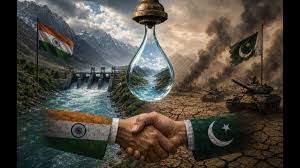
The Indus Waters Treaty occupies a rare place in South Asian geopolitics. Signed at Karachi on 19 September 1960 by India, Pakistan, and the International Bank for Reconstruction and Development, and given retroactive effect from 1 April 1960, it has often been presented as a model of technical cooperation between adversarial states. That reputation is not without foundation. The agreement endured the 1965 war, the 1971 war, the Kargil conflict of 1999, repeated crises over terrorism, and long periods of diplomatic hostility. Yet the central question remains sharper than the usual praise allows: did the treaty merely survive, or did it actually produce a durable, equitable, and strategically rational water settlement?
The distinction matters because rivers are not ordinary diplomatic assets. A border can be drawn with a pen, but a river basin resists such neat division. The Indus system links snowfields, glaciers, monsoon flows, canals, barrages, farms, hydropower stations, and densely populated settlements across a geography that was violently partitioned in 1947. The water that irrigates a field in Punjab or sustains a power project in Jammu and Kashmir is tied to upstream snowmelt, downstream canal design, sediment behaviour, seasonal flood control, and interstate trust. In that sense, the Indus Waters Treaty was never only a legal document; it was an engineering settlement imposed upon a civilisational and ecological continuum.
The basic architecture of the treaty is deceptively simple. The three eastern rivers, Ravi, Beas, and Sutlej, were allocated primarily to India. The three western rivers, Indus, Jhelum, and Chenab, were allocated primarily to Pakistan, while India retained limited rights over them for domestic use, non-consumptive use, limited agricultural use, and run-of-river hydropower subject to detailed design restrictions. The World Bank’s public fact sheet summarises this division and also explains the procedural role the Bank continues to play in dispute settlement.
That arrangement did not emerge from sentimental friendship. It emerged from exhaustion, risk, and hard bargaining. Partition had left canal headworks and river sources on one side of the border while large irrigated command areas lay on the other. Pakistan feared that India, as the upper riparian on crucial stretches, could exercise strategic pressure. India, meanwhile, needed certainty to develop irrigation and hydropower in its own territory. The World Bank’s intervention converted a near-intractable political dispute into a technical and financial settlement, but the settlement carried deep compromises, especially for India as the upper riparian state.
The treaty’s transition arrangements were equally significant. Pakistan required time and infrastructure to replace supplies from the eastern rivers with canals, barrages, and storage linked to the western rivers. India agreed to transitional deliveries and to a fixed financial contribution of 62.06 million pounds sterling toward replacement works. The official treaty text in the United Nations Treaty Series records the legal structure of this bargain, including the definitions of eastern and western rivers, the transition period, and the rights and obligations of both states.
The most striking feature of the Indus Waters Treaty is that it continued to function when most other India-Pakistan arrangements failed. During the 1965 war, India did not collapse the treaty framework. During the 1971 conflict, which transformed the map of South Asia and created Bangladesh, the water arrangement remained in place. During the Khalistani insurgency, the Kashmir insurgency, the Kargil conflict, the Parliament attack crisis, the Mumbai attacks, the Uri attack, and other periods of extreme distrust, the treaty was strained but not abandoned. Commissioners met, data moved, objections were filed, and technical processes continued.
This institutional endurance explains why scholars of international relations have often treated the treaty as evidence that even hostile states can cooperate when technical rules, regular communication, and third-party procedures exist. The Permanent Indus Commission became the treaty’s operational nerve centre. Each country appointed a commissioner. The commission was expected to exchange data, inspect works, discuss questions, and serve as the first forum for differences before they escalated into formal disputes.
However, institutional endurance should not be confused with strategic success. A structure may keep talking even while grievances accumulate. The Indus Waters Treaty did not end India-Pakistan hostility. It did not prevent Pakistan from treating water as a diplomatic pressure point whenever India pursued hydropower projects on the western rivers. It did not prevent technical objections from becoming political campaigns. It did not account adequately for climate change, glacial instability, population growth, renewable energy needs, or the national security environment created by cross-border terrorism.
From India’s standpoint, one of the treaty’s enduring controversies is the scale of the concession. Pakistan received primary rights over the western rivers, which carry the larger share of the Indus basin’s water. India received the eastern rivers and sharply regulated rights on the western rivers, even where those rivers flow through Indian territory. For Jammu and Kashmir, this has long carried developmental implications. Hydropower potential, storage flexibility, flood moderation, irrigation planning, and regional economic growth are all shaped by treaty restrictions that were framed in another era.
This is why projects such as Salal, Baglihar, Kishanganga, Ratle, and the Tulbul or Wullar navigation issue became more than engineering matters. They became tests of whether the treaty permitted India to exercise even its limited rights without being trapped in prolonged procedural contestation. Baglihar went to a Neutral Expert. Kishanganga went through arbitral proceedings. Ratle and Kishanganga again became part of parallel proceedings involving a Neutral Expert and a Court of Arbitration, after India and Pakistan sought different mechanisms under the treaty.
The dispute-resolution system itself reveals both the treaty’s strength and its weakness. On one hand, the existence of technical and legal channels can prevent immediate escalation. On the other hand, when every design feature becomes a potential battlefield, the system may incentivise obstruction rather than resolution. The World Bank has repeatedly clarified that its role is limited and procedural. It does not rewrite the treaty, decide political questions, or impose a comprehensive settlement. It can help appoint functionaries under the treaty mechanism, but it cannot manufacture trust between India and Pakistan.
The phrase often used about the treaty, that it survived wars, is therefore accurate but incomplete. Survival is a low threshold for judging a river system that supports agriculture, livelihoods, power generation, and national security. A better test asks whether the treaty remains fair, adaptive, enforceable, and consistent with contemporary realities. By that standard, the Indus Waters Treaty appears less like a perfect model and more like a Cold War-era compromise that endured because both sides found its breakdown too dangerous, not because either side found it fully satisfactory.
The climate challenge has made this even more urgent. The Indus basin depends heavily on snowmelt, glaciers, and monsoon dynamics. Climate change can alter timing, intensity, and reliability of flows. Too much water at the wrong time produces floods; too little water at the wrong time damages crops, drinking-water systems, and hydropower schedules. A treaty designed around fixed legal categories and mid-twentieth-century hydrological assumptions cannot remain credible unless it can respond to twenty-first-century volatility.
Population pressure adds another layer. India’s needs for clean energy, irrigation efficiency, flood control, and regional development have changed dramatically since 1960. Pakistan’s agricultural dependence on the Indus system also remains profound. Any responsible analysis must therefore avoid simplistic triumphalism. Water cannot be discussed only as leverage; it must also be discussed as a life-support system for ordinary families, farmers, workers, and towns that did not design the treaty but live under its consequences.
At the same time, humanitarian language cannot erase national security. India’s position hardened after the 22 April 2025 Pahalgam terror attack, when New Delhi announced that the treaty would be held in abeyance until Pakistan credibly and irrevocably ended support for cross-border terrorism. By July 2026, Indian official statements continued to describe the treaty as being in abeyance. This marked a decisive shift from the older Indian posture, under which even severe terrorist attacks did not fundamentally alter the treaty’s operation.
This development shows that the treaty’s celebrated insulation from politics was never absolute. It rested on a strategic assumption: that water cooperation should remain separate from armed conflict and terrorism. For decades, India largely upheld that assumption. The question now is whether any country can be expected to maintain extraordinary treaty restraint indefinitely when the broader security environment is persistently hostile. International law values pact stability, but statecraft also requires reciprocity, accountability, and protection of citizens.
A Dharmic view of statecraft would not romanticise either aggression or passivity. It would ask whether an arrangement upholds justice, protects society, preserves ecological balance, and discourages adharma in public conduct. Applied to the Indus Waters Treaty, that perspective suggests a balanced conclusion: India should not treat rivers casually as instruments of suffering, but neither should it accept a frozen framework that disregards security, fairness, and the developmental rights of its own citizens.
The treaty’s history also teaches a deeper lesson about Partition. Political division did not divide ecology cleanly. The Indus basin had been built through interdependence, canal engineering, agrarian settlement, and shared geography. Partition converted that interdependence into vulnerability. The treaty managed that vulnerability through allocation rather than true joint management. It divided rivers into eastern and western categories, but it could not divide the atmosphere, glaciers, sediment loads, flood pulses, or the emotional memory of communities attached to these waters.
For readers trying to understand the treaty today, the most useful lens is not nostalgia but systems thinking. The Indus Waters Treaty is simultaneously a legal instrument, an engineering manual, a diplomatic safety valve, a national security concern, a climate-risk framework, and a legacy of Partition. Its endurance is historically important. Its asymmetries are strategically important. Its technical annexures are legally important. Its human consequences are morally important.
The future of the treaty will likely depend on whether India and Pakistan can move beyond the narrow ritual of objection and counter-objection. A modern framework would need credible terrorism-related safeguards, transparent hydrological data, climate-sensitive flow modelling, faster technical dispute resolution, respect for India’s permissible hydropower rights, and serious attention to the developmental concerns of Jammu and Kashmir. Without such adaptation, the treaty risks becoming a museum piece defended by habit but weakened by reality.
The Indus Waters Treaty survived wars because both states understood the catastrophic danger of uncontrolled water conflict. That achievement should not be dismissed. But survival alone cannot settle the debate. A treaty that remains alive while trust decays, disputes multiply, climate stress intensifies, and terrorism reshapes strategic patience requires more than applause. It requires sober reassessment.
The real legacy of the treaty is therefore not that it solved the Indus question forever. It proved that even hostile neighbours can build procedures when necessity is strong enough. The challenge before India is to ensure that procedure does not become paralysis, restraint does not become strategic self-denial, and cooperation does not become detached from justice. In the Indus basin, the next chapter will be determined not merely by what was signed in 1960, but by whether a changing South Asia can align water security, national dignity, ecological responsibility, and peace with realism.
Inspired by this post on Hindu Post.








Leave a Reply
You must be logged in to post a comment.